PrescientIQ vs. Salesforce Agentforce: Optional vs. Default Approval
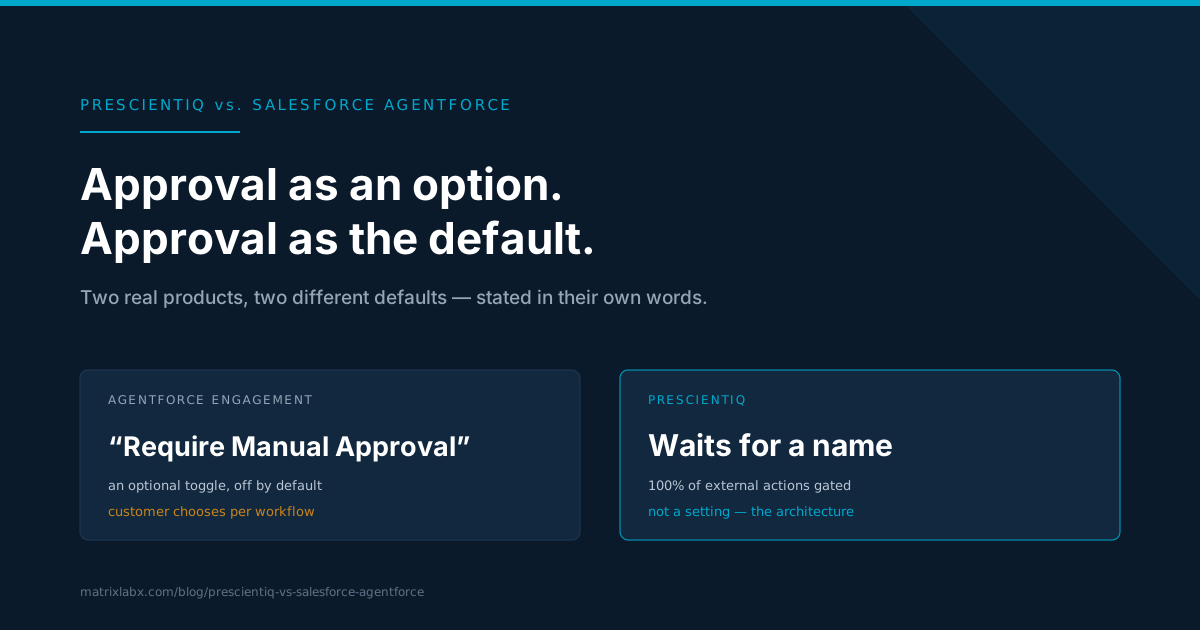
Salesforce’s own help documentation describes a “Require Manual Approval” setting for Agentforce Engagement — a configuration you turn on, off by default. PrescientIQ holds every external action for a named human approval with no setting to disable it. Both are real governance choices. This page states each plainly, cites Salesforce only from its own documentation, and says where Agentforce is the better choice.
If your CRM is Salesforce, you already have an agent platform — it ships inside the system you run today. The question worth answering before you build on it is narrower than “can it do the work.” It is whether the approval step between an agent’s draft and a prospect’s inbox is something you have to remember to configure, or something the system will not let you skip.
What Salesforce says about Agentforce Engagement
Salesforce’s own help documentation for Agentforce Engagement — the CRM-native outbound agent, previously named Agentforce SDR / Lead Nurturing — describes a “Require Manual Approval” setting (surfaced in some flows as “Review Before Send”) that holds the agent’s output for a person to approve before it sends (captured 17 September 2026). That is a real, documented feature, and it is the reason we are not writing “Agentforce has no approval step” anywhere on this page — that would be false, and an outdated capability claim about a named competitor is the expensive kind of wrong.
What the documentation also makes clear is that this is a configuration, not the architecture. It is a toggle a Salesforce admin sets per workflow, and the default state — before anyone configures anything — is for the agent to operate without that review step. The capability exists; whether it is switched on for a given workflow is a customer decision, made or unmade one configuration screen at a time across however many workflows your org runs.
What PrescientIQ does instead
PrescientIQ’s agents research, score, and draft continuously against your CRM data, the same category of work Agentforce does. The difference is where the approval requirement lives.
That gate is enforced at the tool layer, not as a workflow setting an administrator configures and could later leave unset on a new workflow. An agent attempting an external action without a recorded approval fails closed — there is no configuration screen where that behavior can be turned off. This is a real cost, and we are not going to pretend otherwise: it moves the constraint from how fast the system can act to how fast a person can review, on every workflow, with no opt-out.
Default posture, side by side
| Dimension | Agentforce Engagement | PrescientIQ |
|---|---|---|
| Approval step | Optional “Require Manual Approval” toggle, off by default | Held for a named human approval, by architecture |
| Who configures it | A Salesforce admin, per workflow | Nobody — there is no setting to configure or skip |
| Activity record | Logged and stored in Data 360, per Salesforce’s own description | Immutable ledger, always on, purpose-built |
| Published pricing | Flex Credits: $500/100k credits (~20/action); $5/user/mo license — subject to change per Salesforce | $165,000/yr flat, full revenue loop — different scope, see below |
| Best fit | Salesforce-native orgs comfortable configuring governance themselves | Teams that want the gate to be non-optional, by default |
Agentforce figures captured from Salesforce’s own help documentation and pricing page on 17 September 2026; Salesforce’s page itself states pricing is subject to change — confirm current terms directly with Salesforce before budgeting.
Where Agentforce is the better choice
If Salesforce is already your system of record and your governance requirements are ones your own admins can satisfy by configuring the platform’s existing controls, adding a second, separately audited system is a real cost with a real question behind it: what does it buy you that configuring what you already own does not? For many orgs already deep in the Salesforce ecosystem, with the in-house capacity to configure and maintain the approval setting across every relevant workflow, the honest answer may be “not much” — and Agentforce Engagement, inheriting your existing object model and permission structure, is the lower-friction path.
It is also the more natural choice if your agent work needs to move fluidly between many different CRM objects and existing Salesforce automation — Flow, Apex triggers, existing permission sets — where a platform native to that ecosystem has an integration advantage a separate system does not.
What the pricing comparison actually is
| Component | Investment | Billing frequency |
|---|---|---|
| Annual platform feeEnvironment provisioning on Google Cloud, per-agent IAM, audit-ledger setup, and context ingestion from your CRM — plus four cooperating agents (Scout, Herald, Guide, and Steward), their coordinator Marshal, the approval queue and standing-policy controls, and the immutable audit ledger, and the monthly execution volume a typical mid-market deployment runs. One fee, from signature, every year.Target — modeled: live in 21 days or less$165,000/year is the complete platform fee. There is no separate implementation charge and no different first-year number — deployment work is included from signature, not billed as a distinct line. Scope beyond a typical deployment — additional bundles, sustained higher volume — is quoted at your AAR before anything is signed. | $165,000/yr | Billed monthly at $13,750/mo against an annual commitment |
That figure is not a per-workflow or metered charge — PrescientIQ retired that mechanic in September 2026 in favor of one flat annual fee, billed monthly. It is also not directly comparable to Salesforce’s Flex Credit model without pricing your own expected action volume: at roughly 20 credits per action and $500 per 100,000 credits, a workflow running tens of thousands of actions a month adds up differently than one running a few hundred — do that math against your own volume before comparing the two headline numbers.
PrescientIQ is hosted and operated by MatrixLabX on Google Cloud. SOC 2, ISO 27001, and PCI DSS attestations are held by Google Cloud, which operates the underlying infrastructure. They are not MatrixLabX certifications. MatrixLabX application-layer SOC 2 is in progress.
The audit-record question, asked honestly
Salesforce describes Agentforce activity as logged and stored in Data 360 for review and feedback. We have not verified whether that record is immutable, what fields it captures per action, or how access to it is scoped — those are fair, specific questions to put to Salesforce in an evaluation, not claims we are going to make on Salesforce’s behalf. PrescientIQ writes every agent decision and every human approval to an immutable ledger as a structural, always-on part of the architecture, independent of any downstream analytics platform.
Which one fits your governance needs?
Six questions to put to either vendor
Whichever way the decision tree points you, put these to the vendor directly in a live demo: what has to be true at the moment of send; whose identity the agent acts under; what a single approval actually records; which channels it uses and who carries the consent burden; what it costs before you book a call; and what it does when it is uncertain. We cover the CRM-native scope question specifically in Your CRM Now Ships Its Own Agents. What They Can and Cannot Approve.
Frequently Asked Questions
- Does Salesforce Agentforce have a human approval step?
- Yes — Salesforce's own help documentation describes a "Require Manual Approval" (also shown as "Review Before Send" in some flows) setting for Agentforce Engagement, the CRM-native outbound agent formerly named Agentforce SDR / Lead Nurturing. It is a configuration you turn on per workflow; the default state, absent that configuration, is for the agent to act without a human review step. PrescientIQ's equivalent gate is not a setting — every external action is held for a named approval with no configuration path to disable it.
- What is the actual difference between PrescientIQ and Agentforce, then?
- It is not that one has approval and the other doesn't — both do. The difference is whether the gate is the default you have to opt into or the architecture you cannot opt out of. Agentforce ships approval as a customer-configurable choice, workflow by workflow. PrescientIQ enforces it at the tool layer for every externally visible action, with no administrative path to turn it off, so an agent attempting to act without a recorded approval fails closed rather than sending anyway.
- How is Agentforce priced compared to PrescientIQ?
- Salesforce's own pricing page describes Flex Credits at $500 per 100,000 credits, with actions consuming roughly 20 credits each, alongside a per-user license figure of $5 per user per month — and the page itself notes pricing is subject to change. PrescientIQ is a flat $165,000 per year covering four cooperating agents, a coordinator, the approval queue, and the audit ledger. The two are not directly comparable without pricing your own expected action volume against Salesforce's credit model — do that math before comparing headline numbers.
- When is Agentforce the better choice?
- When you are already deep in Salesforce, want your AI agents to inherit the platform's existing permission model and object structure rather than integrate a new system, and are comfortable configuring the approval setting yourself per workflow. If your CRM is Salesforce and your governance needs are already met by Salesforce's own access controls, adding a second, separately-audited system is a real cost you should weigh against what it buys you.
- Does Agentforce have an audit log?
- Salesforce describes activity being logged and stored in Data 360, its customer data platform, for review and feedback. We have not verified whether that record is immutable, what specifically it captures per action, or how it compares structurally to a purpose-built approval ledger — those are fair questions to put to Salesforce directly in an evaluation. PrescientIQ writes every agent decision and every approval to an immutable, always-on ledger as a structural part of the architecture, not a downstream data platform feature.
- Is Agentforce the same product as Agentforce SDR?
- Salesforce renamed the SDR-focused outbound product to "Agentforce Engagement" — if you are researching a product called "Agentforce SDR" or "Lead Nurturing," confirm with Salesforce that you are looking at its current name and current documentation, since the rename means some cached or third-party descriptions may reference the retired name.
Related Reading
Sources
- Salesforce Help, Agentforce Engagement approval / review settings documentation. Captured 17 September 2026. Link
- Salesforce Agentforce pricing page. Flex Credit and per-user license figures captured 17 September 2026; page notes pricing is subject to change. Link
Salesforce, Agentforce, and Data 360 are trademarks of Salesforce, Inc. Other names are the trademarks of their respective owners. MatrixLabX is not affiliated with, endorsed by, or sponsored by Salesforce, Inc. This article makes no representation about the current capabilities, performance, security posture, or commercial terms of any named product, and no comparison of results between them. Vendor descriptions are drawn from Salesforce’s own public documentation on the date given; consult Salesforce’s current documentation for what its products do today, and confirm any figure directly with Salesforce before budgeting against it.
A note on figures in this article
Every PrescientIQ figure in this article is a registered claim rendered through this site’s central claims configuration. Every Agentforce figure is a direct citation from Salesforce’s own documentation, current as of the capture date given. Salesforce’s own pricing page states its figures are subject to change. Neither company’s current pricing, features, or terms are guaranteed to match this article by the time you read it — confirm directly with the vendor before making a decision.
See where your own execution effort is going
The Autonomous Audit Report models where your team's execution capacity is currently spent, what your configuration is actually paying for, and what the governed alternative looks like on your own data — before any commitment.
Get your free AAR benchmark