Inside Steward: what it reads, what it flags, and who acts
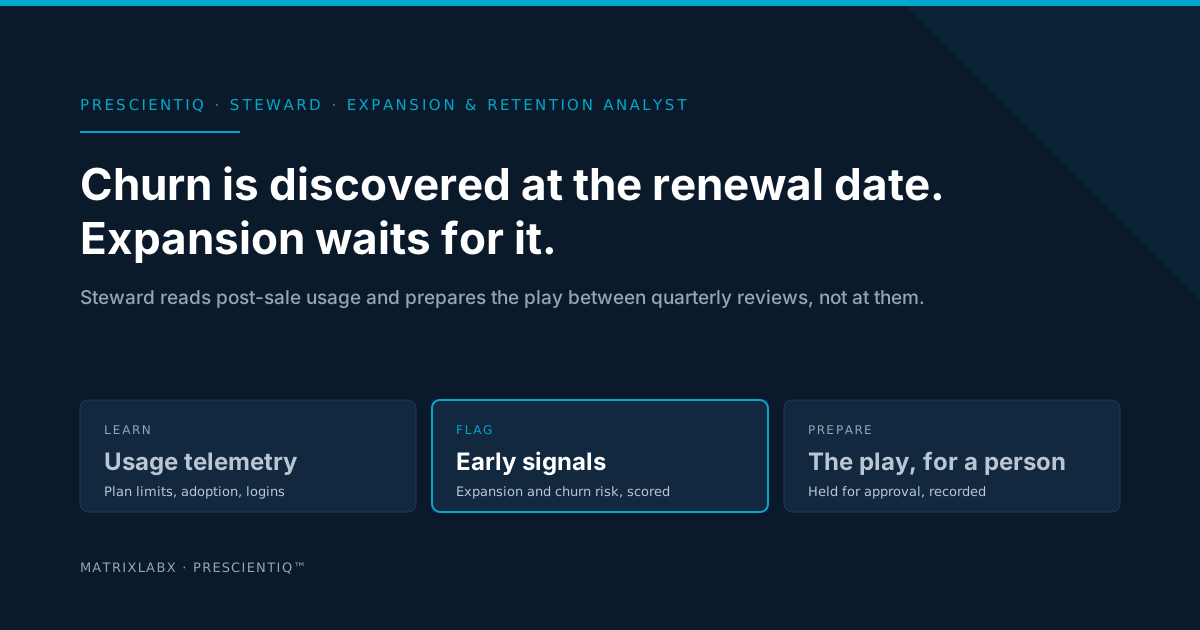
Steward (PrescientIQ’s expansion agent) analyzes post-sale usage telemetry to flag cross-sell opportunities and surface churn-risk signals early, and prepares the play for your team between quarterly reviews, not at them. Any customer-facing message in that play is held for a named person’s approval. The judgment stays with the account owner; what changes is when the work is ready.
Post-sale is where the revenue loop is quietest and the money is largest. A customer’s usage drifts toward a plan limit and nobody pre-builds the expansion case. Logins thin out over a quarter and the first time anyone notices is the renewal call. Both patterns are visible in the telemetry for months. What is missing is not the data; it is a reader with time, and a prepared next step in front of the person who owns the account. We covered why revenue leaks at exactly this seam in how revenue leaks between marketing, sales, and customer success. Steward is built for the seam.
This is what it does, who it is for, where it runs, how the approval gate works, and when it is the wrong thing to buy.
What, who, where, how, and when
A digital worker that reads post-sale usage for every account, flags expansion opportunities and churn-risk signals as they emerge, scores them, and prepares a play with the reasoning attached for the account owner. Not a health-score dashboard, and not an automated renewal email.
Customer success and account management leaders at mid-market SaaS companies where expansion is a material share of new revenue, the RevOps leader who owns the CRM and the telemetry, and the CSMs who review the queue.
Against Salesforce or HubSpot, reading product usage telemetry for live accounts, under your brand. The scope is published rather than discovered during implementation.
Usage signals are compared with the patterns that precede expansion and churn in your product. When an account’s signals move, Steward scores the change deterministically, prepares the play that fits, stores the reasoning with it, and routes it to the owner. Any customer-facing message in the play is held for a named approver.
When churn is being discovered at the renewal date, when expansion moments pass because nobody pre-built the case, when CSMs carry more accounts than they can review weekly, and when someone will own the queue. Not as a substitute for fixing a product customers stop using.
The signal, the score, and the play
Expansion and churn do not announce themselves. They show up as changes in usage: a team that adopts a second feature, a workspace approaching its seat limit, an executive sponsor who stops logging in, support tickets that shift from how-to questions to complaints. A customer health score compresses all of that into one number and leaves a CSM to decide what it means during account review, which for a CSM with forty accounts is once a quarter.
Steward works from the change rather than the snapshot. When an account’s signals move against the patterns that precede expansion or churn in your product, it scores the change, prepares the play that fits, and routes it to the account owner with the reasoning attached: which signals moved, in what direction, and why this play. The owner receives a prepared next step, not a red cell. Account scoring runs on sandboxed deterministic code. No language model performs arithmetic that has a numeric consequence, so a score can be reproduced and checked.
How the approval gate works
A play can contain internal steps and customer-facing steps. The internal steps, such as scoring the account, writing a risk flag to the CRM, or opening an expansion opportunity for the owner, are where teams typically raise the autonomy ceiling first, because an error there lands inside the company and is reversible from the ledger. Any customer-facing message, and anything commercial a customer would see, is held in the approval queue until a named person approves, edits, or rejects it. Your team sets the mode for each class of action:
Human-in-the-loop (HITL). The action is drafted and held. It does not execute until a named person on your team approves it.
Human-on-the-loop (HOTL). The action executes under a standing policy your team sets. A named person supervises and keeps intervention, override, and revocation authority.
Your team chooses the mode for each action class, based on its risk tolerance, and can change it at any time.
Every action, in either mode, is recorded to the audit ledger with its rationale, before-and-after state, and the approver or policy behind it.
Every action class starts in human-in-the-loop until your team changes it.
Each agent runs under its own least-privilege identity, enforced by permissions and not by prompt instructions. Entitlements can be listed, and an agent can be revoked without disabling a person.
Key value propositions
Between the reviews, not at them
Churn signals move months before the renewal and expansion moments pass before the QBR. Steward prepares the play when the signal moves, so the owner works weeks ahead of the date.
Scored, not guessed
Account scoring runs on sandboxed deterministic code. No language model performs arithmetic that has a numeric consequence, so a score can be reproduced and checked.
A play, not an alert
The account owner receives a prepared next step with the signal and the reasoning attached, not a red cell on a health dashboard to interpret and rebuild context around.
The judgment stays with your team
Discounts, escalations, and the decision to let an account go are made by people. Anything commercial a customer would see requires a named approver before it goes out.
Recorded end to end
Every action, in either mode, is recorded to the audit ledger with its rationale, before-and-after state, and the approver or policy behind it. A retained or expanded account can be traced back to what was flagged, what was prepared, and who approved it.
One fee, all four agents
Steward is one of four specialist agents on the Revenue Accelerator platform fee, with Scout, Herald, and Guide, under one coordinator, Marshal. Adding CSMs or reviewers does not change the fee.
Where does your post-sale motion actually find out?
“Churn surprised us” resolves to one of four situations with four different fixes, and only two of them are the case Steward is built for. This routes you to the right starting point.
When does your team learn an account is at risk, or ready to grow?
What it does not do
It does not send without a named person’s approval, and it does not make the commercial decision. It does not fix a product customers stop using; it reports the drop-off early, which is diagnostic data for the product team rather than a retention fix. It does not find the account, which is Scout, reach it, which is Herald, or convert the trial, which is Guide. Steward is the Learn stage of the loop: what it reads post-sale feeds the next cycle of all three.
Where the data runs
PrescientIQ is hosted and operated by MatrixLabX on Google Cloud. SOC 2, ISO 27001, and PCI DSS attestations are held by Google Cloud, which operates the underlying infrastructure. They are not MatrixLabX certifications. MatrixLabX application-layer SOC 2 is in progress.
What it costs
Steward ships as one line of the full Revenue Accelerator platform fee. On our pricing page it is listed as “Steward · Expansion & Retention Analyst,” alongside Scout (prospecting), Herald (outbound), and Guide (trial conversion), under one published rate:
| Component | Investment | Billing frequency |
|---|---|---|
| Annual platform feeEnvironment provisioning on Google Cloud, per-agent IAM, audit-ledger setup, and context ingestion from your CRM — plus four cooperating agents (Scout, Herald, Guide, and Steward), their coordinator Marshal, the approval queue and standing-policy controls, and the immutable audit ledger, and the monthly execution volume a typical mid-market deployment runs. One fee, from signature, every year.Target — modeled: live in 21 days or less$165,000/year is the complete platform fee. There is no separate implementation charge and no different first-year number — deployment work is included from signature, not billed as a distinct line. Scope beyond a typical deployment — additional bundles, sustained higher volume — is quoted at your AAR before anything is signed. | $165,000/yr | Billed monthly at $13,750/mo against an annual commitment |
Frequently Asked Questions
- What does Steward actually do?
- Steward is PrescientIQ’s expansion and retention analyst. It analyzes post-sale usage telemetry for every account, flags cross-sell and upsell opportunities and churn-risk signals early, scores them deterministically, and prepares a play for the account owner. Any customer-facing message in that play is held for a named person’s approval.
- Does Steward contact customers automatically?
- No. Steward prepares the play; a person acts on it. Any message to a customer is held in the approval queue until a named person on your team approves it, and every action is recorded to the audit ledger with the approver behind it. Internal actions such as scoring an account or writing a risk flag to the CRM can run under a standing policy your team sets.
- What signals does Steward read?
- Post-sale usage against plan limits, adoption by team and feature depth, login frequency and trend, executive sponsor changes, support patterns, and renewal timing, from your product telemetry and the CRM record in Salesforce or HubSpot. The signal set is configured with your customer success team so it reflects what churn and expansion actually look like in your product.
- How is this different from a customer health score?
- A health score is a number on a dashboard that a CSM reads during account review. Steward turns a change in the underlying signals into a prepared play, with the reasoning attached, routed to the account owner at the time the signal moves. The difference is who does the noticing and when the work is ready, not the data.
- When does Steward act relative to the renewal?
- Continuously, between quarterly business reviews rather than at them. Churn signals are usually visible months before the renewal date and expansion moments usually pass before anyone pre-builds the case. Steward prepares the play when the signal moves, so the account owner is working weeks ahead of the date instead of at it.
- Who reviews Steward’s plays?
- Usually the customer success manager or account manager who owns the account, sometimes with a second approver for a commercial offer. Review is approve, edit, or reject on a queue, with the signal and the reasoning attached, so the reviewer is judging whether the reason holds rather than rebuilding context from a CRM note.
- Does Steward make the churn decision or the pricing offer?
- No. It flags the signal, scores it, and prepares the play. The decision to offer a discount, escalate to an executive, or let an account go stays with your team, and anything commercial a customer would see requires a named approver. Steward makes the judgment calls visible and timely; it does not take them.
- What does Steward not do?
- It does not send without approval. It does not fix a product that customers stop using; it reports the drop-off early, which is diagnostic data for product, not a retention fix. It does not handle the trial stage, which is Guide’s job, and it does not run onboarding.
Related Reading
- Inside Guide (the stage before this one)
- Net Revenue Retention in SaaS: The Operating Guide
- SaaS Churn Signals: What to Watch and When
- How governed expansion agents catch usage drop-offs in DevSecOps accounts
- Automating expansion revenue in HealthTech
- How to Fix Revenue Leakage Between Marketing, Sales, and Customer Success
- The 2027 RevOps Survival Blueprint
- Beyond Top-of-Funnel: Full Revenue Loop Digital Labor
Notes on this post
Product statements match the current public copy on the pricing and Revenue Accelerator pages. No retention, churn, or expansion figure is stated on this page; the result for your accounts is modeled in a free Autonomous Audit Report on your own data before any commitment. The quotation is George Schildge’s, in a form he supplied for this series. No comparison is made with any named product.
See where your own execution effort is going
The Autonomous Audit Report models where your team's execution capacity is currently spent, what your configuration is actually paying for, and what the governed alternative looks like on your own data — before any commitment.
Get your free AAR benchmark