Agentic AI Architecture: How Governed Digital Labor Is Actually Built
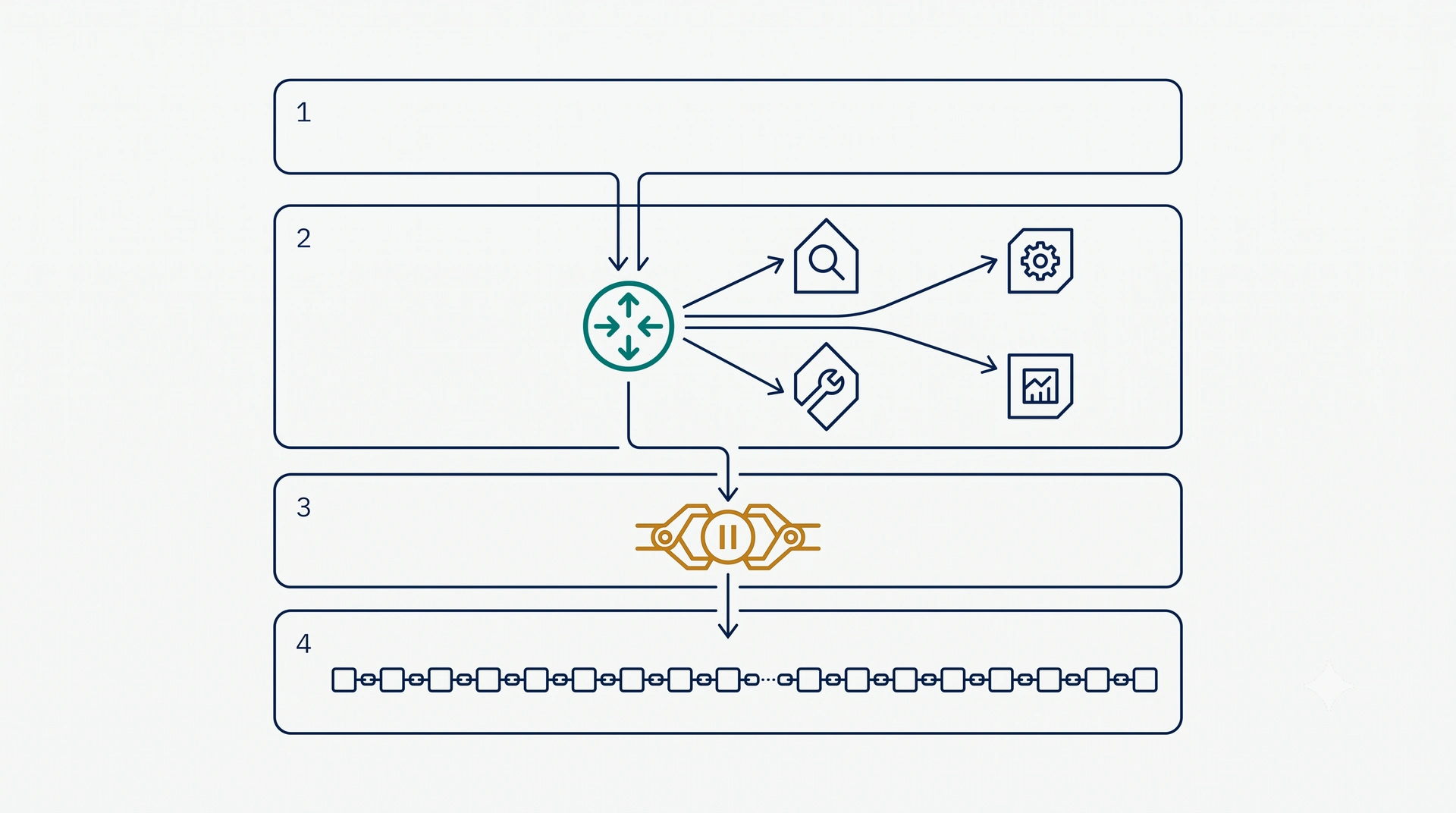
Agentic AI architecture is the design pattern behind digital labor: specialist agents with scoped identities and tool access, an orchestration layer that routes work between them, a human approval gate on consequential actions, and an append-only ledger that records every decision and execution. The architecture — not the model — is what makes agents safe to deploy.
Every serious evaluation of governed digital labor eventually arrives at the same question, usually from the most technical person in the room: what is actually under the hood? It is the right question. The difference between an agent deployment that survives a security review and one that gets killed in procurement is almost never the model. It is the architecture wrapped around the model.
This post is the technical companion to our digital labor guide, written for the CTO, RevOps lead, or architect who has to decide whether any of this is real. It describes the pattern MatrixLabX runs in production inside PrescientIQ.
What is agentic AI architecture?
An agentic architecture is a system design in which software components — agents — are given goals, tools, and bounded authority, rather than scripts to replay. Each agent runs a continuous sense → decide → act → learn loop: it reads the current state of the systems it is connected to, selects an action consistent with its goal and its constraints, executes through the tools it has been granted, and incorporates the result — including human feedback — into its next cycle.
The word bounded is doing the structural work in that definition. An unbounded agent is a liability with an API key. A bounded agent has an identity, a permission scope, an approval protocol, and a paper trail. Everything else in this article is a description of where those bounds live.
What are the layers of an agentic system?
Production agentic systems converge on four layers, in a stack that mirrors the hero diagram above:
- Interface layer. Where work enters and surfaces: triggers from connected systems (CRM events, inbox activity, usage telemetry), scheduled sweeps, and the human-facing approval queue where prepared actions wait for review.
- Orchestration layer. A router that decomposes incoming work and assigns it to the right specialist agent, sequences multi-agent chains, carries state between steps, and enforces that no agent acts outside its lane. This is the layer that separates a coordinated workforce from a pile of bots.
- Approval layer. The human gate. Consequential actions — anything customer-facing, revenue-touching, or record-mutating — are held here until a named human approves, edits, or rejects them. The gate sits on the execution path, which means it cannot be bypassed by any agent, under any prompt.
- Ledger layer. An append-only record beneath everything. Every sense, decision, action, approval, and rejection is written with actor, timestamp, rationale, data consulted, and before/after state. Nothing above this layer can edit what was written.
How do specialist agents differ from one general-purpose agent?
The demo pattern is one impressive generalist agent with access to everything. The production pattern is the opposite: a roster of narrow specialists — a prospecting agent, an outbound agent, an expansion agent, a data-integrity agent — each with its own identity and the minimum tool access its job requires.
Specialization is not an aesthetic preference; it is what makes three enterprise requirements satisfiable at all:
- Least privilege. A prospecting agent that only reads firmographic sources and writes CRM candidates cannot leak what it cannot touch. One generalist agent with union-of-everything permissions makes least-privilege arithmetic impossible.
- Evaluability. A narrow agent has a narrow definition of success, so its reliability can be measured, and its authority widened or revoked on evidence.
- Failure isolation. When a specialist misbehaves, you revoke one scoped identity. When a generalist misbehaves, you are doing incident response on your whole stack.
Where does the human approval step sit?
On the execution path — structurally between decision and action, not beside the system as a review process someone can skip. When an agent's chosen action crosses the consequence threshold, the orchestrator suspends the workflow, writes the pending action to the approval queue, and resumes only on a signed human decision. The approver sees the action, the rationale, and the evidence the agent consulted; approval, edit, and rejection are all recorded outcomes.
This is the mechanism behind the phrase we use across everything MatrixLabX ships: agents execute, humans authorize. The human is not a rubber stamp at the end of the pipeline; the human is a control point the pipeline cannot route around.
What does the audit ledger record?
Enough to reconstruct any action without interviewing anyone: which agent acted, under which identity and permission set, triggered by what, having consulted which data, deciding on what stated rationale, approved or rejected by whom, with what before/after state in the target system. Entries are append-only — corrections are new entries, never edits — so the record's integrity does not depend on anyone's good behavior after the fact.
The ledger is where architecture and compliance meet: when an auditor asks which decisions were automated and who approved them, the evidentiary answer is a ledger query. Design the record at deployment time and the compliance question is solvable before it is ever asked.
How do you scope an agent's permissions?
Like a security engineer, not like a hiring manager. Each agent gets a distinct service identity — its own credentials, never a shared key, never a human's OAuth session — with grants enumerated per tool and per verb: read on these objects, write on those, nothing else. Execution happens governed, inside the customer's own cloud perimeter, so auditability and network controls apply to agents the same way they apply to any workload.
Authority then widens the only defensible way: against the record. An agent that has accumulated a ledger of approved, correct actions in one action class earns a broader grant in that class. Scoping is not a one-time setup decision — it is a policy that moves with demonstrated reliability.
Do agents belong on the org chart?
Not as boxes with reporting lines. The pattern that works — and the one that keeps the legal analysis clean — is agents as a managed capability with a named human owner per agent. The owner holds the approval authority, answers for the agent's output the way a manager answers for a team's, and is the accountable name in the ledger. The agent is not headcount, not a worker, and not a colleague; it is governed capacity that a specific person commands.
Organizations that skip this step and let agents run as ambient, unowned automation discover the gap the first time something goes wrong and the question “whose agent was that?” has no answer. Ownership is a requirement, not an HR formality.
Standing all of this up is a sequencing problem more than a build problem — the specialists, the identities, the approval queue, and the ledger have to come online in an order that keeps each one testable. That sequence is documented in the MatrixLabX context ingestion process.
Frequently asked questions
What model does an agentic architecture run on?
Less than most buyers expect. In a well-designed system the model is a swappable reasoning component inside each agent; the safety and reliability properties come from the architecture around it — scoped identity, orchestration, the approval gate, and the ledger. Model upgrades should improve quality without changing the governance surface.
Is one powerful general agent better than several specialist agents?
For enterprise work, no. A single broad agent needs broad permissions, which makes least-privilege impossible and turns every error into a systemic one. Specialist agents can each be granted the minimum access their job requires, evaluated on a narrow definition of success, and revoked individually.
Does the human approval gate slow everything down?
It gates consequential actions, not all actions. Sensing, analysis, drafting, and internal updates run without interruption; the gate interrupts the moment an action would touch a customer, money, or a system of record. In practice humans review a queue of prepared decisions, which is faster than performing the work itself.
Do AI agents belong on the org chart?
Not as headcount. The pattern that works is agents as a managed capability with a named human owner per agent — the owner holds approval authority and answers for the agent the way a manager answers for a team, without the agent being treated as a worker.
This architecture runs in production, under your approvals.
Explore PrescientIQ →Related
See where your own execution effort is going
The Autonomous Audit Report models where your team's execution capacity is currently spent, what your configuration is actually paying for, and what the governed alternative looks like on your own data — before any commitment.
Get your free AAR benchmark