Multi-agent swarm architecture for revenue operations: a technical blueprint
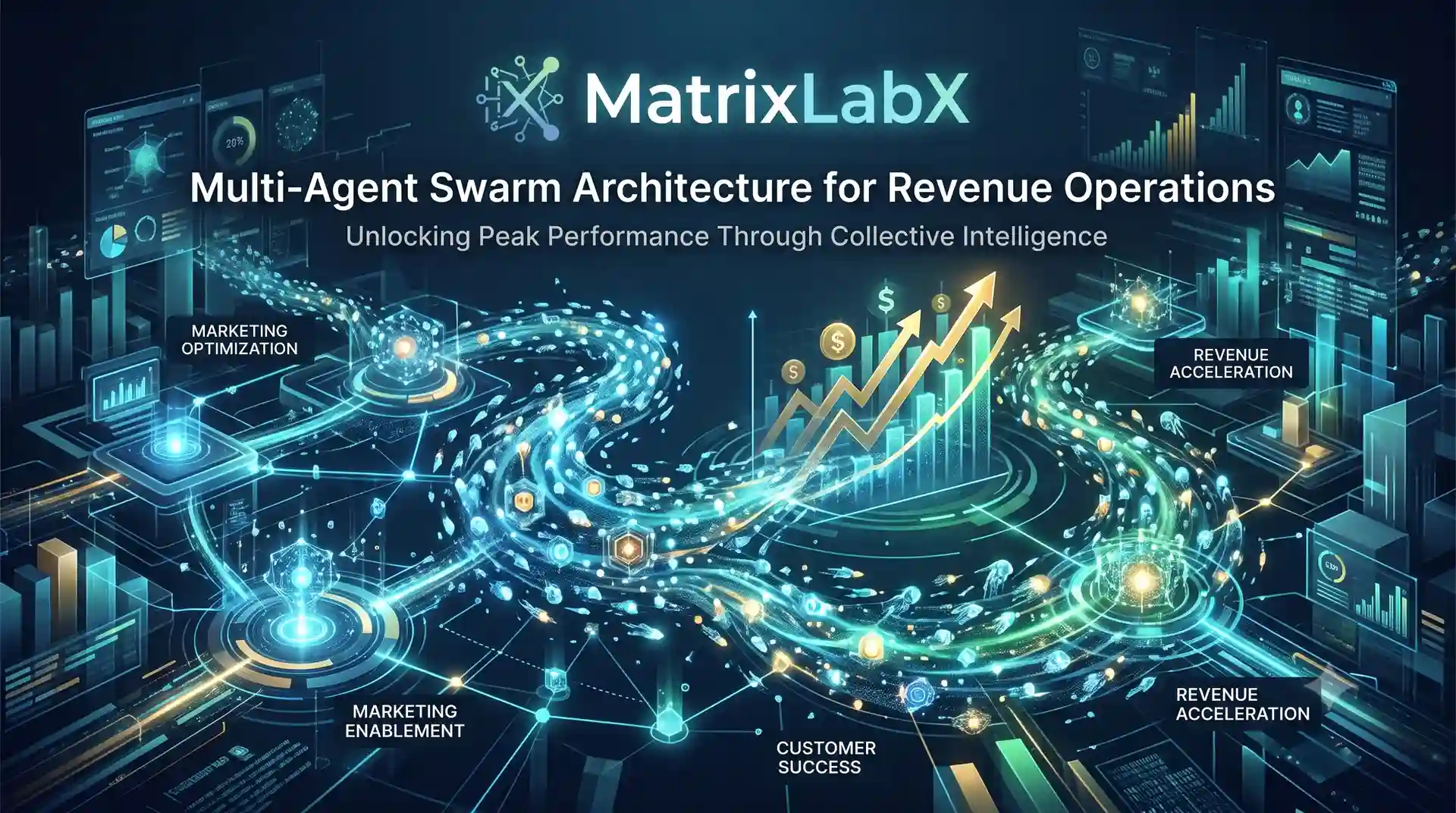
Multi-agent swarm architectureis a system design in which multiple narrow-scoped AI agents — each owning exactly one revenue function — are coordinated by a central orchestrator that routes intent, persists state after every decision, and enforces governance gates before any action leaves your perimeter. It replaces both monolithic "do-everything" agents and brittle point-to-point automation.
🔑 Key takeaways
- Gartner projects 33% of enterprise software will include agentic AI by 2028, up from under 1% in 2024 — and 15% of day-to-day work decisions will be made autonomously.
- The same firm predicts over 40% of agentic AI projects will be canceled by end of 2027 — failures concentrate in projects without orchestration, state persistence, or governance.
- Narrow specialist agents beat one large agent on failure isolation, auditability, and per-workflow governance — the four properties security review actually tests.
- The orchestrator is the product: intent routing, durable state, approval gates, and an immutable audit ledger are what separate production swarms from demos.
- A scoped four-agent revenue swarm deploys in 21 days or less when it starts in monitoring mode and turns on execution one workflow at a time.
Why do single-agent revenue automations fail in production?
Single-agent automations fail because they concentrate every failure mode in one context window. One agent asked to prospect, draft outbound, watch trials, and score expansion carries the full state of every workflow in a single prompt — so one hallucinated field, one stale CRM record, one ambiguous instruction stalls all of them at once. There is a reason Gartner predicts over 40% of agentic AI projects will be canceled by the end of 2027, citing escalating costs and unclear business value (Gartner, 2025). Most of those projects were architected as demos, not systems.
The tension is real for the teams buying them. Salesforce research finds sales reps spend less than 30% of their time actually selling — the rest disappears into administration, data entry, and internal coordination (Salesforce, State of Sales, 2023). Revenue leaders feel that leak every quarter, and the fear of buying an automation that breaks in week three is what keeps the manual work in place. Consequently, the architecture question is not academic: it decides whether the automation survives contact with your CRM.
Data suggests the market has already voted. A LangChain survey of over 1,300 practitioners found a majority of respondents now run agents in production, with most of the remainder actively building toward it (LangChain, State of AI Agents, 2026). The production winners share one trait: they decompose work across specialists instead of scaling one generalist.
What does a revenue-operations swarm actually look like?
A revenue swarm pairs four specialist agents with one coordinator. Each specialist owns a single stage of the revenue loop, holds only the context that stage requires, and exposes a typed contract to the rest of the system. In the context of the 2026 shift toward agentic front ends, this is the pattern Gartner describes as agent ecosystems — networks of specialized agents collaborating across applications (Gartner, 2025). The Revenue Accelerator Stack implements it as four agents:
| Agent | Owns | Decision style | Governance gate |
|---|---|---|---|
| Prospecting | ICP scoring from firmographic + intent signals | Deterministic code, not model guesswork | None — internal only |
| Outbound | Signal-grounded drafts and delivery | Generative draft, deterministic send rules | Hard human approval on every send |
| Trial Conversion | Stall detection and activation sequences | Sandboxed deterministic pricing math | Approval on customer-visible offers |
| Expansion | Upsell and churn-risk surfacing | Deterministic confidence scoring | None — creates review items only |
Notice what the table encodes: different risk levels get different gates. Internal scoring runs free; anything that leaves your building queues for a human. That asymmetry is impossible in a monolith and trivial in a swarm.
What does the orchestrator do that the agents cannot?
The orchestrator turns a set of clever agents into a system of record. It is the component that security teams, auditors, and CFOs actually evaluate, and it carries four responsibilities no specialist can own for itself:
- Intent routing. Every inbound signal — a form fill, a usage drop, a funding event — is classified and dispatched to exactly one specialist, so two agents never act on the same trigger twice.
- Durable state. Workflow state persists to a database after every decision, so a run survives a restart mid-sequence. In PrescientIQ's implementation the coordinator-to-specialist cycle completes in roughly 1.6 seconds, measured in production.
- Approval gates. Externally visible actions enter a human review queue before execution. Agents execute; humans authorize. Nothing sends on model confidence alone.
- The audit ledger. Every action is appended immutably with actor, rationale, confidence, and before/after state — the evidence trail that makes agent activity reviewable like any privileged service account.
In contrast, teams that bolt agents directly onto their CRM inherit none of this. The moment two automations disagree about an account, there is no arbiter and no record of who decided what. That is the small, unglamorous detail that separates the 33% of enterprise software Gartner expects to be agentic by 2028 from the 40% of projects it expects to be canceled a year earlier.
How do you keep a swarm safe enough for security review?
You give every agent its own identity and every action a paper trail. Each specialist holds a dedicated least-privilege service identity; external systems are reached only through typed, scoped tool integrations; inter-agent messages travel over an agent-to-agent protocol rather than shared prompts. Data is recorded to an immutable audit ledger, and the whole assembly runs under the same VPC controls your existing workloads use.
The investment math holds up when governance does. IDC research commissioned by Microsoft measures an average return of 3.7 times per dollar invested in generative AI (IDC, 2024) — yet IBM's 2025 CEO study found only 25% of AI initiatives delivered their expected ROI (IBM, 2025). The spread between those two numbers is mostly architecture. As Andrew Ng put it, "AI is the new electricity" (Stanford GSB, 2017) — and like electricity, it produces value only inside systems built to carry it safely.
What results should a revenue swarm produce — and how fast?
Measure a swarm on throughput per headcount and time-to-production, not demo quality. McKinsey finds 78% of organizations now use AI in at least one business function (McKinsey, State of AI, 2025), and S&P Global Market Intelligence estimates roughly 31% of enterprises run at least one AI agent in production. The differentiator is no longer whether you deploy agents but how much governed work each one absorbs. MatrixLabX's modeled deployment targets for a four-agent revenue swarm:
| Metric | Target | Basis |
|---|---|---|
| Outbound output per headcount | 6× SDR-equivalent | Modeled |
| Marshal cycle latency | ~1.6s | Measured in production |
| Time to production | 21 days or less | Measured across deployments |
Consequently, the deployment sequence matters as much as the architecture. The path that works: connect the CRM through typed integrations, run two weeks in monitoring mode with every action logged but none executed, then enable autonomous execution one workflow at a time, starting with the lowest-risk internal scoring.
How does swarm architecture compare with the alternatives?
The honest comparison is swarm versus monolith versus the point-to-point stack you already own.
| Property | Point-to-point automation | Single large agent | Orchestrated swarm |
|---|---|---|---|
| Failure isolation | Per integration, silent breakage | None — one context fails all | Per agent; others keep running |
| Auditability | Scattered tool logs | One opaque transcript | Immutable per-action ledger |
| Governance granularity | All-or-nothing per tool | One gate for everything | Per-workflow gates |
| Cost model | Per-seat licenses × 14 tools | Per-token, unpredictable | Metered workflows and outcomes |
The cost column is where CFOs lean in. Outcome-metered pricing — Labor as a Service rather than per-seat SaaS — only becomes billable when every workflow is individually metered, which the orchestrator's ledger provides for free.
How do you implement a revenue swarm step by step?
Implementation runs in five stages, each with a hard exit criterion. The sequence exists to keep risk flat while throughput ramps — every stage produces evidence the next stage depends on:
- Context ingestion (days 1–3). Connect CRM, product telemetry, and intent feeds through typed, read-only integrations. Exit when the coordinator can reconstruct your account universe without a single manual export.
- Deterministic baseline (days 3–5). Run scoring agents against history and reconcile their output with what your team actually did. Exit when scoring disagreements are explainable.
- Monitoring mode (week 2). All four agents propose actions; none execute. Exit at a stable human-approval rate on proposals.
- Gated execution (week 3). Enable autonomous execution for internal workflows first, then externally visible ones behind the approval queue. Exit when the audit ledger reconciles cleanly against the CRM.
- Scale and meter (ongoing). Add workflows one at a time; every completed workflow and attributed outcome writes to the same ledger your invoice reconciles against.
Why this might not work for you
A swarm is the wrong first move if your CRM data is too degraded to trust deterministic scoring — fix the data debt first, or scope the deployment to Scout whose job is cleaning it. It is also the wrong move if no one on your team can own the approval queue: a human gate with no human behind it becomes a bottleneck, not a safeguard. And if your revenue motion is fewer than a handful of high-touch enterprise deals a quarter, the coordination overhead outweighs the throughput gain — a swarm pays for itself on volume.
Conclusion: architecture is the moat
The agentic shift is no longer speculative — Gartner sizes agentic AI at more than $450 billion in enterprise software revenue by 2028. The projects that survive it will be the ones built as systems: specialists with narrow contracts, an orchestrator that owns state and governance, and a ledger that makes every action defensible. Start by modeling the numbers on your own data with a free Autonomous Audit Report, then deploy one governed workflow at a time.
Frequently asked questions
What is a multi-agent swarm architecture?
A multi-agent swarm architecture is a system design in which multiple narrow-scoped AI agents, each owning one function, are coordinated by a central orchestrator that routes intent, persists state, and enforces governance — instead of one monolithic model attempting every task.
Why not use one large agent instead of a swarm?
A single large agent concentrates failure: one bad decision path stalls every workflow it touches. Narrow specialist agents isolate failure, keep each prompt context small and auditable, and let you apply different governance to different risk levels — a human gate on outbound sends, none on internal scoring.
What does the orchestrator actually do?
The orchestrator routes each intent to the right specialist agent, persists workflow state after every decision so runs survive restarts, enforces the governance mode set for each action class, and appends every action to an immutable audit ledger with actor, rationale, and before/after state.
How do agents in a swarm communicate?
Through typed messages over an agent-to-agent protocol, never through shared prompts. Each agent exposes a narrow contract, and every external system — CRM, outbound provider, data feeds — is reached only through typed, scoped tool integrations behind least-privilege identities.
Is multi-agent architecture production-ready in 2026?
Yes, with discipline. LangChain survey data shows a majority of teams now run agents in production, and Gartner projects 33% of enterprise software will include agentic AI by 2028. The failures Gartner also predicts concentrate in projects without state persistence, governance gates, or measurable outcomes.
How long does a swarm deployment take for revenue operations?
A scoped four-agent revenue deployment covering prospecting, outbound, trial conversion, and expansion is targeted at 21 days or less, subject to CRM data quality and integration scope. It starts in monitoring mode, connects through typed CRM integrations, and turns on autonomous execution one workflow at a time.
See the swarm modeled on your data
The free Autonomous Audit Report maps the four-agent architecture to your CRM stack and models throughput, cost, and pipeline impact before you commit.
Get your free AAR →Built natively on Google Cloud. Sources: Gartner press releases (2025); LangChain State of AI Agents survey (2026); Salesforce State of Sales research (2023); IDC Business Opportunity of AI study commissioned by Microsoft (2024); IBM CEO Study (2025); McKinsey State of AI (2025); S&P Global Market Intelligence. Modeled MatrixLabX targets are validated per-account in the Autonomous Audit Report.
See where your own execution effort is going
The Autonomous Audit Report models where your team's execution capacity is currently spent, what your configuration is actually paying for, and what the governed alternative looks like on your own data — before any commitment.
Get your free AAR benchmark