The audit ledger is the new system of record for agent actions
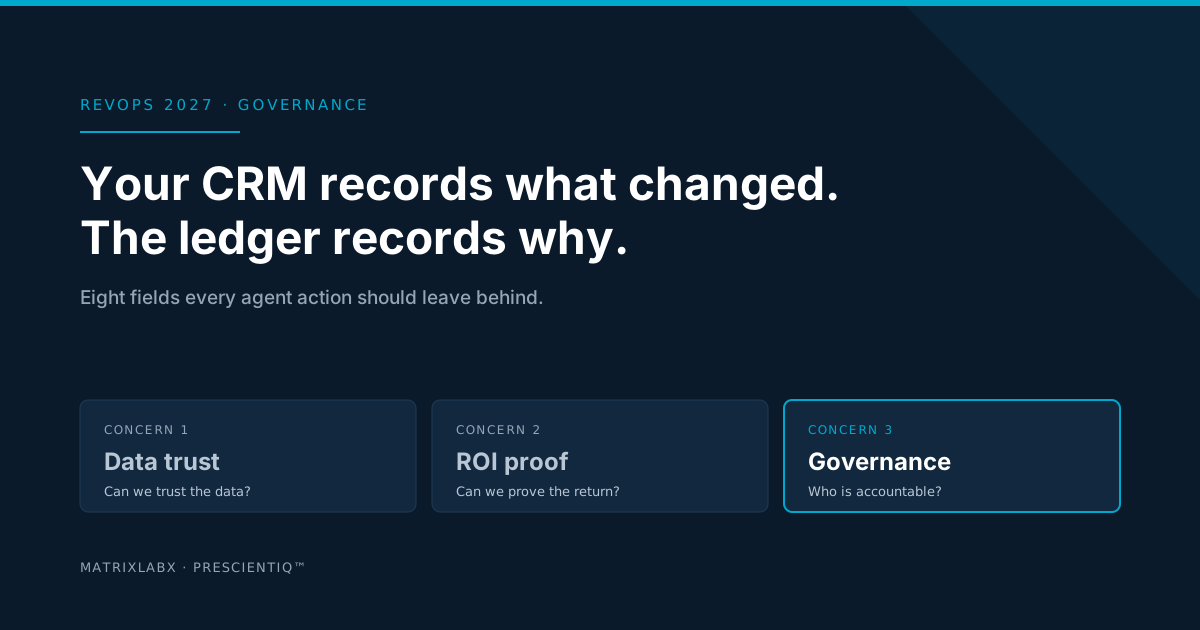
An audit ledger is a tamper-resistant record of every action an AI agent takes: which agent acted, why, what the record looked like before and after, and proof that the entry wasn’t altered. Your CRM records the current state of your data. The ledger records how it got there. When agents act on your behalf, that history becomes the basis for security reviews, incident response, and financial reconciliation.
Your CRM can’t answer the question you’ll be asked
Picture the call. A prospect’s general counsel wants to know why their CEO received an email from your company. A customer asks why their renewal record shows a changed contract value. Your CRO asks why forecast categories shifted overnight on forty opportunities.
Field history in your CRM may tell you what changed. It usually won’t tell you which agent changed it, what input it acted on, what rationale it applied, or whether a person approved it. Once several AI tools can write to the same system, “the integration user updated this field” is no answer at all.
What the research firms say
Gartner names inadequate risk controls as one of three causes behind its prediction that more than 40% of agentic AI projects will be canceled by the end of 2027 (Gartner, June 25, 2025). It also expects oversight technology to become a market of its own, predicting that guardian agents will account for 10 to 15% of agentic AI markets by 2030 (Gartner, June 11, 2025).
Forrester puts a price on the alternative. It predicts that ungoverned use of generative AI will cost B2B companies more than $10 billion in enterprise value through declining stock prices, legal settlements, and fines. Its chief research officer argued that accountability and clarity will decide competitive advantage for B2B leaders (Forrester, October 28, 2025).
Neither monitoring nor accountability works without a record to monitor and account from.
What a complete ledger entry contains
This is a buyer’s checklist. Hold every vendor to it, including us.
| Field | What it answers |
|---|---|
| Actor | Which agent, or person, took the action |
| Action class | What kind of action it was, and therefore which policy governed it |
| Trigger and input | What signal or data prompted the action |
| Rationale | Why the agent chose this action |
| Before state | What the record looked like before |
| After state | What the record looks like now |
| Approval | Whether it ran under standing policy or was approved by a named person, and who |
| Receipt | Proof that the entry hasn’t been altered since it was written |
If any field is missing, a question will eventually arrive that you can’t answer.
Three jobs the ledger does
1. Security and compliance evidence. A reconstructable history of every action is the most direct answer to a security reviewer’s core question: what can this system do, and how would we know what it did?
2. Incident response and correction. With the before state recorded, a bad action becomes a known change you can find and correct, not a mystery you discover in next month’s report.
3. Financial reconciliation. If AI work is counted per action, the same record of executed actions can serve as the basis for the invoice. Finance and security then work from one source of truth.
George Schildge’s view
How PrescientIQ™ implements the ledger
- What is recorded. Every action, in either mode, is recorded to the audit ledger with its rationale, before-and-after state, and the approver or policy behind it.
- When it is recorded. At the moment the action happens, not reconstructed when someone asks.
- Who else uses it. Completed workflows and the outcomes they produce write to the same ledger as your audit trail, so RevOps can reconcile a monthly invoice against it.
That statement covers four of the eight fields by name. In your evaluation, ask us to show you a ledger entry and check it against all eight. A vendor that welcomes that test is telling you something.
Action items for RevOps this quarter
- Pick one AI-driven change to your CRM from last month and try to reconstruct it end to end. Note which of the eight fields above you could not answer.
- Add the eight-field ledger requirement to every AI vendor evaluation and renewal.
- Ask each vendor whether ledger entries can be altered after the fact, and by whom.
- Agree with security and finance on one source of record for agent actions, before you have several.
For how the same evidence problem looks to an auditor, see continuous compliance evidence.
Check the math before you spend anything
The free AAR Benchmark builds a P&L projection on your own pipeline data in a read-only working session. Every figure in it is labeled as modeled.
Get your free AAR Benchmark →Frequently asked questions
- What is an AI audit ledger?
- An AI audit ledger is a tamper-resistant record of every action an AI agent takes. It captures which agent acted, what triggered it, its rationale, the record’s state before and after, whether a person approved it, and proof that the entry was not altered after it was written.
- Why isn’t CRM field history enough for AI agents?
- CRM field history typically shows what changed and when, often attributed to a generic integration user. It rarely shows which agent acted, what input it used, why it chose the action, or whether a person approved it. Those are the questions security, legal, and leadership will ask.
- What should an AI audit ledger record?
- A complete entry records the actor, the action class, the trigger and input, the rationale, the before state, the after state, the approval status and approver, and proof the entry was not altered. Missing any of these leaves a question you may eventually be unable to answer.
- How does an audit ledger help with security reviews?
- Security reviewers want to know what a system can do and how the organization would know what it did. A complete, tamper-resistant record of every agent action answers the second question directly, and supports incident investigation, correction of bad actions, and ongoing compliance evidence.
- Can an audit ledger support billing?
- Yes. When AI work is counted per executed action, the ledger that records those actions can be the basis for the invoice. Finance can then reconcile charges to source events without relying on a separate vendor usage report, and finance and security share one record.
- What does PrescientIQ record in its audit ledger?
- Every action, in either mode, is recorded to the audit ledger with its rationale, before-and-after state, and the approver or policy behind it. Completed workflows and the outcomes they produce write to the same ledger as your audit trail, so RevOps can reconcile a monthly invoice against it.
Sources
- Gartner, “Gartner Predicts Over 40% of Agentic AI Projects Will Be Canceled by End of 2027,” June 25, 2025. Link
- Gartner, “Gartner Predicts that Guardian Agents will Capture 10-15% of the Agentic AI Market by 2030,” June 11, 2025. Link
- Forrester, “2026 B2B Marketing, Sales, And Product Predictions,” October 28, 2025. Link
Research findings are paraphrased and carry their original publication dates. Predictions are the research firms’, not ours. Recommendations and checklists are the author’s and are offered as a starting point, not as benchmarks.
Where PrescientIQ runs
PrescientIQ is hosted and operated by MatrixLabX on Google Cloud. SOC 2, ISO 27001, and PCI DSS attestations are held by Google Cloud, which operates the underlying infrastructure. They are not MatrixLabX certifications. MatrixLabX application-layer SOC 2 is in progress.