How to deploy enterprise AI agents in 21 days or less: the MatrixLabX context ingestion process
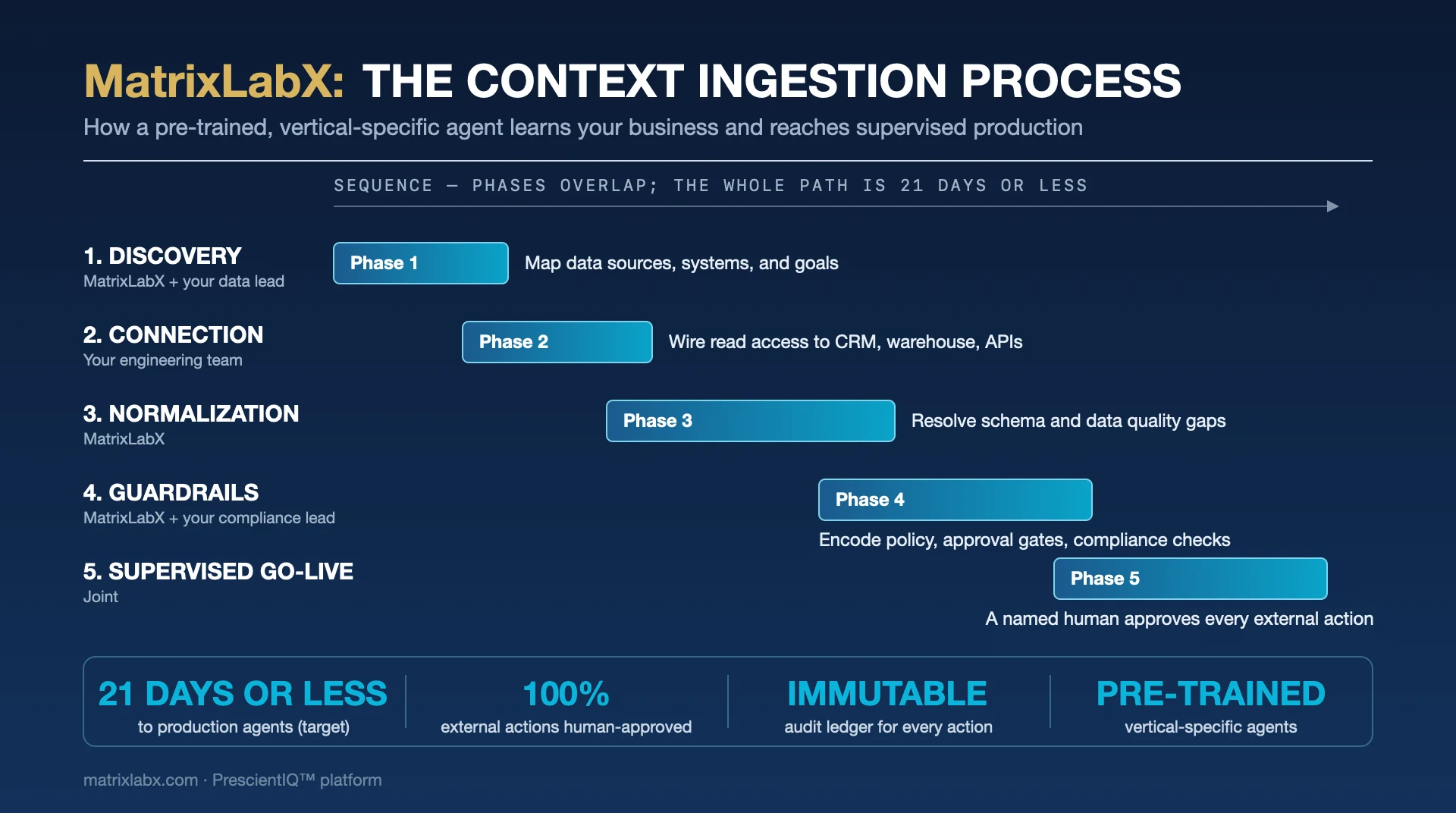
The MatrixLabX context ingestion process is the structured method that teaches a pre-trained, vertical-specific agent to sense, decide, and act on your business data — moving a mid-market enterprise from raw systems to autonomous production agents in 21 days or less, running at a ≥99.5% availability SLO. It replaces months of model training with days of context mapping, because the agent already knows its domain and only needs to learn your company.
✅ Key takeaways
- MatrixLabX reaches production in 21 days or less because agents are pre-trained; you supply context, not training data.
- Context ingestion has five phases: discovery, connection, normalization, guardrails, and supervised go-live.
- Every production deployment ships with a ≥99.5% availability SLO and targets measurable P&L impact within 60 days.
- Autonomous agents post 4× higher goal completion than AI copilot tools because they run workflows end to end.
- Data readiness — not model capability — is the single largest driver of your deployment timeline.
Why does enterprise AI take months when it should take days?
Most enterprise AI programs stall because teams try to build models instead of ingesting context. Gartner reports that at least 30% of generative AI projects will be abandoned after proof-of-concept by the end of 2025, largely due to poor data quality and unclear business value. IBM's Global AI Adoption research found that 40% of organizations cite data complexity as a top barrier to deployment. The problem is rarely the model — it is the months spent training, tuning, and re-scoping before a single workflow runs in production.
MatrixLabX inverts that sequence. Because PrescientIQ™ deploys pre-trained, vertical-specific agents, the work shifts from model construction to context mapping. A McKinsey analysis of AI high performers found they are twice as likely to redesign workflows around AI rather than bolt AI onto existing processes — which is exactly what the context ingestion process does. The result is an autonomous execution platform that reads your data and acts on it, rather than a project plan that never leaves the pilot stage.
“The distinction between a copilot and an autonomous agent is not philosophical — it is a P&L line item.”— George Schildge, CEO & CAIO, MatrixLabX
What exactly is the context ingestion process?
Context ingestion is the five-phase method that turns your systems, rules, and goals into an operating manual an autonomous agent can execute. It is not fine-tuning and it is not prompt engineering. It is the disciplined transfer of business context — data sources, decision logic, escalation paths, and success metrics — into PrescientIQ™ so the agent can operate without human supervision. Forrester notes that agentic AI shifts the enterprise question from “what can the model answer” to “what work can the system complete,” and context is what makes completion possible.
The five phases run in sequence but overlap in practice. Discovery maps your data estate. Connection wires read access to your CRM, warehouse, and APIs. Normalization resolves the schema and quality gaps IBM data teams know all too well. Guardrails encode policy, approval gates, and compliance checks. Supervised go-live puts the agent into production with a human reviewing every action until confidence thresholds are met. Teams that need policy enforcement layer in Compliance Shield during the guardrails phase.
The five phases at a glance
| Phase | What happens | Owner |
|---|---|---|
| 1. Discovery | Map data sources, systems, and goals | MatrixLabX + your data lead |
| 2. Connection | Wire read access to CRM, warehouse, APIs | Your engineering team |
| 3. Normalization | Resolve schema and data quality gaps | MatrixLabX |
| 4. Guardrails | Encode policy, approvals, compliance gates | MatrixLabX + your compliance lead |
| 5. Supervised go-live | Human-reviewed production, then autonomy | Joint |
The full sequence completes in 21 days or less; how long each phase takes depends on data readiness and integration count. Want to see how the phases map to your stack? Review the PrescientIQ™ platform overview for a phase-by-phase breakdown by vertical.
How does a timeline of 21 days or less compare to traditional AI deployment?
A traditional custom-model build runs 6–12 months; the MatrixLabX context ingestion process runs 21 days or less for the same production outcome. IDC forecasts that global spending on AI will surpass $300 billion by 2026, yet Gartner data shows a majority of that spend never reaches durable production value. The gap is almost entirely front-loaded effort: data science hiring, model training, and infrastructure standup that a pre-trained agentic approach removes.
| Dimension | Traditional build / copilot rollout | MatrixLabX context ingestion |
|---|---|---|
| Time to production | 6–12 months | 21 days or less |
| Primary effort | Model training and tuning | Context mapping |
| Data science hiring | Required | Not required |
| Goal completion | Baseline (copilot) | 4× higher vs. copilot tools |
| Uptime commitment | Best effort | ≥99.5% SLA |
| Time to measurable ROI | 9–18 months | Within 60 days |
Speed does not mean cutting corners — it means removing the work that a pre-trained agent makes unnecessary.
“When your competitors are still hiring a data science team, our clients have already moved a P&L number. Fifteen days is not a marketing claim — it is the natural result of shipping labor instead of software.”— George Schildge, CEO & CAIO, MatrixLabX
Cost and benefit over the first year
| Category | Traditional path | Context ingestion path | Net effect |
|---|---|---|---|
| Upfront staffing | Hire ML engineers | Use existing team for read access | Lower fixed cost |
| Operating hours | Business hours | 24/7 autonomous | More throughput |
What does context ingestion look like across real deployments?
The process adapts to the vertical while keeping the same five phases, and three deployments show how quickly context turns into outcomes. Each of the following is drawn from production patterns.
Use case 1: RevOps at a B2B software firm
The challenge
A mid-market B2B firm ran a 14-tool MarTech stack where lead routing, enrichment, and CRM hygiene were split across disconnected point tools. Sales reps spent hours chasing stale records, and CRM accuracy hovered low enough that forecasting was guesswork. Gartner has long tied poor data quality to an average $12.9M in annual cost per organization, and this team felt every dollar of it.
The deployment
Context ingestion mapped their warehouse and CRM in the discovery phase, normalized records in days, and put an autonomous agent into supervised production by day 12.
The outcome
CRM accuracy reached 99.5% under continuous maintenance, and the 14-tool stack consolidated to a single platform. By deploying the Revenue Accelerator Stack, they turned a fragmented toolset into one digital workforce that sensed pipeline changes and acted on them without a rep touching a keyboard.
Use case 2: Fraud detection at a fintech lender
The challenge
A fintech lender fought a rising tide of false-positive fraud flags. Analysts manually reviewed thousands of transactions a week, legitimate customers were declined, and the review queue never emptied. The compliance team could not add headcount fast enough to keep pace with transaction growth.
The deployment
During the guardrails phase, context ingestion encoded the lender's risk policy and approval thresholds directly into the agent.
The outcome
Within the deployment window, the deployment cut false positives by 80%, freeing analysts to focus on genuine risk while customers cleared checkout without friction.
Use case 3: Demand forecasting at a retail operator
The challenge
A multi-location retail operator carried chronic overstock. Buyers forecasted from spreadsheets and last season's gut feel, capital was locked in slow inventory, and warehousing costs climbed every quarter. McKinsey estimates AI-driven supply chain improvements can cut forecasting error by 20–50%, but the operator had no way to capture it.
The deployment
Context ingestion connected point-of-sale, warehouse, and supplier feeds, then normalized them into a single demand signal the agent could act on.
How do you know if your enterprise is ready to deploy agents fast?
Readiness comes down to three questions: is your data reachable, are your workflows definable, and do you have an owner for approvals? The decision tree below walks a CTO through the same triage MatrixLabX uses in the discovery phase. It renders as static HTML and needs no interaction to read — follow the branches top to bottom. For a guided walk-through, review the PrescientIQ™ platform overview.
Deployment readiness decision tree
Yes →
Are your target workflows repeatable and rule-definable?
No →
Data is siloed or access is blocked by policy?
“Agentic AI moves the enterprise conversation from what a model can say to what a system can finish. Context is the difference between the two.”— Forrester Research, on autonomous agents
Step-by-step: how the deployment runs
- Scope the first workflow. Pick one high-volume, rule-definable process — lead routing, fraud review, or demand forecasting — as the beachhead. Narrow scope is why the timeline holds.
- Run discovery. Map every data source, system of record, and success metric. This is where 40% of data-complexity risk gets surfaced early rather than at go-live.
- Provision read access. Your engineering team wires read-only connections to CRM, warehouse, and APIs. No write access is granted until guardrails are live.
- Normalize the data. MatrixLabX resolves schema mismatches, deduplicates, and builds the unified signal the agent will act on.
- Encode guardrails. Policy rules, approval gates, and compliance checks are written into PrescientIQ™.
- Define success metrics. Set the P&L targets the agent will be measured against, so ROI is trackable from the first live action.
- Run supervised go-live. The agent acts in production while a human reviews every action. Confidence thresholds must be met before autonomy expands.
- Release to autonomy. The agent runs 24/7 under the ≥99.5% availability SLO, sensing, deciding, and acting while your team monitors outcomes, not keystrokes.
Why this might not work for you
Rapid deployment is honest work, and it has honest prerequisites. If any of the following describe your environment, plan for a longer runway or a different first step.
- No reachable data. If your systems cannot grant read access within the first few days, the timeline slips — context ingestion cannot map what it cannot see.
- Undefined workflows. If the process you want to automate changes with every case and has no rules, an agent has nothing stable to act on. Standardize first.
- No approval owner. Supervised go-live requires a named human to review actions. Without that owner, autonomy cannot be safely released.
- Unresolved compliance blockers. Regulated data with no policy sign-off path will stall at the guardrails phase until Compliance Shield and legal align.
- Expectation of zero change management. Agents redesign how work flows. Teams unwilling to adjust roles will see adoption, not technology, become the bottleneck.
Frequently asked questions about fast AI agent deployment
How fast can you deploy enterprise AI agents?
MatrixLabX targets production deployment in 21 days or less from signed contract, subject to CRM data quality and integration scope. The timeline depends on data readiness and the number of integrations, not on model training.
What is the context ingestion process?
Context ingestion is how MatrixLabX teaches an agent your business. It maps your data sources, systems, rules, and goals into PrescientIQ, so the agent can sense, decide, and act on your workflows without waiting for prompts.
Do I need to train my own AI model?
No. MatrixLabX agents are pre-trained and vertical-specific. You supply context, not training data. That is why the deployment timeline is measured in days, not the months a custom model build usually demands.
What data do you need to start an AI deployment?
Read access to your CRM, data warehouse, documents, and key APIs is enough to begin. Cleaner data shortens the timeline, but the process includes a normalization step that resolves most gaps during the first few days.
How is an autonomous agent different from an AI copilot?
A copilot waits for a human prompt. An autonomous agent senses events, decides, and acts within the governance mode your team sets, running a workflow end to end instead of one prompted step at a time.
What uptime can I expect after deployment?
PrescientIQ has an engineered availability SLO of ≥99.5% on the model and inference path, with named third-party carve-outs (Salesforce, HubSpot, intent-data vendors, email delivery). It is a design objective, not a measured uptime result.
When will I see measurable ROI from AI agents?
MatrixLabX does not quote a standard payback period. Targets are modeled on your own data in a free Autonomous Audit Report and validated against your environment before any commitment.
What should a CTO do next?
Stop budgeting AI as a model-building project and start scoping it as a context-transfer project. The 21-day ceiling is real because the hard work — training a capable, vertical-specific agent — is already done. What remains is the disciplined transfer of your business context into PrescientIQ™: discovery, connection, normalization, guardrails, and supervised go-live. Enterprises that run this process consolidate 14 tools into one, hold an engineered availability SLO of ≥99.5%, and target measurable P&L impact within 60 days.
The three things to prepare before you begin: reachable data, a definable first workflow, and a named approval owner. Bring those, and the calendar — not the technology — becomes the only constraint. To pressure-test your readiness against a specific workflow, review our See client results library, then map your own path with our team.
MatrixLabX is an autonomous AI agentic consulting firm deploying pre-trained, vertical-specific digital labor for mid-market enterprises — shifting operations from Software as a Service to Labor as a Service. PrescientIQ™ is the autonomous execution platform that analyzes company data and executes marketing, sales, and operational workflows without human supervision. Built natively on Google Cloud.
See where your own execution effort is going
The Autonomous Audit Report models where your team's execution capacity is currently spent, what your configuration is actually paying for, and what the governed alternative looks like on your own data — before any commitment.
Get your free AAR benchmark