What an AI agent security review actually checks
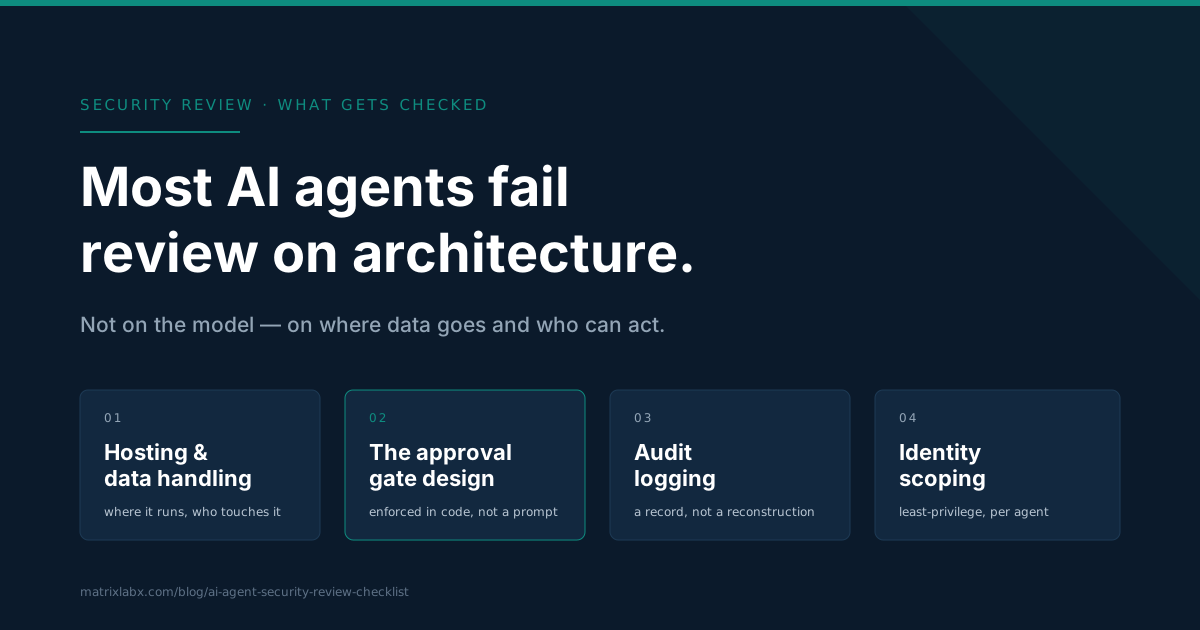
An AI agent almost never fails security review because of the model. It fails on architecture — hosting, the approval gate, audit logging, and identity scoping. This is the checklist a reviewer actually works from, written to use against any vendor you are evaluating.
“Security won’t approve it” is usually offered as the end of an evaluation. It is closer to the beginning of the real one. A security review is not a judgment about whether AI is trustworthy in the abstract — it is a specific set of architecture questions, and a vendor built to answer them clears review the same way a vendor built to avoid them does not.
This is that set of questions, in the order a reviewer typically asks them.
The four things a review checks
Where does the workload actually run, who operates it, and is model-training exclusion a written contract term?
A weak answer sounds like: A page of compliance badges with no answer to where the data physically goes. Ask for the architecture diagram, not the trust page.
Is the gate enforced at the tool layer, with no code path for an unapproved external action — or is it a system prompt asking the model to check first?
A weak answer sounds like: "It always asks before sending." Ask them to try to make it not ask, live, in the demo.
Is every action, its rationale, and the approving identity written to an immutable log at execution time — or reconstructed from application logs after the fact?
A weak answer sounds like: A dashboard screenshot. Ask for the actual record behind one specific row of it.
Does each agent hold its own least-privilege identity, or do they share one service account with broad access?
A weak answer sounds like: "It integrates with your CRM." That describes a connection, not an identity or access boundary.
Why architecture, not the model, is the actual gate
A model can be state of the art and still fail review, because review is not testing the model’s judgment — it is testing what happens when the judgment is wrong. The question underneath all four checks above is the same one: when this agent does something it should not have, who finds out, how fast, and what stopped it from happening in the first place.
On hosting and data handling
PrescientIQ is hosted and operated by MatrixLabX on Google Cloud. SOC 2, ISO 27001, and PCI DSS attestations are held by Google Cloud, which operates the underlying infrastructure. They are not MatrixLabX certifications. MatrixLabX application-layer SOC 2 is in progress.
Two things worth asking any vendor to separate explicitly: which attestations belong to the infrastructure provider versus the vendor’s own application layer, and whether model-training exclusion is a written contract term or a sentence on a web page. A vendor that keeps those two things distinct without being asked is usually the one whose other answers hold up too.
Bringing Security in early
The evaluations that move fastest are the ones where a technical stakeholder sees something concrete before the contract stage — not a slide deck, a live, read-only diagnostic on the team’s own data. If a vendor offers one, that is the session to invite Security to. It gives them an actual system to evaluate instead of a claim to take on faith, and it surfaces architecture questions three weeks earlier than a legal redline would.
For the buyer-side questions to bring into that session — beyond security specifically, covering the full evaluation — see the seven governance questions to ask any AI agent vendor. This post is the deeper version of question one.
Frequently Asked Questions
- Why does Security block most AI agent deployments?
- Rarely because of the model. Almost always because of the architecture around it: unbounded write access to production systems, no gate before an externally visible action, and no reliable record of what happened and who approved it. Those are answerable questions, but only if the vendor was built to answer them.
- What does an AI agent security review actually check?
- Four things in practice: where the workload runs and who can access the data, whether there is an enforced approval gate before any external action, whether every action is logged as it happens rather than reconstructed afterward, and whether each agent holds a scoped, least-privilege identity rather than a shared service account.
- What is the difference between a prompt-level restriction and an enforced approval gate?
- A prompt-level restriction asks the model to behave a certain way, and a sufficiently unusual input can talk it out of that behavior. An enforced gate means the system has no code path that lets an action execute without an approval token — the model cannot send even if it wanted to. Ask a vendor to show you the second, not describe the first.
- How do I get Security involved early instead of at the end of a deal?
- Bring a technical stakeholder into the diagnostic stage rather than the contract stage. If a vendor offers a free, read-only audit or benchmark on your own data, invite Security to that session — it gives them something concrete to review instead of a slide, and surfaces architecture questions before either side has invested in a full evaluation.
- What does "least privilege" mean for an AI agent specifically?
- Each agent holds its own scoped identity rather than a shared service account, and that identity can do only what its function requires — a prospecting agent that reads intent signals does not also hold write access to billing. Ask to see the identity model, not just hear that it exists.
Related Reading
Notes on the figures
This post makes no claim about any named vendor's security posture, and no promise that any specific security review will approve any specific product — review standards vary by organization, industry, and regulatory exposure. The compliance statement and metric on this page render from the site's claims register with their proof class attached. It is general information for structuring your own review, not legal or compliance advice.
See where your own execution effort is going
The Autonomous Audit Report models where your team's execution capacity is currently spent, what your configuration is actually paying for, and what the governed alternative looks like on your own data — before any commitment.
Get your free AAR benchmark