Why most AI agents stop at top of funnel
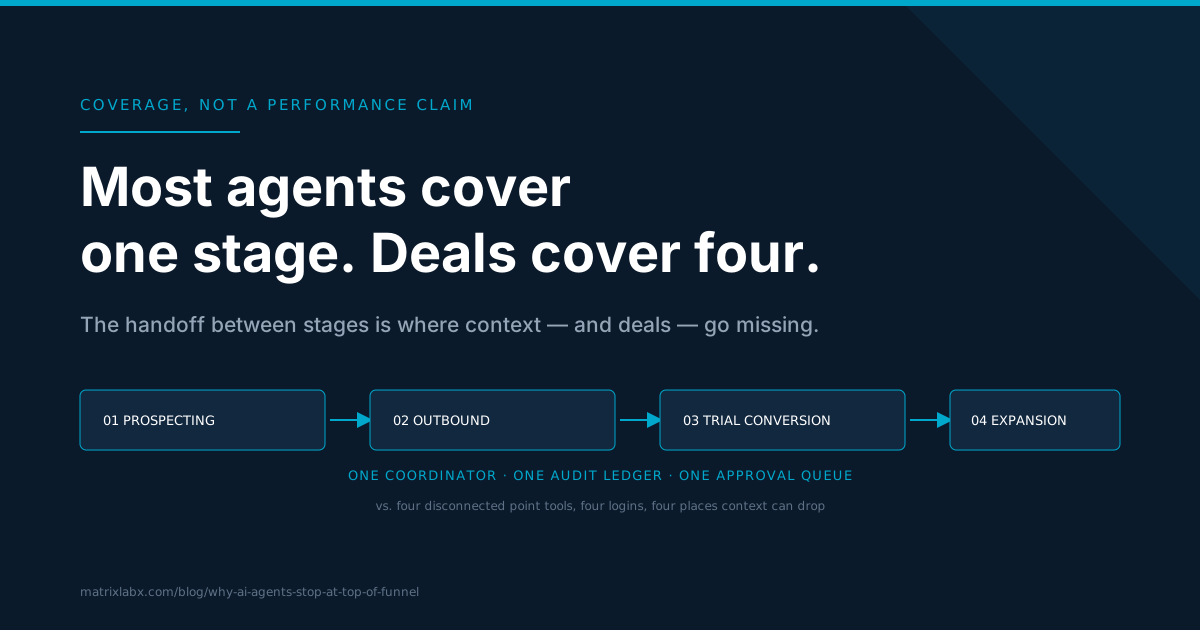
A deal moves through four stages — prospecting, outbound, trial conversion, expansion. Most AI agents are built for the first one or two, then hand off to a different tool. The handoff is where account context most often gets lost, and it is a coordination problem, not a capability gap in any single tool.
Top of funnel is where most AI agent products live, and there is a reasonable explanation for that: it is the highest-volume, most repeatable work in the revenue cycle, so it is the easiest place to build a product that demos well fast. Trial conversion and expansion need a different kind of signal — product usage, not contact data — which is a harder problem, and fewer vendors take it on.
The result is a category full of strong point tools, each covering one stage well, connected to each other by nothing more than whatever fields make it into the CRM. That gap has a name: the handoff, and it is where a meaningful share of pipeline quietly goes missing.
The four stages, and what breaks between them
| Stage | How it’s usually covered | What breaks at the handoff |
|---|---|---|
| 01. Prospecting | The most common stage to see covered — identifying and scoring accounts from intent and firmographic signal. | Research and scoring context rarely survives the move into outreach tooling intact. |
| 02. Outbound | Often bundled with prospecting in a single tool, sometimes standalone. | A reply or a meeting booked here has to be re-discovered by whatever runs onboarding — the trigger signal that started the sequence usually does not travel with it. |
| 03. Trial conversion | The stage most point tools do not reach — it requires in-product usage signal, not contact data. | A stalling trial is often invisible to the tools that ran prospecting and outbound; nothing is watching for it. |
| 04. Expansion | Usually owned by a separate customer-success motion with its own tooling entirely. | Everything learned about the account in the first three stages typically stays behind when ownership changes hands here. |
What full-loop coverage actually requires
Not four agents from four vendors running in parallel — that is still four point tools, just all labeled AI. Coverage across the whole loop requires three things shared across every stage:
- One coordinating layer that every stage-specific agent reports into, so a signal detected in prospecting is still available context when the same account reaches expansion.
- One audit ledger recording what happened at every stage, so account history does not depend on which tool happened to own that stage.
- One approval queue, rather than a different review process per tool — the person approving an action should not need four separate logins to see the full picture of an account.
The stage most often missing entirely from a point-tool stack is trial conversion — the moment a signed customer either activates or quietly churns before ever seeing value. It depends on product telemetry, not contact data, which is why it needs its own intervention logic rather than an extension of an outbound sequence:
Figures labeled as targets are modeled against current human and copilot baselines. They are not guarantees. Every engagement begins with a free Autonomous Audit Report — a P&L projection built on your own data — and targets are validated against your environment before any commitment.
When point tools are still the right call
Not always the wrong architecture. If your actual bottleneck is one stage — you have plenty of qualified trials converting fine, but prospecting volume is the constraint — a point tool aimed specifically at that stage is the cheaper, faster, correct answer. Consolidating into full-loop coverage before you have a handoff problem adds coordination overhead you do not need yet.
The tell is where deals actually go quiet. If it clusters at a specific transition — good first meetings that never start a trial, trials that convert but never expand — that is a handoff problem, and it is the thing this post is about. If it is spread evenly across the whole cycle, the fix is probably inside a single stage, not between them.
On the narrower, more common comparison — a single agent scoped to one system of record, like a CRM-native assistant, versus a coordinated set spanning the loop — we cover that specific boundary in a dedicated post.
Frequently Asked Questions
- Why do most AI agents only cover prospecting or outbound?
- Top of funnel is the easiest place to prove value fast — it is where volume is highest and the work is most repeatable, so it is where most products start and where many stop. Covering trial conversion and expansion requires product-usage signal and a different data model, which is a harder build than most vendors take on.
- What actually breaks when a prospecting tool hands off to a separate CRM or CS tool?
- Context. The research, the signal that triggered outreach, and the reasoning behind a message do not travel with the lead — the next tool starts from whatever fields made it into the CRM, which is rarely all of it. Each handoff is a place institutional memory about the account can be lost.
- What does full-loop coverage actually require?
- One coordinating layer that agents across every stage share, one audit ledger recording what happened at each stage, and one approval queue rather than a separate review process per tool. Without shared coordination, four agents from four vendors are four point tools that happen to be AI, not one system.
- Is full-loop coverage always the right choice over point tools?
- No. If your bottleneck genuinely is one stage — prospecting volume, say — a point tool aimed at that stage is the right, cheaper answer, and consolidating prematurely adds coordination overhead you do not need yet. Full-loop coverage earns its cost when the handoff itself, not any single stage, is where deals are actually being lost.
- How do I know if my handoffs are the actual problem?
- Look at where deals go quiet: after a good first meeting but before a trial starts, or after a trial converts but before expansion conversations begin. A pattern clustered at those transition points is a handoff problem. A pattern spread evenly across the whole cycle usually is not.
- Does an agent for every stage mean I need four different vendor relationships?
- Not necessarily, and that is the actual tradeoff to evaluate. A single coordinated platform removes the handoff problem by construction, at the cost of depending on one vendor across the whole loop. Four best-of-breed point tools keep you flexible per stage, at the cost of the coordination problem this post describes. Neither answer is free.
Related Reading
Notes on the figures
This post describes a category-wide pattern, not any named product, and makes no comparative performance claim about any named vendor. The metrics that render do so through the site's claims register, each carrying its own proof class; targets are modeled against current human and copilot baselines, not guarantees, and are validated against your environment before any commitment.
See where your own execution effort is going
The Autonomous Audit Report models where your team's execution capacity is currently spent, what your configuration is actually paying for, and what the governed alternative looks like on your own data — before any commitment.
Get your free AAR benchmark