Agent Sprawl: When Every Tool in Your Stack Starts Acting on Its Own
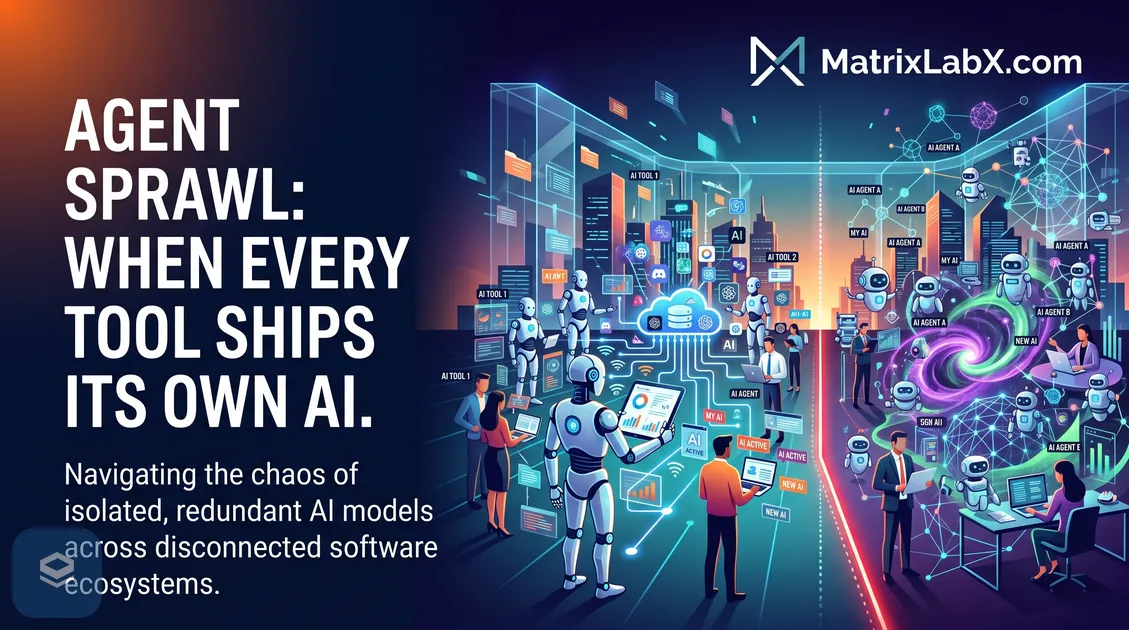
Agent sprawl is the uncontrolled accumulation of AI agents across an organisation's existing software — arriving as features of tools the company already owns rather than as systems anyone deliberately purchased. Each agent acts under its own vendor's permission model, approval design, and log format, which leaves many autonomous actors touching the same records under no common accountability. It differs from tool sprawl in one decisive respect: these objects do not wait to be operated. They act.
Nobody bought agent sprawl. That is the first thing to understand about it, and the reason it is so rarely on anyone's agenda until something goes wrong. There was no purchase order, no security review, no vendor selection, no line item a CFO could point at. The agents arrived through release notes — a feature toggle here, a default-on capability there — inside tools that had already cleared procurement years earlier for entirely different reasons.
The result is an organisation in which the CRM has agents, the sales engagement platform has agents, the support desk has agents, the data vendor has agents, the marketing automation system has agents, and the analytics tool has agents. Each was individually sensible. None of them agreed on who approves what.
How It Happens Without Anyone Deciding
Tool sprawl took a decade and required someone to sign something every time. Agent sprawl compresses that to a few release cycles and requires nobody to sign anything, because the unit of adoption changed. You are no longer adopting a system; you are accepting a feature of a system you already run, often one that is enabled by default and announced in a changelog that your administrators skim.
Three properties make this quietly different from every previous wave of software adoption. The agents are default-on, so the decision to run them is a decision not to disable them — which is not a decision anyone remembers making. They are bundled, so declining them means declining a product you depend on for other reasons. And they are individually reasonable: no single one is alarming, which is exactly why the aggregate never gets reviewed. Sprawl is not a series of bad calls. It is the absence of any call at all.
What Sprawl Actually Breaks
The instinct is to frame this as a cost problem, because that is how tool sprawl was framed and the muscle memory is strong. It is not primarily a cost problem. Redundant spend is real, and auditing what the AI stack actually returns is worth doing on its own merits. But licences that go unused waste money, whereas agents that go ungoverned take actions. Three things break, in this order.
1. Attribution
Open the audit history on a contact record that several tools touch and read the actor column. In most mid-market stacks it is a list of integration users: a name that identifies the vendor, not the automation, and certainly not which of that vendor's several agents acted. The record shows that the field changed. It does not show what changed it, which means the first question anyone asks after an incident — what did this, and on whose authority — has no answer in the system that holds the evidence.
2. Consistency
Suppression is the clearest case. A prospect asks to stop hearing from you, and that state now has to be respected by every agent in the stack — including ones that read a copy of the contact rather than the contact itself, and ones that were enabled after the suppression policy was written. This is the failure mode described in the controls that have to hold before a sequence sends, with an additional actor that never attends the training and never reads the policy. Any state that has to be honoured everywhere is a state that sprawl puts at risk, because sprawl multiplies the number of systems that must independently get it right.
3. Evidence
Each vendor keeps its own log, in its own shape, for its own retention period, exportable on its own terms. Reconstructing a single sequence of events across six of them is an archaeology project, and it is one you will be attempting under time pressure, months after the fact, at the request of someone who is not inclined to accept “the logs do not join up” as an answer. This is precisely the gap described in why compliant companies fail audits: the controls may well have operated, and the organisation cannot demonstrate it.
Sanctioned, Which Is Why It Is Hard to See
Agent sprawl is often confused with shadow AI, and the distinction matters because the remedies are opposites. Shadow AI is unsanctioned — an employee pasting customer data into a consumer chatbot — and the response is detection and policy enforcement. Agent sprawl is entirely sanctioned. Every agent involved came with a tool that passed security review under a signed agreement. There is no policy being violated and no rogue actor to find.
That is what makes it durable. Detection tooling does not surface it, because nothing is hiding. Vendor review does not surface it, because each vendor was reviewed and approved. It only becomes visible when someone asks a question that spans vendors — and organisationally, asking that question is nobody's job. Security owns access, RevOps owns process, each function owns its own tools, and the agents fall precisely into the space between them.
The Inventory That Ends the Argument
Before any decision, do this. It takes an afternoon and it converts a vague unease into a list that people will argue about productively.
- Work backwards from the write. Pull the last month of audit history on your most sensitive object — the contact or the opportunity — and list every distinct actor that wrote to it. Not every vendor. Every actor.
- Then work forwards from the release notes. For each vendor in the stack, check what agent capability shipped enabled-by-default in the last few cycles. This list is almost always longer, because agents that draft, score, or route leave no write behind until a human accepts the suggestion — they are shaping decisions without appearing in the log at all.
- For each actor, answer three questions. What can it write to? Whose identity does it act under? And what happens if a human declines what it proposes — is the action blocked, or annotated?
- Mark every row where an agent can cause something to leave the building. An email, a message, a change visible to a customer. That subset is where governance has to be real, and it is usually smaller than people fear and less controlled than they assume.
The rows that survive that last filter are the actual scope of the problem. Everything else is a housekeeping exercise that can wait.
How Much Exposure Do You Actually Have?
Run the inventory against one real record rather than a hypothetical stack. Each terminal names the gap the answers imply and which readiness dimension it sits in — and the clean path ends not with reassurance but with a re-run date, because the next default-on release changes the answer without anyone deciding it should.
How much agent exposure do you actually have?
Why Consolidation Alone Does Not Fix It
The obvious response is to reduce the number of vendors, and it is a reasonable one — fewer systems means fewer approval models to reconcile, which is the argument made in the CMO's consolidation playbook. But consolidation addresses how many systems act, not whether one accountable path governs their actions. An organisation can consolidate to five platforms and still be unable to say who approved a given outbound action, because five logs that do not join up are only marginally better than fifteen.
What actually resolves sprawl is a single approval path and a single record. Not one vendor — one place where consequential actions are approved by a named human before they execute, and one append-only ledger where every action, its rationale, and its approver are written as a by-product of the work rather than assembled afterwards. That is the difference between monitoring dashboards and human-approved gates: a dashboard reports what happened across your agents, while a gate determines what happens, and only one of those is a control.
It is also the design PrescientIQ™ is built around — specialist agents with their own least-privilege identities, an approval gate on the execution path rather than beside it, and an immutable ledger recording every action with the human who authorised it. The point is not that the agents are better. It is that there is one answer to who did what, and it does not depend on six vendors' retention policies agreeing with each other.
Where to Start This Week
Name someone. Agent sprawl persists because it is structurally nobody's job, and no architecture decision improves that. One named person should hold the inventory, own the enablement policy for new agent features, and be able to answer what happens when two agents act on the same record. That role is cheap to create and it is the only step on this page that does not depend on any of the others.
Then run the inventory above and look only at the rows where something can leave the building. If you cannot name the approver for those rows from a single place, that is the gap — and it is worth finding before someone external finds it for you.
Frequently Asked Questions
- What is agent sprawl?
- Agent sprawl is the uncontrolled accumulation of AI agents across an organisation’s existing software, arriving as features of tools the company already owns rather than as systems anyone deliberately purchased. Each agent acts under its own vendor’s permission model, approval design, and log format, so the organisation ends up with many autonomous actors touching the same records under no common accountability. It is distinct from tool sprawl because the objects in question do not wait to be operated — they act.
- How is agent sprawl different from shadow AI?
- Shadow AI is unsanctioned: an employee pasting customer data into a consumer chatbot without approval. Agent sprawl is fully sanctioned — every agent involved came with a tool that went through procurement, security review, and a signed agreement. That is what makes it harder to see. There is no policy being violated and no rogue actor to find; the governance gap opens between products that were each approved on their own terms.
- Why is agent sprawl a governance problem rather than a cost problem?
- Because the agents act on the outside world. Tool sprawl wastes money on licences nobody opens, which is a budget line. Agent sprawl produces actions — records updated, messages sent, states changed — attributed to whichever service account each vendor happens to use, recorded in whichever log format each vendor happens to keep, for whatever retention period each vendor happens to offer. The cost is real, but the exposure is that nobody can reconstruct who did what.
- How do I inventory the agents already running in my stack?
- Work backwards from the write, not forwards from the vendor list. Pull the last month of audit history on your most sensitive object — the contact or opportunity record — and list every distinct actor that wrote to it. Then, for each vendor in the stack, check what was enabled by default in the last few release cycles. The second list is almost always longer than the first, because agents that draft, score, or route often leave no write behind until a human accepts the suggestion.
- Does consolidating tools solve agent sprawl?
- Partly, and less than teams expect. Reducing the number of vendors reduces the number of approval models to reconcile, which helps. But an organisation can consolidate to a handful of platforms and still have no single answer to who approved a given outbound action, because consolidation addresses how many systems act rather than whether one accountable path governs their actions. The durable fix is a single approval path and a single record, whether the stack has five vendors or fifty.
- What should a revenue team do first?
- Name an owner for the question. Agent sprawl persists because it is nobody’s job: security owns access, RevOps owns process, each function owns its own tools, and the agents fall between them. Before any architecture decision, one named person should hold the inventory, the enablement policy for new agent features, and the answer to what happens when two agents act on the same record. Everything else follows from having someone accountable for the answer.
Related Reading
Sources
- National Institute of Standards and Technology, “AI Risk Management Framework” — the Govern function, on organisational accountability structures and inventories of AI systems in use. Link
- OWASP, “Top 10 for Large Language Model Applications” — excessive agency, the failure class that describes an agent holding more permission than its task requires. Link
This article is general information about operating practice. It is not legal advice, and obligations differ across jurisdictions, sectors, and fact patterns. Consult counsel before changing a control.
See where your own execution effort is going
The Autonomous Audit Report models where your team's execution capacity is currently spent, what your configuration is actually paying for, and what the governed alternative looks like on your own data — before any commitment.
Get your free AAR benchmark