Governed autonomy: why revenue teams moved back to human approval
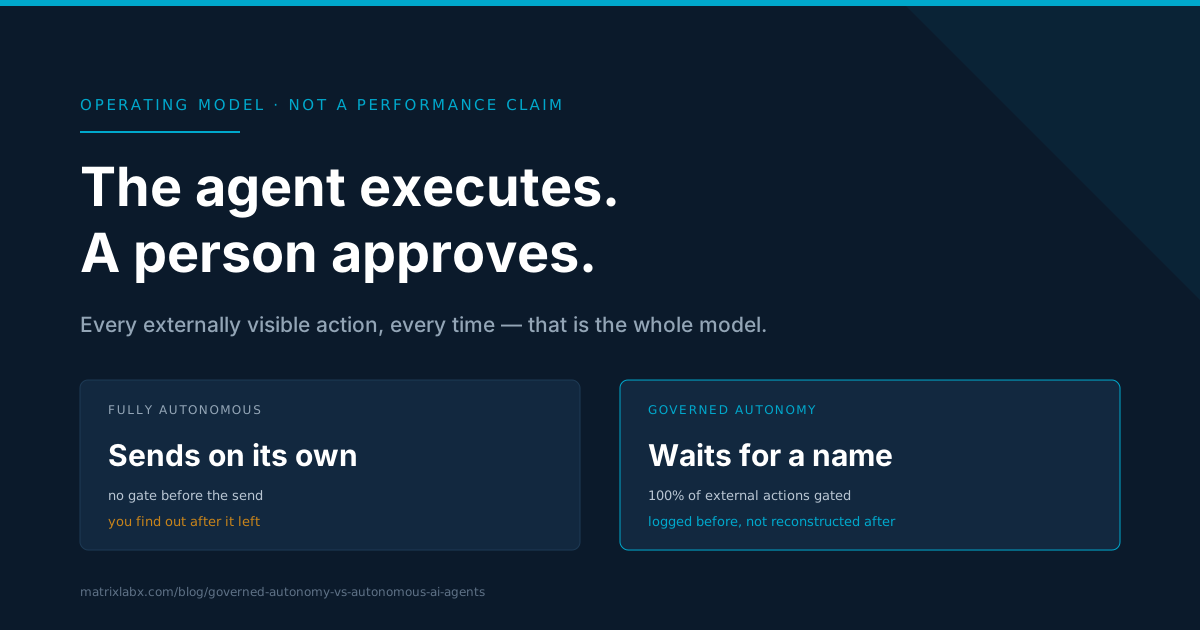
Governed autonomy is the model most revenue teams are actually buying now: an agent researches, scores, and drafts continuously, without supervision — and then stops. Every externally visible action waits for a named human to approve it before it executes. Not because the model cannot be trusted with the work. Because nobody should have to reconstruct, after the fact, who let a message reach a customer.
For a stretch of 2024 and into 2025, the pitch in this category was full autonomy: an agent that finds, contacts, and books meetings with no human in the sequence at all. It demoed well. Deliverability problems and brand-trust incidents from unsupervised outbound sent under a company’s own name were the correction, and the category has been rebuilding around a different model since —one where the agent still does all the work, but a person owns the moment it leaves the building.
That model has a name now: governed autonomy. This post is what it actually means, why it is the thing security and revenue leaders converge on independently, and the signals that say it is worth evaluating for your own team.
What “governed” actually constrains
Not the thinking. An agent under this model researches accounts, scores intent, drafts messages, and prepares CRM changes exactly as continuously as a fully autonomous one does. What changes is the last step.
The gate has to be enforced at the tool layer, not requested in a prompt. An agent instructed to “always ask before sending” is a model asked to behave; an agent with no capability to send without an approval token is a constraint the model cannot route around. That distinction is the entire difference between governed and merely well-intentioned.
The loop under one coordinator, Marshal
Governed autonomy is also a claim about scope, not just about the approval step. A single agent bolted onto one part of the funnel is easy to govern and easy to outgrow. The alternative is four cooperating agents — Scout (prospecting), Herald (outbound), Guide (trial conversion), and Steward (expansion) — coordinated under one runtime, sharing one audit ledger and one approval queue, so a prospect that converts to a trial and then to a customer never has to be re-discovered by a different tool at each stage.
We cover why single-stage coverage is the more common shape in the category — and what breaks at the handoffs between stages — in a companion post: why most AI agents stop at top of funnel.
Five signals it is time to evaluate this
None of these is a reason to buy on its own. Together, or any one at real intensity, they are a reason to run the numbers rather than defer the conversation another quarter.
| Signal | Why it matters |
|---|---|
| You are hiring SDRs or BDRs | That is a direct statement that execution capacity is short. Before the req goes out, it is worth pricing what a governed agent set would add to the same capacity number. |
| A new CRO or VP Revenue is under nine months into the seat | New revenue leaders re-evaluate the stack in the first two quarters almost by default. That window is when a structural change — not a point-tool swap — actually gets evaluated fairly. |
| A security review has already blocked an AI tool | That review found something real: no approval gate, no audit trail, or unclear data handling. The fix is not a better pitch to Security — it is an architecture that answers the review's actual questions. |
| Pipeline coverage is tracking below target this quarter | A coverage gap discovered in week ten of a thirteen-week quarter cannot be closed by hiring — ramp alone takes longer than what is left. It can be closed by adding execution capacity that does not need to ramp. |
| You are about to turn on a CRM-native agent | Worth doing the scope comparison first: a CRM-native agent is bound to what happens inside that one system. Whether that is enough depends on how much of your motion actually happens outside it. |
What buyers ask, in order
Three questions decide most evaluations, roughly in this order:
- Where does the data run, and under what attestations? The honest answer, not a page of badges:
PrescientIQ is hosted and operated by MatrixLabX on Google Cloud. SOC 2, ISO 27001, and PCI DSS attestations are held by Google Cloud, which operates the underlying infrastructure. They are not MatrixLabX certifications. MatrixLabX application-layer SOC 2 is in progress.
- What happens when the CRM is messy? Deployment speed is not the same question as data quality, and conflating them is how a rollout timeline gets promised that the CRM cannot support:
- What does it cost, and does it scale with headcount or with volume? A model priced per seat charges for access. Governed autonomy should be priced for the work, not the roster.
What it costs
Published, not quoted after a call:
| Component | Investment | Billing frequency |
|---|---|---|
| Annual platform feeEnvironment provisioning on Google Cloud, per-agent IAM, audit-ledger setup, and context ingestion from your CRM — plus four cooperating agents (Scout, Herald, Guide, and Steward), their coordinator Marshal, the approval queue and standing-policy controls, and the immutable audit ledger, and the monthly execution volume a typical mid-market deployment runs. One fee, from signature, every year.Target — modeled: live in 21 days or less$165,000/year is the complete platform fee. There is no separate implementation charge and no different first-year number — deployment work is included from signature, not billed as a distinct line. Scope beyond a typical deployment — additional bundles, sustained higher volume — is quoted at your AAR before anything is signed. | $165,000/yr | Billed monthly at $13,750/mo against an annual commitment |
Full detail, including who this is scoped for, is on our pricing page.
What this does not solve on its own
Two limits worth naming plainly, because a vendor that will not name its own limits is telling you something about how the rest of the conversation will go.
Governed autonomy does not replace the judgment of who to approve and what “good” looks like — someone on your team still owns the approval queue and the qualification standard, and that time is real even though it is a fraction of running the execution by hand. And it inherits whatever your CRM data already is: broken attribution or duplicate records do not get fixed by adding an agent on top of them. That is a readiness question, and it is what the Agentic Readiness Audit exists to answer before anything is signed.
Frequently Asked Questions
- What does "governed autonomy" mean for AI agents?
- It means an agent can research, score, draft, and prepare an action continuously and without supervision, but every externally visible action — a send, a CRM write a prospect or customer would see — waits for a named human to approve it before it executes. The agent does the labor; a person owns the moment it becomes real.
- Why did the market move back to human approval after autonomous AI SDRs?
- A wave of fully autonomous outbound tools sent under a company's own brand with no review step, and the failure mode was not that the model was wrong occasionally — it was that nobody could say who authorized a specific message after the fact. Buyers now evaluate agents on whether that question has an answer, not only on what the agent can produce.
- Does human approval slow down an AI agent enough to matter?
- It moves the constraint from execution volume to review capacity, and that is a real, worth-naming cost rather than a free upgrade. What it buys is that no external action happens that a person did not agree to. Whether that trade is worth it depends on what a single wrong action would cost you — a judgment only you can make.
- What is the difference between governed autonomy and a CRM-native agent?
- The comparison is not a ranking: a CRM-native agent is scoped to what happens inside one system of record, while a coordinated agent set works the whole revenue loop — prospecting through expansion — under one approval queue and one audit ledger. We cover that boundary in detail in a dedicated post rather than here.
- What signals mean a revenue team is ready to evaluate governed autonomy?
- The clearest ones: you are hiring SDRs or BDRs because execution capacity is short, a new CRO is less than a year into the seat and re-evaluating the stack, a security review has already blocked an AI tool, or pipeline coverage is tracking below target going into a quarter. Any one of these is a reason to run the numbers rather than a reason to buy.
- What does it cost?
- A single published annual platform fee — see the current figure below, sourced live from the same place the rest of the site reads it, so it cannot go stale here. There is no separate implementation charge and no usage estimate.
Related Reading
- Governed AI SDR: Definition, How It Works, and How It Is Priced
- What an AI Agent Security Review Actually Checks
- Why Most AI Agents Stop at Top of Funnel
- 7 Governance Questions to Ask an AI Agent Vendor
- Agentforce, Breeze, and the Limits of CRM-Native Agents
- Why AI Agent Pilots Stalled — and What Buyers Ask Now
- Agent Sprawl: When Every Tool Ships Its Own AI
Notes on the figures
The metrics and compliance statements on this page render from the site's claims register, each carrying its own proof class. Targets are modeled against current human and copilot baselines, not guarantees, and are validated against your environment before any commitment. Pricing is the published rate for the PrescientIQ Revenue Accelerator and is current as of the date on this post. No comparative performance claim is made about any named vendor or product.
See where your own execution effort is going
The Autonomous Audit Report models where your team's execution capacity is currently spent, what your configuration is actually paying for, and what the governed alternative looks like on your own data — before any commitment.
Get your free AAR benchmark