Autonomous AML and KYC agents: how FinTech firms cut compliance costs 80%
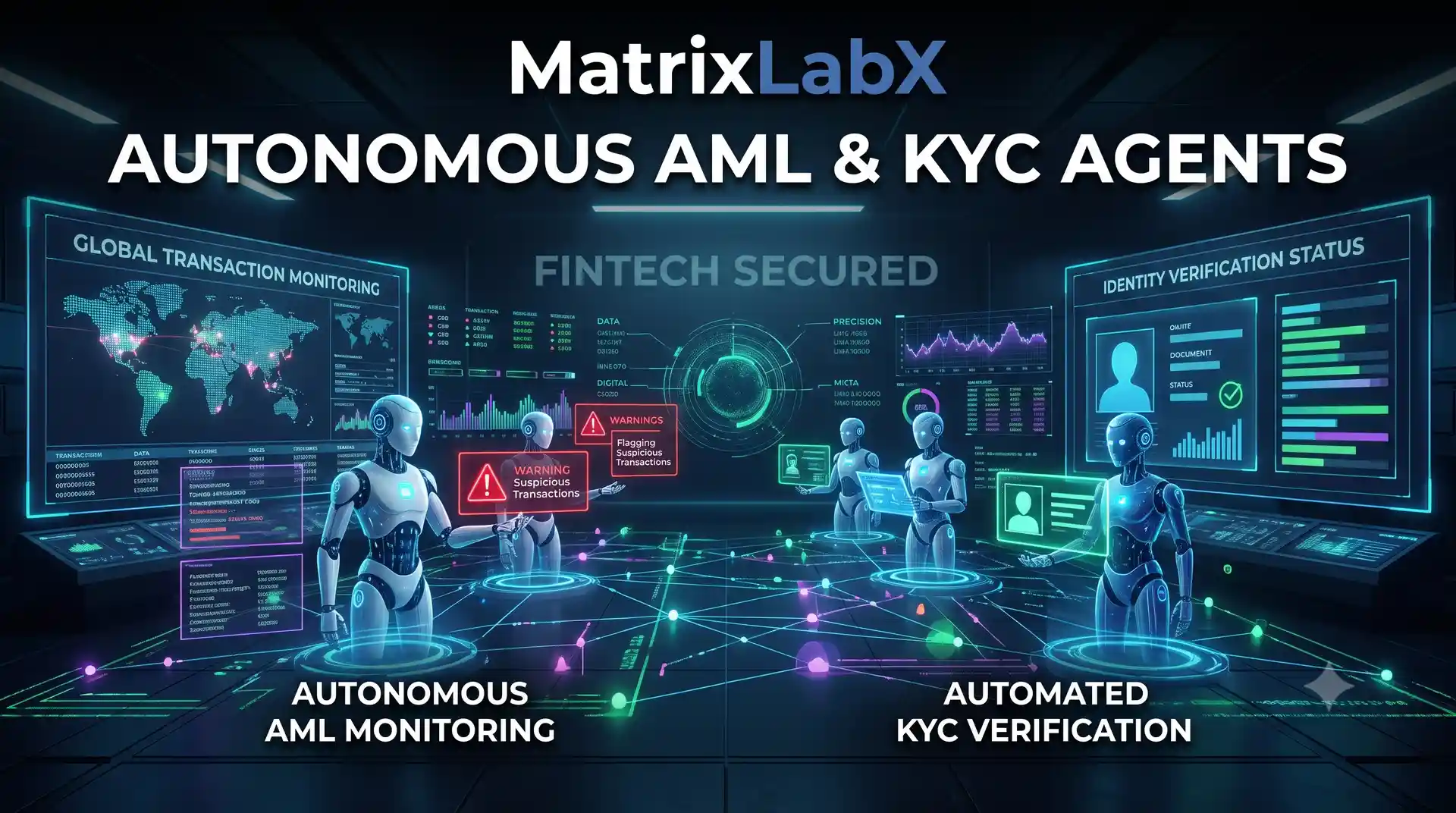
Autonomous AML and KYC agents are governed AI systems that continuously monitor transactions, screen customers against sanctions and politically exposed person lists, investigate alerts in full customer context, and assemble audit-ready case files — executing the repetitive investigative work autonomously while compliance officers approve every consequential decision.
🔑 Key takeaways
- Financial crime compliance costs US and Canadian institutions $61 billion a year, per LexisNexis Risk Solutions — and analyst studies put rule-based alert false positives at 90–95%.
- Most compliance spend goes to investigating noise: alerts that cost real analyst time and close with no finding.
- Governed agents invert the ratio — autonomous triage of the false-positive load, humans on the genuinely suspicious cases, every decision logged immutably.
- Slow KYC is a revenue problem too: industry analyses report 50–70% of prospects abandon onboarding during verification.
- MatrixLabX's modeled target: 80% lower alert-handling cost, validated against your own volumes in a free Autonomous Audit Report.
Why does financial crime compliance cost so much?
Because the industry pays skilled analysts to investigate noise. LexisNexis Risk Solutions puts the annual cost of financial crime compliance at $61 billion for US and Canadian institutions alone, within a global spend exceeding $206 billion (LexisNexis Risk Solutions, True Cost of Financial Crime Compliance, 2024). The uncomfortable arithmetic underneath: analyst reviews consistently find that 90–95% of alerts generated by traditional rule-based transaction monitoring are false positives (PwC analysis). Nine of every ten investigation hours close with no finding.
Anyone who has walked a compliance floor at month-end knows the texture of it — the queue that resets overnight, the second monitor full of half-closed cases, the good analyst who quietly starts interviewing elsewhere. That human tension is the real cost line. Rules engines cannot read context, so they flag everything that crosses a threshold, and the institution absorbs the difference in headcount and burnout.
Consequently, compliance leaders sit inside a squeeze: transaction volumes grow, regulators expect more evidence, and boards mandate flat budgets. Data suggests the pattern is breaking toward autonomy — Gartner projects 33% of enterprise software will include agentic AI by 2028, up from under 1% in 2024 (Gartner, 2025) — and regulated finance, which leads agent adoption per S&P Global Market Intelligence, is where the economics bite first.
Even the regulators have started asking whether the spend buys safety. FinCEN's 2025 request for information on AML compliance costs put the question directly to the industry — whether current program requirements are cost-effective at detecting financial crime (FinCEN RFI, 2025; analysis by Mayer Brown). When the rule-writer itself questions the cost curve, and Gartner sizes agentic AI at more than $450 billion in enterprise software revenue by 2028, the direction of travel for compliance operations is not subtle.
What do autonomous AML and KYC agents actually do?
They run the investigative loop — monitor, contextualize, triage, document — and stop at the decision line. In a governed deployment like the Compliance Shield, specialist agents divide the work the way a well-run compliance team would:
| Agent | Owns | Human gate |
|---|---|---|
| KYC / Onboarding | Document verification, sanctions and PEP screening, risk scoring | Approval on high-risk classifications and rejections |
| Transaction Monitoring | Continuous behavioral analysis in full customer context | None — surfaces scored alerts only |
| Alert Triage | Investigates each alert, closes noise with documented rationale | Human sign-off on every escalation and SAR-relevant case |
| Auditor | Assembles examination-ready case files from the ledger | None — read-only over immutable records |
The architecture matters as much as the agents: each holds a least-privilege identity, reaches core systems only through typed, scoped integrations, and appends every action to an immutable ledger with actor, rationale, and before/after state — the same governed-swarm pattern described in our multi-agent architecture blueprint.
How does the 80% compliance cost reduction actually happen?
By attacking the false-positive load, which is where the money already goes.If 90–95% of alerts are noise and each consumes real analyst minutes, then autonomous triage of that noise — with documented rationale for every closure — removes the bulk of alert-handling cost without touching the human judgment applied to true risk. The 80% figure is MatrixLabX's modeled target for alert-handling cost in a governed deployment, and it is validated against your own alert volumes and staffing before contract, not asserted afterward.
| Cost driver | Manual / rules-only baseline | Governed-agent model |
|---|---|---|
| False-positive investigation | Analysts review every alert manually | Autonomous triage with documented closures |
| KYC onboarding | Days of back-and-forth; 50–70% abandonment risk | Minutes, with a stronger evidence trail |
| Audit preparation | Weeks reconstructing cases from email and spreadsheets | Examination-ready files generated from the ledger |
| Scaling with volume | Linear headcount growth | Metered workflows, flat team |
The broader AI investment data supports the shape of this bet while warning about execution: IDC research commissioned by Microsoft measures an average 3.7× return per dollar invested in generative AI (IDC, 2024), yet IBM's 2025 CEO study found only 25% of AI initiatives delivered expected ROI (IBM, 2025). In compliance, the difference is governance — an agent a regulator can examine is an asset; one they cannot is a liability.
What does a regulator-ready deployment look like step by step?
It looks like a controls implementation, not a software install. The sequence FinTech compliance teams run:
| Step | Action | Expected outcome |
|---|---|---|
| 1. Ingestion | Typed, read-only connections to core banking, KYC vendor, case manager | Full context without new write access |
| 2. Policy encoding | Your AML program and risk appetite become the agents' boundary | Agents enforce your policy, not a vendor default |
| 3. Monitoring mode | Two weeks proposing triage decisions without executing | Measured agreement rate against your analysts |
| 4. Governance review | Compliance and audit inspect the ledger and gates | Sign-off before any autonomous action |
| 5. Staged autonomy | Low-risk closures first; escalations stay human-gated | Cost curve bends within the first quarter |
What does this look like inside a real FinTech?
Three patterns cover most of the deployments we model. Each follows the same arc: a compliance team buried in clerical load, a governed agent absorbing the repetitive layer, and the humans returning to the work that actually requires judgment.
The payments processor drowning in alerts. Before: a mid-market processor's eight analysts open every morning to a four-figure alert queue, and month-end closes on overtime — the classic 90–95% false-positive treadmill. After: the Alert Triage agent investigates each alert in full customer context overnight, closes the noise with a documented rationale, and queues the residual dozens — not thousands — for human review. The bridge: two weeks of monitoring mode in which the agent's proposed closures are scored against what analysts actually decided, so the compliance officer turns on autonomy with an agreement rate in hand, not a vendor promise.
The neobank losing applicants at onboarding. Before: verification takes days of back-and-forth, and the funnel bleeds prospects — the 50–70% abandonment pattern industry analyses describe. After: the KYC agent runs document checks, sanctions and PEP screening, and risk scoring in minutes, escalating only high-risk classifications for human sign-off. The bridge: the agent enforces the bank's own written risk policy, encoded during deployment, so faster onboarding arrives with a stronger evidence trail rather than a looser one.
The lender staring down an examination. Before: audit preparation means three weeks of reconstructing case histories from shared inboxes and spreadsheets. After: the Auditor agent assembles examination-ready case files directly from the immutable ledger — every decision already carries its actor, rationale, and before/after state. The bridge: read-only access; this agent starts delivering value without touching a single production workflow, which is why skeptical compliance teams often deploy it first.
What does the transition feel like for the team?
Consider a composite drawn from the deployments we model. The subject: a compliance officer at a payments FinTech, running a program whose technology line alone rivals what LexisNexis found at large North American banks — some exceeding $50 million annually on compliance technology (LexisNexis Risk Solutions, 2024) — yet whose analysts still clear queues by hand. The challenge: volumes compounding quarterly, a board mandate to hold headcount flat, and an examiner who wants better evidence, not more spreadsheets. The solution: a staged Compliance Shield deployment — monitoring mode first, agreement rates measured against her own analysts, autonomy enabled one closure type at a time, every action landing in the ledger. The result she actually notices is quieter than a dashboard: month-end without overtime, an examination file that exports instead of being excavated, and her strongest analyst working true escalations instead of noise. The small detail that sells it internally is the rationale field — every closed alert explains itself, in writing, forever.
Why this might not work for you
If your alert volume is small enough that two analysts clear the queue comfortably, the coordination overhead outweighs the savings — revisit at scale. If your AML policy exists mostly as tribal knowledge, encode it first; agents enforce written policy, and ambiguity in equals ambiguity out. And if your examiners have taken a hard position against any automation in the alert path, start with the Auditor agent only — read-only case assembly builds the evidence base that changes that conversation.
Conclusion: compliance as a controlled system, not a cost center
The $61 billion the industry spends is not buying $61 billion of risk reduction — it is buying manual review of noise. Governed AML and KYC agents move the noise to machines, keep judgment and accountability with your officers, and hand your examiners a cleaner trail than manual work ever produced. Model the 80% target against your own alert volumes with a free Autonomous Audit Report, or see how peers deploy on the FinTech industry page.
The practical next step is small: name your highest-volume alert type, pull last quarter's false-positive rate for it, and ask what your team would do with those hours back. That single number — your own, not an industry average — is what the AAR turns into a deployment plan, and it is the difference between evaluating AI in the abstract and pricing a specific queue you already pay for every month.
Frequently asked questions
What are autonomous AML and KYC agents?
Governed AI systems that monitor transactions, screen customers, investigate alerts, and assemble audit-ready case files — with compliance officers approving every consequential decision.
How do AI agents reduce AML false positives?
They evaluate each alert in full customer context rather than against static thresholds, closing the 90–95% noise load with documented rationale and routing genuine risk to humans.
Are autonomous compliance agents acceptable to regulators?
Regulators evaluate controls and evidence. Immutable per-action logs with human sign-off on consequential decisions produce a stronger examination trail than manual, scattered casework.
What does KYC automation do to onboarding?
Verification drops from days to minutes, attacking the 50–70% abandonment industry analyses report — while the evidence trail gets stronger, not weaker.
Where does the 80% figure come from?
It is a modeled MatrixLabX target for alert-handling cost, driven by autonomous triage of the false-positive load — validated against your own volumes in a free AAR before contract.
How long does deployment take?
21 days or less: typed integrations, two weeks of monitoring mode, governance review, then staged autonomy behind human-approval gates.
Model the 80% against your own alert volumes
The free Autonomous Audit Report maps your alert load, analyst hours, and onboarding funnel against the governed-agent model — before you commit to anything.
Get your free AAR →Built natively on Google Cloud. Sources: LexisNexis Risk Solutions, True Cost of Financial Crime Compliance (2024); PwC transaction-monitoring analysis; Gartner press releases (2025); IDC Business Opportunity of AI study commissioned by Microsoft (2024); IBM CEO Study (2025); S&P Global Market Intelligence. Modeled MatrixLabX targets are validated per-account in the Autonomous Audit Report.
See where your own execution effort is going
The Autonomous Audit Report models where your team's execution capacity is currently spent, what your configuration is actually paying for, and what the governed alternative looks like on your own data — before any commitment.
Get your free AAR benchmark