Agentic GTM series · Part 3 of 3
The foundation for digital labor: context, governance, and outcomes over model benchmarks
Digital labor governance is the set of controls that decides what an AI agent is allowed to do with your data, when it must stop, and who approves what it prepares. Model benchmark scores measure none of that. Effective digital labor rests on three things instead: grounding in your real GTM context, fail-closed governance with a human-in-the-loop gate and an immutable audit ledger, and measurement against business outcomes.
Most writing about AI for sales sells model capability: a larger context window, a higher score on the latest evaluation, a faster response. For a technology executive deciding whether an agent can be trusted near a CRM and a buyer’s inbox, that is the wrong foundation. The question that matters is not how smart the model is in the abstract. It is what the system does with your context, what happens when it is uncertain, and whether you can prove what it did.
This is the last part of a three-part series. The first defined agentic GTM and the move from fragmented handoffs to accountable outcomes; the second introduced the Agentic GTM Fit Curve for deciding which work digital labor should own. This one is about the foundation under both.
Why model benchmarks are the wrong scorecard for digital labor
Benchmarks answer a narrow question: how a model performs on a fixed test, in isolation. Even on their own terms they are losing reliability. Stanford HAI’s 2026 AI Index reports that “evaluations intended to be challenging for years are saturated in months, compressing the window in which benchmarks remain useful for tracking progress,” and that the benchmarks used to measure AI progress “face growing reliability and gaming concerns, with error rates up to 42% on widely used evaluations.” The same chapter notes top models clustering closely enough to shift competitive pressure “toward cost, reliability, and domain-specific performance.”
Buyers who get value appear to have noticed. MIT NANDA’s preliminary 2025 research on enterprise AI adoption observed that “buyers who succeed demand process-specific customization and evaluate tools based on business outcomes rather than software benchmarks,” and that the divide between success and failure “does not seem to be driven by model quality or regulation, but seems to be determined by approach.”
That matches what a revenue deployment actually tests. A model can top a leaderboard and still email the wrong contact, invent a proof point, or quietly proceed past a record it could not resolve. None of those failures shows up in a benchmark, because a benchmark never sees your ICP, your pipeline, or your approval policy.
Grounding in real GTM context: what it actually requires
“Grounding” is easy to claim and specific to deliver. A generic prompt asks a model to be a helpful sales assistant. A grounded agent works from the material your team already treats as the truth:
- Your CRM data — the accounts, contacts, stages, and history the agent reads before it prepares anything.
- Your qualification criteria — the written ICP definition a human would use to decide whether an account is worth working.
- Your proof points and objection library — what the team is allowed to claim, and how it answers the pushback it hears every week.
- Your disclosure requirements — what must be said, and what must never be said, in front of a buyer.
In PrescientIQ™ this material lives in the Consideration stack, one of the Coverage, Constraint, and Consideration stacks. The Consideration stack holds the material list — ICP definitions, proof points, objection handling, disclosure requirements — and inspects output before it reaches a buyer. The Coverage stack runs continuous account research, ICP qualification, signal monitoring, and sequencing; the Constraint stack instruments throughput and what the configuration can actually carry. Under all three sit the approval gate and the audit ledger.
Governance as infrastructure, not policy paperwork
A governance policy that lives in a document is an instruction the system may or may not follow. Governance as infrastructure is a property of the execution path: the system cannot take the action without passing the control. Here is the decision path when a governed agent meets something it should not resolve alone:
- 01
The agent meets an edge case
A record it cannot match, a claim it cannot source, a buyer outside the ICP definition it was given. The work in front of it is no longer routine.
- 02
It fails closed
Instead of choosing the most plausible answer and proceeding, it stops. No external action is taken on an unresolved question.
- 03
The human-in-the-loop gate
The prepared action, the context it was built from, and the reason it stopped go to a named reviewer, who can approve, edit, or reject it.
- 04
Human review
The reviewer makes the judgment call the agent was not allowed to make. The decision belongs to a person with the authority to make it.
- 05
Logged, immutably
The action, its rationale, and the approving human are written to the immutable audit ledger at that moment, including rejections.
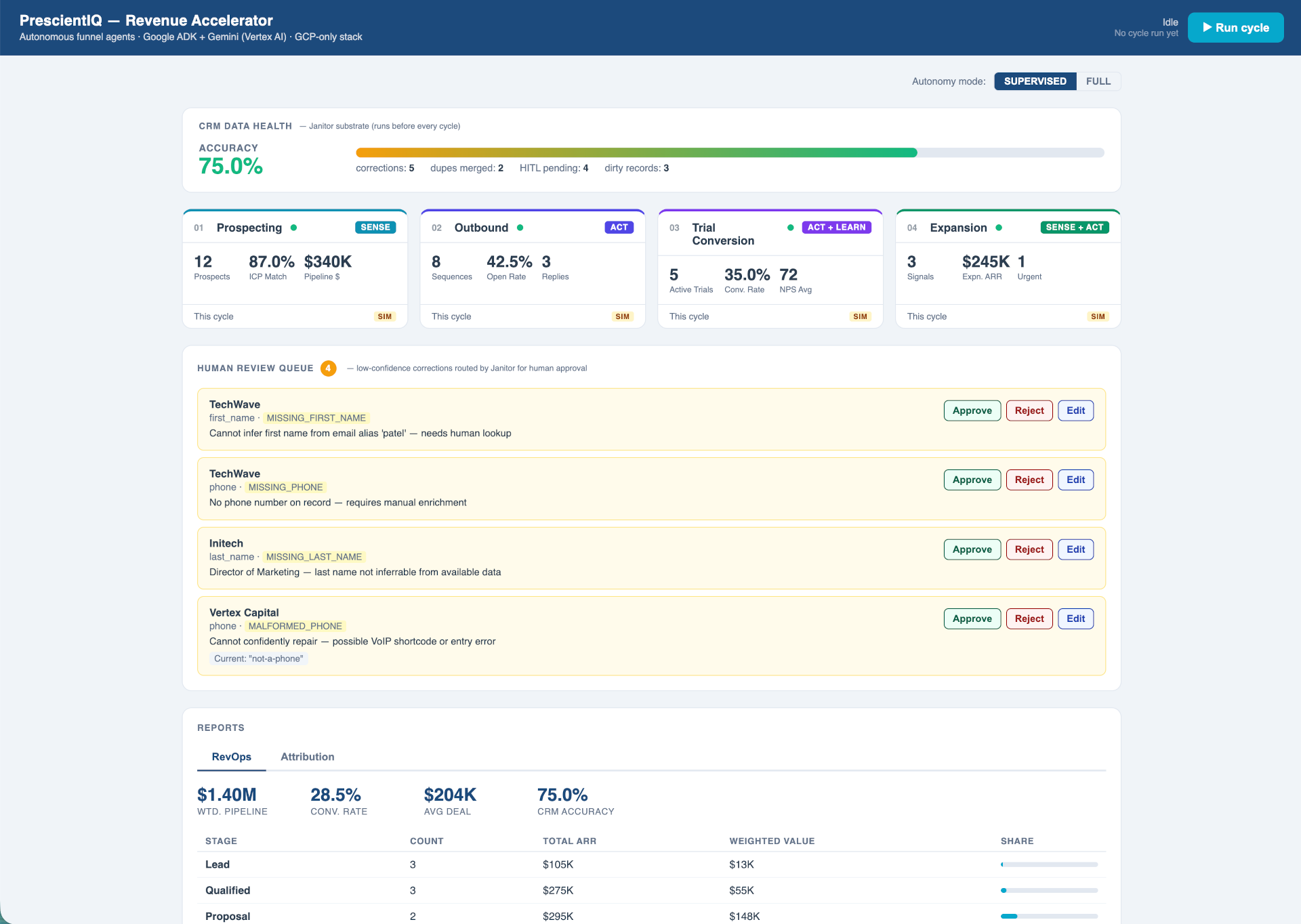
Edge cases the agents could not confidently resolve wait in a human review queue rather than being guessed at.
This is also where the autonomy ladder earns its place. Agent systems sit somewhere on copilot → HITL → HOTL → autonomous: a copilot suggests and a person acts; at HITL the agent acts only after a human approves; at HOTL it acts while a human monitors and can intervene; autonomous systems act without a person in the path. PrescientIQ prepares work continuously, but every externally visible action stays at the HITL rung. That makes it a coworker, not a copilot — it does the work — without letting an unreviewed action reach a buyer.
The EU AI Act Article 50 angle: the compliance bar is rising
Regulators are writing transparency into law, and those duties attach to how a system is designed and deployed, not to how well its model scores. Article 50 of Regulation (EU) 2024/1689 requires providers to ensure that AI systems intended to interact directly with natural persons are designed and developed so that “the natural persons concerned are informed that they are interacting with an AI system,” unless that is obvious to a reasonably well-informed person in context. Article 50(5) requires that information to be given “in a clear and distinguishable manner at the latest at the time of the first interaction or exposure.” Under Article 113, the regulation applies from 2 August 2026.
Article 50(4) is worth reading closely. Deployers of an AI system that generates or manipulates text published to inform the public on matters of public interest must disclose that the text is artificially generated, but that obligation does not apply where the content “has undergone a process of human review or editorial control” and a person holds editorial responsibility for it. That provision covers a specific category of published text, not sales outreach generally, but the drafting shows how the law treats human review: as a control that means something.
The timetable has moved only at the edges. The Digital Omnibus on AI, Regulation (EU) 2026/1744 of 8 July 2026, added a transition under which providers of generative systems placed on the market before 2 August 2026 must comply with the Article 50(2) marking obligation by 2 December 2026. The Commission has also published a voluntary Code of Practice on marking and labelling AI-generated content.
The practical point for a GTM leader: a generic model does not clear this bar out of the box, because a disclosure at first interaction, a record of human review, and a stop when something is uncertain are properties of the system you deploy. Whether Article 50 applies to your program, and what it requires of you, is for your counsel to decide.
Generic model performance vs. grounded, governed digital labor
| Dimension | Generic model performance | Grounded, governed digital labor |
|---|---|---|
| Data grounding | General training data plus whatever fits in a prompt. Your ICP, pipeline, and playbooks are absent unless someone pastes them in. | Grounded in your CRM records, qualification criteria, proof points, and objection library, supplied as the material the agent works from. |
| Behavior at an edge case | Produces the most plausible continuation. Uncertainty looks the same as confidence in the output. | Fail-closed: stops and routes to a named person when approval, data, or confidence is missing. |
| Auditability | Chat history or application logs, reconstructed after the fact if they were kept at all. | Immutable audit ledger: each action, its rationale, and its approver, recorded when it happens. |
| Override capability | A person can ignore the output, but nothing stops an integrated tool from acting on it first. | A human-in-the-loop gate before every externally visible action; approve, edit, or reject. |
| Outcome measurement | Benchmark scores, token usage, seats licensed, or messages generated. | Executed, authorized work and the business result it produced. Rejected work is not counted as output. |
The table compares approaches, not vendors. A strong model can sit inside a well-governed system; the point is that the model’s score is one input, and the dimensions that decide whether it is safe to deploy are the other four.
What “measurable business outcomes” means under LaaS
Pricing reveals what a vendor is actually optimizing. Seat licensing rewards access whether or not work gets done. Usage pricing rewards volume, including volume nobody wanted. PrescientIQ is priced as Labor-as-a-Service: you pay for executed, authorized work rather than for seats, and a draft a reviewer rejects is not counted as work.
That changes the incentive. When a rejected draft earns nothing, producing more drafts is not the goal. Producing drafts a reviewer approves is. Accuracy against your context and your approval standard becomes the thing the system is paid for, which is exactly the thing a benchmark cannot measure. The published fee:
| Component | Investment | Billing frequency |
|---|---|---|
| Annual platform feeEnvironment provisioning on Google Cloud, per-agent IAM, audit-ledger setup, and context ingestion from your CRM — plus four cooperating agents (Scout, Herald, Guide, and Steward), their coordinator Marshal, the approval queue and standing-policy controls, and the immutable audit ledger, and the monthly execution volume a typical mid-market deployment runs. One fee, from signature, every year.Target — modeled: live in 21 days or less$165,000/year is the complete platform fee. There is no separate implementation charge and no different first-year number — deployment work is included from signature, not billed as a distinct line. Scope beyond a typical deployment — additional bundles, sustained higher volume — is quoted at your AAR before anything is signed. | $165,000/yr | Billed monthly at $13,750/mo against an annual commitment |
Full scope is on the pricing page.
Is your governance ready for digital labor?
Two questions tell you whether your controls are infrastructure or paperwork. Answer them for the workflow you would put an agent into first.
What happens when an agent is uncertain?
Where it runs
PrescientIQ is hosted and operated by MatrixLabX on Google Cloud. SOC 2, ISO 27001, and PCI DSS attestations are held by Google Cloud, which operates the underlying infrastructure. They are not MatrixLabX certifications. MatrixLabX application-layer SOC 2 is in progress.
Frequently Asked Questions
- What does "fail-closed" mean for an AI agent?
- It means the default under uncertainty is to stop, not to proceed. When an agent is missing a required approval, cannot resolve a record, or cannot source a claim, the workflow halts and routes to a named person instead of guessing and logging the guess afterward. A fail-open agent treats the edge case as permission; a fail-closed one treats it as a question.
- What does the immutable audit ledger actually record?
- Every agent action, the rationale behind it, and the identity of the human who approved it, written at the moment the action happens. The point is that the record exists before anyone asks for it, so a review is a factual lookup rather than a reconstruction from application logs.
- Can a person override what an agent does?
- Before anything external happens, yes: a reviewer approves, edits, or rejects the prepared action at the human-in-the-loop gate, and a rejection is recorded alongside the draft that prompted it. Nothing externally visible executes without that approval, so the override point is designed in rather than bolted on after an incident.
- Why are model benchmarks a poor way to evaluate digital labor?
- Benchmarks measure a model in isolation, and Stanford HAI’s 2026 AI Index reports that evaluations meant to stay challenging for years are now saturated in months, with reliability concerns and error rates up to 42% on widely used evaluations. None of that tells you whether an agent uses your data, stops at an edge case, or produces a business outcome.
- Does EU AI Act Article 50 apply to AI agents used in sales outreach?
- Article 50 applies from 2 August 2026 and requires AI systems intended to interact directly with natural persons to be designed so those people are informed they are interacting with an AI system, unless that is obvious. Whether and how it applies to a particular outreach program depends on the facts, and that determination belongs to your counsel, not to a vendor’s blog post.
- Does deploying PrescientIQ make a company compliant with the EU AI Act?
- No product makes a deployer compliant on its own; the Act places obligations on providers and deployers, and your counsel determines what applies to you. What governed digital labor can provide is evidence: who approved each external action, what it was based on, and a design that stops rather than proceeds when something is uncertain.
The Agentic GTM series
- Part 1 — The Agentic Era of GTM: From Fragmented Handoffs to Hands-Off Outcomes
- Part 2 — The Agentic GTM Fit Curve: Where Digital Labor Takes Over, and Where Sellers Still Win
Related reading
Sources
- Regulation (EU) 2024/1689 (Artificial Intelligence Act), Articles 50 and 113 — EUR-Lex
- Regulation (EU) 2026/1744 (Digital Omnibus on AI), 8 July 2026 — EUR-Lex
- Commission publishes Code of Practice on marking and labelling of AI-generated content — European Commission
- 2026 AI Index Report, Technical Performance — Stanford HAI
- The GenAI Divide: State of AI in Business 2025 — MIT NANDA (preliminary findings; third-party-hosted copy)
This post is general information, not legal advice, and it makes no claim that PrescientIQ or any deployment satisfies Article 50 or any other provision of the EU AI Act. The MIT NANDA findings are described by their authors as preliminary and interview-based. The metric and compliance statement render from the site's claims register with their proof class attached.
See where your own execution effort is going
The Autonomous Audit Report models where your team's execution capacity is currently spent, what your configuration is actually paying for, and what the governed alternative looks like on your own data — before any commitment.
Get your free AAR benchmark