Beneficial ownership mapping for KYB: entity maps that show their own uncertainty
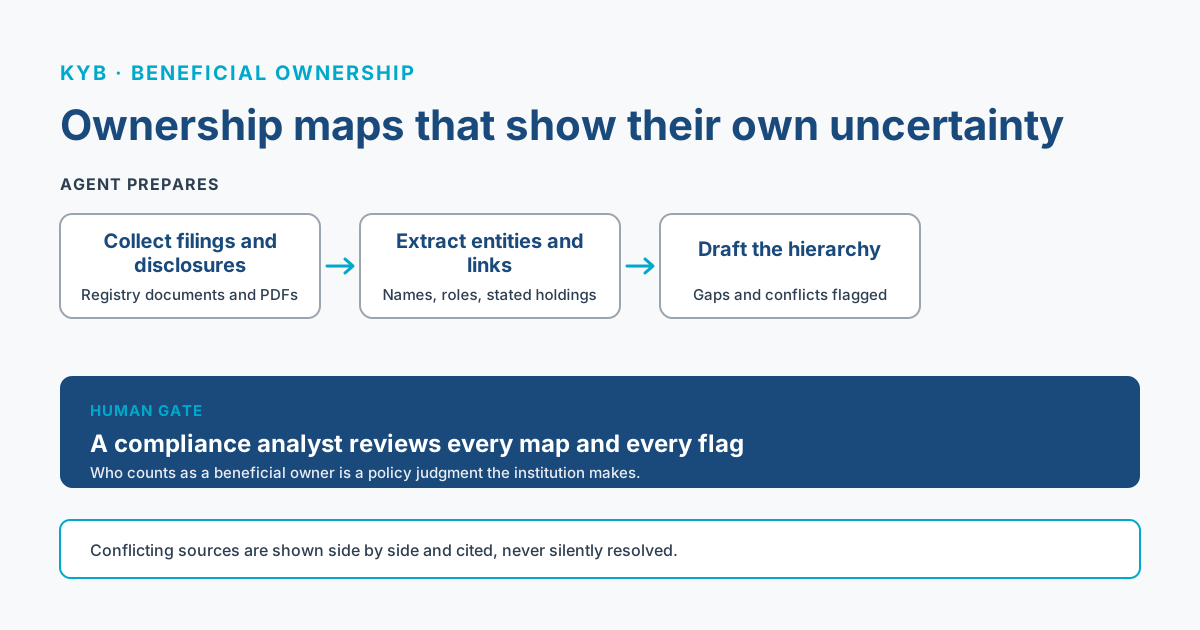
Know-your-business work stalls on one question: who actually owns and controls this entity? Governed agents gather corporate filings and PDF disclosures, cross-reference them, and draft an ownership and entity hierarchy map that flags gaps and conflicts. A compliance analyst reviews every map and every flag. The agent never decides who counts as a beneficial owner under your policy.
This post is part of our guide to agentic AI governance in mid-market financial services. It covers the ownership-mapping workflow specifically, and leaves alert triage to the AML and KYC post.
What is ownership mapping, and why is it slow?
Mapping ownership means tracing a business customer up through its layers: the operating company, the holding company above it, the trusts and partnerships above that, and the people at the top. The result is a hierarchy an analyst can test against the institution’s own ownership policy.
It is slow because the evidence is scattered and inconsistent. Registry filings, formation documents, shareholder lists and customer-provided disclosures arrive in different formats, many of them PDFs. They are rarely current in the same way, and they sometimes contradict each other. The analyst’s real work is reconciling them.
Where does the pain land?
Onboarding delay. Business customers wait while an analyst assembles the structure by hand, and the delay lands at the point of highest customer intent.
Analyst time on assembly, not judgment. Extracting names and percentages from a PDF and drawing the chart is clerical work. Deciding whether a structure raises a concern is the skill, and it gets whatever time is left.
Silent gaps. A missing layer or an unexplained entity is simple to overlook when the map is built under queue pressure. The cost appears later, in a review or an examination.
Refresh burden. Structures change, so periodic review means rebuilding the map again, usually from scratch.
Evidence that cannot be re-traced. If the map lives in a slide or a spreadsheet, nobody can later show which document supported which line.
What does the agent do, and what stays human?
| Step | Agent | Compliance analyst |
|---|---|---|
| Collect documents | Gathers filings and PDF disclosures through scoped, read-only access | Confirms the document set |
| Extract entities and links | Pulls names, roles and stated holdings from each source | Spot-checks the extraction |
| Draft the hierarchy | Builds the entity map and cross-references sources | Reviews every map |
| Flag problems | Marks gaps, conflicts between sources and low-confidence links | Reviews every flag |
| Determine who is a beneficial owner | Nothing | Applies your policy and decides |
| Escalate or reject | Nothing | Owns it |
The design choice that matters is that the agent shows its disagreement rather than resolving it. If two sources conflict on a holding, the map says so and cites both. Low-confidence work goes to a person, and the workflow stops when a required approval or a required document is missing. Each action is written to an immutable ledger with its rationale and approver at the time it occurs.
This is decision support. Applying a threshold, deciding whether a structure is acceptable, and any filing decision belong to your institution. We do not claim an output satisfies a specific regulatory requirement; that determination is for your compliance team and counsel.
What do you gain?
Gains vary with how fragmented your sources and structures are, so we do not quote averages. The shape is consistent.
- A draft instead of a blank page. The analyst starts from a sourced map.
- Visible uncertainty. Gaps and conflicts are surfaced up front, not discovered late.
- Traceable lines. Every link in the hierarchy points at its supporting document.
- Cheaper refresh. A periodic review starts from the prior map and highlights what changed.
- Better use of scarce judgment. The analyst reviews and decides rather than extracting and drawing.
Three illustrative scenarios
Representative profiles, not delivered client results.
Layered holding structure. A commercial customer sits under two holding companies and a partnership. The agent drafts the full chain with sources; the analyst concentrates on the one link marked low-confidence.
Conflicting disclosures.The customer’s disclosure and a registry filing disagree on a holding. The map shows both and flags the conflict, so the analyst requests clarification instead of inheriting an unnoticed error.
Periodic refresh. At review time the agent rebuilds the map from current documents and highlights what differs from the approved version, so the analyst reads the changes first.
See whether your onboarding workflow is ready
The free Agentic Readiness Audit assesses governance, non-human identity, shadow AI, data readiness, workflow suitability, and evidence, and returns a written assessment within 48 hours of the intake session.
Get the readiness auditDecision tree: where should you start?
- Is your ownership policy written clearly enough that two analysts reach the same answer? If not, document it first. The agent maps evidence; it does not supply policy. If yes, continue.
- Is your volume of business customers or periodic reviews large enough that mapping is a recurring queue? If not, the overhead may outweigh the benefit, so revisit at scale. If yes, continue.
- Are structures mostly simple, or often layered and cross-border?Layered structures are the highest-value fit: run with agents proposing first, compare drafts against your analysts’ own maps, and measure the agreement. Simple structures are better served by starting with refresh reviews, where highlighting changes saves the most effort.
- Do your examiners or board resist automation in the onboarding path? If yes, begin with draft-only maps behind full analyst review, because the evidence trail is what changes that conversation. If no, proceed to a staged rollout.
When is this the wrong fit?
If your documents mostly arrive as low-quality scans or photographs, extraction will lean heavily on human review at first. If ownership policy lives only in people’s heads, write it down before automating anything. And if ownership evidence is thin by nature for your customer base, the agent will produce many flags, which is useful information but not a time saving.
Frequently Asked Questions
- Does the agent decide who counts as a beneficial owner?
- No. A governed KYB agent drafts the ownership map from the available evidence and flags gaps and conflicts. Applying your ownership threshold, deciding whether a structure is acceptable, and any escalation or rejection remain the compliance analyst’s judgment under your institution’s written policy.
- What happens when two sources disagree about a holding?
- The map shows the conflict and cites both documents rather than picking a winner, and the flag routes to an analyst. Silently resolving a contradiction is the behavior that produces unexplainable files later, so the workflow is built to surface disagreement instead of hiding it.
- Can agents work from PDF disclosures and corporate filings?
- Yes. The agent reads corporate filings and PDF disclosures and extracts names, roles and stated holdings from them. Extractions it is not confident about are flagged for human review rather than assumed correct, so low-quality scans surface as review items instead of silent errors.
- Can an ownership map be refreshed at periodic review?
- Yes. At review time the agent rebuilds the map from current documents and highlights what differs from the previously approved version, so the analyst reads the changes first rather than re-deriving the whole structure. The prior approved map stays on the record for comparison.
- Does a drafted ownership map satisfy a KYB regulatory requirement?
- MatrixLabX makes no such claim. The workflow produces a sourced map with flagged uncertainty and a contemporaneous record of who reviewed it. Whether that satisfies a specific requirement at your institution is a determination for your compliance team and counsel, not a vendor.
- When is ownership mapping the wrong workflow to automate first?
- When your ownership policy is not written down, when business customer volume is low enough that mapping is not a recurring queue, or when documents arrive mostly as poor-quality scans. In those cases early output leans heavily on human review, which is useful information but not a time saving.
Related Reading
This post describes a decision-support workflow. It is not legal or regulatory advice, and it states no ownership threshold: which threshold applies, and who counts as a beneficial owner, is a determination for your compliance team and counsel.