Credit memo drafting with governed AI agents, and the decision unchanged
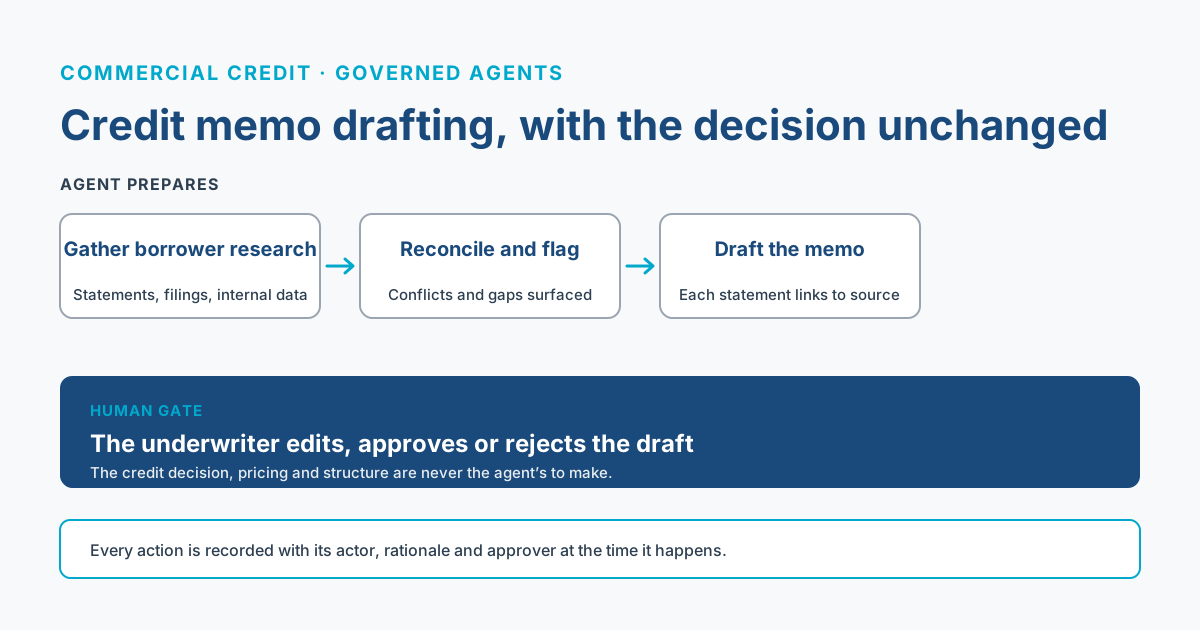
A governed credit memo agent gathers borrower financial statements, filings and your internal data, drafts the memo, and ties each statement to the document it came from. An underwriter reviews and approves it. The agent never makes the credit decision, and every action is recorded with its actor, rationale and approver at the moment it happens. Agents prepare; people decide.
This post is part of our guide to agentic AI governance in mid-market financial services. It covers the commercial credit workflow specifically: what the memo is for, where the time goes, what an agent can take over, and where this is the wrong thing to buy.
What job does a commercial credit memo actually do?
The memo is the written case for a lending decision. It says who the borrower is, how the business makes money, what could go wrong, and how the structure addresses it. It is also the document an examiner, an auditor, or a successor underwriter reads years later to understand why a decision was made.
That is two jobs at once: persuade the committee this month, and stay defensible for the life of the credit. Both rest on the same thing, which is traceability. A claim in the memo is worth exactly as much as the document behind it.
Where does the time actually go?
Community and regional banks and specialty lenders tend to run lean credit teams without an enterprise AI or integration group. The constraint is rarely the judgment. It is everything that happens before the judgment.
Assembly. An analyst collects financial statements, tax returns, filings, public information and internal account history from separate places, then reconciles them by hand.
Reformatting. The same facts are retyped into the memo template, which is where transcription errors enter the file.
Inconsistency. Two analysts structure the same kind of credit differently, so the committee reads two different documents for comparable risk.
Lost provenance. Months later nobody can say which document a number came from, so the file gets rebuilt rather than read.
Senior time on junior work. The person best placed to challenge a structure is busy building the exhibit that supports it.
What does the agent do, and what stays with the underwriter?
The split follows one rule: retrieval, cross-referencing and drafting are agent work; judgment and approval are human work.
| Step | Agent | Underwriter |
|---|---|---|
| Gather borrower research | Pulls from statements, filings and internal data through scoped, read-only integrations | Confirms the source set is complete |
| Normalize and reconcile | Cross-references figures across documents and flags conflicts | Resolves the conflicts |
| Draft the memo sections | Writes the business overview, financial narrative and risk observations, each linked to source | Edits, rewrites or rejects |
| Surface gaps | Lists missing documents and low-confidence items | Decides whether to proceed |
| Credit decision | Nothing | Owns it entirely |
| Pricing and structure | Nothing | Owns it entirely |
Three behaviors matter for a regulated lender. The workflow stops when a required approval or a required document is missing, rather than guessing its way past the gap. Low-confidence work routes to a person instead of being smoothed over. And every action lands on an immutable ledger with actor, rationale and approver, written when it happens rather than reconstructed afterward. The field-level detail is in the eight fields of a complete audit ledger entry.
No agent output is a credit decision. Whether any output satisfies a specific supervisory or recordkeeping requirement is a determination for your compliance team and counsel.
What do you gain, stated honestly?
We do not publish borrowed averages, because the size of the gain depends on your data, your template and how fragmented your sources are. Directionally there are four gains.
- Earlier drafts. The underwriter starts from a sourced draft instead of a blank template.
- Consistency. The same structure and the same standard of sourcing across analysts.
- Traceability. Every statement links to its document, so review is checking rather than re-researching.
- Judgment time. Senior people spend more of the file on structure and risk, and less on assembly.
To size it for your own portfolio, the readiness audit models the delta on your data before any commitment.
Three illustrative scenarios
Representative profiles, not delivered client results.
New relationship.A regional bank’s analyst has a stack of borrower documents and a committee date. The agent assembles the research and drafts the memo with source links; the underwriter spends the time on whether the structure fits the risk.
Annual review. A specialty lender reviews a book of existing credits. The agent drafts each update from the latest financials and flags what changed against the prior memo, so the reviewer reads the changes first.
Conflicting documents. Two filings disagree on a figure. The agent flags the conflict and routes it to a person rather than choosing one, which is the behavior an examiner would want to see.
See whether your credit workflow is ready
The free Agentic Readiness Audit assesses governance, non-human identity, shadow AI, data readiness, workflow suitability, and evidence, and returns a written assessment within 48 hours of the intake session.
Get the readiness auditDecision tree: is this a fit for your credit shop?
- Is your memo template and credit policy written down? If not, document them first. An agent drafts to a standard, and without one the drafts will vary as much as the people do. If yes, continue.
- Are borrower documents reachable through read-only integrations or a controlled upload path? If not, start with a narrow pilot on uploaded documents rather than a full integration. If yes, continue.
- Does committee or examiner scrutiny of memo sourcing concern you? If yes, this is a strong fit, because source-linked drafting and a contemporaneous record address that directly. If no, continue.
- Is the bottleneck drafting time, or deal flow itself? If drafting, proceed with agents proposing first: they draft, underwriters compare against their own drafts, and the scope widens only as the evidence supports it. If deal flow, a drafting agent will not fix it, and sourcing is the place to start.
When is this the wrong fit?
If you originate very few credits, an agent adds coordination cost without enough volume to repay it. If every memo is a bespoke structured deal with little repeatable shape, the drafting gain is smaller than it looks. And if the real obstacle is cultural resistance to automation anywhere near credit, a technical rollout will not resolve it on its own; the read-only, evidence-first workflows described on the governance playbook are a better place to begin.
Frequently Asked Questions
- Does an AI agent make the credit decision?
- No. A governed credit agent gathers borrower research, reconciles it, and drafts the memo. The credit decision, the pricing, and the structure stay with the underwriter and the credit committee. The agent prepares the document that supports a decision; it never approves, declines, or prices a loan at your institution.
- How does a reviewer know where a statement in the memo came from?
- Each drafted statement links to the source document behind it, so review means checking the evidence rather than researching it again. The audit ledger separately records which agent produced the draft, the rationale it carried, and the person who approved, edited, or rejected the result.
- What happens when borrower documents conflict or data is missing?
- The agent flags the conflict and cites both documents instead of choosing between them. When a required document or a required approval is missing, the workflow stops rather than filling the gap with an assumption, and low-confidence items are routed to a person to resolve.
- Does a drafted credit memo satisfy examiner expectations for credit files?
- That determination belongs to your compliance team and counsel. The workflow produces a sourced, attributable record with a contemporaneous log of who approved what. MatrixLabX does not claim that any agent output satisfies a specific supervisory, recordkeeping, or examination requirement at your institution.
- Is credit memo drafting a fit for a small lending team?
- Not always. If you originate few credits, the coordination cost can outweigh the benefit, and highly bespoke structured deals share little repeatable shape. The strongest fit is a team with recurring credit types, a written memo standard, and senior people spending hours on document assembly.
- How is credit memo drafting priced?
- Scope and commercial terms are set during the readiness audit, before any commitment, and the work is priced for the work performed rather than per seat. The audit reviews your workflow first, so the scope reflects your own credit types and document sources rather than a standard package.
Related Reading
This post describes a decision-support workflow. It is not legal, regulatory, or credit advice, and no agent output is a credit decision. Whether a specific practice satisfies supervisory expectations is a determination for your compliance team and counsel.