Portfolio monitoring with governed AI agents: findings that open straight to their evidence
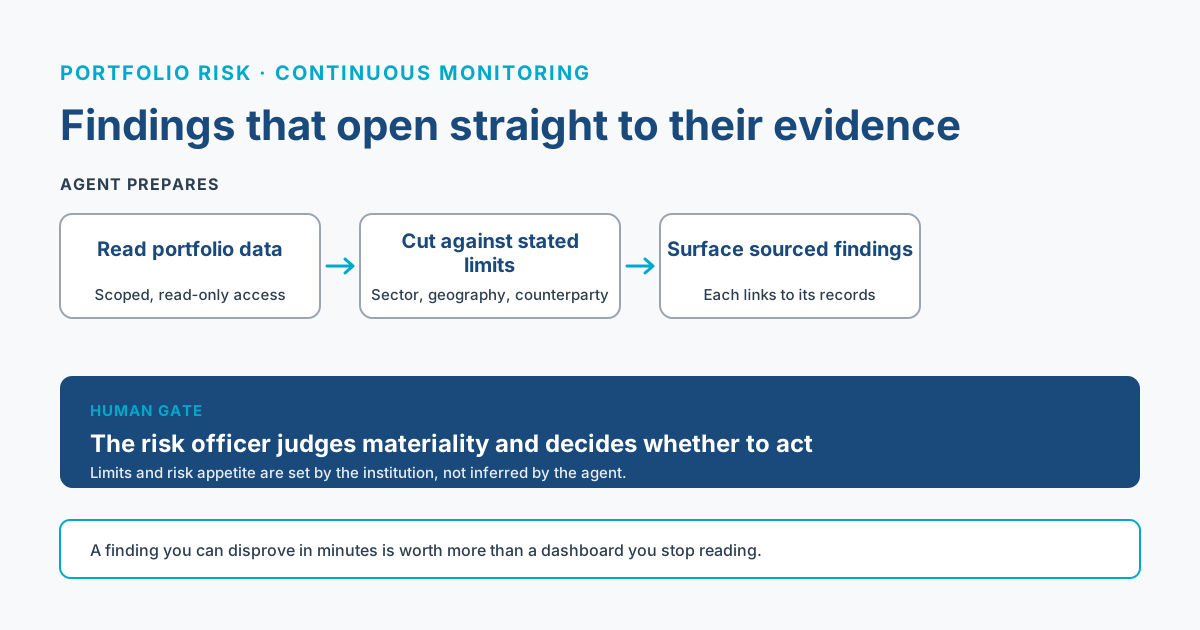
Risk officers rarely lack data. They lack the time to read all of it. Governed agents analyze portfolio exposure against the limits your institution has written down, surface concentration and pricing anomalies, and link each finding to the source records behind it. The risk officer judges materiality and decides whether to act. Agents surface; people decide.
This post is part of our guide to agentic AI governance in mid-market financial services. It covers the portfolio and risk monitoring workflow specifically.
What job does portfolio monitoring do?
Monitoring answers a standing question: is the book drifting somewhere we did not intend? The risk function watches for exposure that has crept into one sector, geography, borrower group or structure, and for pricing that has moved away from policy without anyone deciding it should.
The job is continuous, not episodic. A concentration that builds across a year is not announced by any single transaction, so it surfaces only if someone is looking across the whole portfolio on a regular cadence.
Where does the pain sit?
The review is periodic and the book is not. A quarterly look at a portfolio that changes daily means anomalies are found after they have already formed.
Spreadsheet assembly. Pulling positions from core systems, joining them, and re-cutting them for each question consumes the analyst before the analysis starts.
Findings without provenance. A chart saying exposure is high is useful only if someone can click through to the underlying accounts. Otherwise the first meeting is spent proving the number.
Alert fatigue in reverse. A dashboard full of undifferentiated flags trains people to ignore it. A short list of explained findings does not.
Thin evidence of who looked. When an examiner or board asks how a concentration was handled, the answer gets reconstructed from email.
What does the agent do, and what stays with the risk officer?
| Step | Agent | Risk officer |
|---|---|---|
| Ingest portfolio data | Reads through scoped, read-only integrations | Confirms scope and data definitions |
| Analyze exposure | Cuts the book by sector, geography, counterparty group and structure against your stated limits | Sets the limits and the appetite |
| Surface concentration | Flags build-ups and links each to its source records | Judges materiality |
| Surface pricing anomalies | Flags deals priced away from policy or from comparable deals, linked to source data | Decides whether the deviation was justified |
| Prepare the finding | Writes a short, sourced explanation | Edits or rejects |
| Decide whether to act | Nothing | Owns it |
Every finding carries its link to the data, so review means checking the evidence rather than rebuilding it. Low-confidence results route to a person. Every agent action is written to an immutable ledger with its rationale and, once the risk officer responds, the approver. If a required approval or required data is missing, the workflow stops.
Agent output is analysis, not a risk decision and not advice. Whether any record meets a specific supervisory expectation is a determination for your compliance team and counsel.
What are the gains?
The scale depends on your portfolio, your data quality and your cadence, so we do not publish averages.
- Earlier visibility. Monitoring is continuous rather than waiting for the next review.
- Shorter lists. Explained findings replace undifferentiated flags.
- Faster verification. Each finding opens straight to its source records.
- A record of the response. What was surfaced, who reviewed it and what was decided sits on the ledger.
- Analyst time redirected. From assembling the cut to interpreting it.
Three illustrative scenarios
Representative profiles, not delivered client results.
Slow-building sector exposure. No single loan is large, but originations over several quarters have tilted toward one sector. The agent flags the cumulative position against the stated limit, linked to the accounts that make it up. The risk officer decides whether to tighten appetite.
Pricing that drifted. Several recent deals were priced away from policy. The agent lists them with the comparable deals and the source records, and the officer learns which had a documented reason and which did not.
A finding that is wrong. The agent flags an apparent concentration caused by a mis-coded field. Because the finding links to its source, the analyst spots the data issue in minutes, and the correction is recorded.
See whether your monitoring workflow is ready
The free Agentic Readiness Audit assesses governance, non-human identity, shadow AI, data readiness, workflow suitability, and evidence, and returns a written assessment within 48 hours of the intake session.
Get the readiness auditDecision tree: is this a fit for your risk function?
- Are your concentration limits and pricing policy written down? If not, write them first, because the agent measures against what you state. If yes, continue.
- Is your portfolio data reachable through read-only integrations? If not, start with a defined extract for one segment. If yes, continue.
- Is monitoring today periodic and manual? If yes, this is a strong fit: begin with the agent surfacing findings while your analysts compare them against what they would have found, and measure the agreement. If no, weigh whether the gain is in speed or in provenance.
- Is the larger need sourcing links for committee and examiner conversations? If yes, lead with source-linked findings, because the provenance is the value. If no, proceed to a staged rollout.
When is this the wrong fit?
If your portfolio is small and a single analyst already knows it intimately, an agent adds little. If the underlying data is unreliable, early findings will mostly expose data issues, which is valuable but is a data project first. And if limits and appetite are unwritten, there is nothing for the agent to measure against.
Frequently Asked Questions
- Does the agent decide to reduce exposure or change pricing?
- No. A governed monitoring agent surfaces findings with their source links and a short written explanation. Judging materiality, deciding whether a pricing deviation was justified, and acting on a concentration all remain with the risk officer and the committees your institution already runs.
- How do I know a surfaced finding is real?
- Each finding links to the records behind it, so verification means opening the evidence rather than trusting a summary. When a finding turns out to come from a mis-coded field, the same links make the data problem visible in minutes instead of surviving to a committee meeting.
- What sets the limits the agent measures against?
- You do. The agent cuts the book by sector, geography, counterparty group and structure against the concentration limits and risk appetite your institution has written down. It does not infer a limit, propose one, or treat an absence of stated appetite as permission to invent a threshold.
- What happens when portfolio data is missing or the agent is unsure?
- The workflow stops when required data or a required approval is missing, rather than producing a finding from an incomplete cut. Low-confidence results route to a person. Both behaviors are recorded, so a gap in the data shows up as a gap rather than a silent omission.
- Is there a record of what was reviewed and decided?
- Yes. Every agent action is written to an immutable ledger with its actor, rationale and before-and-after state at the moment it occurs, and the risk officer’s response is recorded against it. That record is what turns a monitoring claim into something an examiner can inspect.
- When is portfolio monitoring the wrong workflow to automate?
- When the portfolio is small enough that one analyst already knows it intimately, when limits and appetite are unwritten so there is nothing to measure against, or when the underlying data is unreliable. In the last case the early findings are mostly data issues, which makes it a data project first.
Related Reading
This post describes a decision-support workflow. It is not legal, regulatory, or investment advice, and no agent output is a risk decision. Whether a specific practice satisfies supervisory expectations is a determination for your compliance team and counsel.