Research drafting for advisory and capital markets teams: a sourced first draft, and the thesis still yours
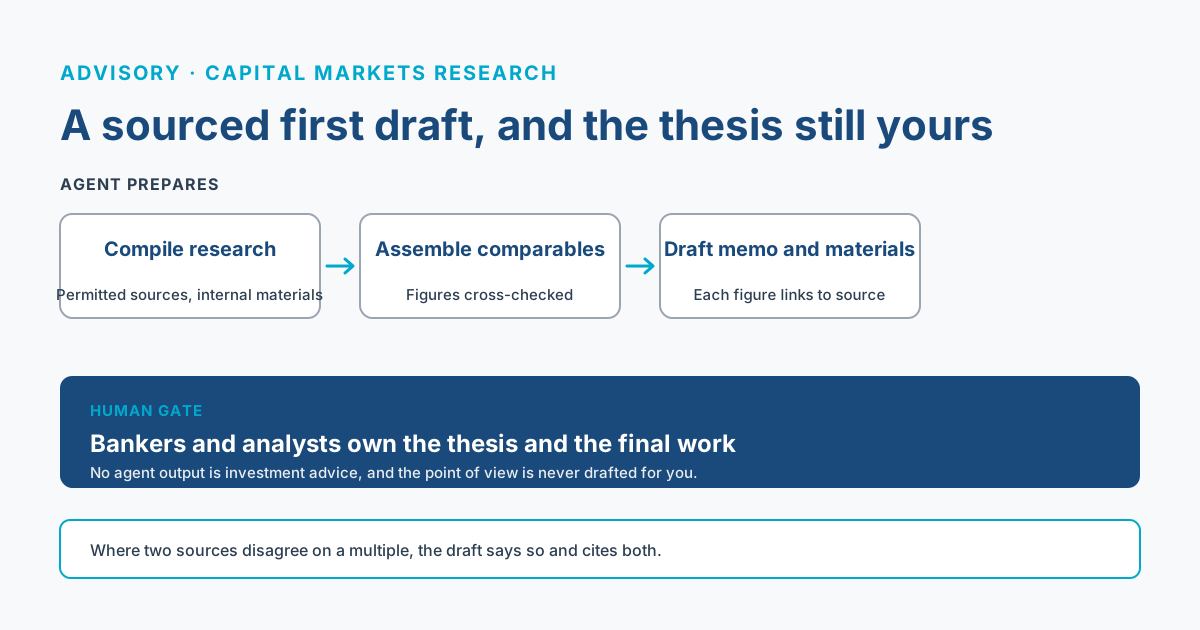
Advisory and capital markets work starts with research that is mostly assembly: market context, company profiles, comparable transactions. Governed agents compile that research into draft pitch materials and investment memos with source links. Bankers and analysts own the final work, and no agent output is investment advice. Agents prepare; people decide.
This post is part of our guide to agentic AI governance in mid-market financial services. It covers the research and drafting workflow specifically.
What job is the research draft doing?
A pitch or an investment memo carries a point of view. The research underneath it, who the company is, how the market is moving, what comparable deals looked like, is the material that supports that view. The draft’s job is to get a credible, sourced starting point in front of a senior person fast enough to shape the argument before the meeting.
The teams that own this work, at advisory boutiques, independent asset and wealth managers, and mid-market banks’ advisory groups, tend to run lean. They do not have an enterprise research or AI engineering group to automate the first draft.
Where does the pain sit?
Junior hours on compilation. The first version of a comparable-deals table or a company profile is assembled by hand from several sources.
Version drift. The same facts are copied between a model, a deck and a memo, and they stop agreeing.
Unclear sourcing. A figure on a slide that nobody can trace is a liability the moment a client asks where it came from.
Compressed timelines. Pitch windows are short, so the research that most deserves skepticism gets the least.
Capacity spent before the thinking starts. Senior time arrives after the assembly is done, leaving less room to challenge the thesis.
What does the agent do, and what stays with the banker?
| Step | Agent | Banker or analyst |
|---|---|---|
| Compile market and company research | Gathers from permitted sources and your internal materials through scoped, read-only access | Confirms sources and scope |
| Assemble comparables | Builds the comparable-transaction set and cross-checks figures | Judges which comparables are relevant |
| Draft materials and memos | Writes sections and tables, each with source links | Edits, rewrites or rejects |
| Flag uncertainty | Marks conflicts between sources and low-confidence figures | Resolves them |
| Form the view | Nothing | Owns the thesis and the recommendation |
| Final work product | Nothing | Owns it entirely |
The behaviors that make this usable in a regulated setting are the same across the platform. Low-confidence work routes to a person. The workflow stops when a required approval or required data is missing. Every agent action is written to an immutable ledger with its rationale and approver at the time it occurs, so the history of a draft is available without reconstruction.
No agent output is investment advice. Whether any output meets a specific supervisory or recordkeeping expectation is a question for your compliance team and counsel.
What are the gains?
They depend on your sources, your template and how much of the first draft is compilation, so we do not publish averages.
- A sourced first draft in front of a senior person earlier in the window.
- One set of facts. A single drafted source of figures reduces drift between model, deck and memo.
- Traceability. Every figure links to where it came from, which makes review a check rather than a rebuild.
- Analyst time shifted. From assembly toward interrogating the argument.
- A record. What was drafted, edited and approved sits on the ledger.
Three illustrative scenarios
Representative profiles, not delivered client results.
Short-fuse pitch. A team has days, not weeks. The agent compiles the market backdrop and the comparables with source links; the banker spends the time on positioning.
Investment memo refresh. A wealth manager revisits a holding. The agent updates the draft with new filings and flags what changed from the last approved memo, so the analyst reads the changes first.
Conflicting comparable data. Two sources disagree on a transaction multiple. The agent flags it and cites both rather than quietly picking one; the analyst resolves it.
See whether your research workflow is ready
The free Agentic Readiness Audit assesses governance, non-human identity, shadow AI, data readiness, workflow suitability, and evidence, and returns a written assessment within 48 hours of the intake session.
Get the readiness auditDecision tree: is this a fit for your team?
- Is a large share of your first-draft time compilation rather than analysis? If not, the gain will be small, so revisit if volume grows. If yes, continue.
- Are your approved sources and templates defined? If not, define them first, because the agent drafts to a standard you set. If yes, continue.
- Does sourcing and version control worry your senior reviewers? If yes, this is a strong fit, because source-linked drafting and a contemporaneous record address it directly. If no, continue.
- Is your pain the speed of the first draft, or the quality of the thesis? If the first draft, begin with the agent drafting while analysts compare against their own work and measure the difference. If the thesis, an agent will not supply a point of view, and that work stays with your senior people.
When is this the wrong fit?
If your edge is proprietary research that is not written down, an agent has nothing to compile. If most deliverables are bespoke narrative with little repeatable structure, the drafting gain narrows. And if your sources are restricted in ways that prevent automated access, scope the pilot to the sources you can use.
Frequently Asked Questions
- Does the agent give investment advice or form the recommendation?
- No. A governed research agent compiles and drafts material with source links. The thesis, the recommendation and the final work product belong to the bankers and analysts. No agent output is investment advice, and the point of view is never drafted on your behalf or inferred from the research.
- How do reviewers trust the figures in a drafted memo?
- Each figure links to the source it came from, so a reviewer checks evidence rather than re-deriving it. Where two sources disagree on a transaction multiple, the draft says so and cites both rather than silently choosing, and the conflict routes to an analyst to resolve.
- Does this reduce version drift between the model, the deck and the memo?
- It helps, because one drafted set of figures feeds the documents instead of each being typed separately. It is not a substitute for a single source of truth in your own systems. The gain is that every figure carries its provenance, so drift is visible when it happens.
- What if the agent is unsure, or a source is unavailable?
- Low-confidence work routes to a person, and the workflow stops when required data or a required approval is missing. Sources your firm cannot use for automated access are simply out of scope, and the draft shows what it could not cover rather than filling the gap.
- Is there a record of what was drafted and approved?
- Yes. Every agent action is written to an immutable ledger with its actor, rationale and before-and-after state at the moment it occurs, so the history of a draft is available without reconstruction. Who edited, approved or rejected each version is recorded alongside it.
- When is research drafting the wrong workflow to automate?
- When your edge is proprietary research that is not written down, because the agent has nothing to compile. When deliverables are bespoke narrative with little repeatable structure, the gain narrows. And when your approved sources restrict automated access, scope a pilot to the sources you can actually use.
Related Reading
This post describes a decision-support workflow. It is not legal, regulatory, or investment advice, and no agent output is investment advice. Whether a specific practice satisfies supervisory expectations is a determination for your compliance team and counsel.