HIPAA vs HITRUST: What Changes When Audit Readiness Becomes Continuous
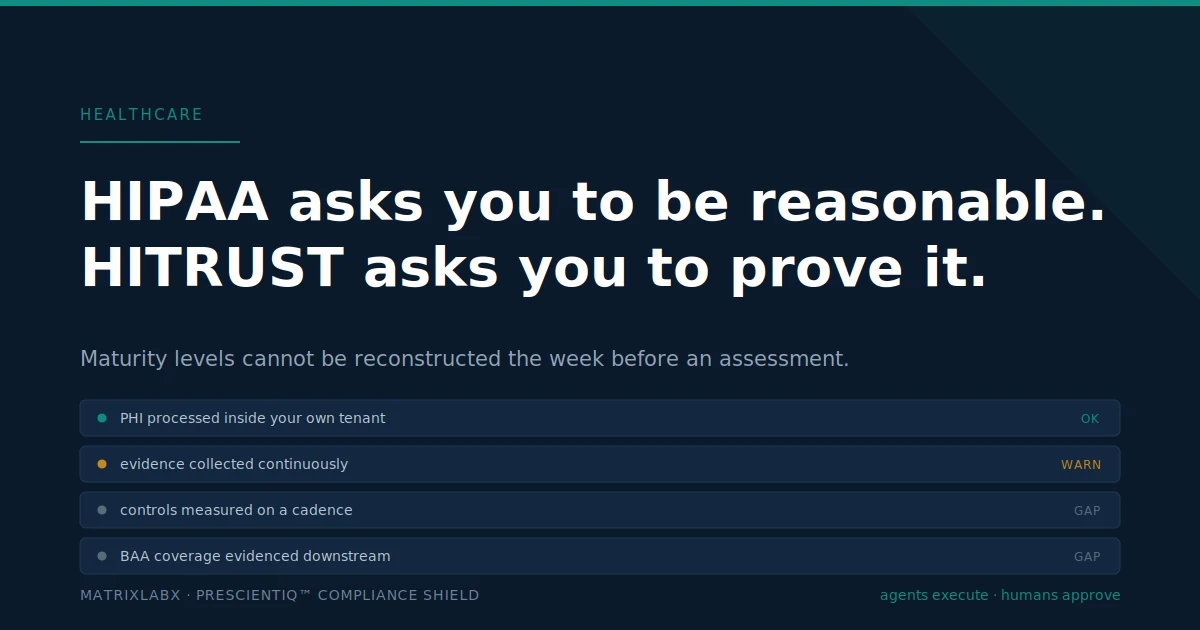
HIPAA's Security Rule is deliberately flexible — it asks for reasonable and appropriate safeguards and leaves the implementation to you. HITRUST CSF is the opposite: it specifies the control, the parameter, and the maturity level at which you must demonstrate it. Organizations that comfortably satisfy the first frequently fail the second, and not because their security is worse than they thought. They fail because HITRUST asks for measured, sustained, contemporaneous proof, and manual evidence collection cannot produce that at the required granularity.
What is the actual difference between HIPAA and HITRUST?
They are different kinds of object. HIPAA is law; HITRUST CSF is a certifiable framework built on top of it, designed to make the law's flexibility testable.
| HIPAA Security Rule | HITRUST CSF | |
|---|---|---|
| Nature | Federal regulation | Certifiable control framework |
| Specificity | Addressable and required standards, flexible implementation | Prescriptive control specifications with defined parameters |
| Assessment | Enforcement following complaint, breach, or audit | Scheduled external assessment |
| Scope | PHI safeguards | Maps HIPAA plus SOC 2, ISO 27001, NIST, PCI DSS and others |
| Evaluation model | Reasonable and appropriate | Five maturity levels: policy, procedure, implemented, measured, managed |
| What satisfies it | Documented, defensible judgment | Documented, evidenced, measured, and sustained |
The last row is the whole story. HIPAA can be satisfied by a defensible decision. HITRUST requires that the decision be documented as policy, operationalized as procedure, demonstrably implemented, measured on a cadence, and managed based on those measurements — five separate evidentiary burdens for a single control [Inherited — HITRUST CSF maturity model as published].
Why does HITRUST break manual evidence collection specifically?
Because the burden multiplies along two axes at once.
Across controls. A HITRUST assessment covers hundreds of control requirements depending on scope and risk factors. Each needs evidence at each applicable maturity level.
Across time.“Measured” and “managed” are not point-in-time properties. You cannot demonstrate them with a screenshot taken the week before the assessor arrives — they require a record showing the measurement happened repeatedly and that something changed in response.
A team collecting evidence manually can produce a convincing snapshot. It cannot retroactively produce a year of contemporaneous measurement records, and no amount of effort in the assessment window fixes that. This is the evidence production gap in its most acute form: the failure mode is structural and the deadline is fixed.
How do crosswalks remove duplicate work?
Most health systems are not carrying one framework. They are carrying HIPAA because it is law, HITRUST because a payer or partner demanded certification, SOC 2 because an enterprise customer did, and PCI DSS because they take patient payments.
Those frameworks overlap heavily. Encryption at rest, access review cadence, audit logging, incident response, vendor management — each appears in all four, phrased differently, assessed separately. Without a crosswalk, that is four evidence collections for one underlying control.
With one, evidence is collected once against a canonical control and projected into each framework's schema. Assess once, report many. Worth being precise about what this reduces: it reduces the reporting and collection labor. It does not reduce the security work, and it does not lower the bar for any framework. Anyone claiming otherwise is describing something you should not buy.
How should a BAA be structured to survive a HITRUST assessment?
A standard HIPAA business associate agreement says the vendor will safeguard PHI. That sentence is unassessable. A HITRUST-aligned agreement has to say who owns which control, and how you will know.
Four structural additions, each mapping to a specific assessment domain:
1. A responsibility assignment matrix as an addendum. For each applicable CSF control, state explicitly whether it is yours, the vendor's, or shared — with shared controls decomposed rather than left as a single ambiguous row. This is what the third-party risk domain is looking for, and its absence is a common finding.
2. Quantified parameters, not adverbs. Assessors reject “regularly” and “as needed.” The agreement — and the policy behind it — must state the number. Not “credentials are reviewed periodically” but “privileged access is reviewed every 90 days, with results retained for six years.” The specific values are yours to set based on risk; what is not optional is that a value exists.
3. A contractual right to telemetry.If your automated evidence collection needs the vendor's audit logs, configuration histories, and scan results, the agreement has to compel their provision. Otherwise your continuous monitoring stops at your own perimeter and the downstream portion of your footprint is evidenced by an annual questionnaire.
4. A formal exception path. Deviations are inevitable; casually permitted deviations are a finding. Require a risk acceptance record carrying the compensating controls, a residual risk score against a standard method, a named executive approver, and a hard expiration date. An exception without an expiry is a permanent unevidenced control wearing a temporary label.
What can be automated, and what cannot?
The split is the same in every regulated setting, so it is worth seeing the general shape before the healthcare-specific version. Agents take the volume-bound work — retrieval, enrichment, pattern matching. Humans keep everything that carries judgment or personal legal accountability. The same divide applied to day-to-day clinical administration — rather than to assessment evidence — is the subject of why mid-market healthcare operators are turning to HIPAA-eligible AI agents.
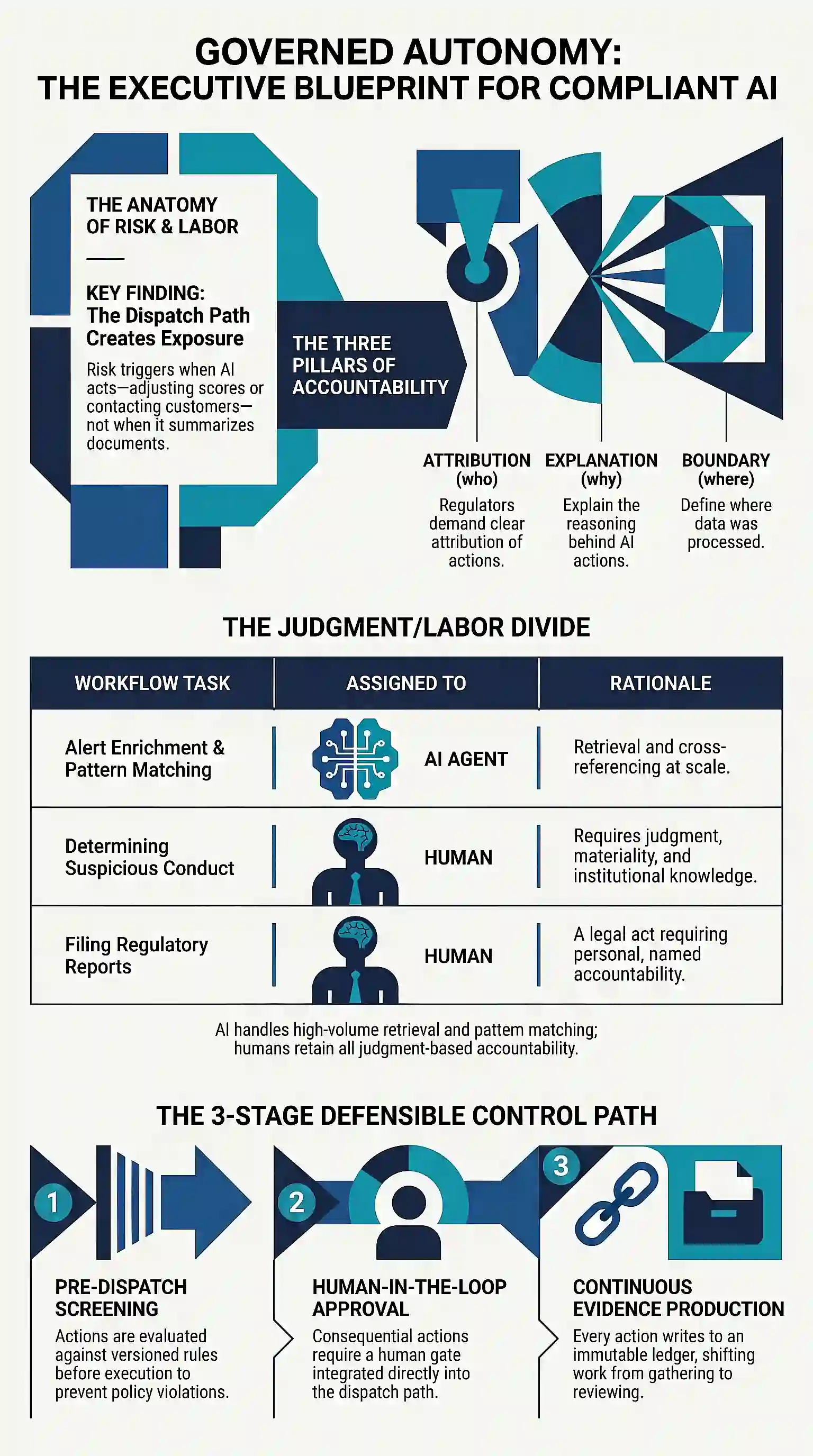
| Task | Nature of the work | Agent or human |
|---|---|---|
| Harvesting access logs, configuration state, encryption posture | Retrieval at volume | Agent |
| Mapping collected evidence to CSF control objectives | Structured mapping | Agent |
| Continuous gap detection against target profile | Rule evaluation | Agent |
| Flagging anomalous EMR access against normal clinical workflow | Pattern detection | Agent — surfaces, does not conclude |
| Tracking BAA status and vendor posture across the ecosystem | Record maintenance | Agent |
| Determining whether an incident is a reportable breach | Legal judgment | Human — always |
| Accepting residual risk on an exception | Executive judgment, named owner | Human — always |
| Deciding clinical-workflow appropriateness of an access pattern | Clinical and contextual judgment | Human — always |
The anomalous-access row deserves a note, because it is where healthcare automation most often oversells. An agent can establish that an access pattern deviates from the norm for that role. It cannot know that the clinician was covering a colleague's panel that afternoon. Surfacing is the agent's job; concluding is not.
Everything the agents do lands on an immutable ledger with actor, rationale, sources consulted, and before/after state, on Google Cloud under a Google BAA and per-agent least-privilege identity [Inherited — Google Cloud platform capability; BAA eligibility subject to your own executed agreement]. PHI stays in the perimeter that governs it — which is the precondition for using generative AI on clinical or billing data at all.
Decision tree: what is your first move?
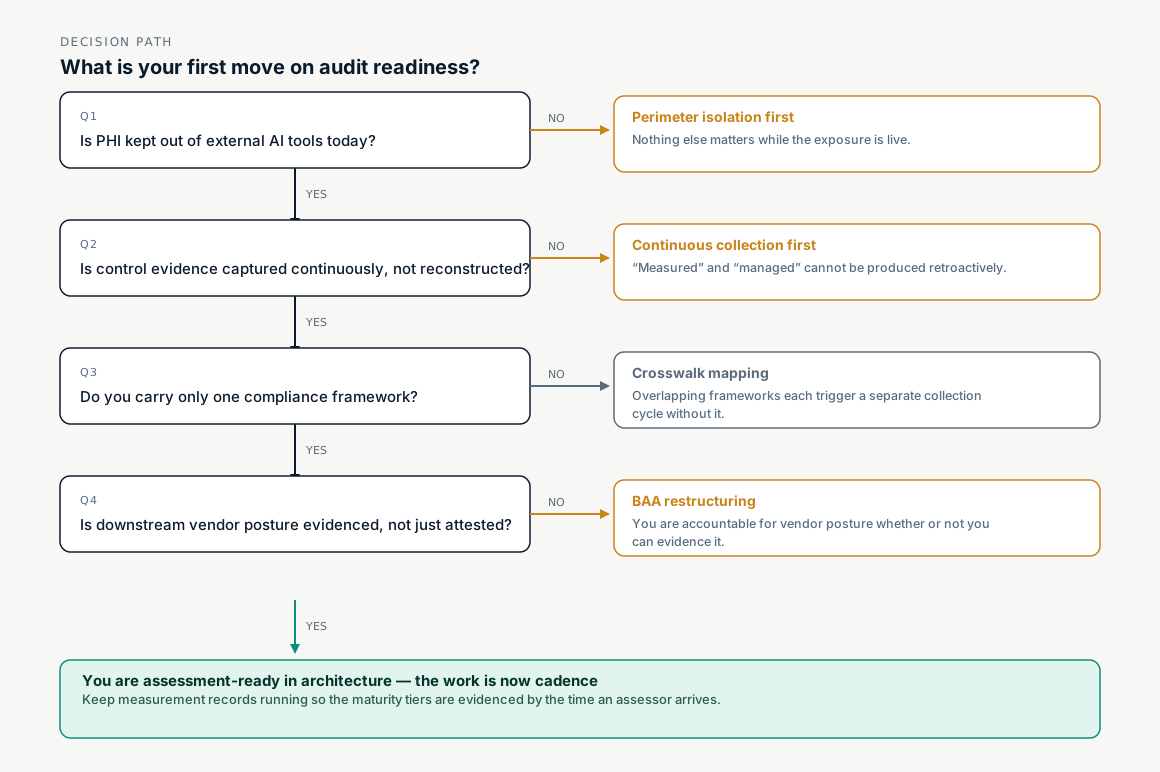
| Your situation | First move | Why |
|---|---|---|
| PHI reaching external AI tools today | Perimeter isolation | Nothing else matters while the exposure is live |
| HITRUST certification required, evidence reconstructed | Continuous collection | Maturity levels cannot be reconstructed retroactively |
| Multiple frameworks, duplicated evidence work | Crosswalk mapping | Largest labor reduction, no security trade-off |
| Downstream vendors unevidenced | BAA restructuring | You are accountable for their posture regardless |
The ladder
1 — Autonomous Audit Report (free). Modeled on your own data: which controls have contemporaneous evidence versus reconstructed, where framework overlap is duplicating collection, BAA coverage across your vendor ecosystem, and your retention posture. [Assessment scope — modeled on client data]
2 — Control Mapping Sprint. Canonical control set built and crosswalked across HIPAA, HITRUST CSF, SOC 2, and PCI DSS as applicable. Yours regardless of what follows.
3 — Governed pilot. One domain — typically access review or vendor management — running on Google Cloud with continuous collection, the human approval gate, and the ledger, so you can inspect what an assessor would receive.
4 — Compliance Shield in production. Full control path across your framework set, with standing-record re-testing when rules change.
Frequently asked questions
Is HITRUST required if we already comply with HIPAA?
No. HITRUST certification is not a legal requirement. It is commonly required contractually by payers, health systems, and enterprise partners as evidence that HIPAA obligations are met to a testable standard.
Why do HIPAA-compliant organizations fail HITRUST assessments?
Because HITRUST evaluates maturity, not just existence. A control can be correctly implemented and still score poorly if there is no evidence it was measured on a cadence and managed in response to those measurements.
Can generative AI be used on PHI?
Yes, provided the processing occurs within a covered perimeter under an executed business associate agreement and PHI is not exposed to models or services outside it. The architectural question — where the data is processed — determines the answer, not the model.
What should a HITRUST-aligned BAA include that a standard one does not?
A control responsibility matrix, quantified parameters rather than adverbs, a contractual right to the vendor's audit telemetry, and a formal exception process with residual risk scoring and expiration dates.
How does a compliance crosswalk reduce audit work?
By collecting evidence once against a canonical control and projecting it onto each framework's schema, so overlapping requirements across HIPAA, HITRUST, SOC 2, and PCI DSS do not each trigger a separate collection cycle.
Related
- Compliance Shield: Governed AI Agents for Regulated Industries
- Why Compliant Companies Fail Audits: The Evidence Production Gap
- How Do Financial Firms Govern Internal AI Under FINRA, SEC, and the EU AI Act?
- What Is Digital Labor? The Complete Guide to Governed AI Agents in the Enterprise
- The PrescientIQ™ platform
See where your own execution effort is going
The Autonomous Audit Report models where your team's execution capacity is currently spent, what your configuration is actually paying for, and what the governed alternative looks like on your own data — before any commitment.
Get your free AAR benchmark