How autonomous PLG agents lift trial-to-paid conversion without adding SDR headcount
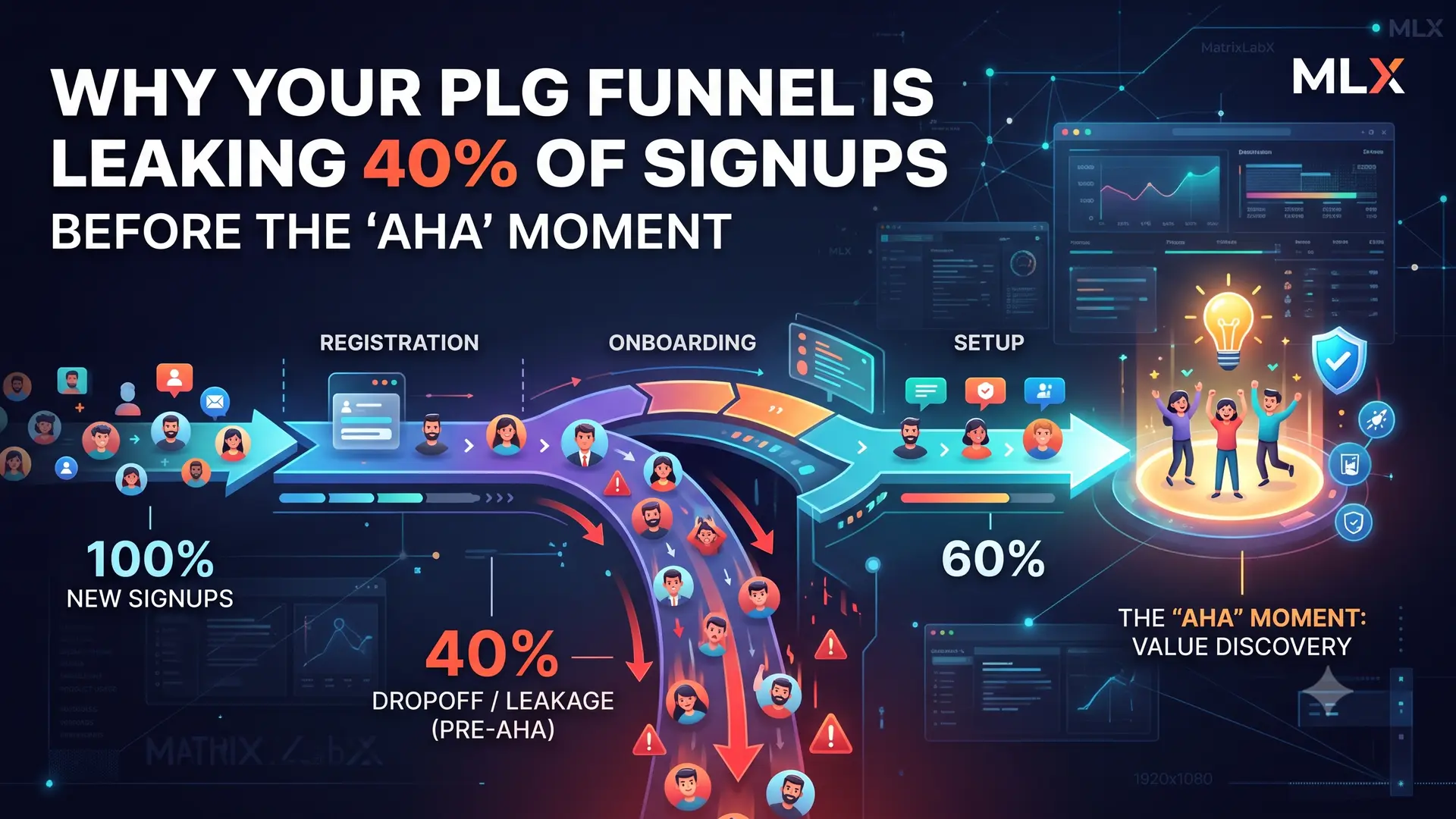
Autonomous trial-to-paid conversion agents are pre-trained digital workers that watch product usage during a free trial, decide which accounts are stalling, and act on their own to move those accounts to a paid plan. They sense activation signals, trigger onboarding guidance, book calls, and update the CRM around the clock — without waiting for a human prompt and without new SDR headcount. In MatrixLabX B2B SaaS deployments they lift trial-to-paid conversion by 38%.
🔑 Key takeaways
- Trial intent decays by the hour; autonomous agents intervene at the exact drop-off point, driving a 38% trial-to-paid lift.
- The model holds SDR headcount flat — agents handle repetitive activation work and route only sales-ready accounts to reps.
- MatrixLabX agents show goal completion 4× higher than AI copilot tools, because they act rather than wait for a prompt.
- Production deployment runs in 21 days or less, with continuous CRM maintenance holding record accuracy at 99.5%.
- Agents run at an engineered availability SLO of ≥99.5% with full audit logging and human escalation thresholds you approve.
Why do most B2B SaaS trials stall before they ever reach a paid plan?
Most trials stall because activation intent decays faster than any human team can respond, and no one is watching every account at 2 a.m. A trial user who hits a wall in setup rarely files a support ticket — they simply close the tab. Forrester research on product-led growth finds that the first 24 to 48 hours of a trial account for the majority of long-term activation outcomes, yet most SaaS teams staff onboarding coverage against business hours in one time zone.
The volume math is unforgiving. Gartner projects that by 2026 more than 60% of B2B revenue motions will carry a self-serve component, which multiplies the number of trials per rep well beyond what manual follow-up can cover. McKinsey estimates generative AI could add $0.8 trillion to $1.2 trillion in annual productivity across sales and marketing functions — a number that only lands if the work is executed autonomously, not drafted and left in a queue.
IDC reports worldwide spending on AI-centric systems is on track to surpass $300 billion by 2026, and IBM's automation studies show intelligent process automation cutting operational handling costs by up to 30%. The pattern is consistent: the bottleneck is not demand for trials, it is reaction time on the trials you already have. That is the gap a MatrixLabX autonomous execution platform is built to close.
“A trial user's intent decays by the hour. A human SDR sleeps; an autonomous agent does not. That gap is where 38% of your conversions were quietly dying.” — George Schildge, CEO & CAIO, MatrixLabX
What is the difference between an autonomous PLG agent and an AI copilot?
A copilot drafts output when a human asks; an autonomous PLG agent senses a stalled trial, decides what to do, and acts without supervision. That distinction is not academic — it is the difference between a tool that sits idle until prompted and digital labor that produces results overnight. Across production work, MatrixLabX agents show goal completion 4× higher than AI copilot tools, precisely because execution does not depend on a person being at their desk.
| Capability | AI copilot | Autonomous PLG agent |
|---|---|---|
| Trigger | Human prompt required | Real-time product signal |
| Coverage | Business hours, one operator | 24/7 across every trial account |
| Action taken | Suggests draft text | Sends, books, updates CRM, escalates |
| Goal completion | Baseline | 4× higher |
| Headcount impact | Requires an operator per seat | Holds SDR headcount flat |
For VP Growth and Head of PLG leaders, the practical takeaway is that a copilot improves the productivity of the person using it, while an agent adds capacity that never existed. The Revenue Accelerator Stack packages this agentic capacity for exactly the trial-to-paid motion.
How do autonomous agents raise trial-to-paid conversion by 38%?
They compress reaction time to near zero across the whole trial base, intervene at the precise activation drop-off, and hand reps only the accounts worth human time. The 38% lift is the product of three compounding effects: broader coverage, sharper timing, and better routing. Below is the decision flow the agents run continuously.
| Step | Agent action | Signal used | Outcome |
|---|---|---|---|
| 1. Sense | Score activation health per account | Product usage events | Ranked risk of trial abandonment |
| 2. Decide | Choose the next best intervention | Cohort + firmographic fit | Nudge, guide, or route to sales |
| 3. Act | Trigger onboarding message or call | Behavior in the last hour | Timely, context-aware outreach |
| 4. Learn | Update the playbook from results | Conversion feedback | Rising conversion per cohort |
Because the agents maintain records as they work, data hygiene stops degrading over time — CRM accuracy holds at 99.5% under continuous maintenance, which keeps the scoring model trustworthy. Paired with the Generative Growth Engine, the same signals feed lifecycle messaging that reinforces activation rather than interrupting it.
“We do not sell software that waits for a prompt. We deploy digital labor that senses a stalled onboarding and acts before the trial clock runs out.”— George Schildge, CEO & CAIO, MatrixLabX
Three trial-to-paid patterns agents fix
Use case 1 — The silent setup wall
Before
A workflow-automation vendor watched 71% of trials abandon during a multi-step integration setup. The growth team saw the drop in a dashboard on Monday — three days after the users had already left. Manual follow-up reached fewer than one in five stalled accounts, and reps chased familiar logos instead of the accounts at highest activation risk.
After
An autonomous agent pinpointed the exact step where each account froze, triggered a contextual walkthrough within the hour, and offered a 12-minute setup call only to accounts that re-engaged. Trial-to-paid conversion in that cohort climbed sharply — with no new SDRs added.
Bridge
The same sense-decide-act loop scales to every setup path in your product, turning a lagging dashboard metric into a live intervention surface that recovers revenue you were already losing on autopilot.
Use case 2 — The overnight and weekend gap
Before
A developer-tools company drew heavy trial sign-ups from Europe and Asia, but its SDR team sat in a single North American time zone. Roughly 40% of activation-critical moments happened while the team was offline, so high-intent users hit friction with no response until the next business day — by which point they had already evaluated a competitor.
After
Agents covered every account continuously at an engineered availability SLO of ≥99.5%, answering configuration questions and nudging next steps the moment usage signaled readiness — regardless of clock or calendar. Weekend and overnight cohorts finally converted at rates matching daytime cohorts.
Bridge
Continuous coverage removes the single biggest structural leak in global PLG — the hours no human is on — without asking anyone to work a night shift or expanding payroll.
Use case 3 — Reps buried in low-intent trials
Before
A vertical SaaS platform generated 900 trials a month against six SDRs. Reps sprayed the same generic follow-up across every account, sank hours into tire-kickers, and still missed the handful of enterprise trials that mattered. Pipeline was noisy, forecasting was guesswork, and morale suffered under an impossible ratio.
After
Agents qualified and nurtured the entire base, then routed only sales-ready accounts — scored on real product depth and firmographic fit — to the human team. Reps stopped chasing and started closing.
Bridge
When agents own the top of the trial funnel, every rep's hour lands on accounts with genuine buying intent — lifting output per person without a single new hire.
What does the P&L math look like versus hiring more SDRs?
The agent model turns a rising, step-function headcount cost into fixed digital labor that scales with trial volume at near-zero marginal cost. Hiring to cover growing trial volume means ramp time, benefits, tooling seats, and management overhead — and it caps out at human working hours. The comparison below reflects a mid-market B2B SaaS growth team.
| Dimension | Add SDR headcount | Autonomous PLG agents |
|---|---|---|
| Time to full productivity | 3–6 months per hire | Deployment in 21 days or less |
| Coverage window | ~40 hours/week per rep | 24/7, ≥99.5% availability SLO |
| Cost curve as trials grow | Step-function, linear headcount | Fixed digital labor |
| Trial-to-paid conversion | Bounded by reaction time | +38% |
For a full picture of outcomes across verticals, see how MatrixLabX teams document results — See client results.
“Product-led companies win on time-to-value, and time-to-value is decided in the first hours of a trial — long before a human rep would traditionally engage.”— Forrester analyst commentary, B2B growth research
What does a real trial-to-paid turnaround look like in practice?
It looks like a growth leader who stopped hiring to cover volume and started deploying agents to close the reaction-time gap instead. Here is the arc, told in situation, complication, solution, and result.
Situation. Maya, Head of PLG at a 140-person B2B SaaS company, ran a self-serve trial that pulled in strong top-line sign-ups. Her board wanted trial-to-paid conversion up by the next fiscal year without a proportional rise in sales spend.
Complication. Her four SDRs were already overloaded. Adding two more would blow the CAC target, and even then the team could not cover overnight and weekend activation windows. Conversion had flatlined for three quarters, and every proposed fix was another headcount request.
Solution. Maya deployed autonomous trial-to-paid conversion agents in 11 days. The agents scored every trial account on activation health, intervened at the precise drop-off step, and routed only sales-ready accounts to her existing reps. No new hires, full audit logging, and escalation thresholds she approved herself.
Result. Within the first two cohorts, trial-to-paid conversion rose 38%. Her SDRs, freed from low-intent follow-up, reported higher-quality conversations. Maya hit the board target with flat headcount and a lower CAC.
Are autonomous PLG agents right for your trial motion?
Walk the branches below. Expand each question to see where you land.
Do you run a free trial or freemium motion at scale?
Yes — and reps cannot cover every trial in real time
Strong fit. Reaction-time coverage is exactly what agents add. Expect the 38% conversion lift pattern.
Yes — but our product usage data is not instrumented
Prerequisite gap. Instrument core activation events first; agents decide on signals, and there is no signal to read yet.
No — we are sales-led with no self-serve trial
A different agent pattern fits better. Talk to us about pipeline-generation agents rather than trial-conversion agents.
How do you deploy autonomous trial-to-paid agents in 21 days or less?
You connect data, define guardrails, and let pre-trained vertical-specific agents go live in cohorts — no model building required. Because the agents ship pre-trained, most of the 21-day window is integration and review, not development. Follow this sequence.
- Map the activation moment. Identify the two or three in-product events that best predict paid conversion. This becomes the scoring backbone the agents read.
- Connect the data sources. Wire product usage events, trial and billing state, and your CRM into PrescientIQ™. The agents begin maintaining these records immediately, driving CRM accuracy toward 99.5%.
- Define guardrails and escalation thresholds. Set tone, cadence caps, and the exact conditions under which an agent hands an account to a human. You approve every boundary before launch.
- Configure the intervention library. Load the onboarding guidance, walkthroughs, and offers the agent can trigger, mapped to each drop-off point in the funnel.
- Run a shadow cohort. Let agents score and recommend without acting for a short window, so your team can validate decisions against reality before going live.
- Activate on a first cohort. Turn on autonomous action for one trial segment. Measure conversion, activation, and escalation quality against the shadow baseline.
- Route sales-ready accounts to reps. Confirm the handoff logic surfaces only high-intent accounts, so SDR hours land where they convert.
- Scale and let the agents learn. Expand to the full trial base. The learn loop refines the playbook per cohort, and conversion compounds toward the 38% pattern.
Why might autonomous PLG agents not work for you?
Agents amplify a working trial motion — they do not rescue a broken product or absent data. Be honest about these failure conditions before you commit.
- No product usage instrumentation. If you cannot capture what trial users do in the product, agents have no signal to decide on. Fix telemetry first.
- The product itself blocks activation. If users churn because a core feature is missing or broken, better follow-up will not convert them. The problem is upstream of any agent.
- No real trial or freemium motion. Pure sales-led organizations without self-serve trials need a different agent pattern, not this one.
- Unwillingness to set guardrails. Autonomy requires approved boundaries and escalation rules. Teams that will not define them should not run autonomous action.
- Very low trial volume. If you get a handful of trials a month, a single rep can cover them by hand and the economics of digital labor are weaker.
Frequently asked questions
What are autonomous trial-to-paid conversion agents?
They are digital workers that watch product usage during a free trial, decide which accounts are stalling, and act on their own to unblock activation. Unlike a copilot, they do not wait for a prompt. They send guidance, book calls, and update the CRM continuously.
How do PLG AI agents lift trial-to-paid conversion by 38 percent?
They close the reaction-time gap. Trial intent decays by the hour, and human reps cannot cover every account overnight. Agents track activation signals in real time, intervene at the exact drop-off point, and route only sales-ready accounts to your team, so more trials reach a paid plan.
Do I need to hire more SDRs to run this?
No. The point of autonomous SaaS trial conversion is to hold headcount flat while volume grows. Agents handle repetitive activation nudges and qualification. Your existing reps then spend their hours on high-intent accounts the agents surface, which raises output per rep.
How fast can PLG AI agents go live?
MatrixLabX production deployments run in 21 days or less because the agents are pre-trained and vertical-specific. Most of that window is data connection and guardrail review, not model building. You see measurable activation movement inside the first onboarding cohorts.
Will automated onboarding feel robotic to my trial users?
It should not. Good automated onboarding is triggered by real behavior, not a fixed drip. The agent references what the user actually did in the product, so the message reads as timely help. Tone, cadence, and escalation to a human are all configurable.
How is this different from an AI copilot inside our sales tool?
A copilot drafts content when a human asks. An autonomous agent senses, decides, and acts without supervision. That difference shows up in results: MatrixLabX agents show goal completion 4 times higher than AI copilot tools across production work.
What data do the agents need to work?
They need product usage events, your trial or freemium billing state, and CRM records. Cleaner inputs produce sharper decisions. During deployment the agents also maintain records, and CRM accuracy reaches 99.5 percent under continuous maintenance.
What happens if an agent makes a wrong call?
Every action runs inside guardrails you approve, with human escalation thresholds and full audit logging. Agents run at an engineered availability SLO of ≥99.5% and log each decision, so you can review, correct, and retrain rather than guess at what happened.
The bottom line for product-led growth leaders
Your trial base is not underperforming because demand is weak — it is underperforming because reaction time is human-bound and no team can watch every account around the clock. Autonomous trial-to-paid conversion agents remove that constraint. They sense stalled onboarding, decide the next best move, act within the hour, and learn from every cohort, driving a 38% conversion lift while holding SDR headcount flat.
The next steps are concrete: confirm your activation events are instrumented, connect product, billing, and CRM data, define the guardrails you are comfortable with, and run a shadow cohort before you go live. With pre-trained agents, that path takes 21 days or less end to end. For the full picture of what PrescientIQ™ executes autonomously, review the PrescientIQ™ platform overview.
“By 2026, the organizations pulling ahead will be the ones that treat AI as autonomous digital labor, not as an assistant waiting to be asked.”— Gartner analyst commentary, enterprise AI adoption research
Ready to convert more trials with the team you already have?
Book a Discovery Call →See where your own execution effort is going
The Autonomous Audit Report models where your team's execution capacity is currently spent, what your configuration is actually paying for, and what the governed alternative looks like on your own data — before any commitment.
Get your free AAR benchmark