What “AI-ready data” means for revenue teams
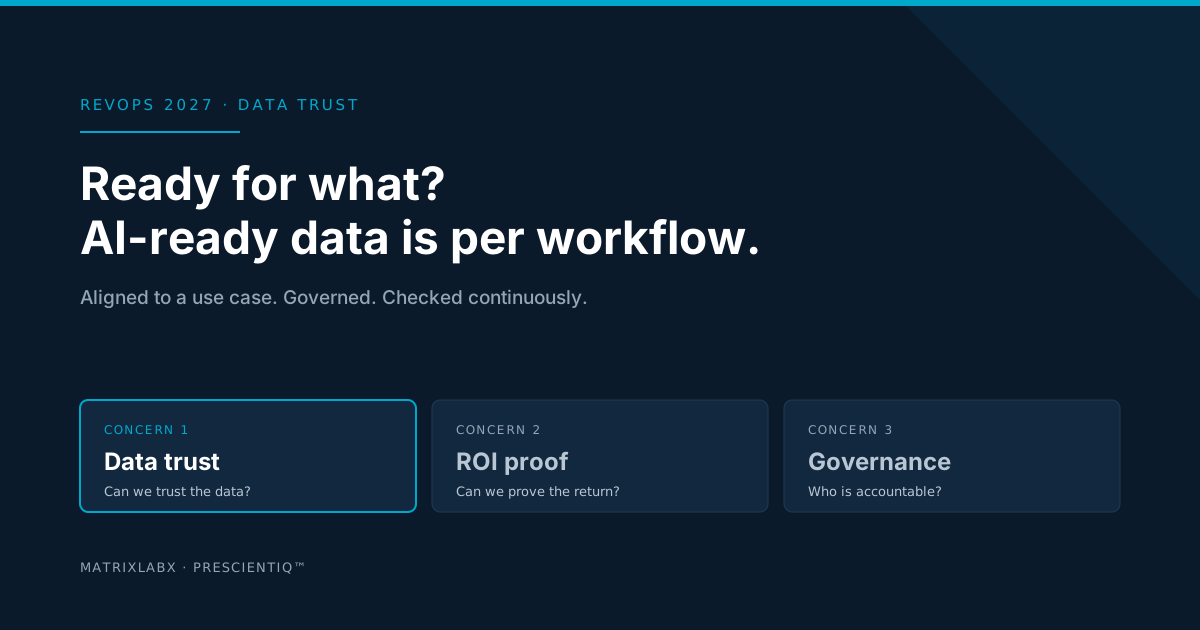
AI-ready data is not the same as a clean CRM. It is data that fits a specific AI use case, is actively governed, and is quality-checked continuously instead of in periodic audits. For RevOps, that means defining data readiness workflow by workflow (prospecting, outbound, trial conversion, expansion) and not trying to fix the whole CRM before any agent goes live.
Gartner’s warning, translated for RevOps
In February 2025, Gartner published one of the most-cited AI findings of the cycle. It predicted that through 2026, organizations will abandon 60% of AI projects that are not supported by AI-ready data. A Gartner survey of 248 data management leaders found that 63% of organizations either lacked, or were unsure they had, the right data management practices for AI.
Gartner’s more useful point often gets lost: organizations that treat AI-ready data as traditional data management put their AI efforts at risk.
For a revenue team, traditional data management means the CRM is clean enough for the pipeline report. AI-ready means clean enough for a machine to act on without a person re-checking every record. That is a different bar.
Three properties of AI-ready revenue data
1. Aligned to a use case. Data is ready, or not, for something. The fields a Trial Conversion workflow needs, such as product events, trial start dates, and activation milestones, have little in common with the fields an Expansion workflow needs. A readiness assessment that ignores the use case measures the wrong thing.
2. Actively governed. Someone owns each field the workflow depends on, including who can write to it, from which systems, and under what rules. If three tools can overwrite a lead-source field, it isn’t governed. It’s contested.
3. Continuously quality-assured. Quarterly audits don’t meet this bar. When an agent acts daily, quality has to be checked at least as often as the data is used. Otherwise you are auditing last quarter’s errors while this week’s are already in customers’ inboxes.
A workflow-by-workflow readiness map
| Revenue workflow | Data it depends on | The readiness question |
|---|---|---|
| Prospecting | Firmographics, intent signals, ICP fit criteria | Can we reproduce why each account was scored the way it was? |
| Outbound | Contact details, trigger events, prior touch history | Is the contact still at the company, and is the trigger still current? |
| Trial conversion | Product usage events, trial dates, activation milestones | Do product events reach the revenue system fast enough to act on a stall? |
| Expansion | Usage trends, renewal dates, account health signals | Are health signals current enough to act ahead of the CSM review? |
Start with the workflow where the readiness answer is closest to yes. That is your first agent deployment, not the one with the most impressive demo.
George Schildge’s view
How PrescientIQ™ fits
Four specialist agents (Scout, Herald, Guide, and Steward) work under one coordinator, Marshal. Readiness can be assessed and deployed one workflow at a time:
- Reproducible scoring. Account scoring runs on sandboxed deterministic code. No language model performs arithmetic that has a numeric consequence, so a score can be reproduced and checked.
- Grounded outreach. Outreach is grounded in the specific signal that triggered it, with the reasoning behind each draft captured alongside it.
- Stall response. Guide, the trial conversion agent, watches in-product behavior and prepares an activation sequence when a trial stalls before its value event. The message is held for approval before it sends.
- A continuous quality signal. Every action, in either mode, is recorded to the audit ledger with its rationale, before-and-after state, and the approver or policy behind it.
The free Autonomous Audit Report is a P&L projection built on your own data in a read-only working session. Every figure in it is labeled as modeled. It shows which workflows your current data can support before you commit.
Action items for RevOps this quarter
- Rank your four core revenue workflows by data readiness using the table above.
- For the top-ranked workflow, list every field it reads and writes, and name an owner for each.
- Document which systems can write to each field, and remove write access that has no business reason.
- Set a quality-check cadence for those fields that matches how often the workflow will run.
Check the math before you spend anything
The free AAR Benchmark builds a P&L projection on your own pipeline data in a read-only working session. Every figure in it is labeled as modeled.
Get your free AAR Benchmark →Frequently asked questions
- What is AI-ready data?
- AI-ready data is data that fits a specific AI use case, is actively governed, and is quality-checked continuously. It differs from traditional data management, which aims for data clean enough for reporting. AI-ready data must be reliable enough for a system to act on without a person re-checking every record.
- Why does Gartner say AI projects fail without AI-ready data?
- Gartner found that 63% of organizations lacked, or were unsure they had, the right data management practices for AI. It predicts that through 2026, organizations will abandon 60% of AI projects not supported by AI-ready data, because systems acting on unreliable data produce unreliable outcomes.
- Does the whole CRM need to be AI-ready?
- No. Readiness should be assessed for each workflow. The fields a trial-conversion workflow needs differ from those an expansion workflow needs. Starting with the single workflow whose data is closest to ready lets RevOps prove value on real data without an open-ended cleanup project.
- How should RevOps assess data readiness?
- List the fields each planned workflow reads and writes, name an owner for each field, document which systems can write to it, and measure freshness on a cadence that matches how often the workflow runs. The workflow scoring best across those checks is the right first deployment.
- What does “actively governed” mean for CRM data?
- It means each field has an owner and defined rules about which systems and people can change it. When several tools can overwrite the same field without coordination, the data is contested, not governed, and any agent acting on it inherits that uncertainty.
- How does PrescientIQ support AI-ready data?
- PrescientIQ deploys four specialist agents, so readiness can be addressed one workflow at a time. Scoring runs on deterministic code and can be reproduced. Every action is recorded to the audit ledger with its before-and-after state. The free AAR Benchmark shows which workflows your data can support.
Sources
- Gartner, “Lack of AI-Ready Data Puts AI Projects at Risk,” February 26, 2025. Link
Research findings are paraphrased and carry their original publication dates. Predictions are the research firms’, not ours. Recommendations and checklists are the author’s and are offered as a starting point, not as benchmarks.
Where PrescientIQ runs
PrescientIQ is hosted and operated by MatrixLabX on Google Cloud. SOC 2, ISO 27001, and PCI DSS attestations are held by Google Cloud, which operates the underlying infrastructure. They are not MatrixLabX certifications. MatrixLabX application-layer SOC 2 is in progress.