How to deploy agents on the CRM you actually have
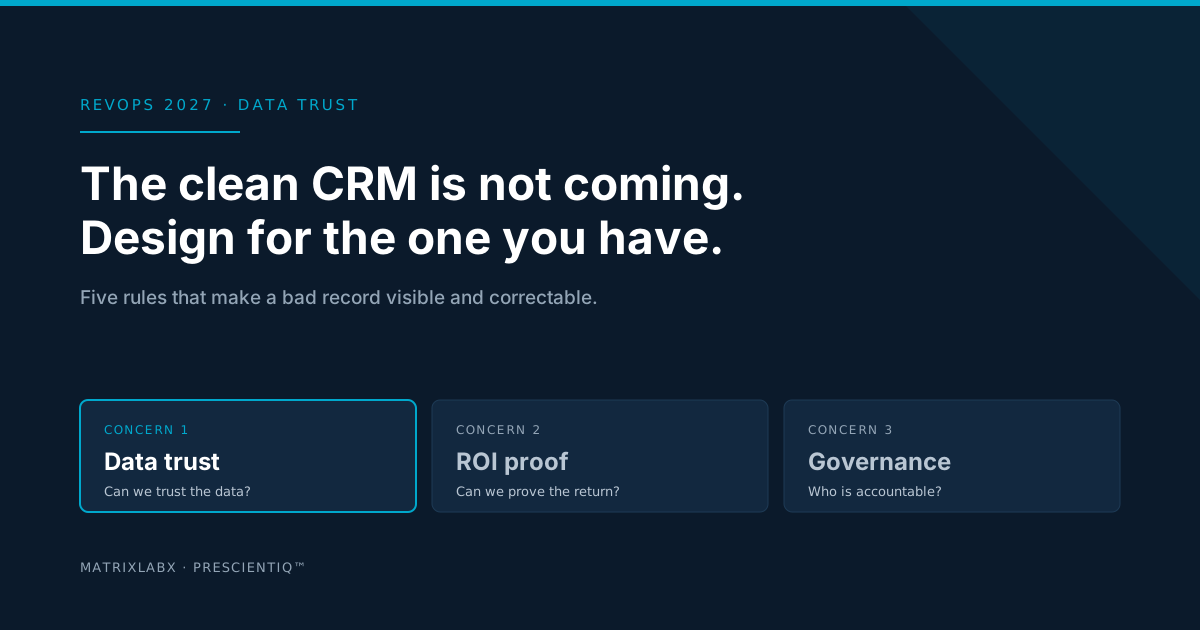
You don’t need a perfect CRM to deploy revenue agents. You need five design choices: scope each agent to one workflow, compute scores deterministically, ground every action in a current trigger, record every write before and after, and hold the riskiest action classes for human approval. Together these make errors visible and correctable, not silent.
The “clean data first” trap
“We’ll deploy AI once the data is clean” sounds prudent. In practice it is a deferral with no end date. Contact data changes continuously, so the clean state you are waiting for starts eroding the moment the cleanup ends.
The research points the same way. Gartner warns against treating AI-ready data as a traditional data management exercise (Gartner, February 2025). McKinsey’s 2025 State of AI survey found that the organizations seeing the most value from AI are the ones redesigning workflows, not waiting for ideal conditions.
Five design rules for agents on imperfect data
Rule 1: Scope each agent to one workflow. A general-purpose agent touching every object in your CRM inherits every data problem you have. A specialist agent scoped to one workflow inherits only that workflow’s problems, which you can measure and fix.
Rule 2: Keep the math deterministic. Language models are good at reading context and drafting language. They are not the right tool for arithmetic with a business consequence. Scores, thresholds, and pricing logic should run in deterministic code, so any result can be reproduced and audited.
Rule 3: Ground every action in a current trigger. An outreach built on a six-month-old enrichment snapshot is a guess. An outreach built on a trigger that fired this week (a job posting, a funding event, a product-usage stall) is anchored in current reality, even if other fields on the record are stale.
Rule 4: Record every write before and after. This is the rule that makes imperfect data survivable. If every CRM change records its prior state, its new state, the agent that made it, and why, a bad write is a line in a ledger you can find and correct, not corruption you discover next quarter.
Rule 5: Hold the riskiest action classes. Not every action carries the same risk. A field update on an internal record is different from an email in your brand’s name to a new prospect. Set a different autonomy level for each class, and hold the ones where a data error would reach a customer until data quality in that workflow has earned trust.
George Schildge’s view
How PrescientIQ™ applies the five rules
Rule 5 depends on two governance modes, which your team chooses between for each action class:
Human-in-the-loop (HITL). The action is drafted and held. It does not execute until a named person on your team approves it.
Human-on-the-loop (HOTL). The action executes under a standing policy your team sets. A named person supervises and keeps intervention, override, and revocation authority.
Your team chooses the mode for each action class, based on its risk tolerance, and can change it at any time.
Every action, in either mode, is recorded to the audit ledger with its rationale, before-and-after state, and the approver or policy behind it.
Every action class starts in human-in-the-loop until your team changes it.
| Design rule | How PrescientIQ implements it |
|---|---|
| One workflow per agent | Four specialist agents (Scout, Herald, Guide, and Steward) work under one coordinator, Marshal. |
| Deterministic math | Account scoring runs on sandboxed deterministic code. No language model performs arithmetic that has a numeric consequence, so a score can be reproduced and checked. |
| Current triggers | Outreach is grounded in the specific signal that triggered it, with the reasoning behind each draft captured alongside it. |
| Before-and-after record | Every action, in either mode, is recorded to the audit ledger with its rationale, before-and-after state, and the approver or policy behind it. |
| Held action classes | Your team chooses the mode for each action class, based on its risk tolerance, and can change it at any time. Every action class starts in human-in-the-loop until your team changes it. |
Action items for RevOps this quarter
- Choose one workflow and write its scope in a single sentence. If the sentence needs “and,” narrow it.
- Identify every calculation in that workflow and confirm it runs in deterministic code.
- Classify each action the workflow takes by where an error would land: internal record, internal person, or customer.
- Set the autonomy level for each class. Hold customer-facing classes first.
- Before go-live, confirm you can pull a before-and-after record of any action from the previous week.
Check the math before you spend anything
The free AAR Benchmark builds a P&L projection on your own pipeline data in a read-only working session. Every figure in it is labeled as modeled.
Get your free AAR Benchmark →Frequently asked questions
- Can AI agents work with imperfect CRM data?
- Yes, if the deployment is designed for it. Scope each agent to one workflow, compute scores deterministically, ground actions in current triggers, record every write before and after, and hold the riskiest action classes for approval. These choices make data errors visible and correctable, not silent.
- Why should agent scoring be deterministic?
- Deterministic scoring produces the same result from the same inputs every time, so any score can be reproduced and explained. Language models are strong at reading context and drafting language but are not the right tool for calculations with business consequences like prioritization, thresholds, or pricing.
- What does “before-and-after” logging mean?
- It means every change an agent makes records the field’s prior value, its new value, which agent made the change, and why. If an agent acts on a bad record, RevOps can find the change and correct it, and does not have to discover the damage in a later report.
- Which agent actions should require human approval?
- Start with actions where a data error would reach a customer, such as outbound emails to new prospects. Internal record updates carry lower risk. Set autonomy levels by action class and relax them as data quality in each workflow earns trust through measured results.
- Is waiting for clean data a safer approach?
- Usually not. CRM data changes continuously, so a clean state starts eroding as soon as the cleanup ends. Gartner warns against treating AI-ready data as traditional data management. Designing for imperfect data lets teams deploy safely now and not defer indefinitely.
- How does PrescientIQ handle risky actions on imperfect data?
- Your team chooses the mode for each action class, based on its risk tolerance, and can change it at any time. Every action class starts in human-in-the-loop until your team changes it. Every action, in either mode, is recorded to the audit ledger with its rationale, before-and-after state, and the approver or policy behind it.
Sources
- Gartner, “Lack of AI-Ready Data Puts AI Projects at Risk,” February 26, 2025. Link
- McKinsey & Company, “The state of AI in 2025: Agents, innovation, and transformation,” survey fielded June to July 2025. Link
Research findings are paraphrased and carry their original publication dates. Predictions are the research firms’, not ours. Recommendations and checklists are the author’s and are offered as a starting point, not as benchmarks.
Where PrescientIQ runs
PrescientIQ is hosted and operated by MatrixLabX on Google Cloud. SOC 2, ISO 27001, and PCI DSS attestations are held by Google Cloud, which operates the underlying infrastructure. They are not MatrixLabX certifications. MatrixLabX application-layer SOC 2 is in progress.