Why your CRM data decays faster than your cleanup cycle
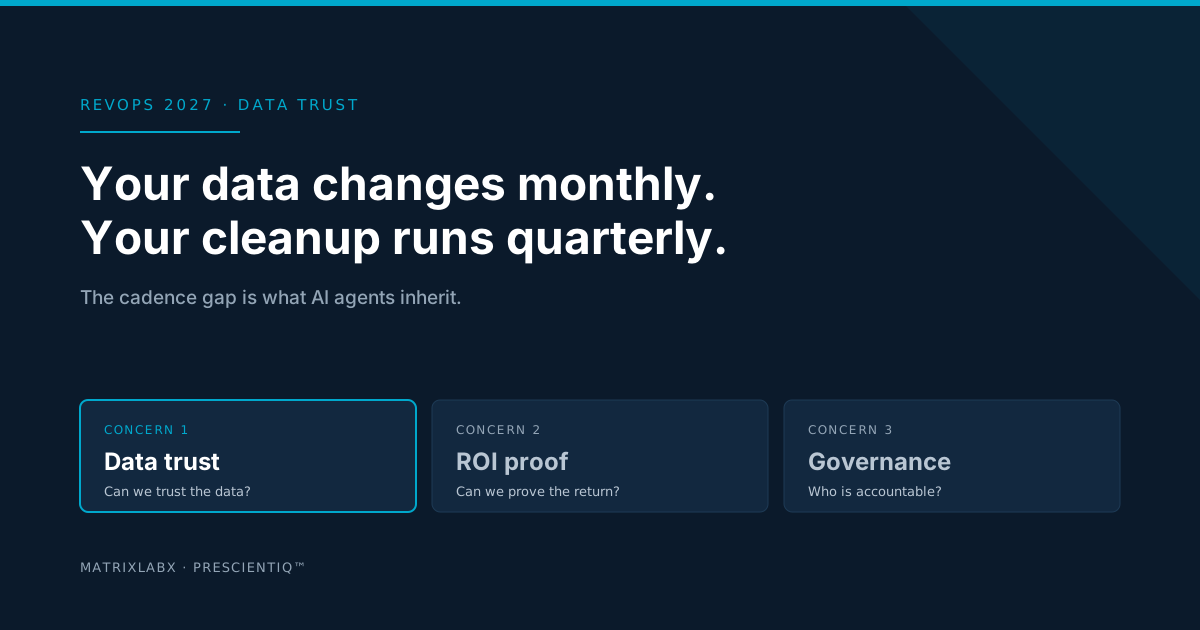
CRM data decays continuously as people change jobs, companies restructure, and contact details go stale. Most revenue teams clean data in periodic batches. When change happens every month and cleanup happens every quarter, the CRM is never fully current. AI agents acting on that data inherit the gap. In 2027 it becomes a pipeline problem, not just a reporting problem.
The cadence mismatch nobody puts on the roadmap
Every RevOps team knows the CRM drifts. What few teams quantify is the rate of drift compared with the rate of repair.
Lusha measured it directly. Tracking more than 140,000 US sales leaders, it found that about one in eight changed roles within twelve months and about a quarter within twenty-four, which works out to close to 1% every month (Lusha, September 2026). The same study is candid about the figure most of the industry repeats. Lusha could not find a primary source for the claim that 30% of contact data decays each year, and its own numbers suggest that figure is closer to a two-year rate.
The lower, measured number is still enough to break a quarterly process. If records go stale every month and you repair them every quarter, you are always working on data that was partly wrong before the cleanup finished.
Why this matters more in 2027 than it did in 2024
When CRM data fed dashboards, stale data produced a bad chart. A person looked at the chart, applied judgment, and moved on.
When CRM data feeds agents, stale data produces an action: an email to someone who left the company six months ago, a lead routed to the wrong territory, an expansion play aimed at an account that already churned. The judgment layer that used to catch the error is the thing you just automated.
This is the core of Gartner’s warning. It found that 63% of organizations lacked, or were unsure they had, the right data management practices for AI, and it predicts that 60% of AI projects without AI-ready data will be abandoned through 2026 (Gartner, February 2025). Practitioners see the same thing. In Default’s H1 2026 survey of more than 300 RevOps leaders, poor data quality was the most-cited barrier to AI adoption.
What the cost looks like on the revenue team
76%
The cost shows up in three places:
- Lost revenue. In the same Validity survey, 37% of respondents reported losing revenue as a direct result of poor data quality.
- Seller time. Every stale record is research, re-verification, or a bounced message in place of selling.
- Trust. The less visible cost is that leadership stops believing the forecast, so every AI initiative has to clear a higher bar.
George Schildge’s view
How PrescientIQ™ fits
PrescientIQ doesn’t pretend your CRM is clean. It makes every change the agents make visible:
- Every action, in either mode, is recorded to the audit ledger with its rationale, before-and-after state, and the approver or policy behind it.
- Outreach is grounded in the specific signal that triggered it, with the reasoning behind each draft captured alongside it.
- Agents read from and write back to Salesforce and HubSpot through typed, scoped integrations.
That turns agent-made changes from an invisible tax into a record your RevOps team can review.
Action items for RevOps this quarter
- Measure your decay rate, not just your error count. Sample 200 contacts touched in the last 90 days and check how many titles, companies, or emails have changed.
- Match repair cadence to decay cadence on the fields your planned agent workflows depend on. Monthly at minimum.
- Make change-logging a buying requirement. Any system that writes to the CRM must record what it changed, before and after.
- Report data freshness to the CRO alongside pipeline, so the cost of drift is visible where budget decisions are made.
For the repair side of the problem, see RevOps and CRM data debt.
Check the math before you spend anything
The free AAR Benchmark builds a P&L projection on your own pipeline data in a read-only working session. Every figure in it is labeled as modeled.
Get your free AAR Benchmark →Frequently asked questions
- How fast does B2B CRM data decay?
- Estimates vary, and many widely repeated figures have no primary source. Lusha’s 2026 measurement of more than 140,000 US sales leaders found about one in eight changed roles within twelve months, close to 1% a month. That is meaningful change every month, faster than a quarterly cleanup can repair.
- Why isn’t a quarterly CRM cleanup enough?
- Because change is continuous and cleanup is periodic. Records keep going stale between cleanups, so the CRM is never fully current. When agents act on that data, the gap becomes wrong outreach, misrouted leads, and mistimed plays, not a slightly inaccurate report.
- How does CRM data quality affect AI agents?
- Agents turn data into actions. When a dashboard reads stale data, a person can apply judgment. When an agent reads stale data, it may email the wrong person or route a lead incorrectly. Gartner predicts 60% of AI projects without AI-ready data will be abandoned through 2026.
- What does poor CRM data cost a revenue team?
- In Validity’s 2025 survey of 602 CRM users, 37% reported losing revenue as a direct result of poor data quality, and 76% said less than half of their CRM data is accurate and complete. The largest cost is often lost leadership confidence in the forecast.
- What should RevOps measure first?
- Start with decay rate on the fields your planned agent workflows read and write. Sample recently touched contacts, check how many details changed, and repeat monthly. That gives you a repair cadence tied to real drift, not a calendar, and a baseline to show leadership.
- How does PrescientIQ handle imperfect CRM data?
- Every action, in either mode, is recorded to the audit ledger with its rationale, before-and-after state, and the approver or policy behind it. An error becomes visible and traceable, not silent. Outreach is grounded in the specific signal that triggered it, and agents write back to Salesforce and HubSpot through typed, scoped integrations.
Sources
- Lusha, “B2B Data Decay Rate: We Measured 12.6% a Year,” September 12, 2026. Link
- Validity, “The State of CRM Data Management in 2025,” announced July 10, 2025. Link
- Gartner, “Lack of AI-Ready Data Puts AI Projects at Risk,” February 26, 2025. Link
- Default, “The State of AI in Revenue Operations: H1 2026 Report”. Link
Research findings are paraphrased and carry their original publication dates. Predictions are the research firms’, not ours. Recommendations and checklists are the author’s and are offered as a starting point, not as benchmarks. The Lusha figure measures job changes among the sales leaders it tracks, which is one cause of contact data going stale, not a rate for every field in a CRM.
Where PrescientIQ runs
PrescientIQ is hosted and operated by MatrixLabX on Google Cloud. SOC 2, ISO 27001, and PCI DSS attestations are held by Google Cloud, which operates the underlying infrastructure. They are not MatrixLabX certifications. MatrixLabX application-layer SOC 2 is in progress.