Category Definition
Governed AI SDR
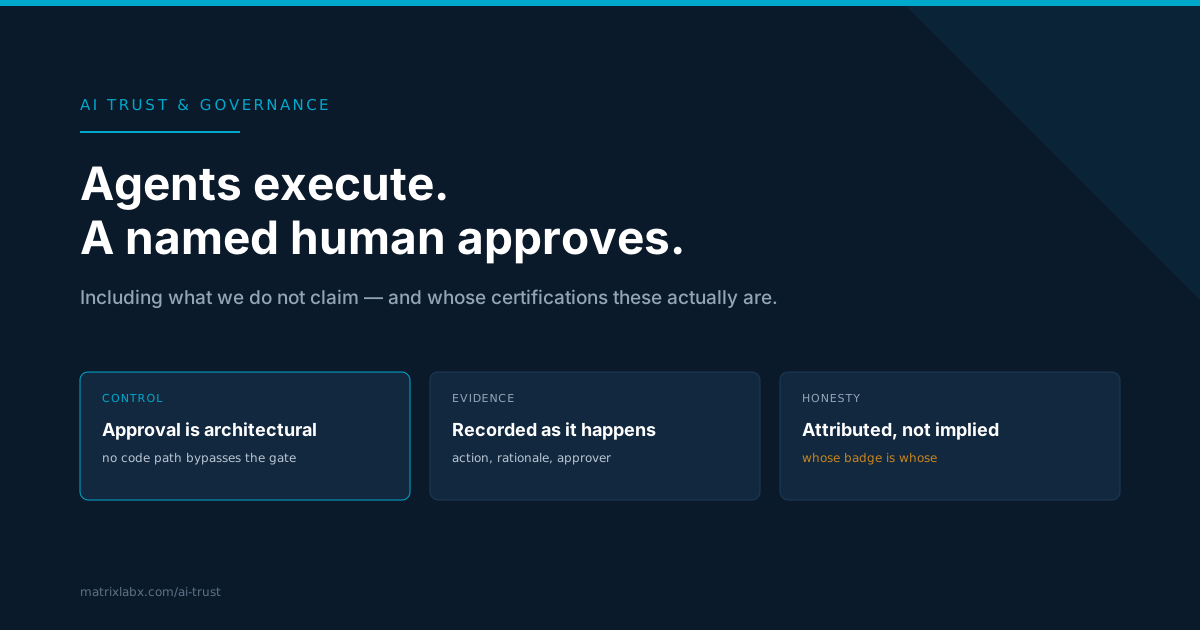
A governed AI SDR is an AI sales development agent that researches and drafts continuously, but requires a named human to approve every externally visible action — a send, a CRM write a prospect would see — before it executes. The approval is enforced at the tool layer, not requested in a prompt, and every action is recorded to an immutable audit ledger. Labor-as-a-Service is how this is commonly billed. It is not what makes it governed.
“AI SDR” stopped meaning one thing somewhere around the point every vendor in the category started using it. Some products send outbound with no review step at all. Others hold every message for approval. Those are not two flavors of the same thing — they are different architectures with different failure modes, and the word “governed” is doing the actual load-bearing work in that distinction.
This page defines the term precisely, separates it from a billing model it frequently gets confused with, and gives you a way to check which one you are actually being sold.
What makes an AI SDR “governed”
Where does the workload actually run, and is model-training exclusion a written contract term?
Is it enforced with no code path for an unapproved send — or a system prompt asking the model to check first?
Is every action written to an immutable log at execution time, or reconstructed from application logs afterward?
Does each agent hold its own least-privilege identity, or share one broad-access account?
The full version of this checklist, with what a weak answer sounds like on each point, is in what an AI agent security review actually checks.
Governed vs. ungoverned AI SDR
The comparison that matters is structural, not a performance contest — this is about where control sits, not which one produces more volume.
| Dimension | Governed AI SDR | Ungoverned / autonomous AI SDR |
|---|---|---|
| Send authority | Every message waits for a named human to approve it before it sends. | Sends without a per-message review step once the model decides. |
| Audit trail | Immutable ledger: action, rationale, and approver written at the moment it happens. | Best-effort application logs, reconstructed after the fact if kept at all. |
| Identity | Each agent holds its own scoped, least-privilege identity. | Often a shared service account or API key with broad access. |
| Behavior under uncertainty | Fails closed — stops and routes to a person when confidence or data is missing. | Fails open — proceeds on its best guess and flags it later, if at all. |
| Billing model commonly paired with it | Often Labor-as-a-Service — but this is a separate choice, not a defining feature. | Per-seat, flat SaaS fee, or usage priced on send volume — also a separate choice. |
Notice the last row. That pairing is common, and the next section explains exactly why — but it is a separate decision, not a package deal.
Labor-as-a-Service is how it’s priced. Not what it is.
“Governed AI SDR” and “Labor-as-a-Service” get used almost interchangeably in vendor pitches, including some of our own. They describe two different things, and conflating them makes both harder to evaluate.
Governed AI SDR is an operating model — the answer to what an agent is allowed to do, who signs off, and what gets recorded. Fail-closed behavior, a human-in-the-loop gate, an immutable audit ledger, least-privilege identity. None of that is a pricing decision.
Labor-as-a-Service is a billing model — the answer to what you pay for. You pay for executed, approved work rather than for a license to access software, whether or not anyone uses it.
That still does not make them one axis. A governed AI SDR could, in principle, be sold under a flat per-seat fee. An ungoverned one has been sold under a metered, LaaS-styled rate. When evaluating a vendor, ask about each separately: is the send behavior actually gated at the tool layer — that is governance — and is the price tied to completed, approved work rather than seats or volume — that is billing. A yes on one does not answer the other.
How PrescientIQ prices it
Labor-as-a-Service here, specifically, means a flat annual platform fee — not a per-message meter. Worth naming explicitly, since “Labor-as-a-Service” sometimes gets read as “billed per unit of work” by default. Ours is priced for the work the platform is built to do at a typical deployment’s volume:
| Component | Investment | Billing frequency |
|---|---|---|
| Annual platform feeEnvironment provisioning on Google Cloud, per-agent IAM, audit-ledger setup, and context ingestion from your CRM — plus four cooperating agents (Scout, Herald, Guide, and Steward), their coordinator Marshal, the approval queue and standing-policy controls, and the immutable audit ledger, and the monthly execution volume a typical mid-market deployment runs. One fee, from signature, every year.Target — modeled: live in 21 days or less$165,000/year is the complete platform fee. There is no separate implementation charge and no different first-year number — deployment work is included from signature, not billed as a distinct line. Scope beyond a typical deployment — additional bundles, sustained higher volume — is quoted at your AAR before anything is signed. | $165,000/yr | Billed monthly at $13,750/mo against an annual commitment |
Full detail is on our pricing page. For what a governed AI SDR costs against an outbound agency retainer or an in-house SDR pod — cost structure only, not an output-equivalence claim — see AI SDR vs. agency retainer and the true cost of a seven-person SDR team.
Where it runs
PrescientIQ is hosted and operated by MatrixLabX on Google Cloud. SOC 2, ISO 27001, and PCI DSS attestations are held by Google Cloud, which operates the underlying infrastructure. They are not MatrixLabX certifications. MatrixLabX application-layer SOC 2 is in progress.
What this looks like in PrescientIQ
The “AI SDR” function splits across two cooperating agents rather than one. Scout, the Pipeline Research Analyst, finds and scores accounts deterministically — no LLM arithmetic on anything with a numeric consequence — and hands qualified accounts to Herald, the Outbound Engagement Rep, which drafts outreach grounded in the trigger signal that fired. Every draft from either agent waits at the same approval queue. Neither one has a code path that skips it.
For the broader argument about why the market moved back to this model after a wave of fully autonomous outbound tools, see governed autonomy. For the axis buyers actually use to evaluate this category, see AI SDR alternatives: the one axis that actually decides it.
Is the AI SDR you’re evaluating actually governed?
One question about what happened the last time you asked, or the last time you tried.
When you asked about the approval gate, what did you actually get?
See what a governed AI SDR looks like on your own pipeline
The Agentic Readiness Audit models the workflow on your own CRM data before anything is signed — including whether your sending domain, approval chain, and CRM data are ready for it.
Get the free readiness auditFrequently Asked Questions
- What is a governed AI SDR?
- An AI SDR that researches and drafts continuously, but where every externally visible action — a send, a CRM write a prospect would see — waits for a named human to approve it before it executes, with that approval enforced at the tool layer rather than requested in a prompt. Every action, its rationale, and the approving human are recorded to an immutable audit ledger.
- Is Labor-as-a-Service the same thing as a governed AI SDR?
- No. Governance is an operating model — what the agent may do and who signs off. Labor-as-a-Service is a billing model — what you pay for. They are usually sold together because outcome-based billing only holds up when the outcomes are verifiable, and the audit ledger a governed agent produces is what makes that verification possible. But a governed agent could be sold under seat pricing, and an ungoverned one has been sold under metered pricing. Ask about each separately.
- How is a governed AI SDR different from an autonomous one?
- An autonomous AI SDR sends without a per-message approval step — the model decides and the message goes. A governed one still researches and drafts on its own, but nothing externally visible leaves without a named person approving it first. The difference is not how much work the agent does; it is who owns the moment the work becomes visible to a prospect.
- Does governance make an AI SDR slower?
- It moves the constraint from drafting capacity to review capacity, which is a real cost worth naming rather than a free upgrade. Reviewing a prepared draft is faster than researching and writing one from nothing, but it is not zero, and a team that adds a governed AI SDR without deciding who owns the approval queue has moved the bottleneck, not removed it.
- How can I tell if a vendor's AI SDR is actually governed, or just says so?
- Ask them to try to make it send something without approval, live, in a demo — not to describe the approval flow, but to attempt to bypass it. A gate enforced in the architecture survives that request; a gate written into a system prompt usually does not. Also ask to see one real row of the audit log, not a dashboard screenshot.
- How is a governed AI SDR priced?
- There is no single answer — that is the point of separating the two axes. Ours is priced as Labor-as-a-Service: a flat annual platform fee for the work the agents perform, not per seat and not metered per message.
Related Reading
- Governed Autonomy: Why Revenue Teams Moved Back to Human Approval
- AI SDR Alternatives: The One Axis That Actually Decides It
- What an AI Agent Security Review Actually Checks
- Base Salary vs. Fully Loaded SDR Cost — the Multiplier Most CROs Get Wrong
- What Is Labor as a Service (LaaS)?
- AI Trust & Governance at MatrixLabX
Notes on this page
“Governed AI SDR” describes an operating model, not a certification, and no third party audits vendors against this definition — it is a category description, evaluated the way this page suggests: by testing the gate, not by taking a label at face value. The metric and compliance statement above render from the site's claims register with their proof class attached. Pricing is current as of the date on this page. No performance or output-equivalence claim is made against any named vendor, an agency retainer, or an in-house SDR team.