Inside Herald: what it drafts, who approves it, and when to use it
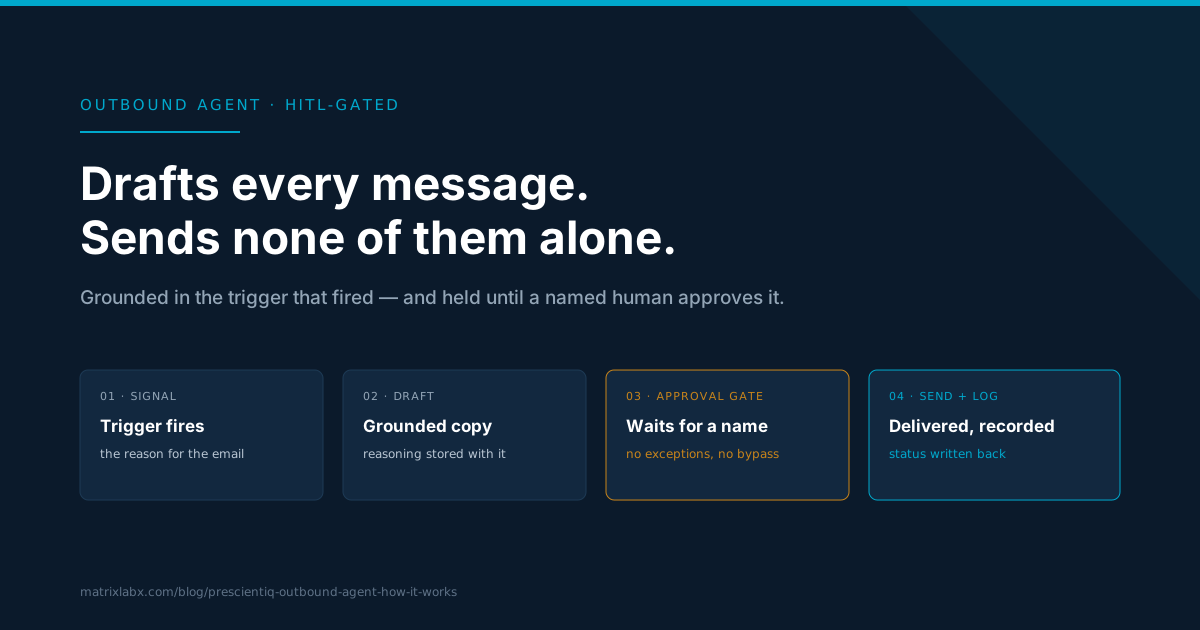
Herald drafts every message grounded in the specific trigger that made an account worth contacting — and sends none of them without a named approver. Every draft waits in the approval queue until someone on your team approves, edits, or rejects it, because sending with nobody accountable is the failure mode that made this category untrustworthy in the first place.
Outbound is the part of the revenue motion where automation has done the most visible damage. Tools that could send at volume without a review step burned sending domains and brand trust fast enough that the market corrected back to human approval — a correction we cover in full in the governed autonomy pillar. Herald is built on the far side of that correction.
This is what it does, who it is for, where it runs, how the approval gate actually works, and when it is the wrong thing to buy.
What, who, where, how, and when
A digital worker that turns a qualified account into a drafted, signal-grounded message and puts it in front of a named person to approve — not a sequencer that fires templates on a schedule, and not a copilot waiting to be prompted.
Revenue leaders who need outbound capacity without another headcount request, RevOps leaders who own the stack it plugs into, and the SDRs or AEs who review the queue.
Against Salesforce or HubSpot, sending from your own authenticated domain under your brand. Not on-premises, and not against other CRMs — that scope is deliberate and published rather than discovered during implementation.
A trigger fires on a qualified account, the agent drafts copy grounded in that specific signal and stores the reasoning with it, the draft is held in an approval queue, and only an approved message is delivered — with the status written back and the decision logged.
When the constraint is drafting capacity rather than strategy, when intent signals are already being collected but nobody has time to act on them, and when someone is willing to own an approval queue. Not when nobody can review, and not before your sending domain is properly authenticated.
How the approval gate actually works
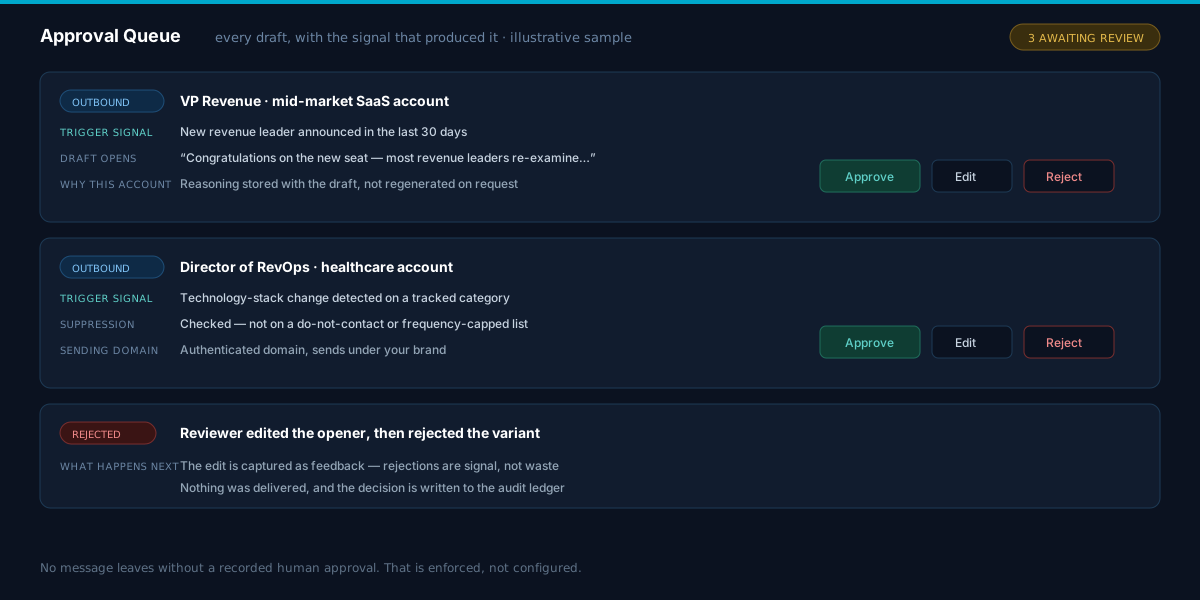
Every draft goes through your approval queue before it sends. This section describes what that gate looks like from the reviewer’s side.
A reviewer does not open a queue of paragraphs. Each draft arrives with the trigger signal that produced it and the reasoning behind the angle, so the decision being made is whether the reason holds — not whether the sentence reads well. Approve, edit, or reject. An edit is captured as feedback rather than discarded, which means a rejected draft is still doing work.
Where the bottleneck moves
Here is the honest trade, and it is worth stating before a procurement conversation rather than during one. A human pod’s outbound ceiling is drafting hours — an industry-cited range puts a rep at roughly 40 to 60 genuinely personalized touches a day, and more volume means another seat. Under a governed agent, drafting stops being scarce, and the ceiling becomes how much a reviewer can clear.
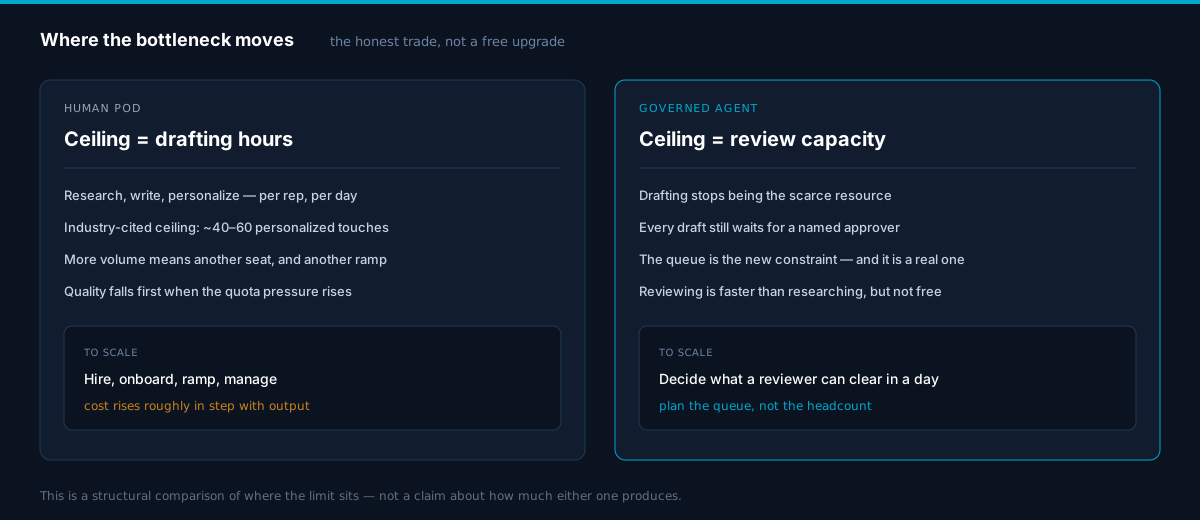
That is a real cost, not a free upgrade. Reviewing a drafted message is faster than researching and writing one, but it is not zero, and a team that buys outbound capacity without deciding who owns the queue has moved the bottleneck rather than removed it. Deciding that in advance is most of the implementation.
How that compares to what you are paying now
Outbound is the one function where both alternatives are priced and familiar, which makes the comparison unusually concrete. Both tables below are cost-structure comparisons only. Neither claims that an agent produces the output of a given number of people — that is a measurement we do not have and will not assert.
1. Against a mid-market agency retainer
An outbound agency sells precisely this function. Retainers for that coverage commonly run somewhere between $60,000 and $300,000 a year in the mid-market — a general range worth using to sanity-check a quote rather than a number for any specific firm.
| Dimension | Agency retainer | Herald |
|---|---|---|
| Headline cost | Roughly $60,000–$300,000/yr, scoped by team size and channel mix | One published platform fee covering all four agents, not a per-function line |
| Who writes in your voice | An agency copywriter learning your category, often rotating between accounts | Drafts written against your signals, edited and approved by your own people |
| Who owns the sending domain | Frequently the agency, or a lookalike domain they provision for you | You do — it sends from your authenticated domain under your brand |
| Message-level approval | Usually campaign-level sign-off; individual sends are rarely reviewed | Every individual message waits for a named approver before it sends |
| Ramp | Weeks to months per assigned rep, and it resets when the account team changes | No ramp — drafting runs from deployment |
| What happens at the end | The playbook and the relationships leave with the agency | The approval history and the reasoning stay in your own audit trail |
What a retainer buys that this does not: a strategist who will argue with you about positioning, human judgment on genuinely ambiguous accounts, and the ability to redirect a campaign mid-quarter with a phone call. The fuller version of this math is in our agency-retainer cost comparison.
2. Against a seven-person SDR pod
The in-house comparison is harder, because the number most teams carry is the base-salary line rather than the run rate. For a seven-rep pod — the standard shape, since seven is about one manager’s span of control — the published model looks like this:
| Line | Annual cost | What it covers |
|---|---|---|
| Base-salary budget line | $434,000 | The number that appears in the plan — roughly a third of the real run rate |
| Seven reps, fully loaded | $889,000 | ~$127,000 each once variable comp, payroll tax, benefits, and ramp drag are counted |
| One dedicated manager | $205,000 | Seven reps is one manager's span of control — coaching, pipeline inspection, hiring |
| Tech stack, five categories × 7 seats | $108,000 | Dialer, sequencer, data, intent, and enrichment seats |
| Total annual run rate | ≈ $1,202,000 | Roughly 2.8× the base-salary line the board sees |
| Cost per held meeting | ≈ $1,250 | Once ramp, vacancies, and turnover cut effective capacity to about 76% of theoretical |
The line-by-line decomposition is in the seven-person SDR team cost model, with the tooling line broken out separately in the tech stack tax.
Where is your outbound actually breaking?
“Outbound is not working” usually resolves to one of four different problems with four different fixes. This routes you to the version of the audit that starts from the right one.
What is actually broken in your outbound today?
Is your sending setup ready for this?
The Autonomous Audit Report is free, covers six dimensions — governance, non-human identity, shadow AI, data readiness, workflow suitability, and evidence — and comes back as a written assessment within 48 hours of the intake session. For outbound specifically, these are the preconditions it looks at.
What would need to be true before the first send?
What it does not do
It does not send without a named person’s approval. It does not find the accounts — that is Scout, which hands qualified accounts across. It does not make your outbound legal: channel rules, consent, and record-keeping remain your obligation, and we cover what has to be true before a sequence sends in a dedicated post, with the channel-specific version in when autonomous outbound reaches SMS and the phone. And it does not repair a damaged sending domain — that has to be fixed before volume, not after.
A typical deployment timeline, subject to CRM data quality and integration scope.
Where the data runs
PrescientIQ is hosted and operated by MatrixLabX on Google Cloud. SOC 2, ISO 27001, and PCI DSS attestations are held by Google Cloud, which operates the underlying infrastructure. They are not MatrixLabX certifications. MatrixLabX application-layer SOC 2 is in progress.
What it costs
Herald ships as one line of the full Revenue Accelerator platform fee — on our pricing page it is listed as “Herald · Outbound Engagement Rep,” alongside Scout (prospecting), Guide (trial conversion), and Steward (expansion), under one published rate:
| Component | Investment | Billing frequency |
|---|---|---|
| Annual platform feeEnvironment provisioning on Google Cloud, per-agent IAM, audit-ledger setup, and context ingestion from your CRM — plus four cooperating agents (Scout, Herald, Guide, and Steward), their coordinator Marshal, the approval queue and standing-policy controls, and the immutable audit ledger, and the monthly execution volume a typical mid-market deployment runs. One fee, from signature, every year.Target — modeled: live in 21 days or less$165,000/year is the complete platform fee. There is no separate implementation charge and no different first-year number — deployment work is included from signature, not billed as a distinct line. Scope beyond a typical deployment — additional bundles, sustained higher volume — is quoted at your AAR before anything is signed. | $165,000/yr | Billed monthly at $13,750/mo against an annual commitment |
Frequently Asked Questions
- What does Herald actually do?
- It reads accounts already qualified by Scout (PrescientIQ’s prospecting agent), drafts outreach grounded in the specific trigger signal that made the account relevant, and places every draft in an approval queue. It stores the signal and the reasoning alongside each message, so a reviewer can see why this account, why now, and why this angle.
- Does it send outbound automatically?
- No. Every draft waits for a named person on your team to approve it before it sends, and every send is recorded to the audit ledger with the approver behind it.
- What does "grounded in the trigger signal" mean in practice?
- The message is written against the specific event that made the account worth contacting — a leadership change, a technology-stack shift, an operational change — rather than a generic template with a merge field. The signal that fired is stored with the draft, so the reviewer is approving a documented reason, not just a paragraph of copy.
- Who reviews the drafts, and how long does that take?
- Usually whoever owns the outcome the message serves — an SDR, an AE, or their manager. Review is approve, edit, or reject on a queue, not a conversation with a bot. Reviewing a drafted message is meaningfully faster than researching and writing one, but it is real work and it is worth staffing deliberately.
- Will an AI outbound agent damage our domain reputation?
- The documented failure mode in this category comes from sending at volume with no review step. An approval gate addresses that directly, but it does not replace sending-domain hygiene: authenticated domains, suppression lists, and frequency caps still have to be in place. Those are preconditions, not features you get for free.
- How does the cost compare to an outbound agency retainer?
- Mid-market outbound retainers commonly run somewhere between $60,000 and $300,000 a year depending on team size and channel mix. The platform fee covers all four agents rather than one function, and your brand voice stays under your own approvers rather than an agency's copywriter. Treat that range as orientation for checking a quote, not a figure for any specific firm.
- Is this equivalent to a seven-person SDR pod?
- No, and we do not claim that. A seven-rep pod runs roughly $1.2 million a year fully loaded, which is a useful cost baseline — but a pod also handles live objection handling, relationship building, and escalation that an agent does not. The comparison is about cost structure and where the capacity limit sits, not output equivalence.
- What has to be in place before it can run?
- Salesforce or HubSpot, an authenticated sending domain with SPF, DKIM, and DMARC configured, and suppression and frequency rules you are willing to state explicitly. If any of those are missing, that is a finding worth surfacing before deployment rather than after the first send.
Related Reading
- Inside Scout (the stage before this one)
- Inside Guide (the stage after this one)
- Inside Steward
- Governed Autonomy: Why Revenue Teams Moved Back to Human Approval
- Outbound Compliance Controls: What Has to Be True Before a Sequence Sends
- AI SDR vs. Agency Retainer: How the Full Cost Actually Compares
- The True Cost of a Seven-Person SDR Team
- Beyond Top-of-Funnel: Full Revenue Loop Digital Labor
Notes on the figures
The 40–60 personalized-touches-per-day ceiling is a general, industry-cited range offered for context, not a measured MatrixLabX or PrescientIQ result. The $60,000–$300,000 agency-retainer range is a general market observation for orientation, not a verified statistic about any specific firm. The seven-person SDR pod model is a cost model of a typical buyer's own staffing, published in full in the linked companion post — not a claim about output, and not a claim that any number of agents substitutes for any number of people. The metrics and compliance statement on this page render from the site's claims register with their proof class attached, and pricing is current as of the date on this post. Nothing here is legal advice on outbound compliance; see the linked compliance posts and your own counsel.
See where your own execution effort is going
The Autonomous Audit Report models where your team's execution capacity is currently spent, what your configuration is actually paying for, and what the governed alternative looks like on your own data — before any commitment.
Get your free AAR benchmark