SOC 2 and HIPAA compliant AI agent architecture: what enterprise security teams actually need
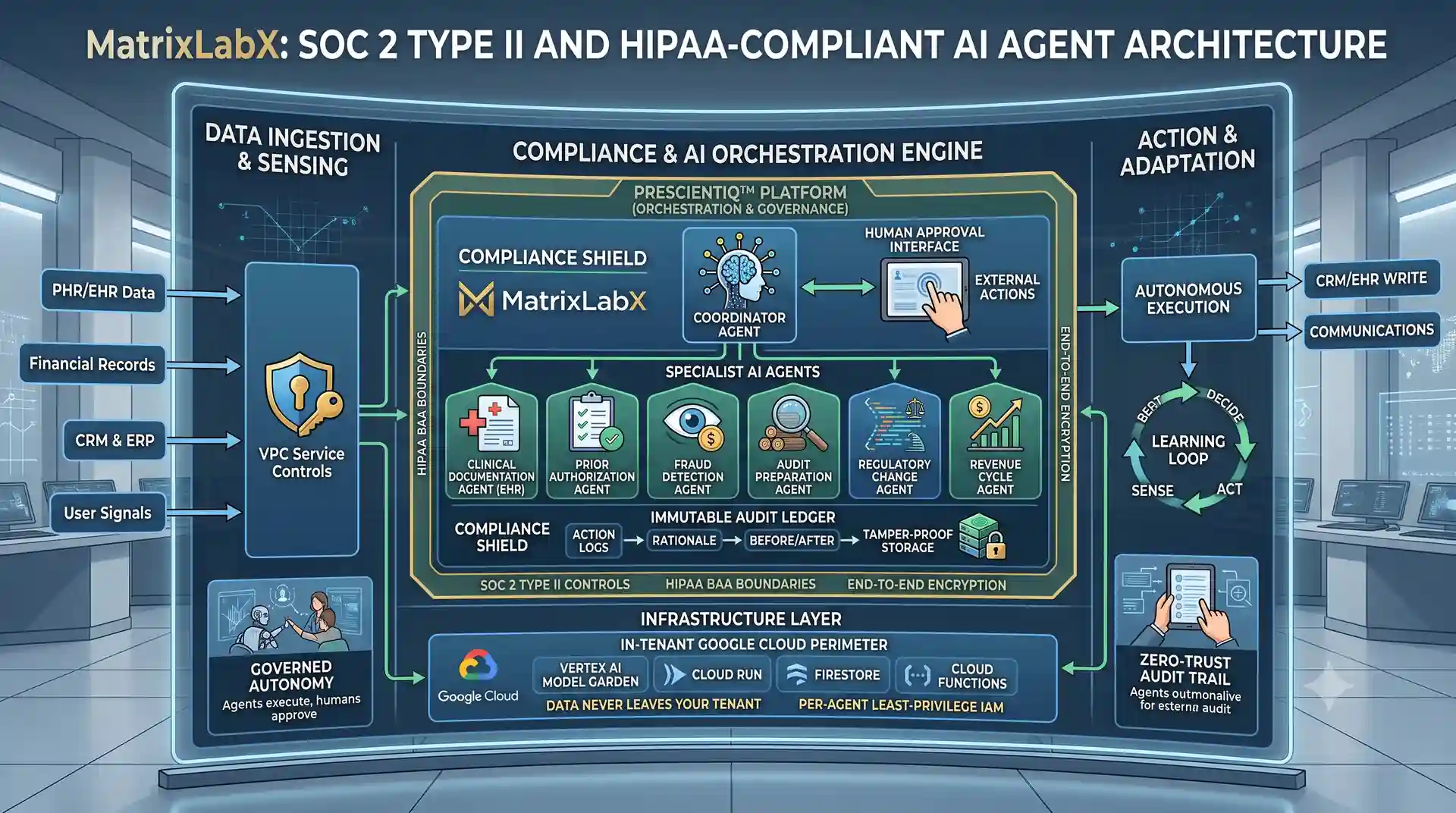
SOC 2 HIPAA compliant AI agents are autonomous software workers that operate inside your existing trust boundary— enforcing least-privilege access, encrypting protected data in transit and at rest, and logging every decision to an immutable audit trail. Instead of adding a new attack surface, a correctly architected agent inherits the SOC 2 Trust Services Criteria and HIPAA safeguards your assessors already review, treating the agent like any governed privileged identity. The result is a digital workforce that regulators can audit and that delivers measurable P&L impact — such as an 80% reduction in fraud false positives — without weakening a single control.
🔑 Key takeaways
- Compliance is an architecture decision, not a policy PDF. Scoped credentials, encryption, and immutable logging make an agent auditable by design.
- The average breach now costs $4.88M according to IBM, and healthcare records remain the most expensive to lose — the case for zero-trust AI is financial, not theoretical.
- Autonomous agents reach 4× higher goal completion than AI copilot tools while staying inside your control plane.
- Production deployments take 21 days or less because agents arrive pre-trained and vertical-specific under a signed Business Associate Agreement.
Why do security teams distrust AI agents in regulated environments?
Security teams distrust AI agents because most vendors bolt autonomy onto systems that were never designed to be audited. A CISO at a healthcare or FinTech firm is not paid to admire model benchmarks — they are paid to answer one question in front of an auditor: who did what, to which record, and can you prove it. When an AI tool cannot produce that evidence, it is not a productivity gain; it is an open finding.
The financial stakes are unambiguous. IBM's 2024 breach research puts the global average cost of a data breach at $4.88M, with healthcare the most expensive sector for the fourteenth consecutive year. Gartner projects that through 2026, organizations that operate AI without governance controls will face materially higher regulatory scrutiny. Forrester has found that a majority of enterprise security leaders rank data governance as their top blocker to AI adoption — ahead of cost or model accuracy.
The distrust is rational. The mistake is assuming it applies to every architecture equally. An agent that authenticates through your identity provider, holds scoped and revocable credentials, and streams logs into your existing SIEM is not a black box — it is a governed service identity. MatrixLabX builds every agent on the autonomous execution platform precisely so that it slots into the trust boundary your auditors already know how to review.
“The distinction between a copilot and an autonomous agent is not philosophical — it is a P&L line item.”— George Schildge, CEO & CAIO, MatrixLabX
What does a SOC 2 and HIPAA compliant AI agent architecture actually require?
A compliant architecture requires five non-negotiable control layers: identity, least-privilege authorization, encryption, immutable audit logging, and human-in-the-loop guardrails. Miss any one and your assessment turns into a remediation project. Below is how each SOC 2 Trust Services Criterion and HIPAA safeguard maps to a concrete agent control.
| Requirement | Copilot tool | MatrixLabX compliant agent |
|---|---|---|
| Identity & access | Shared API key, broad scope | Per-agent identity via your IdP, scoped and revocable |
| Data at rest / in transit | Often unclear, may train shared models | Encrypted end to end; no training on your data |
| Audit trail | Prompt history at best | Immutable, timestamped log of every action |
| HIPAA coverage | Rarely a signed BAA | Signed Business Associate Agreement in scope |
| Failure behavior | Continues, hallucinates | Halts, escalates, reversible actions |
The pattern is consistent: compliance is engineered at the boundary, not promised in a marketing deck. The Compliance Shield enforces these five layers so your team validates evidence rather than builds controls from zero. IDC research indicates that enterprises embedding governance into AI from day one reach production far faster than those retrofitting controls after a failed audit.
How does zero-trust AI reduce risk instead of adding to it?
Zero-trust AI reduces risk by removing the manual data handoffs where most breaches actually begin, then constraining every agent to the minimum access it needs to finish one task. McKinsey estimates that a large share of operational risk in regulated workflows comes from human error in repetitive data handling — the exact work agents absorb. When a governed agent replaces a spreadsheet emailed between four people, you eliminate four exposure points, not add one.
Zero-trust means no implicit permission. Each agent proves identity on every request, holds credentials scoped to a single system, and cannot move laterally. If one agent's token is compromised, the blast radius is bounded by design. This is how MatrixLabX sustains an engineered availability SLO of ≥99.5% across all production deployments while cutting fraud false positives by 80% in FinTech — fewer false alarms means analysts focus on real threats.
| Metric | Manual / copilot baseline | Compliant agent outcome |
|---|---|---|
| Fraud false positives | Baseline volume | 80% reduction |
| Admin hours (healthcare docs) | Manual processing | 20 hours saved / week |
| Goal completion | Copilot baseline | 4× higher |
| Production uptime | Varies by vendor | ≥99.5% SLA |
| Time to deploy | Months of build | 21 days or less |
These outcomes are governed, not accidental. The Revenue Accelerator Stack proves the same principle on the commercial side: risk controls and growth are not in tension when the architecture is right.
Three regulated use cases in before, after, and bridge
Use case 1 — Healthcare intake and document processing
Before: A mid-market provider network had four coordinators keying patient intake forms into three systems by hand. Protected health information sat in shared inboxes for hours, records were duplicated, and every transcription was an audit risk. Backlogs pushed billing cycles late and staff burned out on repetitive entry. After: A compliant agent now ingests intake documents inside an encrypted, access-controlled environment under a signed Business Associate Agreement, logging every record touch. The team recovered 20 admin hours per week and eliminated the shared-inbox exposure entirely. Bridge: The path was a 12-day deployment where the security team validated audit logging against HIPAA controls before a single live record was processed — evidence first, automation second.
Use case 2 — FinTech fraud detection
Before: A payments company drowned its fraud analysts in alerts. False positives buried genuine threats, good customers were blocked, and the review queue never emptied. Every manual export of transaction data to a review sheet was itself a governance gap the CISO flagged quarterly. After: A zero-trust agent with scoped, revocable credentials scores transactions in place and never exports raw data. False positives dropped 80%, so analysts spend their time on the cases that matter. Bridge: Analysts kept human approval on high-risk holds while the agent handled triage, and every decision streamed to the existing SIEM — trust was earned through visible, reversible behavior.
Use case 3 — CRM data integrity for a regulated lender
Before:A regulated lender's CRM was a liability. Duplicate borrower records, stale consent flags, and inconsistent fields meant compliance reporting required a week of manual reconciliation, and auditors questioned data lineage every cycle. After: The CRM Janitor agent runs continuous maintenance, holding CRM accuracy at 99.5% with a full log of every correction. Compliance reporting shifted from a week of cleanup to a same-day export with defensible lineage. Bridge: The agent was scoped to the CRM alone, could not reach adjacent systems, and wrote an immutable change record for each field it touched — so data quality improved without widening access.
“Auditors do not fear autonomy. They fear the absence of evidence. Give them a clean, immutable trail and an agent becomes the easiest identity in your environment to review.”— George Schildge, CEO & CAIO, MatrixLabX
One CISO's path from veto to advocate
Situation: Maria, the VP of Engineering and acting security lead at a 280-person specialty health-services firm, had killed two prior AI proposals. Both vendors promised productivity and waved away her questions about audit trails and protected health information. Her board wanted efficiency; her SOC 2 renewal was 90 days out. She could not risk a finding.
Complication: The operations team was drowning in document intake and pushing hard for automation. Maria was cast as the blocker — the person standing between the company and obvious gains. The pressure was real, but so was the exposure: one mishandled record could unwind the whole compliance program.
Solution: Instead of a demo, MatrixLabX started with her control framework. Each agent authenticated through the company identity provider, held credentials scoped to a single system, and wrote immutable logs into the existing SIEM. A Business Associate Agreement was signed before any live data moved. Maria's team spent the first week validating evidence, not watching slideware.
Result: The deployment closed in 11 days. The intake agent recovered 20 admin hours per week, the SOC 2 renewal passed with no AI-related findings, and Maria presented the audit log to the board herself. She went from the veto vote to the internal advocate — because the architecture answered her question before she finished asking it.
How do you decide whether an AI agent is ready for regulated production?
You decide by walking the agent through the same readiness gates you apply to any privileged service account — identity, scope, evidence, and failure behavior. Use the decision tree below before you approve any deployment.
Compliant AI agent readiness decision tree
Step 1 — Does the agent authenticate through your identity provider?
Yes → Continue to Step 2.
No → Stop. A shared key is not a governed identity. Do not proceed.
Step 2 — Are the agent's credentials scoped and revocable?
Yes → Continue to Step 3.
No → Scope credentials to one system and add revocation before any production access.
Step 3 — Does every action write to an immutable audit log?
Yes → Continue to Step 4.
No → Without an evidence trail you cannot pass SOC 2 or HIPAA audit controls. Fix logging first.
Step 4 — On anomaly, does the agent halt and escalate?
Yes → Ready for a scoped production pilot with human approval on high-risk actions.
No → An agent that proceeds through uncertainty is a liability. Add guardrails before launch.
Every gate above is enforced natively on the Generative Growth Engine and across all agentic deployments, so readiness review becomes verification rather than construction.
How do you implement compliant AI agents step by step?
You implement compliant agents in a fixed sequence that puts evidence and access controls ahead of automation. The full path takes 21 days or less because agents arrive pre-trained and vertical-specific — the security work, not the model building, sets the timeline.
| Phase | Owner | Exit criteria |
|---|---|---|
| 1. Scope & BAA | Security + Legal | Signed Business Associate Agreement, defined data scope |
| 2. Identity wiring | IAM team | Per-agent identity via IdP, least-privilege scope |
| 3. Encryption check | Security | Data encrypted in transit and at rest, no model training |
| 4. Audit log validation | SecOps | Immutable logs streaming to existing SIEM |
| 5. Guardrail test | Engineering | Agent halts and escalates on injected anomaly |
| 6. Scoped pilot | Joint | Live on limited volume with human approval |
- Define scope and sign the BAA. Name the exact data, systems, and outcomes in play. For any protected health information, the Business Associate Agreement is signed before a single live record moves.
- Wire per-agent identity. Register the agent in your identity provider with least-privilege scope. No shared keys, no standing admin rights, revocation ready on day one.
- Confirm encryption. Verify data is encrypted in transit and at rest and that your data is never used to train shared models. This is a hard gate, not a checkbox.
- Validate audit logging. Confirm every decision and data access writes an immutable, timestamped record into your existing SIEM before real work starts.
- Test the guardrails. Inject an anomaly and confirm the agent halts and escalates rather than proceeding. Route high-risk actions through human approval.
- Run a scoped pilot. Launch on limited volume, watch the logs in real time, and measure against a defined outcome such as hours saved or false positives reduced.
- Review evidence, then scale. Walk the audit trail with your assessors, confirm no findings, and expand the agent's scope only after the evidence holds.
- Monitor continuously. Keep the agent under the same SecOps alerting and access-review cadence as any privileged identity, sustaining the ≥99.5% availability SLO.
Why this might not work for you
Honesty matters more than a sale. A compliant agent deployment can stall or fail if:
- You have no functioning identity provider or SSO. Per-agent identity is the foundation. Without a working IdP, you must fix identity first, which adds weeks outside the 21-day window.
- Your source data is ungoverned. If protected records live in unmanaged spreadsheets and shared inboxes with no ownership, an agent inherits that chaos. Data governance is a prerequisite, not an output.
- Leadership wants autonomy without oversight. If your organization resists human approval on high-risk actions, you will fight the guardrails that make the system auditable — and lose the compliance benefit.
- You cannot sign a Business Associate Agreement. For HIPAA-regulated data, no BAA means no deployment. That is a legal gate, not a technical one.
- You expect zero human involvement on day one. Trust is earned through visible, reversible behavior. Teams that refuse a scoped pilot rarely reach full autonomy safely.
Frequently asked questions
Are SOC 2 and HIPAA compliant AI agents actually possible?
Yes. A compliant AI agent runs inside the same trust boundary your auditors already review. When the agent enforces least-privilege access, encrypts data in transit and at rest, and logs every action to an immutable trail, it inherits your existing SOC 2 and HIPAA controls rather than breaking them.
What is the difference between an AI copilot and a compliant AI agent?
A copilot waits for a human prompt and returns text. A compliant AI agent senses, decides, and acts inside governed systems with scoped credentials and full auditability. That is why agents reach 4 times higher goal completion than copilot tools while staying inside your control plane.
How do AI agents handle protected health information under HIPAA?
Under a signed Business Associate Agreement, agents process protected health information only within encrypted, access-controlled environments. Data is never used to train shared models, and every read or write of a patient record is logged. This is how healthcare teams save 20 admin hours per week without new exposure.
What audit evidence do compliant AI agents produce?
Compliant agents emit immutable, timestamped logs of every decision, tool call, and data access. That evidence maps directly to SOC 2 Trust Services Criteria and HIPAA audit-control requirements, so your assessors review agent activity the same way they review any privileged service account.
Does deploying AI agents expand my attack surface?
Only if you deploy them wrong. A zero-trust design gives each agent scoped, revocable credentials and blocks lateral movement. Done right, agents shrink risk by removing the manual data handoffs where breaches actually start, cutting fraud false positives by 80 percent in FinTech.
How long does a compliant AI agent deployment take?
Production deployments take 21 days or less because the agents arrive pre-trained and vertical-specific. Most of that window is spent wiring credentials, confirming your Business Associate Agreement, and validating audit logging with your security team rather than building models from scratch.
Can compliant AI agents work with our existing SIEM and identity tools?
Yes. Agents authenticate through your identity provider and stream logs into your existing SIEM. They behave like governed service identities, so your security operations center monitors them with the tooling and alerting playbooks you already run today.
What happens if a compliant AI agent makes a mistake?
Guardrails catch it. High-risk actions route through policy checks and human approval, credentials are scoped to limit blast radius, and every step is reversible and logged. When an anomaly appears, the agent halts and escalates rather than proceeding, protecting your an engineered availability SLO of ≥99.5%.
The bottom line for security teams
Compliance is not the obstacle to autonomous AI — it is the specification. The security teams that win with agents are the ones who stop treating governance as a checklist and start treating it as architecture: per-agent identity, scoped credentials, end-to-end encryption, immutable audit trails, and guardrails that halt on doubt. Get those five layers right and an agent becomes the most reviewable identity in your estate while delivering an 80% cut in fraud false positives and 20 recovered admin hours per week.
MatrixLabX is an autonomous AI agentic consulting firm deploying pre-trained, vertical-specific digital labor for mid-market enterprises — shifting operations from Software as a Service to Labor as a Service. PrescientIQ™ is the autonomous execution platform that analyzes company data and executes marketing, sales, and operational workflows without human supervision. Built natively on Google Cloud. Your next step is a scoped conversation about your control framework — not a demo. Want proof first? See client results or review the PrescientIQ™ platform overview.
Ready to deploy a digital workforce your auditors can trust?
Book a Discovery Call →See where your own execution effort is going
The Autonomous Audit Report models where your team's execution capacity is currently spent, what your configuration is actually paying for, and what the governed alternative looks like on your own data — before any commitment.
Get your free AAR benchmark