The CRM accuracy crisis: how autonomous agents maintain data integrity without human cleanup
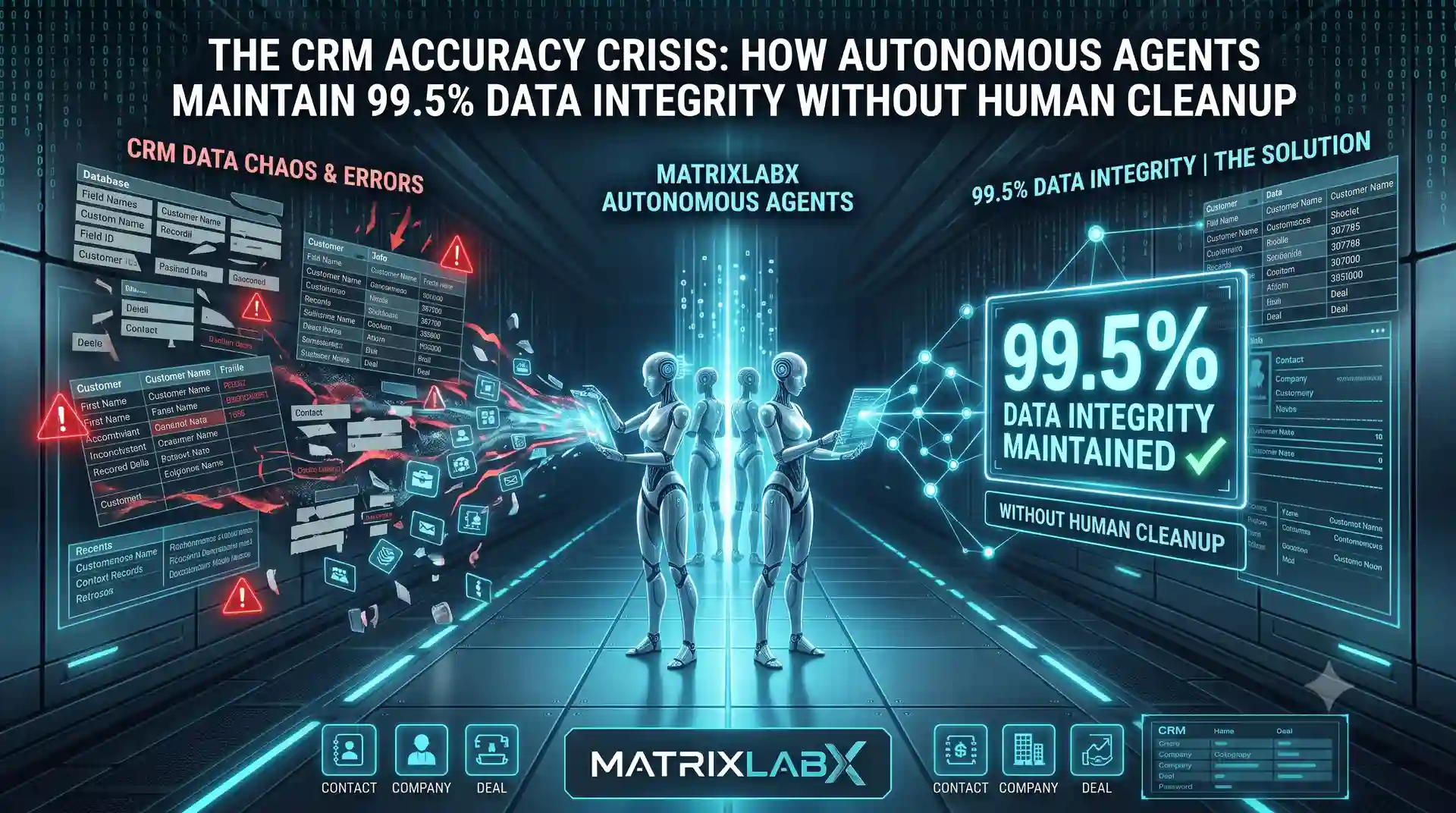
Autonomous CRM data quality agents are governed AI systems that continuously scan contact, company, and deal records for duplicates, staleness, and missing fields, then merge, enrich, and correct records the moment decay happens — with sales operations approving any merge that touches an active deal, and every change logged to an immutable audit ledger.
🔑 Key takeaways
- 76% of organizations report that less than half their CRM data is accurate and complete (Validity, 2026 State of CRM Data report), and 37% say they have directly lost revenue to it.
- An analysis of 12 billion Salesforce records found 45% were duplicates — jumping to 80% for records created via API integrations, exactly where most CRMs pick up the most volume.
- Contact data decays 25–30% annually, and reps lose roughly 500 hours a year — about a quarter of their capacity — validating and correcting records instead of selling.
- Merges and deletions on active deal or sequence records stay human-gated: agents propose, RevOps approves, and the ledger records why.
- MatrixLabX's measured target: 99.5% data integrity via the CRM Janitor's continuous maintenance — validated against your own CRM export in a free Autonomous Audit Report.
Why does CRM data decay faster than teams can clean it?
Because decay is continuous and cleanup projects are not. Contact data decays 25–30% annually as people change jobs, get promoted, and companies restructure — a rate high enough that a database left untouched for a year has already lost a quarter of its usable records. Validity's 2026 State of CRM Data report puts a finer point on the current state: 76% of organizations say less than half their CRM data is accurate and complete, and 37% of CRM users report directly losing revenue because of it. A quarterly cleanup project fixes the backlog that exists on the day it runs and starts decaying again the moment it ends — which is why most RevOps teams describe data hygiene as a treadmill rather than a project with an end date.
There is a specific moment every sales operations leader knows: opening a pipeline report before a board meeting and finding three versions of the same account, two closed deals still marked open, and a contact who left the company eight months ago still assigned as the champion. That tension — knowing the number on the slide is built on data you do not fully trust — is what the accuracy crisis feels like in person. The fear underneath it is sharper: a forecast miss traced back to a duplicate record nobody caught before the number went to the board.
The scale of the underlying mess is larger than most teams assume. An analysis of 12 billion Salesforce records found 45% were duplicates overall — a rate that jumps to 80% for records created via API integrations, which is exactly how most modern CRMs pick up volume from forms, enrichment tools, and marketing automation. Gartner puts the average annual financial impact of poor data quality at $12.9 million per organization, and MIT research finds bad data costs most companies 15–25% of revenue a year. The constraint has moved: the question is no longer whether clean data would help, but whether any team can clean it faster than it decays.
What does an autonomous CRM data quality agent actually do differently?
It runs the cleanup logic every day instead of once a quarter. A dedup tool or cleanse project is a snapshot; an agent-run data quality process never stops running. In a governed deployment on the PrescientIQ platform, the CRM Janitor and its supporting agents divide the work:
| Agent | Owns | Human gate |
|---|---|---|
| Signal Ingestion | CRM record changes, enrichment feeds, job-change and firmographic signals | None — read-only |
| Detection | Scores duplicates, staleness, and missing fields continuously | None — internal analysis |
| CRM Janitor | Enriches and corrects records; drafts merges with confidence scores | Auto-applies below risk threshold; flags the rest |
| Commitment | Merges or deletes records tied to open deals or active sequences | RevOps approval on every active-record change |
Note the split: low-risk corrections — a missing title, a stale phone number, an obvious duplicate with no deal attached — apply automatically, because reversing a bad field enrichment costs nothing. Anything touching a record tied to revenue in motion queues for a human, because merging the wrong two accounts mid-negotiation is not reversible in the same way. That gate placement is the same governed-swarm pattern from our multi-agent architecture blueprint, applied to the database instead of the pipeline.
Where does the 99.5% data integrity target come from?
From closing the gap between decay rate and correction rate.If contact data decays 25–30% a year and a database is only cleaned once a quarter, accuracy oscillates between a peak right after cleanup and a trough right before the next one — which is consistent with Validity finding most organizations sitting below 50% accuracy on any given day. An agent that corrects continuously never lets the trough form: decay gets caught and fixed within the same operating cycle it happens in, instead of accumulating for weeks. MatrixLabX's 99.5% is a measured target for the CRM Janitor operating this way — validated against your own CRM export in a free Autonomous Audit Report before any contract, never asserted afterward.
| Metric | Industry evidence | MatrixLabX measured target |
|---|---|---|
| CRM data accuracy | Less than 50% at 76% of orgs (Validity, 2026) | 99.5% via continuous maintenance |
| Duplicate rate | 45% overall, 80% via API integrations (12B-record analysis) | Measured and merged continuously |
| Revenue impact of bad data | $12.9M/year avg. (Gartner); 15–25% of revenue (MIT) | Quantified per account in the AAR |
| Time to production | — | 21 days or less (target) |
The hours-back case is just as direct as the accuracy case. Sales reps lose roughly 500 hours a year — about 62 working days, or nearly a quarter of their annual capacity — validating, correcting, and working around bad data instead of selling. When the agent absorbs that correction work, the hours do not disappear; they convert back into selling time, which is why data quality initiatives that reach the CRM Janitor stage tend to show up in pipeline metrics as much as in data-quality dashboards.
What does this look like inside a real RevOps team?
Three patterns cover most of the deployments we model.
The scale-up with three inbound sources feeding one CRM. Before: forms, a marketing automation tool, and a sales engagement platform all create contacts independently, and by month six the database has thousands of near-duplicate records nobody has time to reconcile. After: the detection agent scores every new record against the existing database in real time, and the Janitor merges the obvious cases automatically while flagging ambiguous ones for a quick RevOps decision. The bridge: two weeks of shadow scanning to calibrate the merge-confidence threshold against the team's own tolerance for risk.
The enterprise seller losing forecast credibility. Before: stale opportunity stages, missing close dates, and contacts who changed jobs eighteen months ago quietly inflate the pipeline number every quarter, and finance has stopped trusting the forecast without a manual audit first. After: the agent flags staleness the week it occurs instead of at quarter-end, and finance gets a pipeline number built on records that were checked days ago, not months. The bridge: the pilot scoped to one region's pipeline, where the forecast-accuracy improvement made the expansion case by itself.
The manufacturer whose AEs lose selling time to CRM debt. Before: account executives spend hundreds of hours a year deduping and reconciling records instead of chasing buyer signals — the exact pattern our CRM debt research in manufacturing tech documents. After: the Janitor absorbs the reconciliation work, and the hours flow back into prospecting. The bridge: read-write access scoped to contact and company objects first — deal-stage logic came only after the account team saw the merge decisions it would have made itself.
How do you deploy without breaking active pipeline records?
Five stages, each with a hard exit criterion.
| Step | Action | Expected outcome |
|---|---|---|
| 1. Integration | Read-write API access scoped to contact, company, deal objects | Full record visibility, scoped write permissions only |
| 2. Baseline | Agent scores the full database for duplicates and staleness | Accuracy rate and duplicate count, in writing |
| 3. Shadow mode | Two weeks flagging proposed merges and corrections without applying them | RevOps agreement rate on proposals |
| 4. Governance review | RevOps sets the auto-apply confidence threshold and approval gates | Sign-off before any live merges begin |
| 5. Staged autonomy | Clear-cut duplicates first; active-deal merges stay RevOps-approved | Accuracy curve reaches target inside the first quarter |
In contrast to a dedup tool that runs once and hopes the database stays clean, nothing here asks RevOps to trust a black box with an open pipeline: the agent earns write access by matching the team's own merge decisions in shadow mode first, on the account's own data, with the comparison on paper.
Why this might not work for you
If your CRM record volume is small and one operations person already keeps it clean by hand, the agent's edge compounds with scale and integration count — a 200-contact database may not need it yet. If your team has no agreed rule for which record wins when two accounts conflict, fix the ownership policy first; an agent enforcing an undefined rule just automates the disagreement faster. And if deal-stage definitions vary by rep or region without a shared standard, the staleness detection will surface inconsistencies the org has to resolve before the accuracy number can mean anything — worth knowing before you buy, not after.
Conclusion: accuracy is a maintenance problem, not a project
Every RevOps team has run a data cleanup project. The ones who stop needing another one are the ones who replaced the project with a process that never stops running — closing the gap between decay rate and correction rate instead of racing to catch up every quarter. The Validity and Gartner numbers say the cost of not doing this is already large; the CRM Janitor is the architecture that converts continuous correction into a number your forecast can actually stand on. Model the 99.5% against your own CRM export with a free Autonomous Audit Report, or see the full stack on the Revenue Accelerator Stack page.
If you want a number before a meeting, pull one your sales ops team already tracks: the percentage of open opportunities with a close date more than 30 days in the past. Wherever that number sits above zero, you are looking at decay your current process has not caught yet — the exact gap the agent closes first. Bring that report to the AAR and the model comes back scoped to the records you already suspect are stale, not a generic industry average. See client results for how that has played out in production deployments.
Frequently asked questions
What are autonomous CRM data quality agents?
Autonomous CRM data quality agents are governed AI systems that continuously scan contact, company, and deal records for duplicates, staleness, and missing fields, then merge, enrich, and correct records in real time — with sales operations approving any merge that touches an active deal, and every change logged to an immutable audit ledger.
How is this different from a one-time data cleanse or dedup tool?
A cleanse project fixes today's data and starts decaying again tomorrow — contact data decays 25–30% annually. An autonomous agent runs the same detection and correction logic continuously, so the database never accumulates a backlog large enough to need another project.
Where does the 99.5% data integrity figure come from?
It is a target, not a measured result: ≥99.5% is the CRM accuracy index that agent writebacks are maintained against. It is validated against your own CRM export in a free Autonomous Audit Report before any commitment.
Does the agent merge or delete records without approval?
Not on active records. Field-level enrichment and staleness flagging run autonomously; any merge or deletion that touches a record tied to an open deal or an active sequence queues for one-click RevOps approval, logged with its rationale.
What data does deployment require?
Read-write API access scoped to contact, company, and deal objects in your CRM (Salesforce, HubSpot, or equivalent), plus whatever enrichment sources you already license. Deployment starts in monitoring mode, so the agent flags before it ever touches a live record.
How long until results show?
Production deployment is targeted at 21 days or less, subject to CRM data quality and integration scope. It starts with two weeks of shadow scanning against your database, then staged autonomy beginning with clear-cut duplicate merges.
Model 99.5% integrity against your own CRM
The free Autonomous Audit Report scores your actual CRM export for duplicates, staleness, and missing fields and shows the accuracy and hours-back math before you commit to anything.
Get your free AAR →Built natively on Google Cloud. Sources: Validity 2026 State of CRM Data report; Gartner research on the financial impact of poor data quality; MIT research on the revenue cost of bad data; independent analysis of 12 billion Salesforce records on duplicate rates. Modeled and measured MatrixLabX targets are validated per-account in the Autonomous Audit Report.
See where your own execution effort is going
The Autonomous Audit Report models where your team's execution capacity is currently spent, what your configuration is actually paying for, and what the governed alternative looks like on your own data — before any commitment.
Get your free AAR benchmark