Why AI Deserves Power—and Why People Must Answer for It
AI deserves real authority in the organizations that use it: the power to act, not only to suggest. There is work it does more consistently and with broader coverage than any team can staff for. But that power is only worth granting on one condition: the people who grant it stay answerable for it, and keep the ability to justify, watch, correct, and stop it. Power and accountability are not a trade-off. The second is what makes the first possible.
Why should organizations give AI the power to act, not just advise?
Because advice inherits the limits of whoever has to act on it.
An AI system that only suggests produces a queue. Every recommendation waits for a person with the time to read it, decide on it, and carry it out. The system may see the signal the moment it fires, but the response happens whenever the person gets to it. For work where timing is most of the value, such as an inbound inquiry, a compliance exposure forming in a message thread, or a record that has drifted out of date, the gap between suggestion and action is where the value leaks.
Advisory AI also leaves the hardest part of the work where it was. The research, the drafting, the record updates, and the follow-through are still bounded by the hours of the people doing them. The organization gets better suggestions and the same throughput.
Granting AI the power to act closes that gap. The system does the work within a defined scope. A named person holds approval over what is consequential. And the organization gets the benefit AI was adopted for in the first place: coverage of work that people could not reach in time.
That is the argument for power. It is a strong one, and it is the reason MatrixLabX exists. It comes with a condition, and the condition is the subject of the rest of this article.
What is AI better suited to than people, and what isn't it?
The honest answer is a division of labor, not a ranking. The table compares suitability, not performance.
| Work | Better fit | Why |
|---|---|---|
| Continuous monitoring across many channels | AI | Coverage is bounded by attention, and AI attention does not run out at the end of a shift |
| Applying a defined rule the same way every time | AI | Consistency does not degrade with volume or fatigue |
| Keeping a complete record of what was done and why | AI | The record is written as a byproduct of the work, not as a separate chore |
| Responding when a signal fires outside working hours | AI | The response does not wait for the next business morning |
| Judgment under genuine ambiguity | People | Context that is not written down, and stakes that are not in the rule set |
| Relationships and trust with customers | People | Trust is extended to people and institutions, not to systems |
| Deciding what level of risk is acceptable | People | It is a value judgment the organization must own |
| Answering for the outcome | People only | Accountability cannot transfer to the system |
The last row is not a limitation of current technology that future models will overcome. It follows from what accountability is: answerability, consequence, and authority over the arrangement, none of which a system can hold. We make that argument in full in Who Is Accountable When AI Acts? The Case for Governed AI.
Why is withholding power from AI its own risk?
Organizations tend to treat under-delegation as the safe default. It is not free.
The work stays undone. Every account not reached, every exposure not caught before it sent, every record not maintained is a cost. It does not appear on an invoice, which is why it rarely gets counted.
Ungoverned use fills the gap. When an organization does not give AI a sanctioned way to do the work, people find their own. Employees paste data into tools nobody approved, and outputs move into customer-facing work with no record of where they came from. The real alternative to governed AI is often not "no AI." It is AI that nobody can account for.
Pilots never graduate. A capability that is always advisory is always a pilot. It never generates the evidence needed to be trusted with more, so it never gets more. The organization pays for the experiment and never collects the return.
The discipline, then, is not to minimize the authority AI is given. It is to grant authority in a way the organization can answer for, and to expand it as the record earns it.
How should AI earn more authority over time?
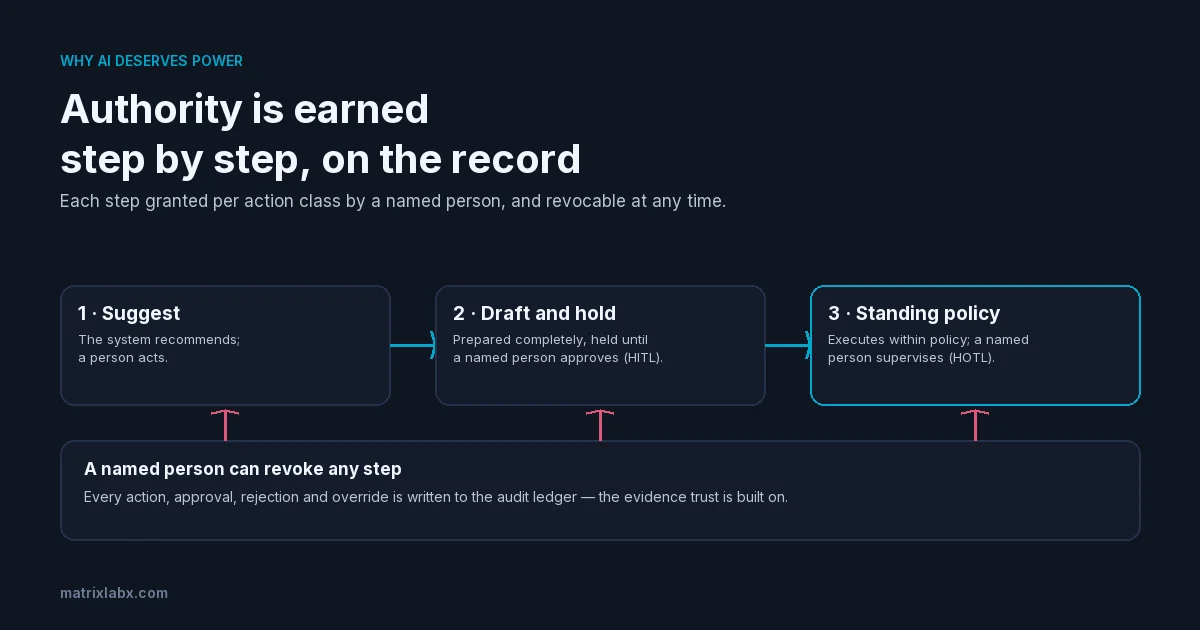
The same way a new colleague does: step by step, on evidence, with each expansion granted by someone who can answer for it.
A governed progression has three practical stages for any class of action:
- Suggest. The system recommends and a person acts. Useful for learning what the system would do, but throughput stays bounded by people.
- Draft and hold (human-in-the-loop). The system prepares the action completely and holds it. It does not execute until a named person approves it. Every approval and every rejection is recorded, which builds the evidence base for what comes next.
- Execute under a standing policy (human-on-the-loop). For an action class where the record shows the policy holds, the system executes within that policy, and a named person supervises with intervention, override, and revocation authority.
Three rules keep the progression accountable. Each step is granted per class of action, not across the board. Each grant is made by a named person, on the evidence in the record, and recorded itself. And each grant is revocable at any time, returning the class to per-action approval the moment the evidence turns.
In PrescientIQ™, every action class starts in human-in-the-loop until the customer's own team decides to move it. The system does not promote itself. Trust is earned from the record, not from a demo.
What does earned trust in AI actually rest on?
On the record, not on the demo.
A demonstration shows what a system can do under conditions someone chose. It says little about what the system will do on the four-hundredth ordinary Tuesday, with messy data, an edge case nobody anticipated, and no one watching closely. The only thing that answers that question is a history of what the system actually did in production, under real conditions, with every action and every human decision written down.
That is why the audit ledger matters to the argument for power, not just to the argument for control. Each approval, each rejection, each override, and each correction is evidence about where the system can be trusted and where it cannot yet. An organization that keeps that record can expand authority where the evidence supports it and hold back where it does not. An organization without it is guessing, and guesses tend to settle on "no."
Why must people answer for the power they grant?
Because power without an answerable owner has not been delegated. It has been abandoned.
Granting AI the power to act brings four standing duties with it, the ones set out in The Case for AI: Power to Act, Duty to Answer:
- Justify the arrangement: why this system does this work, in this scope, under these conditions.
- Watch it: know what it is doing, action by action, on whose authority.
- Correct it: trace an error to its action, its rule, and its source, and fix all three.
- Stop it: halt an action, an agent, or everything, without needing the system's cooperation.
These duties are the price of the power, and they are worth paying, because an organization that can discharge them can grant AI far more authority than one that cannot. The executive who can show the board exactly what the system is authorized to do, and exactly how to stop it, is the executive who gets to deploy it.
What does earned authority look like in a regulated function?
PrescientIQ™ Compliance Shield is designed around exactly this progression, in the channel where getting it wrong is most expensive.
The system ingests the organization's own compliance manual, monitors the channels where exposure lives, and scores every flag into a severity tier. The organization's own compliance team assigns each tier a governance mode and sets every row. Lower tiers, such as an educational nudge to the sender or an alert to a manager, can run under a standing policy with a named supervisor who can change it at any time. The highest tier runs human-in-the-loop by design: the message is quarantined before it reaches the recipient and held until a compliance officer grants an exception or confirms the violation. Nothing in that tier executes on the agent's own authority.
When regulation changes, a governance agent drafts a proposed policy update for the compliance team to approve. It never changes the rules on its own. And every flag, decision, and resolution is written to an immutable ledger that can be compiled into dossiers an examiner will ask for.
That is AI with real power in a high-stakes channel, working inside a grant that the organization can justify, watch, correct, and stop. Compliance Shield is the next release on the PrescientIQ roadmap, with a closed beta targeted for December 2026 and general availability for January 2027 Target — roadmap. See the Compliance Shield overview.
Our vision. A B2B market where buying feels like being understood. Every buyer gets the right answer at the right moment, never repeats themselves, and never receives a message that wasn't worth their time — because autonomous digital labor runs the operational work of revenue with discipline, earns more autonomy only as it earns trust, and gives people back their time for judgment, relationships, and the ideas that move a business forward.
For the broader case for deploying governed labor instead of buying more software, see digital labor.
How much authority AI should hold in your organization, and in which action classes, is a question about your own operation. The free Autonomous Audit Report (AAR) models it on your data before any commitment.
Frequently asked questions
Should AI be allowed to act without a human approving each action?
For some action classes, yes: low-consequence, reversible, well-understood actions can run under a standing policy with a named supervisor who can intervene or revoke it. Consequential or hard-to-reverse actions should be held for a named person's approval. Deciding which is which is a human decision the organization owns.
How do you decide how much authority to give an AI agent?
Grant it per class of action, starting with drafts held for approval. Expand to a standing policy only when the recorded history of approvals and rejections shows the policy holds, and make every expansion a recorded, revocable decision by a named person.
What is the risk of giving AI too little authority?
Work that AI could cover goes undone, employees turn to ungoverned tools to fill the gap, and advisory pilots never generate the evidence needed to graduate. Under-delegation carries costs of its own; they are simply less visible.
Can authority given to an AI agent be taken back?
It must be. In a governed system, a named person can revoke a standing policy at any time, returning that action class to per-action approval, and can suspend an individual agent without stopping the others.
What is governed autonomy?
An operating model in which AI agents execute real work within a defined scope, a named person holds approval over consequential actions, and every action is recorded to an immutable audit ledger with its rationale and authorization. Its short form is "agents execute, humans authorize."
See where your own execution effort is going
The Autonomous Audit Report models where your team's execution capacity is currently spent, what your configuration is actually paying for, and what the governed alternative looks like on your own data — before any commitment.
Get your free AAR benchmark