Who Is Accountable When AI Acts? The Case for Governed AI
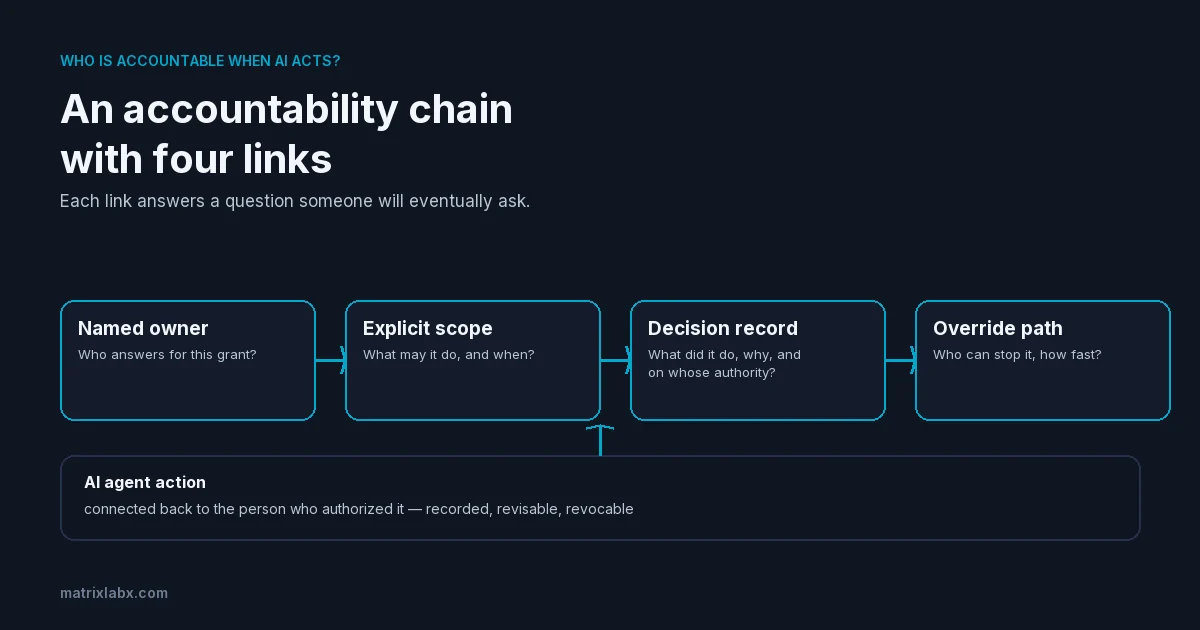
When an AI system acts, the people and institutions that gave it the authority to act are accountable for what it does. Accountability does not transfer to the system, spread thinly across vendors, or dissolve into "the algorithm." Governed AI is the practice of keeping that chain unbroken and provable: a named owner for every grant of authority, an explicit scope, a decision record for every action, and a working path to override or stop it.
Who is accountable when AI acts?
The short answer is the grantor: whoever decided that the system could act, in that scope, on that authority. In an organization that is rarely one person. It is a layered chain.
The executive sponsor is accountable for the decision to deploy AI into a function at all. The function owner is accountable for the scope: which work the system may do, which systems it may touch, and which actions must wait for approval. The approver is accountable for the individual consequential actions they authorize. And the institution is accountable to its customers, regulators, and board for the arrangement as a whole.
Layered is not the same as diluted. Each layer answers for a different decision, and each decision has an owner. The chain fails when a layer is missing, or when two layers each assume the other one holds the answer.
This is the practical core of a broader argument we make in The Case for AI: Power to Act, Duty to Answer: AI deserves real power, and the people who grant it keep the duty to justify, watch, correct, and stop it.
Why can't accountability transfer to the AI system?
Because accountability has three components, and an AI system cannot hold any of them.
Answerability. To be accountable is to be the one who can be asked why, and who owes an answer. An AI system can generate an explanation of how it reached an output. It cannot answer for why it was allowed to act in the first place: why it was deployed, why it was given that scope, why its output was trusted for that decision. Those questions are about human choices, and only the people who made them can answer.
Consequence. Accountability means that consequences land somewhere: remediation, liability, sanction, a changed role, a changed process. Consequences can reach people and institutions. They cannot meaningfully reach a model.
Authority to change the arrangement. Being accountable includes being able to fix what went wrong. An AI system has no authority over its own deployment, scope, or rule set. The people who granted those do.
None of this is an argument against AI. It is the opposite. Once you accept that accountability stays with the grantor, you know exactly what the grantor needs in order to carry it, and you can build that in from the start rather than discovering its absence during an incident review.
Where does AI accountability break down in practice?
Rarely because anyone intends to evade it. Usually because the chain was never made explicit. The common failure patterns are worth naming.
The many-hands problem. A model provider, an integrator, an internal platform team, a business owner, and a reviewer all touch the arrangement. When something goes wrong, each can reasonably point to another. Without a named owner for each decision, the chain has no fixed end.
Approval without information. A human approval step only means something if the approver can meaningfully decline. An approver shown too little context, too many items, or too little time to evaluate them is not exercising judgment. An approval gate that cannot say no is decoration, and it moves the appearance of accountability onto a person who was never given the means to carry it.
Shared credentials. When an agent acts through a generic integration account, the record says "system" did it. The action happened on the organization's full authority, and no one can say which grant permitted it.
Records without reasons. Logs that capture outputs but not rationale, sources, prior state, or the authorizing person or policy can prove that something happened. They cannot prove why, or on whose authority, which is what an examiner, a customer, or a board will ask.
Implicit grants. A new connector is added, a permission is widened, a workflow is extended to a new channel, and nobody decides that the system's authority has grown. It simply has. Capability expanded; accountability did not follow.
What makes an AI accountability chain unbroken?
Four links. Each one answers a question someone will eventually ask, and each one corresponds to a duty the grantor carries.
| Link | The question it answers | What fails without it |
|---|---|---|
| Named owner | Who answers for this grant of authority? | Every party can point elsewhere; the chain has no end |
| Explicit scope | What is the system allowed to do, and under which conditions? | Authority grows by default as connectors and permissions accumulate |
| Decision record | What did it do, why, from which sources, and on whose authority? | Actions can be shown to have happened but cannot be justified or corrected |
| Override path | Who can stop it, how fast, and without its cooperation? | Oversight exists on paper but cannot be exercised when it matters |
The named owner is where the duty to justify lives. The decision record is what makes watching and correcting possible. The override path is the duty to stop, made operational. An organization that has all four can answer any accountability question about its AI. An organization missing one will eventually be asked the question that link would have answered.
What is the difference between human-in-the-loop and human-on-the-loop?
These are the two governance modes that determine where a person sits relative to an AI action. Choosing between them is itself an accountable decision.
Human-in-the-loop (HITL). The action is drafted and held. It does not execute until a named person approves it. This is the right mode for actions that are consequential, hard to reverse, or reach a customer, a patient, or a regulator.
Human-on-the-loop (HOTL). The action executes under a standing policy the organization sets. A named person supervises and keeps intervention, override, and revocation authority. This is the right mode for action classes that are well understood, low in consequence, and where the record has shown the policy holds.
The important word in both definitions is named. Oversight assigned to "the team" or "operations" is oversight assigned to no one. And the choice of mode belongs to the organization, per class of action, recorded, and revisable. In PrescientIQ™, every action class starts in human-in-the-loop until the customer's own team decides otherwise.
What do regulators and standards bodies expect?
The direction of regulation and standards is consistent with the argument above: oversight by people, records of what systems did, and accountability that sits with the organizations that build and use AI.
The EU AI Act requires high-risk AI systems to be designed so that they can be effectively overseen by natural persons, including the ability to override or interrupt the system through a stop button or a similar procedure Inherited — EU AI Act, Regulation (EU) 2024/1689, Article 14. It requires such systems to allow automatic recording of events over their lifetime Inherited — EU AI Act, Article 12. And it requires deployers to assign human oversight to people with the necessary competence, training, and authority Inherited — EU AI Act, Article 26.
The NIST AI Risk Management Framework places governance, including clear roles, responsibilities, and accountability structures, at the foundation of managing AI risk Inherited — NIST AI RMF 1.0, 2023.
Whether a particular system falls into a regulated risk category depends on its use, sector, and jurisdiction, and this article is not legal advice. But the expectation running through all of these frameworks is the same one this article started from: when AI acts, a person must be able to see it, answer for it, and stop it.
How does governed AI keep the accountability chain provable?
By treating each link as architecture rather than policy. MatrixLabX builds to one operating principle: agents execute, humans authorize.
In PrescientIQ, the owner and scope of each action class are set by the customer's own team, and each class is assigned a governance mode. Each agent acts through its own least-privilege identity, so no agent acts on authority it was not explicitly given. Every action, in either mode, is written to an immutable audit ledger with its rationale, its before-and-after state, and the approver or standing policy behind it. And standing policies can be revoked by a named person at any time, returning an action class to per-action approval.
PrescientIQ™ Compliance Shield applies the same chain to the channel where accountability is tested most directly. Flags are scored into severity tiers. The highest-tier messages are quarantined before they reach the recipient and held for a named compliance officer to grant an exception or confirm the violation. The agent flags; your people decide. The auditor agent keeps the record of every flag, decision, and resolution, and compiles it into dossiers an examiner can use. Compliance Shield is the next release on the PrescientIQ roadmap, with a closed beta targeted for December 2026 and general availability for January 2027 Target — roadmap. See the Compliance Shield overview.
Our mission. MatrixLabX replaces the fragmented revenue stack with governed autonomous agents that do the operational work of a revenue function — so mid-market B2B companies grow faster with the team they already have, and every buyer they serve is met with relevance, speed, and honesty. Agents execute. Humans authorize. Results compound.
For the other side of this argument, the case for giving AI real authority in the first place, read Why AI Deserves Power, and Why People Must Answer for It. For the broader shift from software seats to governed labor, see digital labor.
The accountability chain in your own organization is a specific question with a specific answer. The free Autonomous Audit Report (AAR) models it on your own data: where governed agents would carry work, which action classes belong under per-action approval, and what the projected impact is, before any commitment.
Frequently asked questions
Can an AI system be held responsible for its own actions?
Not in any meaningful sense. An AI system can explain its output, but it cannot answer for the decision to deploy it, bear consequences, or change the arrangement it operates under. Accountability stays with the people and institutions that granted it the authority to act.
Is the AI vendor or the deploying company accountable?
Both carry obligations, and they are different ones. The vendor answers for how the system is built and described. The deploying organization answers for the decision to use it, the scope it was given, the systems it was connected to, and how it is supervised. Neither can hand its share to the other, or to the system.
What is an AI accountability chain?
The set of links that connects every AI action back to a person who can answer for it: a named owner for the grant of authority, an explicit scope, a decision record for each action, and a working path to override or stop the system.
What makes a human approval step meaningful?
The approver must be named, must see enough context to evaluate the action, and must be able to decline it without penalty. An approval step that cannot realistically say no provides the appearance of oversight without the substance.
How do you prove who approved an AI action?
With a decision record written at the time of the action: the action itself, its rationale, the sources it relied on, the before-and-after state, and the named approver or the standing policy that authorized it, stored in an immutable ledger that cannot be quietly amended.
See where your own execution effort is going
The Autonomous Audit Report models where your team's execution capacity is currently spent, what your configuration is actually paying for, and what the governed alternative looks like on your own data — before any commitment.
Get your free AAR benchmark