The Case for AI: Power to Act, Duty to Answer
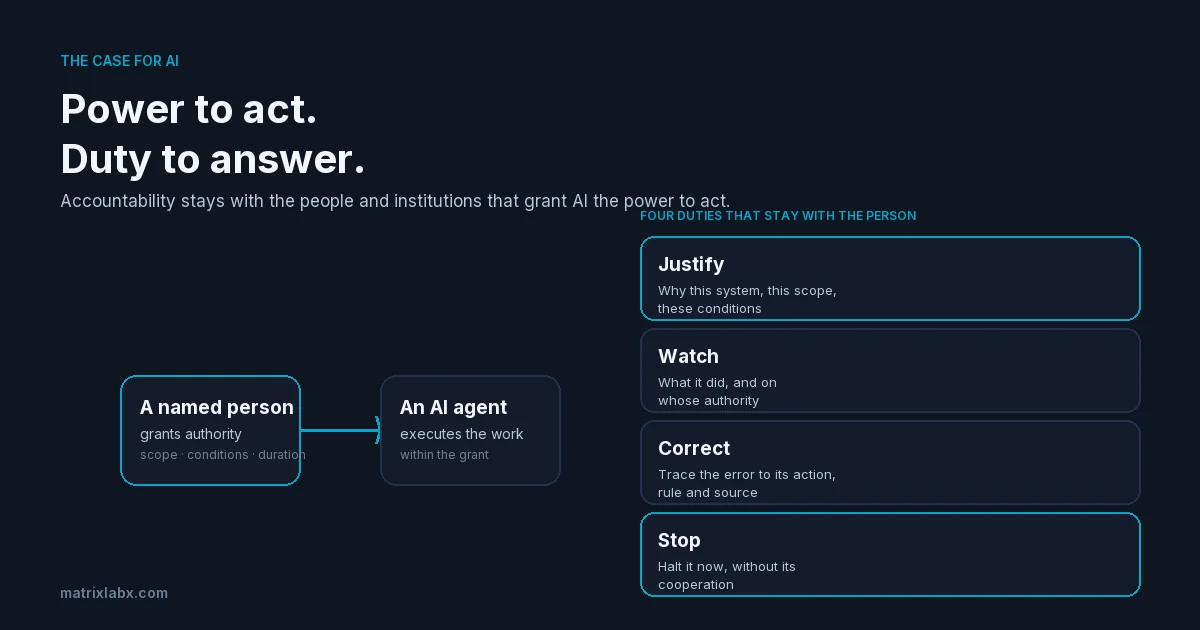
Artificial intelligence is an extremely powerful and beneficial technology, and organizations should use it to do real work, not just to draft suggestions. But accountability for what AI does remains with the people and institutions that grant it the power to act. So does everything that follows from that grant: the duty to justify the arrangement, to watch it, to correct it, and to stop it when necessary. Governed AI is not a compromise between power and control. It is the only arrangement under which the power is worth granting.
Why is AI worth giving the power to act?
Start with the affirmative case, because it is the one that usually gets skipped in conversations about AI risk.
AI systems can now read, reason over, and act on more information than any team of people can hold in view at once. They do not tire at the end of a shift. They do not lose context when a colleague leaves. They respond to a signal when it fires rather than the next business morning. Work that was once bounded by the hours in a day (sourcing, research, monitoring, record maintenance, first-pass review) becomes bounded instead by how well the work is defined.
That matters most in exactly the places organizations are least staffed to cover. A compliance team cannot read every message before it is sent. A revenue team cannot reach every account on its list inside the window when a buying signal is live. A risk function cannot watch every pattern across every channel as it forms. In each case the constraint is not skill or judgment. It is coverage, and coverage is what AI provides at a scale people cannot.
There is a second benefit that gets less attention: consistency. A person applying a policy on the four-hundredth review of the week is not applying it the way they did on the first. A well-specified system applies the same rule the same way every time. When the rule is wrong, it is wrong visibly and correctably rather than silently and intermittently.
And there is a third: memory. An agent that records what it did, why, from which sources, and on whose authority produces an operating record that human workflows rarely produce on their own. The organization stops depending on what someone remembered to write down.
So the case for AI is not speculative. It is structural. There is real work, currently undone or done late, that AI can do well. Declining to use it is not a neutral choice. It is a decision to keep leaving that work undone.
The question is not whether to give AI the power to act. It is on what terms.
Who is accountable when AI acts?
The people and institutions that granted it the power to act. Always.
This is not a legal technicality or a cautious hedge. It follows from what accountability is. To be accountable is to be answerable: to be the one who can be asked why something happened, who can give reasons, who can bear consequences, and who can change what happens next. An AI system can produce an explanation of its output. It cannot answer for the decision to deploy it, to give it that scope, to connect it to that system, or to let it act on that customer's record. Those were human decisions, made by people inside institutions, and the answerability for them stays where they were made.
Delegation does not change this. When a manager delegates a task, the manager does not stop being responsible for the outcome of their function. They have added a party to the chain, not removed themselves from it. Delegating to AI works the same way, with one difference that makes the point sharper: an AI system cannot take on any share of the answerability that a human delegate partly carries. Every link in the chain that matters has a person at it.
Organizations that understand this deploy AI more confidently, not less. They know where answerability sits, so they know who has to be satisfied before a new capability goes live, who watches it once it does, and who has the authority to pull it back. Organizations that lose track of it tend to discover the gap at the worst possible moment: when a regulator, a customer, or a board asks who approved what, and the honest answer is that nobody can say.
We make the full argument for why accountability cannot move to the system in Who Is Accountable When AI Acts? The Case for Governed AI.
What does it mean to grant AI the power to act?
Granting power is an act, not an accident. It happens through specific decisions, and each one is a point where accountability attaches.
Scope. Which work may the system do? Draft outreach, or send it? Flag a message, or hold it? Suggest a record change, or write it?
Authority. Under whose name does it act, and with which permissions? A system running on broad, shared credentials acts on the organization's full authority whether anyone intended that or not. A system acting through its own narrowly scoped identity acts only on the authority it was explicitly given.
Conditions. When may it act on its own, and when must it wait? Some actions are low-consequence and reversible. Others reach a customer, a patient, a regulator, or a record that cannot be quietly amended.
Duration. How long does the grant hold, and what would cause it to be revisited?
Consider an illustrative case Illustrative — not a specific client. A revenue team connects an agent to its CRM so the agent can draft follow-ups when a trial stalls. Months later, a second integration gives the same agent the ability to send email directly. Nobody decided that the agent should now contact prospects on its own. The permission simply arrived with the connector. When a prospect complains about a message they received, the team discovers that it cannot say who authorized sending, under which rule, or whether anyone ever reviewed the scope after the change. The agent did exactly what it was able to do. The failure was in the grant: authority expanded, and accountability did not follow it.
The same agent, governed, looks different. The send action is its own action class, held for a named person's approval until that person decides otherwise. The new integration changes nothing until someone with authority changes the grant, and that change is recorded.
Scope, authority, conditions, and duration are each a decision somebody makes, or, worse, a default nobody made. The discipline of governed AI is to make them explicitly, record them, and assign an owner to each. Once the grant is explicit, the duties that follow from it become concrete.
What are the four duties that follow from granting AI power?
The duties are not an add-on to the decision to deploy. They are the rest of that decision. An organization that grants AI the power to act takes on four standing obligations.
The duty to justify
Before the grant, someone must be able to say why this system should do this work, in this scope, under these conditions. The reasons have to hold up in front of the people affected. Justification is not a business-case slide. It is an answer to the question a customer, an examiner, or an employee would ask: why was a machine allowed to do this, and why was that a reasonable choice?
Good justifications are specific. They name the work, the benefit, the risk, and the control that addresses the risk. They say why one action class is safe to run under a standing policy and why another must wait for a named person. And they are written down before the system goes live, not reconstructed afterward.
The duty to justify also continues after deployment. When circumstances change (a new regulation, a new channel, a new category of data), the original justification may no longer cover the arrangement. The owner of the grant has to be able to say whether it still does.
The duty to watch
Once AI is acting, somebody has to know what it is doing. Not in aggregate, not by dashboard impression, but in a form that can be inspected action by action when it matters.
Watching has two layers. The first is supervision in the moment: a named person who can see what the system is doing, notice when something looks wrong, and intervene. The second is the record: a complete, tamper-evident account of each action, its rationale, the sources it relied on, the prior state it changed, and the person or standing policy that authorized it.
The second layer is what lets the first scale. No one can watch everything live. But when every action is recorded with its reasons and its authority, the organization can answer any question after the fact, and can detect patterns across actions that no single supervisor would see.
The duty to correct
AI will sometimes be wrong. So will the rules it was given. The duty to correct means there is a working path from noticing an error to fixing it: the specific action, the rule that produced it, and the downstream records it touched.
Correction depends on the record. If you do not know what the system changed, you cannot change it back. If you do not know which rule drove an action, you cannot fix the rule. This is why field-level lineage (which actor wrote a value, from which source, replacing which prior value, under whose approval) is not an audit luxury. It is the precondition for correction.
Correction also runs upstream. When the same kind of error recurs, the right fix is often not to the output but to the grant itself: narrow the scope, move an action class back from a standing policy to per-action approval, or change the rule set the system reasons against.
The duty to stop
The last duty is the one that proves the other three are real. Whoever grants AI the power to act must keep the ability to stop it: quickly, completely, and without needing the system's cooperation to do so.
Stopping takes several forms. Revoking a standing policy so that an action class returns to per-action approval. Suspending a single agent while the others keep working. Blocking an action before it dispatches because it fails a rule. Pausing everything while an incident is understood.
A system that can only be stopped by negotiating with it, or by an engineer hunting for the right process to kill, has not been granted power. It has taken it. The design test is simple: can the named owner stop this, now, and does the record show that they could have at every point along the way?
Doesn't accountability slow AI down?
No. Accountability is what lets it speed up.
The common framing sets governance against capability, as if every approval gate and audit record were a tax on what AI could otherwise do. For any organization that answers to a board, a regulator, or a customer, the opposite holds. Without a clear owner, an explicit grant, a complete record, and a working stop, AI stays in pilot. Legal cannot sign off. Security cannot sign off. The executive who would have to answer for it declines to sponsor it. The capability exists and the organization cannot use it.
With the four duties discharged by design, the conversation changes. The risk owner can see exactly what is authorized. The compliance officer can see exactly what was held and why. The executive can answer the board's question before it is asked. Each action class can move from per-action approval to a standing policy as the record accumulates evidence that it is safe to, and move back if the evidence turns.
That is governance as throughput. The organizations that get the most out of AI will not be the ones that grant it the most power soonest. They will be the ones that can grant it power defensibly, because that is what lets them keep granting more.
How does governed autonomy turn accountability into architecture?
MatrixLabX builds to one operating principle: agents execute, humans authorize. Our platform, PrescientIQ™, is designed so that each of the four duties maps to a structural control rather than to a policy document someone has to remember.
| Duty | The question it answers | The structural control |
|---|---|---|
| Justify | Why is this system allowed to do this work? | Action classes defined, and assigned a governance mode, by the customer's own team, with rules grounded in the customer's own source documents |
| Watch | What is it doing, and on whose authority? | An immutable audit ledger recording each action's rationale, before-and-after state, and the approver or standing policy behind it |
| Correct | How do we fix it when it is wrong? | Field-level lineage on every governed write, so an error traces back to its action, its rule, and its source |
| Stop | Can we halt it now? | Every action class starts in human-in-the-loop; standing policies are revocable at any time by a named person; per-agent least-privilege identity limits what any single agent can reach |
Two governance modes carry most of the weight. In human-in-the-loop (HITL), an action is drafted and held. It does not execute until a named person on your team approves it. In human-on-the-loop (HOTL), an action executes under a standing policy your team sets, and a named person supervises with intervention, override, and revocation authority. Your team chooses the mode for each action class based on its own risk tolerance, and can change it at any time.
The distinction matters because it puts the grant where accountability says it belongs: with the organization, explicitly, per class of action, on the record.
What does governed AI look like in a regulated function?
The clearest test of the thesis is the function where an unaccountable action has the most concrete consequences: compliance.
PrescientIQ™ Compliance Shield is designed to turn a static compliance manual into an active boundary. A monitoring agent scans in-flight messages and transaction data against the organization's own ingested manual and scores each flag into a severity tier. The highest-tier messages are quarantined before they reach the recipient and held until a compliance officer grants an exception or confirms the violation. A governance agent drafts proposed policy updates when regulation changes, for the compliance team to approve, never on its own authority. A risk-intelligence agent surfaces patterns that no single message breaks a rule on. An auditor agent maintains the immutable record of every flag, every decision, and every human resolution, and compiles it into audit-ready dossiers on demand.
Read that description against the four duties. The rules are grounded in the organization's own documentation: that is the justification. Every flag and decision is recorded: that is the watching. The ledger ties each decision to a rule and a person: that is what makes correction possible. And nothing in the highest tier executes on the agent's own authority: that is the stop, built into the dispatch path rather than bolted on afterward.
Compliance Shield is the next release on the PrescientIQ roadmap, with a closed beta targeted for December 2026 and general availability for January 2027 Target — roadmap. Early-access design-partner conversations are open for fintech and healthcare compliance teams. See the Compliance Shield overview.
What does MatrixLabX believe?
The thesis of this article is not a positioning exercise. It is the reason the company exists.
Mission. MatrixLabX replaces the fragmented revenue stack with governed autonomous agents that do the operational work of a revenue function — so mid-market B2B companies grow faster with the team they already have, and every buyer they serve is met with relevance, speed, and honesty. Agents execute. Humans authorize. Results compound.
Vision. A B2B market where buying feels like being understood. Every buyer gets the right answer at the right moment, never repeats themselves, and never receives a message that wasn't worth their time — because autonomous digital labor runs the operational work of revenue with discipline, earns more autonomy only as it earns trust, and gives people back their time for judgment, relationships, and the ideas that move a business forward.
Where should you go from here?
If you are the person who will answer for AI in your organization, read Who Is Accountable When AI Acts? The Case for Governed AI. It maps the accountability chain link by link and covers what regulators expect of it.
If you are the person who has to make the case for deploying AI, read Why AI Deserves Power, and Why People Must Answer for It. It covers how authority should be earned and expanded over time.
For how these controls are specified in practice, see enterprise AI governance. For the broader shift from buying software to deploying governed labor, see digital labor.
The honest way to decide how much power to grant AI in your own organization is against your own data, not a general argument. The free Autonomous Audit Report (AAR) models where governed agents would carry work in your operation, which action classes belong under per-action approval, and what the projected impact is, before you commit to anything.
Frequently asked questions
Is AI beneficial or dangerous?
AI is an extremely powerful and beneficial technology. The risks that matter to an organization come from how power is granted to it: without a defined scope, supervision, a complete record, or a working way to stop it. Governed AI addresses those conditions directly, which is what makes the benefits usable.
Who is responsible when an AI system makes a mistake?
The people and institutions that granted it the power to act. An AI system can explain its output, but it cannot answer for the decision to deploy it, the scope it was given, or the systems it was connected to. Those decisions, and the duty to justify, watch, correct, and stop the arrangement, stay with the people who made them.
What does "agents execute, humans authorize" mean?
It is the operating principle of governed autonomy. AI agents do the work within a defined scope, a named person holds approval over consequential actions, and every action is recorded to an immutable audit ledger with its rationale and the approver or standing policy behind it.
Does human oversight make AI slower?
Not in the way that matters. Without clear ownership, a complete record, and a working stop, AI tends to stay in pilot because no one can sign off on it. Governance is what allows an organization to deploy AI into real workflows and expand its authority as the record builds evidence.
What is the difference between human-in-the-loop and human-on-the-loop?
In human-in-the-loop, an action is drafted and held until a named person approves it. In human-on-the-loop, an action executes under a standing policy the organization sets, while a named person supervises and keeps intervention, override, and revocation authority. The organization chooses the mode for each action class and can change it at any time.
See where your own execution effort is going
The Autonomous Audit Report models where your team's execution capacity is currently spent, what your configuration is actually paying for, and what the governed alternative looks like on your own data — before any commitment.
Get your free AAR benchmark