PHP2Shell: AI just changed exploit economics. Is your agentic stack fail-closed?
Short answer: on October 21, 2026, the PHP project shipped emergency releases for two critical runtime flaws, together called PHP2Shell, that allow unauthenticated remote code execution. Wiz Research found them with frontier AI models and says the bugs had sat in PHP for more than a decade. The lesson for revenue leaders is not about PHP. AI has made hard-to-exploit flaws practical, so the question for any agentic stack is what it does when something breaks mid-action: stop, or keep going.
What happened with PHP2Shell?
- The fix. PHP 8.5.12, 8.4.27, 8.3.36 and 8.2.35 were released on October 21, 2026 to fix CVE-2026-109618 and CVE-2026-109619, both rated CVSS v4.0 9.2. The PHP security advisory lists every PHP installation serving web requests as at risk, including PHP-FPM, Apache with mod_php, php-cgi, FrankenPHP and LiteSpeed, and rates the risk highest for mod_php.
- Older versions. PHP 8.1 and older no longer receive updates from the PHP project. Given the severity, the security team published minimal source backports for 7.4, 8.0 and 8.1; otherwise, the advisory points users to their distribution or LTS vendor.
- The blast radius. Wiz Research reported on October 21, 2026 that the flaws live in PHP itself, so an application with clean code can still be exposed on an affected version. Wiz demonstrated pre-authentication remote code execution against WordPress, Drupal and Joomla, and a memory-disclosure attack that can leak passwords, authentication tokens, API keys and certificates without code execution.
- The reach. Per Wiz, every PHP version released in the last decade, back to 5.4, is affected by at least one of the issues. Wiz puts PHP behind 70% of websites (Wiz Research, October 2026).
- The follow-up. On October 23, 2026, php.net published an informational advisory recommending
session.upload_progress.enabled=0until the next regular bugfix release, to close an unlikely remote-code-execution path now tracked as CVE-2026-115560.
Why does PHP2Shell change exploit economics?
Wiz’s disclosure timeline is the part every operator should read twice. Wiz found the first vulnerability on August 19, 2026, confirmed unauthenticated remote code execution against Drupal the next day, and against WordPress the day after.
Wiz attributes that speed to frontier models, naming Wiz Atlas, Gemini 4 Argon and GPT-5.6 Sol, which helped chain several bugs and adapt the exploit to different PHP versions, configurations and memory layouts. That per-target adaptation is the work that used to need scarce specialists and months of effort. Wiz’s own conclusion: “This changes the economics of both discovery and exploitation.”
Read that as an operator, not a researcher. For years, “theoretically vulnerable, but nobody could practically weaponize it” was an acceptable risk posture. Wiz’s argument is that complexity no longer holds as a barrier. Old bugs in a backlog become live targets, and any control that depends on an attacker finding the work too hard is now a weaker bet. The same shift is behind securing the B2B AI supply chain in RevOps.
Why is PHP2Shell a fail-open pattern?
Strip away the memory-safety detail and PHP2Shell has a simple shape. According to the PHP advisory, out-of-memory handling can interrupt PHP while internal request data is only partly initialized, and request cleanup may then treat that invalid data as valid. Separately, request-owned state can survive after its memory is freed, and a later request handled by the same worker may use it before normal initialization resets it. Wiz adds that the memory-disclosure path works even when the application never starts a session.
In plain terms: a request dies abnormally, leftover state survives, and the next request trusts it. That is what failing open looks like. A fail-closed system does the opposite. When something breaks, it discards what it cannot verify and stops until it can.
Why is this a revenue-leadership problem, not only an IT one?
Agentic revenue stacks have the same shape, one layer up.
- Agents hold standing credentials: OAuth tokens to your CRM, mailboxes, calendars and enrichment tools. Wiz showed PHP worker memory leaking exactly that class of secret.
- Agents run multi-step actions: research, draft, approve, send, write back to the CRM. Steps fail mid-flight all the time, through timeouts, rate limits, model errors and expired tokens.
- Agents act externally: under your brand, from your domains, against your sender reputation.
So the useful question is not whether your agent vendor runs PHP. It is whether your stack, end to end, fails open or fails closed. Plenty of revenue stacks still touch PHP somewhere: a WordPress marketing site, a form handler, a plugin that pushes leads into the CRM.
What are the seven questions that test whether an agentic stack is fail-closed?
Ask these of every vendor, and every internal build, that lets AI act on your pipeline. For the wider procurement view, pair them with the AI agent security review checklist.
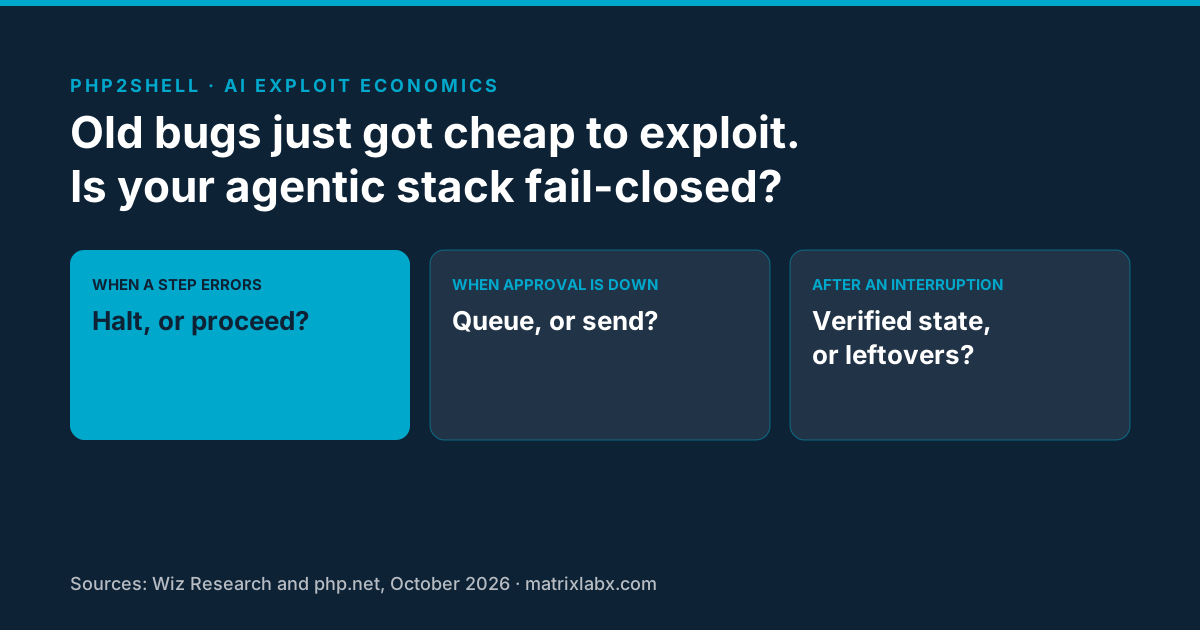
- Default on error. When a step throws, times out or returns something malformed, does the agent halt, or proceed with what it has?
- Approval-gate failure mode. If the human-approval service is unavailable, do external messages queue, or go out unapproved?
- State after interruption. When a multi-step action dies halfway, does the next run resume from verified, logged state, or from whatever was left in memory?
- Credential scope. Does each agent hold its own least-privilege, short-lived, revocable credentials, or one shared admin token?
- An audit trail you own. Is there an append-only record of what each agent did, who approved it, and the before-and-after state, one your security team can read without the vendor in the room?
- Kill switch. Can one person stop all agent execution in a single action?
- Runtime inventory. Do you know every runtime under your agents and martech, including PHP versions, and which were on 8.1 or older this week?
If the honest answer to any of the first three is “it proceeds,” you are running a fail-open stack. With AI-assisted exploitation, that is no longer a theoretical gap.
See what your agents would do before they do it.
The free Autonomous Audit Report (AAR) is a read-only assessment of a sample of your CRM and pipeline data. It maps where pipeline leaks today, what governed digital workers would execute, and where a named person approves, with every figure labeled as modeled. It is not a penetration test or a security audit. A MatrixLabX solution architect replies within 48 hours to arrange the sample.
Get your free AAR Benchmark →What should you do about PHP2Shell this week?
From the PHP advisories:
- Patch. Update to PHP 8.5.12, 8.4.27, 8.3.36 or 8.2.35, or install your Linux distribution’s or LTS vendor’s patched packages.
- If you cannot patch today, apply the interim measures php.net lists, such as disabling session upload progress and capping request sizes. The PHP project is explicit that these reduce exposure to specific attack paths but do not make an installation safe.
- Apply the October 23 recommendation to set
session.upload_progress.enabled=0until the next regular bugfix release.
Beyond the patch:
- Ask every vendor in your revenue stack, in writing, whether any component ran on an affected PHP version and when it was patched.
- Treat exposed secrets as rotation candidates. If an internet-facing PHP service was unpatched and handled API keys or tokens, Wiz’s memory-disclosure finding is reason enough to rotate them.
- Run the seven questions above against your agentic tools before your next renewal, not after your next incident.
How does PrescientIQ™ approach governance?
PrescientIQ™ is built on one premise: digital workers execute, humans authorize. Your team chooses how much oversight each kind of action gets. The two modes are:
Human-in-the-loop (HITL). The action is drafted and held. It does not execute until a named person on your team approves it.
Human-on-the-loop (HOTL). The action executes under a standing policy your team sets. A named person supervises and keeps intervention, override, and revocation authority.
Your team chooses the mode for each action class, based on its risk tolerance, and can change it at any time.
Every action, in either mode, is recorded to the audit ledger with its rationale, before-and-after state, and the approver or policy behind it.
Every action class starts in human-in-the-loop until your team changes it.
How a ledger of agent actions becomes the record your security and finance teams review is covered in the agent audit ledger as a system of record. The full specification of the crew is on the Revenue Accelerator Stack page.
Where the data runs
PrescientIQ is hosted and operated by MatrixLabX on Google Cloud. SOC 2, ISO 27001, and PCI DSS attestations are held by Google Cloud, which operates the underlying infrastructure. They are not MatrixLabX certifications. MatrixLabX application-layer SOC 2 is in progress.
Frequently asked questions
- What is PHP2Shell?
- PHP2Shell is the name Wiz Research gave to two critical vulnerabilities in the PHP runtime, CVE-2026-109618 and CVE-2026-109619. Both are memory-safety flaws in how PHP handles requests that end abnormally, chiefly out-of-memory errors, and both can let an unauthenticated attacker run code on an affected server.
- Which PHP versions fix PHP2Shell?
- PHP 8.5.12, 8.4.27, 8.3.36 and 8.2.35, released on October 21, 2026, fix both PHP2Shell vulnerabilities. PHP 8.1 and older no longer receive updates from the PHP project, so those installations need a backported fix from a Linux distribution or LTS vendor, or an upgrade to a supported version.
- Is a PHP site safe from PHP2Shell if it never uses sessions?
- No. Wiz Research reports that the PHP2Shell memory-disclosure attack works even when the application never starts a session, and the PHP project lists every PHP installation serving web requests as at risk. Patching to a fixed release is the only complete remedy; interim configuration changes only reduce exposure.
- Why does PHP2Shell change exploit economics?
- PHP2Shell changes exploit economics because frontier AI models made a decade-old, hard-to-exploit flaw practical. Wiz Research used models to chain several bugs and adapt the exploit to different versions and memory layouts, work that once needed scarce specialists. When that effort drops, bugs that seemed too complex to weaponize become real targets.
- What does fail-closed mean for an agentic AI stack?
- A fail-closed agentic AI stack stops when something it depends on breaks. If a step errors, an approval check cannot complete, or state cannot be verified, the agent halts instead of acting on what it has. A fail-open stack proceeds anyway, which is the same pattern PHP2Shell exploits at the runtime level.
- How does the free Autonomous Audit Report relate to agent security?
- The free Autonomous Audit Report is a read-only assessment on a sample of your own CRM and revenue data. It maps where pipeline leaks, what governed digital workers would execute, and where a named person approves. It is not a penetration test or a security audit; it is the execution map to review before any agent acts.
Sources
- Wiz Research (Sagi Tzadik, Shir Tamari, Nir Ohfeld, Tomer Schwartz), PHP2Shell: AI uncovers critical RCE vulnerabilities affecting 70% of the Internet, October 21, 2026.
- The PHP Group, Security advisory: Critical remote code execution vulnerabilities, update now, October 21, 2026.
- The PHP Group, Informational advisory: Session upload progress, October 23, 2026.
Related reading
Notes on this page
Every fact about PHP2Shell comes from the Wiz Research disclosure or the php.net advisories, dated and linked above; the 70% figure is Wiz’s own. The seven questions are MatrixLabX’s own test. This page states no MatrixLabX performance figures and makes no security certification claim; any projected impact for your company is modeled on your own data in the Autonomous Audit Report and labeled as a target until validated.
See where your own execution effort is going
The Autonomous Audit Report models where your team's execution capacity is currently spent, what your configuration is actually paying for, and what the governed alternative looks like on your own data — before any commitment.
Get your free AAR benchmark