Managed Revenue Operations · Motion lane
Managed expansion and retention: act on usage signals between QBRs
Last updated
» Direct answer
MatrixLabX runs PrescientIQ's Steward and Herald workers as a managed expansion lane. Steward surfaces upsell and churn-risk signals from usage, seat utilization, and feature adoption, each with a deterministic confidence score. Your operator turns them into prioritized plays. Account decisions stay with your CSMs and account owners.
The signal → the work → what you control
Steward · Expansion & Retention Analyst
- The signal
- Post-sale usage, seat utilization, and feature adoption for every customer account.
- The work
- Surfaces upsell and churn-risk signals, each with a deterministic confidence score, and drafts the expansion or retention play for the account owner.
- What you control
- Whether to expand, discount, escalate, or let an account go stays with your CSMs and account owners.
Herald · Outbound Engagement Rep
- The signal
- A play your account owner has chosen to run.
- The work
- Drafts the customer-facing outreach in the play, grounded in the account's own usage.
- What you control
- Every customer-facing draft is held in the approval queue. Your operator pre-reviews it, and a named person on your team approves it before it sends.
Marshal · Revenue Operations Coordinator
- The signal
- Every signal, draft, approval, and rejection across the lane.
- The work
- Routes work between Steward and Herald and writes every action, its rationale, the operator, and the approver to the audit ledger.
- What you control
- The ledger exports to CSV for your RevOps, finance, or compliance team at any time.
What your operator does every week
- Reviews the accounts Steward flagged for expansion or churn risk, and the confidence behind each one.
- Turns the strongest signals into prioritized plays for each account owner, ahead of the next QBR rather than at it.
- Pre-reviews every customer-facing draft within your tier's service level.
- Checks CRM writeback accuracy, so the usage and account fields your team reads stay current.
- Sends the Monday ledger report: signals flagged, plays chosen, drafts approved and rejected, and outcomes recorded.
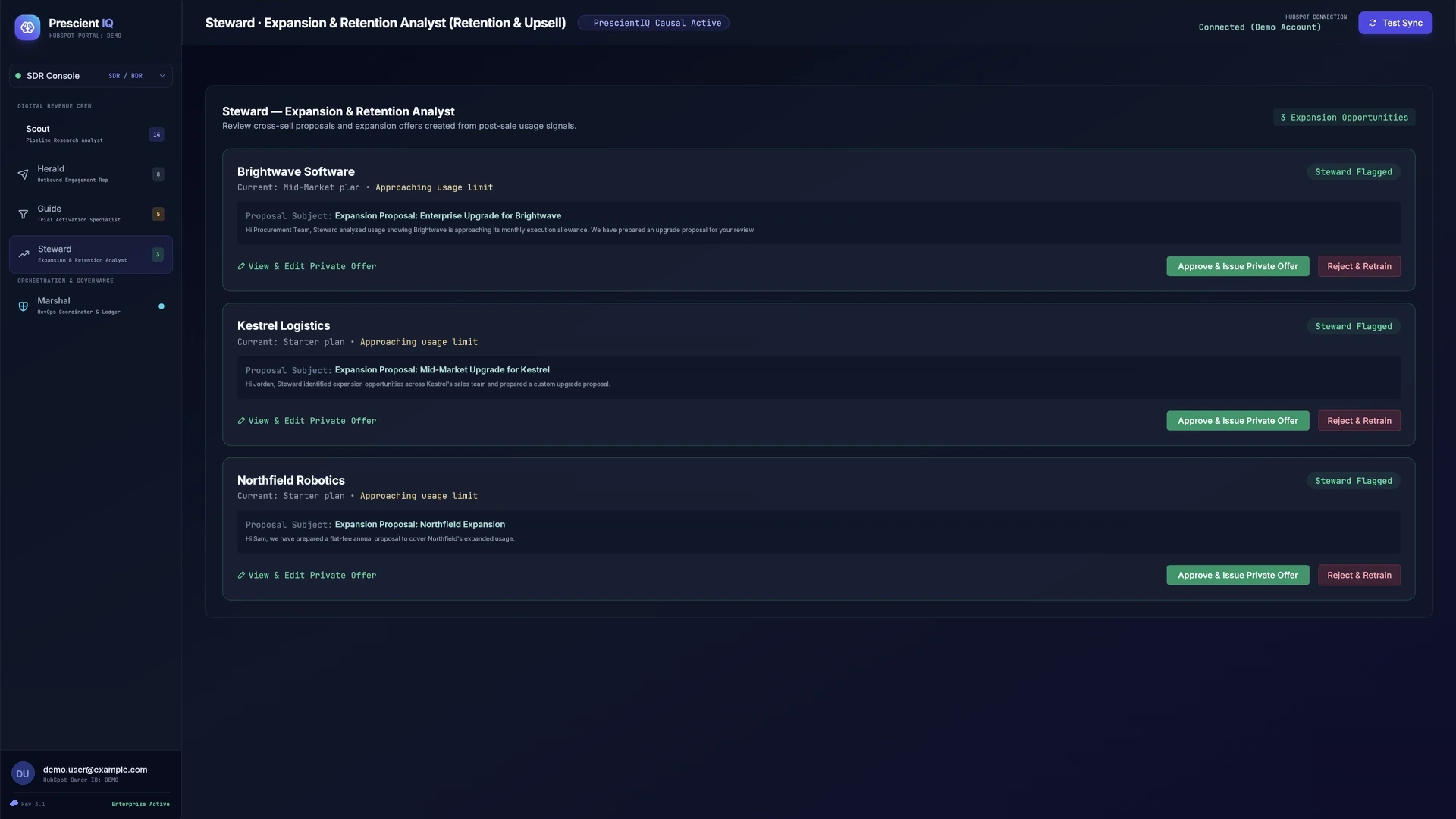
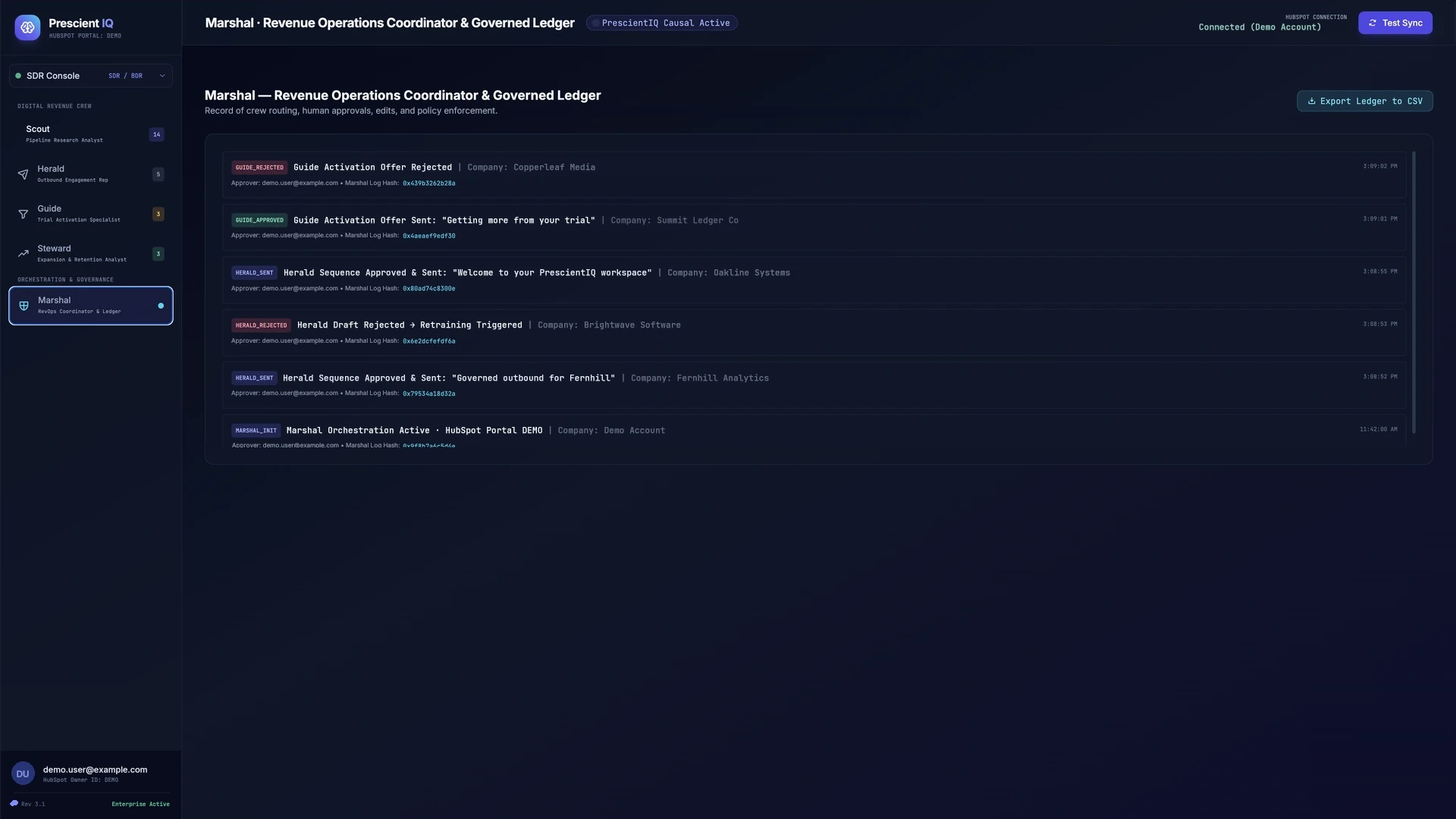
Screens show a demo workspace with sample data. The companies and addresses are fictional.
What we can prove for this lane
Figures labeled as targets are modeled against current human and copilot baselines. They are not guarantees. Every engagement begins with a free Autonomous Audit Report — a P&L projection built on your own data — and targets are validated against your environment before any commitment.
This lane is included in Pipeline Crew ($8,999/mo) and in every Revenue Crew and Revenue Command plan. See managed pricing →
Two ways to run PrescientIQ™
Run it yourself
PrescientIQ™ Sales Accelerator from $399/mo (annual), or Revenue Accelerator at $165,000/yr. Your team configures the crew, staffs the approval queue, and owns deliverability.
See self-run pricing →We run it for you
PrescientIQ™ Managed Revenue Operations from $8,999/mo. A named MatrixLabX operator runs the crew; your team authorizes. Includes the platform at its published price.
See managed pricing →Frequently asked questions
- What is managed expansion and retention?
- Managed expansion and retention is a MatrixLabX service in which a named operator runs PrescientIQ's Steward and Herald workers on your customer base. Steward surfaces upsell and churn-risk signals from usage, and your operator turns them into prioritized plays for the account owners who make the decisions.
- Does Steward contact customers on its own?
- No. In MatrixLabX managed expansion and retention, Steward prepares plays and Herald drafts any customer-facing message, and every draft is held in the PrescientIQ approval queue. Your MatrixLabX operator pre-reviews it, and a named person on your team approves it before it sends.
- Who decides on discounts, escalations, and renewals?
- Your team does. In MatrixLabX managed expansion and retention, PrescientIQ's Steward surfaces the signal and your operator prepares the play, but every decision about pricing, escalation, or whether to let an account go stays with your CSMs and account owners.
- What data does Steward need?
- PrescientIQ's Steward reads post-sale usage, seat utilization, and feature adoption for each customer account, plus account records in Salesforce or HubSpot. Your MatrixLabX operator confirms which usage data your product already sends during the free Autonomous Audit Report.
- How much does managed expansion and retention cost?
- MatrixLabX managed expansion and retention is included in Pipeline Crew at $8,999 a month as its one motion lane, and in every Revenue Crew and Revenue Command plan. Each price is the published PrescientIQ platform fee plus a managed-service fee, with no seats and an exit right at day 90.
Keep reading
- How managed revenue operations works
- Managed SDR pricing, every tier itemized
- Managed outbound (Scout + Herald)
- Managed trial conversion (Guide + Herald)
- How governed expansion agents catch usage drop-offs before your CSMs do
- Net revenue retention in SaaS: the operating guide
- Run it yourself: Sales Accelerator pricing or Revenue Accelerator pricing
Get your free Autonomous Audit Report
A solution architect models your funnel on your own CRM data, read-only, and returns a priced proposal. Requests are answered within 24 hours, Monday–Friday, 9:00 AM–4:00 PM Eastern.
PrescientIQ is hosted and operated by MatrixLabX on Google Cloud. SOC 2, ISO 27001, and PCI DSS attestations are held by Google Cloud, which operates the underlying infrastructure. They are not MatrixLabX certifications. MatrixLabX application-layer SOC 2 is in progress.