RevOps in 2027: the three concerns that will decide whether your AI plan survives
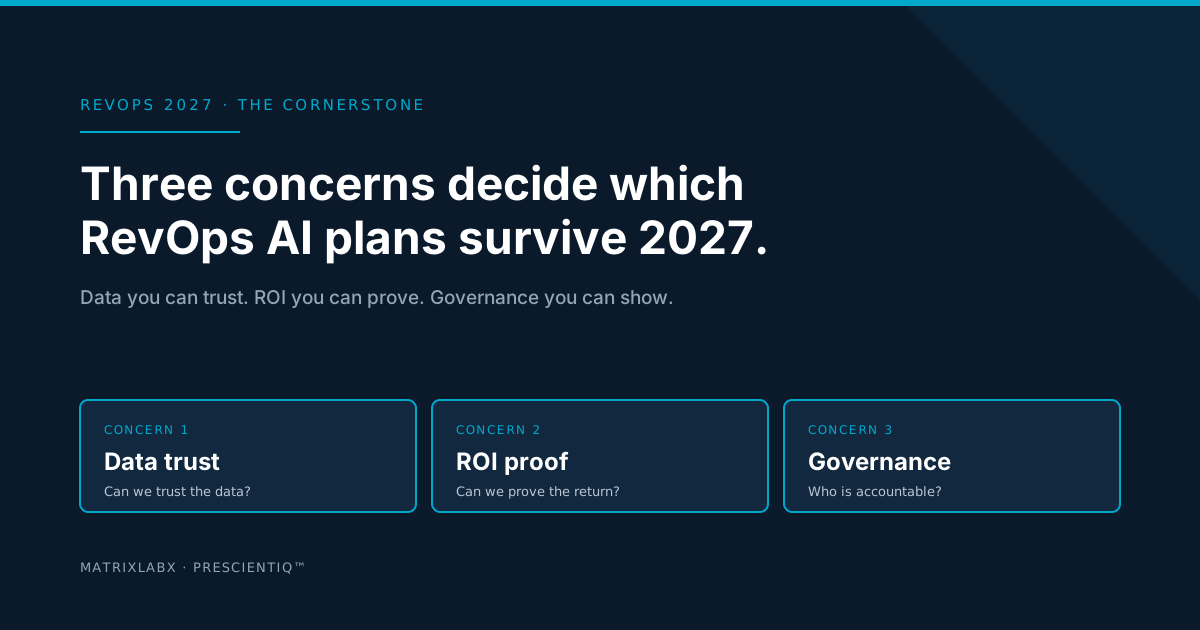
Revenue operations leaders face three concerns in 2027. First, trusting the CRM data that AI agents will run on. Second, proving AI return on investment before deferred budgets are cut. Third, governing what agents are allowed to write and send. The three are linked: bad data produces wrong agent actions, and ungoverned wrong actions produce the incidents that end AI programs.
Why 2027 is the year the bill comes due
2026 was the year the AI hype cycle met the finance department. Forrester’s 2026 predictions said fewer than one-third of decision-makers could tie AI’s value to their organization’s financial growth. It expected CEOs to lean on CFOs to approve AI investments on ROI, and enterprises to push a quarter of their planned AI spend into 2027 (Forrester, October 2025).
That makes 2027 the year the deferred budget gets decided again, and RevOps is usually the function asked to defend it. The revenue stack is where AI is most visible to the board, closest to the number, and most exposed when something goes wrong in front of a customer.
The research firms agree on the stakes:
- Gartner predicts that more than 40% of agentic AI projects will be canceled by the end of 2027. The causes it names are escalating costs, unclear business value, and inadequate risk controls (Gartner, June 25, 2025).
- Gartner also predicts that through 2026, organizations will abandon 60% of AI projects that are not supported by AI-ready data (Gartner, February 26, 2025).
- McKinsey’s 2025 State of AI survey found that only 39% of respondents report any enterprise-level EBIT impact from AI. It classifies about 6% as AI high performers (McKinsey, survey fielded June to July 2025, 1,993 participants).
Each of those findings maps to one RevOps concern. Taken together, they explain why so many revenue AI programs look impressive in a demo and stall in production.
Concern 1: Can we trust the data the agents will run on?
What the research firms say
Gartner’s February 2025 research is the clearest warning. In a third-quarter 2024 survey of 248 data management leaders, 63% of organizations either did not have, or were unsure whether they had, the right data management practices for AI. Gartner linked that gap directly to its prediction that 60% of AI projects without AI-ready data will be abandoned through 2026.
Gartner’s key point is that AI-ready data is not the same thing as clean enough for a dashboard. It is data aligned to a specific use case, actively governed, and continuously quality-assured.
RevOps practitioners report the same problem. In Default’s H1 2026 survey of more than 300 RevOps leaders, poor data quality was the most-cited barrier to AI adoption, named by 19% of respondents.
The underlying mechanics make it worse. Lusha tracked more than 140,000 US sales leaders and found that about one in eight changed roles within twelve months, close to 1% every month (Lusha, September 2026). In Validity’s 2025 survey of 602 CRM users, 76% said less than half of their CRM data is accurate and complete. A quarterly cleanup cannot keep pace with change that happens every month.
George Schildge’s view
How PrescientIQ™ mitigates the risk
- Every action is recorded. Every action, in either mode, is recorded to the audit ledger with its rationale, before-and-after state, and the approver or policy behind it. A bad write becomes a traceable event your team can find and correct, not silent corruption.
- Deterministic scoring. Account scoring runs on sandboxed deterministic code. No language model performs arithmetic that has a numeric consequence, so a score can be reproduced and checked.
- Grounded actions. Outreach is grounded in the specific signal that triggered it, with the reasoning behind each draft captured alongside it.
- Salesforce and HubSpot. Agents read from and write back to Salesforce and HubSpot through typed, scoped integrations.
Action items for RevOps
- Pick the three revenue workflows you would hand to an agent first. For each one, list the CRM fields it reads and writes.
- Measure the fill rate and freshness of those fields only. Do not audit the whole CRM.
- Make “records before-and-after state on every write” a pass/fail requirement in every agent evaluation.
Go deeper: Why your CRM data decays faster than your cleanup cycle · What “AI-ready data” means for revenue teams · How to deploy agents on the CRM you actually have
Concern 2: Can we prove the ROI before the budget is cut?
What the research firms say
Forrester’s forecast is blunt. As financial rigor slows production deployments and eliminates proofs of concept, enterprises will defer a quarter of planned AI spend into 2027. The CFO, not the innovation team, becomes the approver (Forrester, October 2025).
Gartner adds a market-quality problem it calls agent washing: vendors rebranding existing assistants and automation products as agentic. Gartner estimates that only about 130 of the thousands of vendors claiming agentic AI are real, and its analysts add that many use cases positioned as agentic do not need an agentic implementation at all (Gartner, June 2025).
McKinsey’s data shows how rare value at scale still is. Most organizations report use-case-level benefits, but only 39% report enterprise-level EBIT impact. The high performers stand out for redesigning workflows instead of bolting AI onto existing ones (McKinsey, 2025).
George Schildge’s view
How PrescientIQ mitigates the risk
- Free AAR Benchmark. The free Autonomous Audit Report is a P&L projection built on your own data in a read-only working session. Every figure in it is labeled as modeled.
- Invoices that reconcile to a ledger. Completed workflows and the outcomes they produce write to the same ledger as your audit trail, so RevOps can reconcile a monthly invoice against it.
- One flat fee, never per seat. The Revenue Accelerator is one annual platform fee of $165,000, billed monthly. Adding reviewers does not change it. Pricing is published on the pricing page.
- Agents that execute. Four specialist agents (Scout, Herald, Guide, and Steward) work under one coordinator, Marshal. They do the research, the outreach, the CRM write, the trial save, and the expansion play. They are not assistants that stop at a recommendation.
Action items for RevOps
- Write the CFO’s three questions down now: What does it cost per unit of work? What baseline are we comparing against? How will we know by month three?
- Ask every vendor on your 2027 shortlist to model the ROI on your data before contract, not after.
- Refuse any invoice you cannot reconcile to source events.
Go deeper: The 2027 AI budget review: what CFOs will ask RevOps · Agent washing: how to tell a real revenue agent from a rebranded assistant · Measure before you commit: a pre-purchase P&L for revenue AI
Concern 3: Who is accountable for what the agents write and send?
What the research firms say
Inadequate risk controls are one of the three causes Gartner names for agentic project cancellations. Gartner expects oversight to become its own market. It predicts that guardian agents, technology that monitors, redirects, or blocks other agents’ actions, will account for 10 to 15% of agentic AI markets by 2030, and that 70% of AI apps will use multi-agent systems by 2028. Its analysts argue that once agents interact with each other at machine speed, human oversight alone is no longer enough (Gartner, June 11, 2025).
Forrester sees the cost of getting this wrong landing in go-to-market specifically. It predicts that ungoverned use of generative AI will cause B2B companies to lose more than $10 billion in enterprise value through declining stock prices, legal settlements, and fines (Forrester, October 28, 2025).
George Schildge’s view
How PrescientIQ mitigates the risk
Your team sets the governance mode for each class of action:
Human-in-the-loop (HITL). The action is drafted and held. It does not execute until a named person on your team approves it.
Human-on-the-loop (HOTL). The action executes under a standing policy your team sets. A named person supervises and keeps intervention, override, and revocation authority.
Your team chooses the mode for each action class, based on its risk tolerance, and can change it at any time.
Every action, in either mode, is recorded to the audit ledger with its rationale, before-and-after state, and the approver or policy behind it.
Every action class starts in human-in-the-loop until your team changes it.
- A scoped identity for every agent. Each agent runs under its own least-privilege identity, enforced by permissions and not by prompt instructions. Entitlements can be listed, and an agent can be revoked without disabling a person.
- Defended inputs. Agents read web pages, email replies, and CRM fields other people write into. Each inbound surface is treated as untrusted and defended accordingly.
- Plain statements about where it runs. The platform statement at the foot of this page says who hosts PrescientIQ and whose attestations apply.
Action items for RevOps
- Inventory every AI tool that can write to your CRM or send in your brand’s name today, including pilots.
- For each action class (research, CRM field update, outbound send, trial message, expansion play), decide who approves it and whether it runs under standing policy.
- Require a reconstructable record of every agent action as a contract term, not a roadmap promise.
Go deeper: Human-in-the-loop vs. human-on-the-loop: setting the autonomy ceiling for each revenue action · The audit ledger is the new system of record for agent actions · Passing the security review before any agent touches the CRM
How the three concerns compound
The three concerns are one chain, and a weak link anywhere breaks it:
| If this fails | This happens next | The budget review sees |
|---|---|---|
| Data trust | Agents act on stale or wrong records | Wrong-account outreach, bad routing, forecast drift |
| Governance | Nobody can reconstruct which agent did what, or why | An incident with no root cause, and a stalled security review |
| ROI proof | Value can’t be tied to the P&L | The deferred 2027 spend doesn’t come back |
Programs that survive 2027 will address all three before scaling: a data scope tied to specific workflows, a governance mode per action class, and an ROI model the CFO has checked.
The RevOps 2027 readiness scorecard
Score each statement 0 (no), 1 (partly), or 2 (yes). Be honest. Nobody is grading this but you, and nothing you select is stored or sent.
Answered 0 of 9
0 / 18
- 14–18:
- Ready to scale
- 8–13:
- Fix the lowest-scoring concern first
- 0–7:
- Start with a current-state diagnosis
Ten questions to ask any revenue-agent vendor in 2027
- Does the agent execute the action, or draft it for a human to execute?
- What permissions does each agent hold, and which actions is each one unable to take?
- Where is my revenue data processed, and who operates that environment?
- Can I set a different autonomy level for each type of action?
- What exactly is recorded for every action: actor, rationale, before-and-after state?
- Can that record be altered after the fact?
- Which calculations are performed by a language model, and which are deterministic?
- Will you model ROI on my own data before I sign?
- Can my finance team reconcile the invoice to source events?
- Which of your compliance attestations are yours, and which are inherited from your cloud provider?
Ask us the same ten. Our answers to the questions about hosting and attestations are on the AI trust and governance page, including what we do not claim.
The bottom line
Most AI programs that fail in 2027 will not fail for lack of better models. They will fail because they ran on data nobody trusted, took actions nobody could reconstruct, and produced value nobody could prove. RevOps is the function in a position to fix all three. The work is less glamorous than a demo and far more likely to survive a budget review.
For the operating plan built on these three concerns, with three moves per front, a decision tree for which front to fix first, and a 90-day calendar, read The 2027 RevOps Survival Blueprint.
Check the math before you spend anything
The free AAR Benchmark builds a P&L projection on your own pipeline data in a read-only working session. Every figure in it is labeled as modeled.
Get your free AAR Benchmark →Frequently asked questions
- What are the top RevOps concerns for 2027?
- The top three are data trust, ROI proof, and agent governance. RevOps needs CRM data reliable enough for agents to act on. It needs a way to prove AI value before deferred budgets are cut. And it needs governance over what agents can write or send. Weakness in one undermines the others.
- Why is 2027 a turning point for AI in revenue operations?
- Forrester predicted that enterprises would defer a quarter of planned AI spend into 2027, with CFOs approving investments based on ROI. That makes 2027 the year deferred budgets are decided again. Gartner separately predicts that over 40% of agentic AI projects will be canceled by the end of 2027.
- Do we need clean CRM data before deploying AI agents?
- Not perfectly clean data, but data scoped and measured for the specific workflows you automate. CRM data changes continuously, so waiting for a clean state rarely works. A stronger approach is to deploy on current data with systems that record every change before and after, so errors are visible and correctable.
- What is agent washing?
- Agent washing is Gartner’s term for vendors rebranding existing AI assistants, robotic process automation, or conversational tools as agentic AI without real agentic capability. Gartner estimates only about 130 of thousands of vendors claiming agentic AI are real. RevOps should test whether an agent executes work under defined permissions.
- What is the difference between human-in-the-loop and human-on-the-loop?
- Human-in-the-loop (HITL): The action is drafted and held. It does not execute until a named person on your team approves it. Human-on-the-loop (HOTL): The action executes under a standing policy your team sets. A named person supervises and keeps intervention, override, and revocation authority. Your team chooses the mode for each action class, based on its risk tolerance, and can change it at any time.
- What is the AAR Benchmark?
- The AAR Benchmark is MatrixLabX’s free Autonomous Audit Report. It builds a P&L projection on your own pipeline data in a read-only working session. Every figure is labeled as modeled, so your CFO can check the assumptions before any purchase decision. Every PrescientIQ engagement begins with it.
Sources
- Forrester, “2026 Technology & Security Predictions: As AI’s Hype Fades, Enterprises Will Defer 25% Of Planned AI Spend To 2027,” October 28, 2025. Link
- Forrester, “2026 B2B Marketing, Sales, And Product Predictions,” October 28, 2025. Link
- Gartner, “Gartner Predicts Over 40% of Agentic AI Projects Will Be Canceled by End of 2027,” June 25, 2025. Link
- Gartner, “Lack of AI-Ready Data Puts AI Projects at Risk,” February 26, 2025. Link
- Gartner, “Gartner Predicts that Guardian Agents will Capture 10-15% of the Agentic AI Market by 2030,” June 11, 2025. Link
- McKinsey & Company, “The state of AI in 2025: Agents, innovation, and transformation,” survey fielded June to July 2025. Link
- Default, “The State of AI in Revenue Operations: H1 2026 Report”. Link
- Lusha, “B2B Data Decay Rate: We Measured 12.6% a Year,” September 12, 2026. Link
- Validity, “The State of CRM Data Management in 2025,” announced July 10, 2025. Link
Research findings are paraphrased and carry their original publication dates. Predictions are the research firms’, not ours. Recommendations and checklists are the author’s and are offered as a starting point, not as benchmarks. The Lusha figure measures job changes among the sales leaders it tracks, which is one cause of contact data going stale, not a rate for every field in a CRM.
Where PrescientIQ runs
PrescientIQ is hosted and operated by MatrixLabX on Google Cloud. SOC 2, ISO 27001, and PCI DSS attestations are held by Google Cloud, which operates the underlying infrastructure. They are not MatrixLabX certifications. MatrixLabX application-layer SOC 2 is in progress.