Agent washing: how to tell a real revenue agent from a rebranded assistant
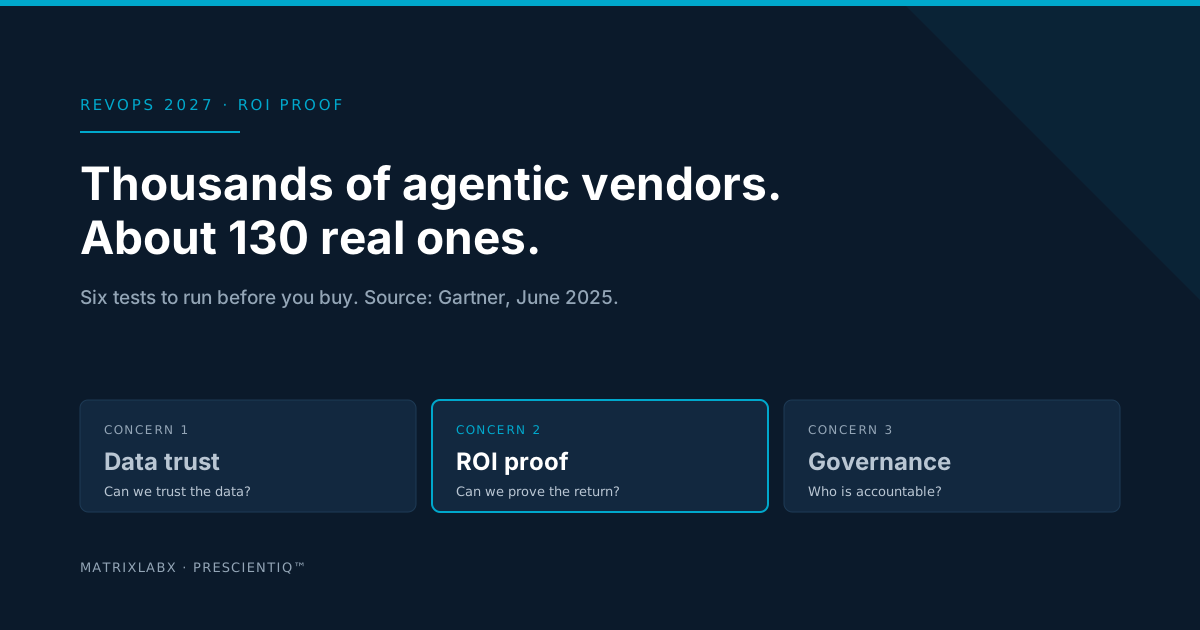
Agent washing is Gartner’s term for vendors relabeling existing AI assistants, robotic process automation, and conversational tools as agentic AI. RevOps can separate real agents from rebrands with six tests: does it execute or only suggest, what permissions does it hold, where does it run, what does it record, how is its math done, and will the vendor model ROI on your data.
Thousands of vendors, about 130 real ones
When Gartner predicted that more than 40% of agentic AI projects would be canceled by the end of 2027, it also named a market problem feeding that failure rate. Many vendors, it said, are engaging in agent washing: rebranding existing assistants, automation products, and similar tools without substantial agentic capability. Gartner’s estimate is that only about 130 of the thousands of agentic AI vendors are real (Gartner, June 25, 2025).
Gartner’s analysts added a second warning that is just as useful to buyers. Most agentic projects today are early experiments driven by hype, and many use cases positioned as agentic don’t require an agentic implementation at all.
For RevOps, that creates two risks at once. You might buy something labeled an agent that is really an assistant, so you pay for autonomy and get a drafting tool. Or you might deploy real autonomy on a task that didn’t need it, and take on the risk without the return.
Six tests to run before you buy
Test 1: Does it execute, or does it suggest? Ask the vendor to show a complete action end to end: the research, the CRM write, the send. If a person has to copy, paste, click, or re-enter anything to finish the work, it is an assistant. That may be fine, but price and staff it as one.
Test 2: What can each agent do, and what can’t it do? Real agent designs give each agent a defined identity with specific permissions. Ask which actions each agent is unable to take. A vendor that can’t answer has a single system with broad access, not a governed set of agents.
Test 3: Where does it run? Where is your revenue data processed, and who operates that environment? Which attestations are the vendor’s own, and which belong to its cloud provider? The answers set the length of your security review.
Test 4: What does it record? For any action, can you see which agent did it, why, what the record looked like before, and what it looks like after? Can that record be altered later? “We have logs” is not the same answer.
Test 5: How is the math done? Ask which calculations a language model performs and which run in deterministic code. Scoring, prioritization, and pricing logic produced by a language model can’t be reliably reproduced.
Test 6: Will they model ROI on your data before you sign? A vendor confident in its product will model the return on your pipeline. A vendor selling a rebrand will show you a case study.
When you don’t need an agent
Gartner’s second point deserves its own section. Some revenue tasks are well served by simpler tools:
- Fixed-rule routing with known conditions is usually automation, not agency.
- Summarizing a call for a rep is assistant work.
- Work that requires judgment, multi-step execution, and action in your systems, such as researching an account, choosing the trigger, drafting the outreach, executing the send, and updating the CRM, is where agents earn their cost.
Matching the tool to the task is the cheapest ROI decision you will make in 2027.
For the three categories side by side, see RevOps platform vs. sales engagement tool vs. AI revenue agent.
George Schildge’s view
How PrescientIQ™ answers the six tests
| Test | PrescientIQ |
|---|---|
| Execute or suggest | Agents execute the research, the outreach, the CRM write, the trial save, and the expansion play, in the governance mode your team sets for each action class. |
| Permissions | Each agent runs under its own least-privilege identity, enforced by permissions and not by prompt instructions. Entitlements can be listed, and an agent can be revoked without disabling a person. |
| Where it runs | PrescientIQ is hosted and operated by MatrixLabX on Google Cloud. SOC 2, ISO 27001, and PCI DSS attestations are held by Google Cloud, which operates the underlying infrastructure. They are not MatrixLabX certifications. MatrixLabX application-layer SOC 2 is in progress. |
| What it records | Every action, in either mode, is recorded to the audit ledger with its rationale, before-and-after state, and the approver or policy behind it. |
| How the math is done | Account scoring runs on sandboxed deterministic code. No language model performs arithmetic that has a numeric consequence, so a score can be reproduced and checked. |
| ROI on your data | The free Autonomous Audit Report is a P&L projection built on your own data in a read-only working session. Every figure in it is labeled as modeled. |
Run the same six tests on us. What we claim, and what we do not, is set out on the AI trust and governance page.
Action items for RevOps this quarter
- Send the six tests to every AI vendor on your 2027 shortlist, and ask for demonstrations, not written answers.
- Re-classify your current AI tools as agent, assistant, or automation. Compare what you pay against what each actually does.
- For each planned agent use case, confirm it requires judgment plus multi-step execution. If not, use a simpler tool.
Check the math before you spend anything
The free AAR Benchmark builds a P&L projection on your own pipeline data in a read-only working session. Every figure in it is labeled as modeled.
Get your free AAR Benchmark →Frequently asked questions
- What is agent washing?
- Agent washing is Gartner’s term for vendors rebranding existing AI assistants, robotic process automation, and similar tools as agentic AI without substantial agentic capability. Gartner estimates only about 130 of the thousands of vendors claiming agentic AI are real, which makes careful evaluation essential for RevOps buyers.
- How can RevOps tell if an AI agent is real?
- Ask to see a complete action executed end to end, with nobody copying and pasting. Ask which actions each agent cannot take, where your data is processed, what is recorded for each action, which calculations are deterministic, and whether the vendor will model ROI on your data before contract.
- Why do agent permissions matter?
- Defined permissions per agent limit the damage any single agent can do and make its behavior inspectable. A system where one component can read, write, and send everything is harder to govern, harder to secure, and harder to explain in a security review or after an incident.
- When does a revenue task not need an AI agent?
- Tasks with fixed rules and known conditions, like simple lead routing, are usually better served by automation. Summarizing a call is assistant work. Agents earn their cost on work that requires judgment, multiple steps, and actions in your systems, such as research-to-send outbound.
- Why ask vendors to model ROI before purchase?
- A model on your own pipeline data tests whether the product fits your motion, not the vendor’s best customer. It gives your CFO a figure to check and a baseline to measure against. A vendor unwilling to model on your data is asking you to carry the risk.
- Does PrescientIQ execute actions or suggest them?
- PrescientIQ executes. Four specialist agents (Scout, Herald, Guide, and Steward) work under one coordinator, Marshal. Each runs under its own least-privilege identity. Your team chooses the mode for each action class, based on its risk tolerance, and can change it at any time.
Sources
- Gartner, “Gartner Predicts Over 40% of Agentic AI Projects Will Be Canceled by End of 2027,” June 25, 2025. Link
Research findings are paraphrased and carry their original publication dates. Predictions are the research firms’, not ours. Recommendations and checklists are the author’s and are offered as a starting point, not as benchmarks.
Where PrescientIQ runs
PrescientIQ is hosted and operated by MatrixLabX on Google Cloud. SOC 2, ISO 27001, and PCI DSS attestations are held by Google Cloud, which operates the underlying infrastructure. They are not MatrixLabX certifications. MatrixLabX application-layer SOC 2 is in progress.