Measure before you commit: building a pre-purchase P&L for revenue AI
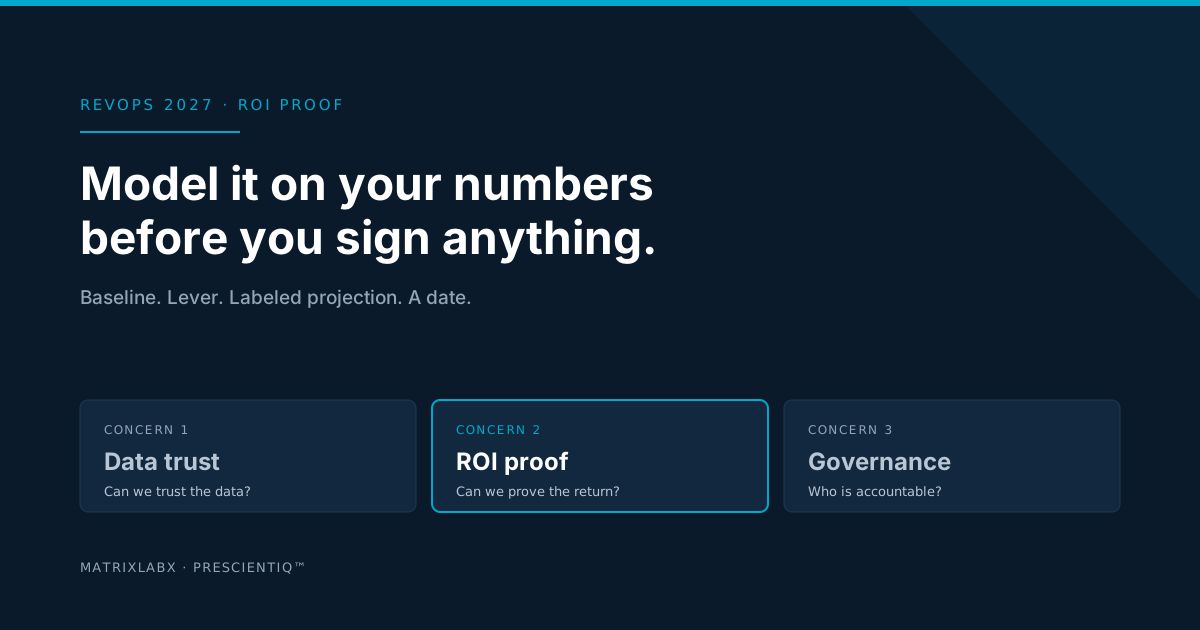
A pre-purchase P&L models what a revenue AI deployment would change in your own numbers before you sign. It has four parts: a measured baseline, the specific P&L lever each workflow moves, a clearly labeled modeled projection, and a measurement plan with a date. It turns an AI purchase from a bet into a test your CFO can check.
The gap between using AI and profiting from it
39%
McKinsey’s 2025 State of AI survey shows the gap clearly. Many respondents report cost and revenue benefits at the use-case level, but only 39% report any EBIT impact at the enterprise level. McKinsey classifies about 6% as AI high performers: organizations attributing 5% or more of EBIT to AI and reporting significant value.
Forrester’s finding points the same way. Fewer than one-third of decision-makers can tie AI’s value to their organization’s financial growth (Forrester, October 2025).
Most of that gap is a measurement problem that starts before purchase. If nobody wrote down the baseline, nobody can prove the change. If nobody named the P&L line, the benefit stays at the use-case level and never reaches EBIT.
The four parts of a pre-purchase P&L
Part 1: A measured baseline. For each workflow, capture what it consumes and produces today: hours, fully loaded cost, headcount allocation, and output (accounts researched, meetings booked, trials converted, expansions closed). Use your own system data, not survey averages.
Part 2: The P&L lever. Name the line each workflow moves. Revenue workflows typically map to four levers:
| Workflow | P&L lever |
|---|---|
| Prospecting | Pipeline created per dollar of research cost |
| Outbound | Cost per meeting or per qualified opportunity |
| Trial conversion | New revenue recovered from stalled trials |
| Expansion | Expansion revenue captured; churn risk surfaced earlier |
Part 3: A labeled projection. Model the expected change in each lever on your numbers, and label it as modeled. The label is what makes the projection credible: it tells your CFO exactly what has been tested and what hasn’t.
Part 4: A measurement plan. Name the metric, the data source, and the date on which the projection will be checked against reality. A projection without a test date is a hope.
Common mistakes
- Using a vendor’s case study as your forecast. One named account’s result says nothing reliable about your pipeline.
- Measuring activity, not outcome. Emails sent is not a P&L line. Meetings and pipeline are.
- Skipping cost-to-serve. If you can’t see what each unit of AI work costs, you can’t compute its margin.
- No control. Where possible, compare against a segment or period without the AI, so the effect is isolated.
George Schildge’s view
How PrescientIQ™ builds your pre-purchase P&L
The free AAR Benchmark is MatrixLabX’s pre-purchase P&L. The free Autonomous Audit Report is a P&L projection built on your own data in a read-only working session. Every figure in it is labeled as modeled.
- It is modeled against your current human and copilot baselines, not against survey averages.
- Figures labeled as targets are not guarantees. They are validated against your environment before any commitment.
- After deployment, measurement runs on the same record that bills you. Completed workflows and the outcomes they produce write to the same ledger as your audit trail, so RevOps can reconcile a monthly invoice against it.
Action items for RevOps this quarter
- Build the baseline sheet for your top three revenue workflows using system data from the last full quarter.
- Assign each workflow a single P&L lever from the table above.
- For any AI initiative already running, add the missing piece, whether that’s a baseline, a lever, a label, or a date.
- Before any 2027 purchase, require a projection on your data with a named measurement date.
To find where the funnel leaks before you model it, see how to fix revenue leakage between marketing, sales, and customer success.
Check the math before you spend anything
The free AAR Benchmark builds a P&L projection on your own pipeline data in a read-only working session. Every figure in it is labeled as modeled.
Get your free AAR Benchmark →Frequently asked questions
- What is a pre-purchase P&L for AI?
- A pre-purchase P&L models what an AI deployment would change in your own financial results before you buy. It includes a measured baseline, the P&L lever each workflow affects, a clearly labeled projection, and a measurement plan with a date for testing the projection against actual results.
- Why do so few companies see EBIT impact from AI?
- McKinsey’s 2025 survey found only 39% of respondents report enterprise-level EBIT impact from AI. A common cause is measurement: without a baseline and a named P&L line, benefits stay at the use-case level. High performers tend to redesign workflows and track outcomes, not activity.
- What should a revenue AI baseline include?
- Include hours, fully loaded cost, headcount allocation, and output for each workflow, such as accounts researched, meetings booked, trials converted, or expansions closed. Use your own system data from a defined period. The baseline must match the metric you plan to measure after deployment.
- Why label AI projections as modeled?
- Labeling separates what has been measured from what has been projected. It lets a CFO judge the assumptions and prevents a projection from being mistaken for a commitment. Clear labels make a business case more credible, because they show exactly what the measurement plan still needs to prove.
- What P&L levers do revenue agents affect?
- Prospecting affects pipeline created per dollar of research cost. Outbound affects cost per meeting or qualified opportunity. Trial conversion affects new revenue recovered from stalled trials. Expansion affects expansion revenue captured and how early churn risk surfaces. Each workflow should map to one primary lever.
- How does the AAR Benchmark work?
- The free AAR Benchmark builds a P&L projection on your own pipeline data in a read-only working session. Every figure is labeled as modeled, and targets are validated against your environment before any commitment. It gives your CFO a business case to check before any purchase decision.
Sources
- McKinsey & Company, “The state of AI in 2025: Agents, innovation, and transformation,” survey fielded June to July 2025. Link
- Forrester, “2026 Technology & Security Predictions: As AI’s Hype Fades, Enterprises Will Defer 25% Of Planned AI Spend To 2027,” October 28, 2025. Link
Research findings are paraphrased and carry their original publication dates. Predictions are the research firms’, not ours. Recommendations and checklists are the author’s and are offered as a starting point, not as benchmarks.
Where PrescientIQ runs
PrescientIQ is hosted and operated by MatrixLabX on Google Cloud. SOC 2, ISO 27001, and PCI DSS attestations are held by Google Cloud, which operates the underlying infrastructure. They are not MatrixLabX certifications. MatrixLabX application-layer SOC 2 is in progress.