RevOps platform vs. sales engagement tool vs. AI revenue agent: which one do you need?
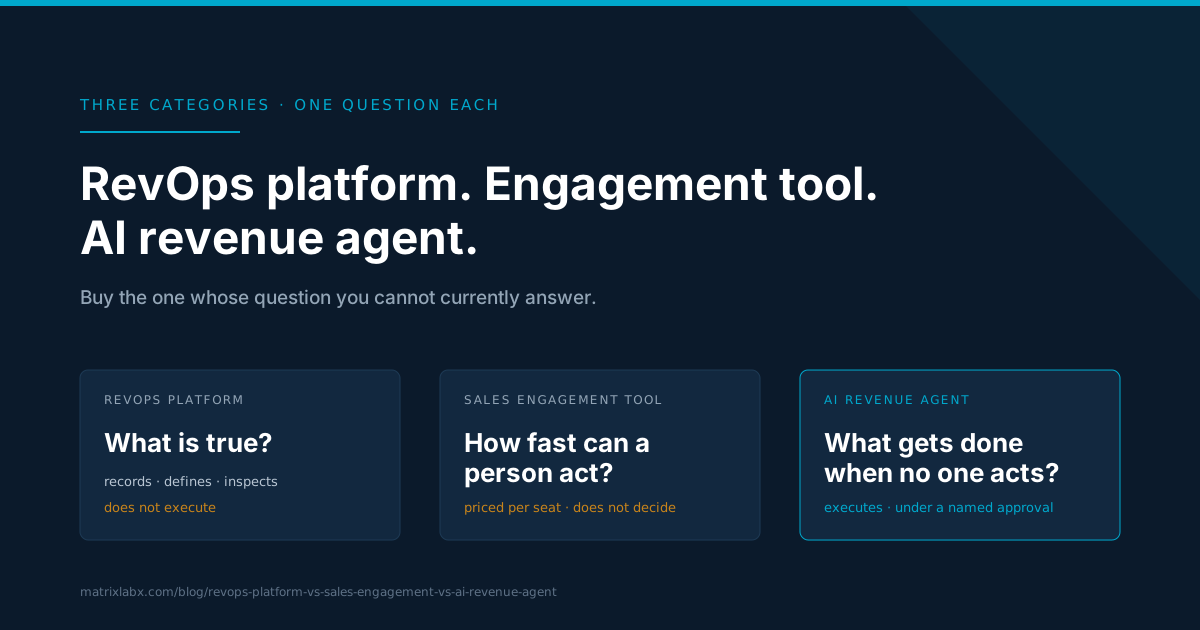
A RevOps platform records and analyzes: it unifies revenue data, enforces funnel definitions, and supports forecasting and inspection for operations and leadership. A sales engagement tool helps humans execute: sequences, dialers, templates, and task queues that multiply a rep’s throughput. An AI revenue agent executes steps of the workflow itself — reading signals, choosing accounts, drafting outreach, writing to the CRM — under human approval. They answer three different questions: what is true, how fast can a person act on it, and what gets done when no person is acting. The one you need is the one whose question you cannot currently answer.
Most revenue-technology evaluations go wrong before the first demo, because the buyer is comparing products from three different categories as if they were three answers to one question. They are not. A RevOps platform, a sales engagement tool, and an AI revenue agent each solve a distinct problem, are operated by different people, and are paid for in different units. Put a RevOps platform in a bake-off against an AI agent and one of them will always look like it “does less” — which is true, and beside the point.
This article defines the three categories by what they do, who works in them every day, and what you are actually buying. It then gives you a symptom-based way to work out which gap you have, a stage-by-stage guide, and an honest account of the integration burden each one carries. It names no vendors in any category, including our own competitors; the categories are the point.
The three categories, defined
1. RevOps platform: the system of analysis
A revenue operations platform sits on top of your CRM and the rest of your revenue data — marketing automation, product usage, billing, support — and does three things. It unifies the data into one view of the funnel. It enforces definitions: what counts as an MQL, when a lead is sales-accepted, what a product-qualified lead is, when a renewal is at risk. And it inspects: forecast roll-ups, pipeline coverage, conversion by stage, attribution, territory and quota planning.
Its daily users are the RevOps team and revenue leadership. Its unit of value is a better decision — a more accurate forecast, a territory plan that holds, a stage definition everyone finally agrees on. It does not send an email, book a meeting, or move a deal. That is not a limitation; it is the category. When a RevOps platform vendor starts talking about execution, they are usually describing a workflow-rule feature that fires a task to a human, not the execution itself.
2. Sales engagement tool: the human execution surface
A sales engagement tool is where a seller does the work. Multi-step sequences across email, phone, and social; templates and snippets; a dialer; a task queue for the day; activity logging back to the CRM so the record reflects what happened. Its daily users are SDRs, BDRs, and account executives, and its unit of value is throughput per rep: more touches per hour, fewer dropped follow-ups, less time typing into the CRM.
What it does not do is decide. Someone still chooses which accounts go into which sequence and what the message says, and someone still has to be at the keyboard for the tool to produce anything. It is priced per seat almost without exception, which means its cost is a function of headcount — a property that matters a great deal once headcount is the thing you cannot add. We covered what that looks like on a seven-seat stack in the SDR tech stack tax.
3. AI revenue agent: digital labor under approval
An AI revenue agent performs steps of the revenue workflow itself. It reads intent and firmographic signals, decides which accounts fit and which to work now, drafts outreach grounded in the trigger that made the account interesting, watches a trial for a stall, surfaces an expansion signal, and writes the outcome back to the CRM. Its unit of value is executed work — a workflow step completed — rather than a seat or a report.
The category is young enough that its most important design choice is still contested: what happens at the boundary between the agent and the outside world. Some products in the category send autonomously. A governed design holds every externally visible action — an email, a CRM write, a scheduled call — for a named human approval, and records the decision, its rationale, and the approver to an immutable ledger. That single difference determines who is accountable for what was sent, and it is the axis we would evaluate any product in this category on first. We set out that argument in full in Governed AI SDR: definition, how it works, and how it is priced.
Side by side
| Dimension | RevOps platform | Sales engagement tool | AI revenue agent |
|---|---|---|---|
| Core job | Unify data, enforce definitions, inspect the funnel | Help a seller execute more touches, logged | Execute workflow steps itself, under approval |
| Daily user | RevOps, sales and marketing leadership | SDRs, BDRs, account executives | An approver; a RevOps or sales owner of the policy |
| Unit of value | A better decision | Throughput per rep | A workflow step completed |
| Typical pricing shape | Per user or by data volume | Per seat | Per agent, per outcome, or flat fee — varies by vendor |
| Integration burden | Heaviest: every revenue system into one model | CRM sync plus email, calendar, telephony | CRM read and write, signal sources, and an approval queue someone staffs |
| Becomes necessary when | Teams stop agreeing on the numbers | Reps know what to do and lack hours | Work between people is not happening at all |
| Will not do | Send anything or move a deal | Decide who to contact or what to say | Fix definitions nobody agreed to, or a CRM nobody trusts |
| Typical failure mode | A prettier version of the same disagreement | Faster delivery of the wrong message | Confident execution against bad data, or no one staffing approvals |
They are layers, not substitutes
The most useful mental model is a stack. At the bottom is the CRM, the system of record. Above it, RevOps discipline — whether that is a dedicated platform or a rigorously run CRM with agreed definitions — decides what is true. On top of that sit two execution surfaces side by side: a human one, which is the engagement tool, and a digital one, which is the agent. Both read from the record and write back to it. Neither replaces the layer beneath.
Seen this way, the classic buying mistakes are all category errors. Buying an agent to fix a data problem: the agent executes confidently against a funnel whose stages mean different things to different teams. Buying a RevOps platform to fix a capacity problem: you now have an excellent view of the accounts nobody is working. Buying an engagement tool to fix a judgment problem: reps send more of a message nobody validated, faster. Each tool did its job. The job was the wrong one.
Salesforce’s State of Sales statistics page reports that sellers use an average of 8 tools to close deals, that 42% feel overwhelmed by too many tools, and that overwhelmed sellers are 45% less likely to attain quota. A stack of eight tools is usually a stack that was assembled one symptom at a time, without anyone asking which category each purchase belonged to. The fix is rarely a ninth tool.
Which one you need, by symptom
Work from the sentence that gets said in your pipeline review, not from the vendor’s feature grid. Three sentences map cleanly to the three categories, and a fourth maps to none of them.
- “Marketing and sales do not agree on the numbers.” A definitions and system-of-record problem. If there is no agreed dictionary, no platform fixes it — write the dictionary first. If there is one and the fight is about forecast or attribution, that is the RevOps platform category.
- “Reps have the list and the message, but not the hours.” A throughput problem. Judgment is already being exercised by a person; they need sequences, a dialer, and logging. That is the sales engagement category, and its per-seat pricing is appropriate because the constraint really is hours.
- “Nobody is working these accounts at all.” A coverage problem: trials stall overnight, expansion signals sit unread, outbound stops when the rep is in meetings. That is the AI revenue agent category — provided someone can approve what it proposes.
- “We do not know who owns this.” Not a category. No purchase in any of the three fixes an ownership gap, and every one of them makes it more expensive.
Which category is your actual gap?
Which one you need, by stage
Stage is a rougher guide than symptom, but it is where most buyers start, so here is how the three categories usually arrive.
Early stage. A well-configured CRM and a sales engagement tool cover almost everything. Definitions can live in a document because the people who wrote it are still the people using it. An AI revenue agent can make sense here for one narrow motion — trial follow-up, say — if the founder or first sales hire is willing to be the approver, but a full platform is usually more system than the funnel has stages.
Mid-market. This is where RevOps discipline becomes non-optional, because marketing, sales, and customer success are now separate teams with separate dashboards, and the seams between them are where revenue leaks. Whether that discipline is a dedicated platform or a RevOps lead with a disciplined CRM depends on data volume and how many systems feed the funnel. It is also the stage where the coverage gap becomes visible: there are more signals than people to act on them, and hiring to close the gap runs into the headcount ceiling. That combination — real RevOps discipline plus an unstaffable coverage gap — is the case for governed digital labor, and it is the segment PrescientIQ is built for.
Enterprise. All three categories, typically, with the agent layer under the tightest governance because the cost of an unapproved external action is highest: named accounts, regulated channels, procurement and security review on every vendor. The question at this stage is less which category than who signs off on what the agent is allowed to do.
Integration burden, honestly
Every vendor in every category says integration is straightforward. Here is the real shape of it.
The RevOps platform carries the heaviest data burden, because its whole value depends on every revenue system — CRM, marketing automation, product analytics, billing, support — landing in one model with one set of definitions. The work is mostly mapping and reconciliation, and it is mostly your team’s work, not the vendor’s.
The sales engagement tool is the lightest technically: a CRM sync, email and calendar, telephony. The burden is behavioral — reps have to actually log in it, and activity has to actually flow back to the record, or the CRM decays into a partial history of what the tool did.
The AI revenue agent needs CRM read and write access, the signal sources it acts on, and — the part vendors talk about least — an approval queue that a named person will staff every working day, plus a written policy for what the agent may propose. The technical integration is bounded. The organizational one is real, and it is the reason deployment windows in this category are measured in weeks rather than days.
Where PrescientIQ sits, and where it does not
PrescientIQ is an AI revenue agent. Specifically, it is four cooperating agents — Scout (prospecting), Herald (outbound), Guide (trial conversion), and Steward (expansion) — under one coordinator, Marshal, with a human-in-the-loop approval queue and an immutable audit ledger. It reads signals, scores accounts with deterministic sandboxed logic, drafts outreach grounded in the exact trigger, watches trials for a stall, surfaces expansion and churn-risk signals, and writes every outcome back to your CRM.
It is not a RevOps platform. It does not forecast, plan territories, model compensation, or replace your reporting layer; it acts on the funnel definitions your RevOps function owns. It is not a sales engagement tool. It does not give your reps a dialer or a task queue; it does work alongside them, and it can reduce how central a sequence tool is for the motions it covers. It runs on top of Salesforce or HubSpot as the system of record, and it depends on that record being trustworthy.
The design choice that places it within the category is the boundary.
That gate is enforced at the tool layer rather than in a prompt an agent could be talked around, and there is no setting to disable it. It is a deliberate cost — the constraint moves from how much the system can produce to how much a person can review — and it is the reason the question “who approves the queue?” appears in the decision tree above before any question about features.
What it costs, and in what unit
| Component | Investment | Billing frequency |
|---|---|---|
| Annual platform feeEnvironment provisioning on Google Cloud, per-agent IAM, audit-ledger setup, and context ingestion from your CRM — plus four cooperating agents (Scout, Herald, Guide, and Steward), their coordinator Marshal, the approval queue and standing-policy controls, and the immutable audit ledger, and the monthly execution volume a typical mid-market deployment runs. One fee, from signature, every year.Target — modeled: live in 21 days or less$165,000/year is the complete platform fee. There is no separate implementation charge and no different first-year number — deployment work is included from signature, not billed as a distinct line. Scope beyond a typical deployment — additional bundles, sustained higher volume — is quoted at your AAR before anything is signed. | $165,000/yr | Billed monthly at $13,750/mo against an annual commitment |
The unit matters as much as the number. That is one flat annual fee for the full loop — four agents, Marshal, the approval queue, the ledger, and the execution volume a typical mid-market deployment runs — and it does not move with the number of people who use it. It is not per seat, which is the engagement-tool shape, and it is not per workflow or metered; that mechanic was retired in September 2026. Smaller sales teams that want the same governed model at a self-serve scale should look at Sales Accelerator, which is priced separately.
PrescientIQ is hosted and operated by MatrixLabX on Google Cloud. SOC 2, ISO 27001, and PCI DSS attestations are held by Google Cloud, which operates the underlying infrastructure. They are not MatrixLabX certifications. MatrixLabX application-layer SOC 2 is in progress.
What this comparison does not settle
Three things, deliberately. First, vendor selection within a category: two RevOps platforms can differ more from each other than from an engagement tool, and this page names none of them. Second, data quality: every category assumes a CRM you trust, and if yours has decayed, that is the first project regardless of what you buy — the CRM data debt problem is usually older than the tooling decision. Third, whether your organization will actually staff the human side of whichever category you choose. A RevOps platform nobody maintains, an engagement tool nobody logs in, and an agent nobody approves all fail the same way, and the invoice arrives regardless.
Frequently Asked Questions
- What is a RevOps platform?
- A RevOps platform is a system of analysis that sits on top of your CRM and other revenue data. It enforces shared funnel definitions, unifies data across marketing, sales, and customer success, and supports forecasting, territory, and pipeline inspection. Its users are operations and leadership. It informs decisions; it does not execute outreach or move deals on its own.
- What is a sales engagement tool?
- A sales engagement tool is execution tooling for human sellers: multi-step sequences, templates, dialers, task queues, and activity logging back to the CRM. Its daily users are SDRs and account executives. It multiplies the throughput of a person who already knows who to contact and what to say; it does not decide either of those things itself.
- What is an AI revenue agent?
- An AI revenue agent is digital labor that performs steps of a revenue workflow itself: reading signals, deciding which accounts to work, drafting outreach, and writing results back to the CRM. In a governed design, every externally visible action waits for a named human approval and is recorded to an audit ledger. Its unit of value is executed work, not seats.
- Can an AI revenue agent replace a sales engagement tool?
- For some motions, partly. An agent can draft and, once approved, send the outreach a sequence tool would otherwise have a rep click through, so the rep-facing sequence tool becomes less central. It does not replace the human execution surface for deals that reps run personally, and it does not replace the CRM as the system of record.
- Do I need a RevOps platform before I deploy an AI revenue agent?
- You need RevOps discipline, not necessarily a RevOps platform. An agent acts on your funnel definitions and your CRM data, so if those are contested or unreliable it will execute confidently against the wrong picture. A clean CRM and agreed stage definitions are the prerequisite. Whether that discipline lives in a dedicated platform or in a well-run CRM depends on your scale.
- How are these three categories typically priced?
- RevOps platforms are usually priced per user or by data volume. Sales engagement tools are almost always priced per seat, which means their cost scales with headcount. AI revenue agents are priced in several ways across the market: per agent, per outcome, or as a flat platform fee. PrescientIQ uses a single flat annual fee, so the price does not move with the number of people using it.
Related Reading
Sources
- Salesforce, State of Sales statistics page — average of 8 tools used to close deals; 42% of sellers overwhelmed by too many tools; overwhelmed sellers 45% less likely to attain quota. Link
Category definitions on this page are the author’s. No vendor in any category is named, and no statement is made about any specific product’s capabilities, pricing, or terms other than PrescientIQ’s. Third-party figures are reported as published by their source on the date of writing.
A note on figures in this article
Every PrescientIQ figure in this article is a registered claim rendered through this site’s central claims configuration, with its proof class shown. Target-class figures are modeled, not guaranteed, and are validated against your own data in the Autonomous Audit Report before any commitment.
See where your own execution effort is going
The Autonomous Audit Report models where your team's execution capacity is currently spent, what your configuration is actually paying for, and what the governed alternative looks like on your own data — before any commitment.
Get your free AAR benchmark