The 2027 AI budget review: what CFOs will ask RevOps
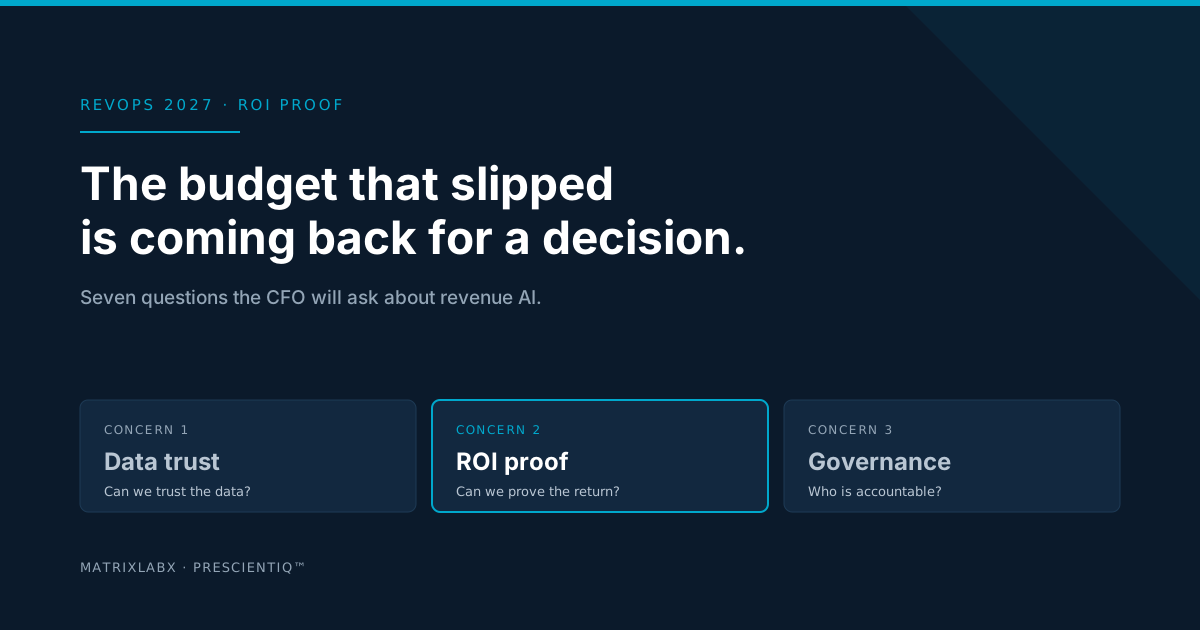
In 2027, CFOs will approve revenue AI spend based on provable return, not strategic promise. RevOps should prepare to answer seven questions: the baseline, the unit cost of work, the time to measurable impact, how value ties to the P&L, how the invoice reconciles, what happens when the AI is wrong, and what it costs to exit.
The budget that slipped is coming back for a decision
Forrester’s 2026 predictions described a reckoning. Fewer than one-third of decision-makers could tie AI’s value to their organization’s financial growth. CEOs were expected to lean on CFOs to approve AI investments on ROI. As financial rigor slowed deployments and eliminated proofs of concept, enterprises would defer a quarter of their planned AI spend into 2027 (Forrester, October 2025).
Gartner’s forecast runs in parallel: more than 40% of agentic AI projects canceled by the end of 2027, with escalating costs and unclear business value as two of the three named causes (Gartner, June 2025).
So the 2027 planning cycle has a new shape. The money isn’t gone. It’s waiting, and it goes to the programs that can show their math.
The seven questions
1. “What’s the baseline?” Before AI, how many hours, dollars, and people does this workflow consume, and what does it produce? Without a baseline, any improvement claim is unfalsifiable, and CFOs know it.
2. “What does a unit of work cost?” Not the license fee: the cost per completed action. Per-seat pricing hides this. A count of completed work exposes it, which is uncomfortable but far simpler for finance to plan around.
3. “When will we see it?” A credible answer names a measurement date and the metric that will move by then. “Over time” is not an answer.
4. “Where does it show up on the P&L?” Cost avoided, pipeline created, conversion recovered, or churn prevented. Pick the line, and be specific about how the measurement will isolate AI’s contribution from everything else that changed.
5. “Can we reconcile the invoice?” If the vendor’s bill can’t be traced to source events your team can inspect, finance is underwriting a variable it can’t forecast.
6. “What happens when it’s wrong?” Finance cares about downside. What is the blast radius of a bad action, how is it detected, and how is it corrected? Gartner lists inadequate risk controls alongside cost and value as a cause of cancellation. It’s a financial question, not only a security one.
7. “What does it cost to exit?” Contract term, data portability, and whether you can take your data and your records with you if you leave.
George Schildge’s view
How PrescientIQ™ answers the seven questions
| CFO question | PrescientIQ answer |
|---|---|
| Baseline | The free Autonomous Audit Report is a P&L projection built on your own data in a read-only working session. Every figure in it is labeled as modeled. |
| Unit cost | One flat annual platform fee of $165,000, billed monthly and never per seat. The ledger counts every completed workflow, so finance can divide one by the other. Drafts, retries, and rejected actions never bill. |
| Timing | Figures in the audit are labeled as modeled and validated against your environment before any commitment. |
| P&L line | Four agents map to four levers: Scout to pipeline creation, Herald to outbound execution, Guide to trial conversion, and Steward to expansion. |
| Invoice reconciliation | Completed workflows and the outcomes they produce write to the same ledger as your audit trail, so RevOps can reconcile a monthly invoice against it. |
| When it’s wrong | Your team chooses the mode for each action class, based on its risk tolerance, and can change it at any time. Every action, in either mode, is recorded to the audit ledger with its rationale, before-and-after state, and the approver or policy behind it. |
| Exit | The ledger can be exported. Ask us for retention, deletion, and data-return terms in writing before you sign, and ask every vendor on your shortlist for the same. |
Pricing is published in full on the pricing page, including what the fee covers.
Action items for RevOps before the budget review
- Write the baseline for each AI-funded workflow on one page: hours, cost, output.
- Convert every AI line item into cost per unit of completed work.
- Put a measurement date and a single target metric next to every AI initiative.
- Ask each vendor to show how its invoice reconciles to source events. Treat “we’ll send a usage report” as a no.
- Bring a downside section. CFOs trust plans that name their own failure modes.
For the cost side of the comparison, see how the full cost of an AI SDR compares with an agency or an SDR pod.
Check the math before you spend anything
The free AAR Benchmark builds a P&L projection on your own pipeline data in a read-only working session. Every figure in it is labeled as modeled.
Get your free AAR Benchmark →Frequently asked questions
- Why will 2027 AI budget reviews be tougher?
- Forrester predicted that CFOs would approve AI investments on ROI and that enterprises would defer a quarter of planned AI spend into 2027. It found fewer than one-third of decision-makers could tie AI value to financial growth. Deferred budgets will return only for programs that show their math.
- What will CFOs ask about revenue AI?
- Expect seven questions: the baseline, the cost per unit of work, when impact appears, which P&L line it affects, whether the invoice reconciles to source events, what happens when the AI is wrong, and what it costs to exit. Preparing answers in advance signals discipline.
- How should RevOps establish an AI baseline?
- Document what each workflow consumes and produces before AI: hours, fully loaded cost, headcount, and output such as meetings booked or trials converted. Measure it for the same period you will compare against. Without a baseline, improvement claims cannot be tested.
- Why does invoice reconciliation matter for AI spend?
- If an invoice traces to source events finance can inspect, the spend becomes auditable and plannable. If it relies on a vendor-generated usage summary, finance is underwriting a number it cannot independently verify. That matters most where pricing varies with consumption.
- Should RevOps present vendor ROI figures to the CFO?
- Present vendor figures only as context, never as your forecast. A vendor’s best customer result says little about your pipeline. A stronger case is a model built on your own data, clearly labeled as modeled, with a specific date and metric for testing it.
- How does PrescientIQ support a CFO review?
- The free AAR Benchmark builds a P&L projection on your own pipeline data in a read-only working session, with every figure labeled as modeled. The Revenue Accelerator is one flat annual fee of $165,000, never per seat, and it is published. RevOps can reconcile the invoice against the audit ledger.
Sources
- Forrester, “2026 Technology & Security Predictions: As AI’s Hype Fades, Enterprises Will Defer 25% Of Planned AI Spend To 2027,” October 28, 2025. Link
- Gartner, “Gartner Predicts Over 40% of Agentic AI Projects Will Be Canceled by End of 2027,” June 25, 2025. Link
Research findings are paraphrased and carry their original publication dates. Predictions are the research firms’, not ours. Recommendations and checklists are the author’s and are offered as a starting point, not as benchmarks.
Where PrescientIQ runs
PrescientIQ is hosted and operated by MatrixLabX on Google Cloud. SOC 2, ISO 27001, and PCI DSS attestations are held by Google Cloud, which operates the underlying infrastructure. They are not MatrixLabX certifications. MatrixLabX application-layer SOC 2 is in progress.