Navigating the AI Coherence Crisis: Moving from Code Abundance to Market Impact
As we traverse the rapidly evolving landscape of artificial intelligence, a profound shift is occurring beneath our feet. For the past few years, the tech industry has been obsessed with the sheer volume of AI output.
However, as organizations mature in their AI journeys, it has become abundantly clear that AI does not eliminate the constraints on innovation; rather, it simply relocates them. The primary challenge has transitioned from the act of building things to the much more complex task of making those things matter to the end-user.
At MatrixLabX I speak with leaders daily across the Software as a Service (SaaS), Financial Services, and Healthcare sectors. In all these industries, the narrative is shifting. We are moving away from raw enthusiasm and entering an era defined by the need for coherence, strategic go-to-market (GTM) orchestration, and measurable return on investment (ROI).
It was 2002, when I was brought in as VP of Global Marketing for an HP spin-off to orchestrate a complete turnaround for an $85M software developer. I inherited a fragmented $6 million marketing budget. In a bold efficiency play, I rationalized and slashed marketing spend by 50%. Instead of lead generation collapsing, the streamlined global team delivered a 162% increase in qualified leads year-over-year.
Or, my time at Sun. That was fun. Following major strategic acquisitions, Sun needed to integrate brand-new software assets — specifically the iPlanet suite and Forte (4GL/Java) technologies — into their existing hardware-heavy Americas sales machine. I led the cross-functional integration, training sales teams and structuring delivery programs to turn complementary software products into immediate revenue drivers.
My point is not to brag (maybe a little), but to explain these were not easy to do. Over 30 years, I've seen M&A, startups, acquisitions, failures, closures, rightsizing, downsizing, and re-organizations. And today it's happening faster.
Scott Brinker recently wrote that AI abundance has a coherence problem, and paged product marketing. I picked out three major themes.
Do you know how many features are in Microsoft Word? Well over 2,000 distinct commands and features are accessible via the Ribbon, dialog boxes, and contextual menus, and the complete VBA object model exposes thousands more programmable objects, properties, and methods — making it one of the most feature-rich word processors in existence.
How many do you use?
In this analysis we will explore the three primary crises of AI abundance, how they uniquely impact our core target audiences, and where PrescientIQ™ fits.
Point 1: The death of “tokenmaxxing” and the demand for real ROI
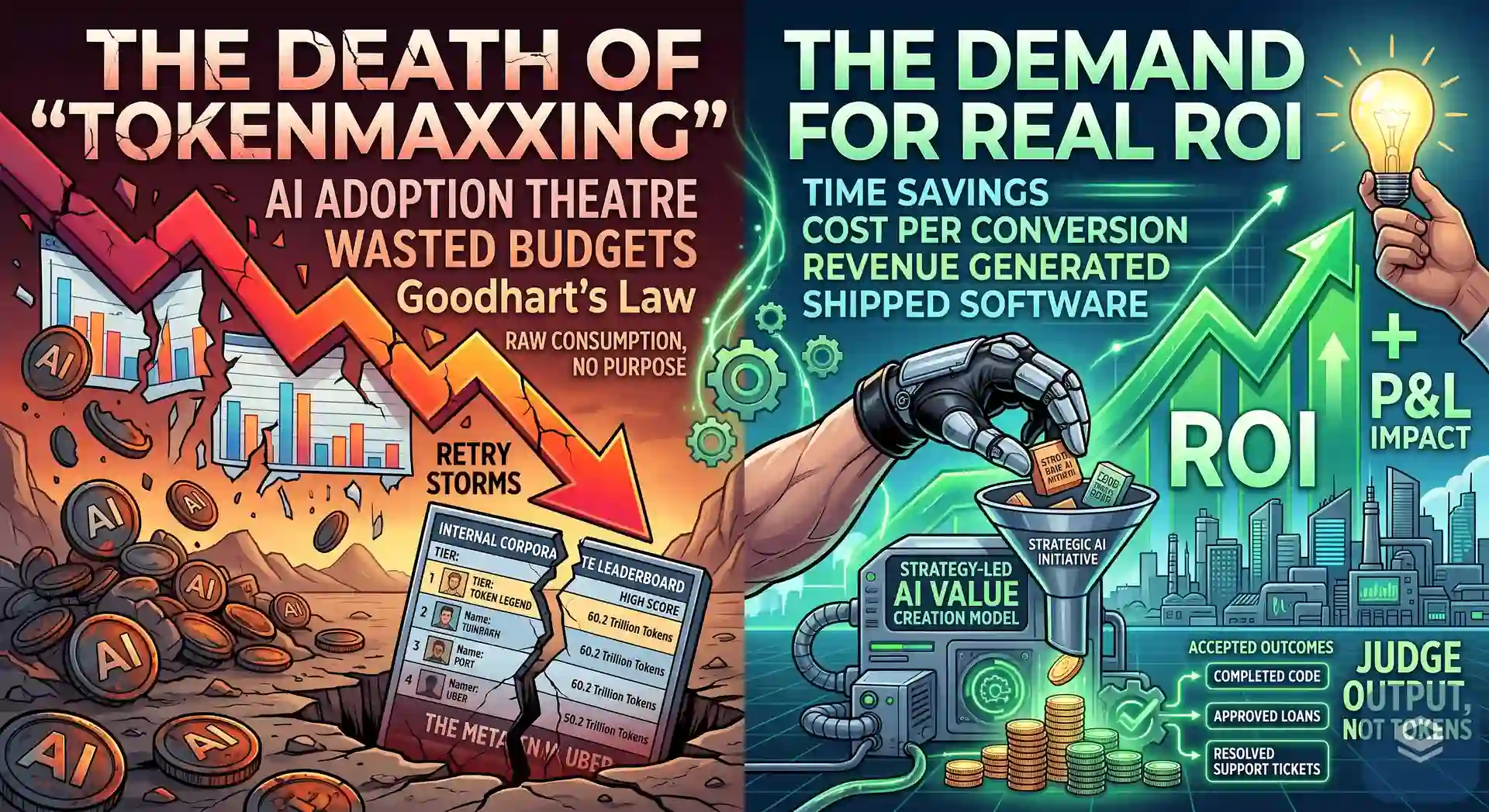
We are witnessing the end of an era where success was measured by how much money a company could throw at compute capacity. Treating financial expenditure as a metric to be maximized, entirely divorced from measurable ROI, is a fundamentally flawed business strategy.
The short-lived “tokenmaxxing” movement — where employees were essentially rewarded with badges of honor for spending as much as possible on AI consumption — is thankfully fading.
While this hyper-consumption phase successfully kickstarted AI adoption and organizational learning, the bills are now rolling in, and corporate leadership is snapping back to reality. The market has grown incredibly weary of “AI washing,” which involves slapping an AI label on any product that moves.
Cramming arbitrary AI features into established products and processes that nobody asked for is now far more likely to annoy users than amaze them. In fact, low-quality “AI slop” is actively being banished from enterprise environments. Ultimately, vibes without value are simply vanity.
Impact on our ideal customer profiles
- SaaS: SaaS providers have spent heavily on API credits powering generic chatbots that fail to reduce churn or drive upsells. Investors are now demanding that AI features demonstrate concrete revenue retention, forcing SaaS leaders to justify every token spent.
- Financial services: In FinServ, capital allocation is rigorously scrutinized. Banks and wealth management firms quickly realized that funding massive LLM deployments without a clear path to improved alpha, operational efficiency, or risk mitigation is a violation of fiduciary duty. They require deterministic ROI, not experimental playgrounds.
- Healthcare: Healthcare systems operate on razor-thin margins. Purchasing expensive, AI-branded administrative tools that do not demonstrably reduce clinician burnout or improve patient outcomes is fiscally irresponsible. Administrators are actively rejecting “AI-washed” software in favor of tools that provide measurable cost savings.
Point 2: The shift in bottlenecks — shipping is easy, absorption is hard
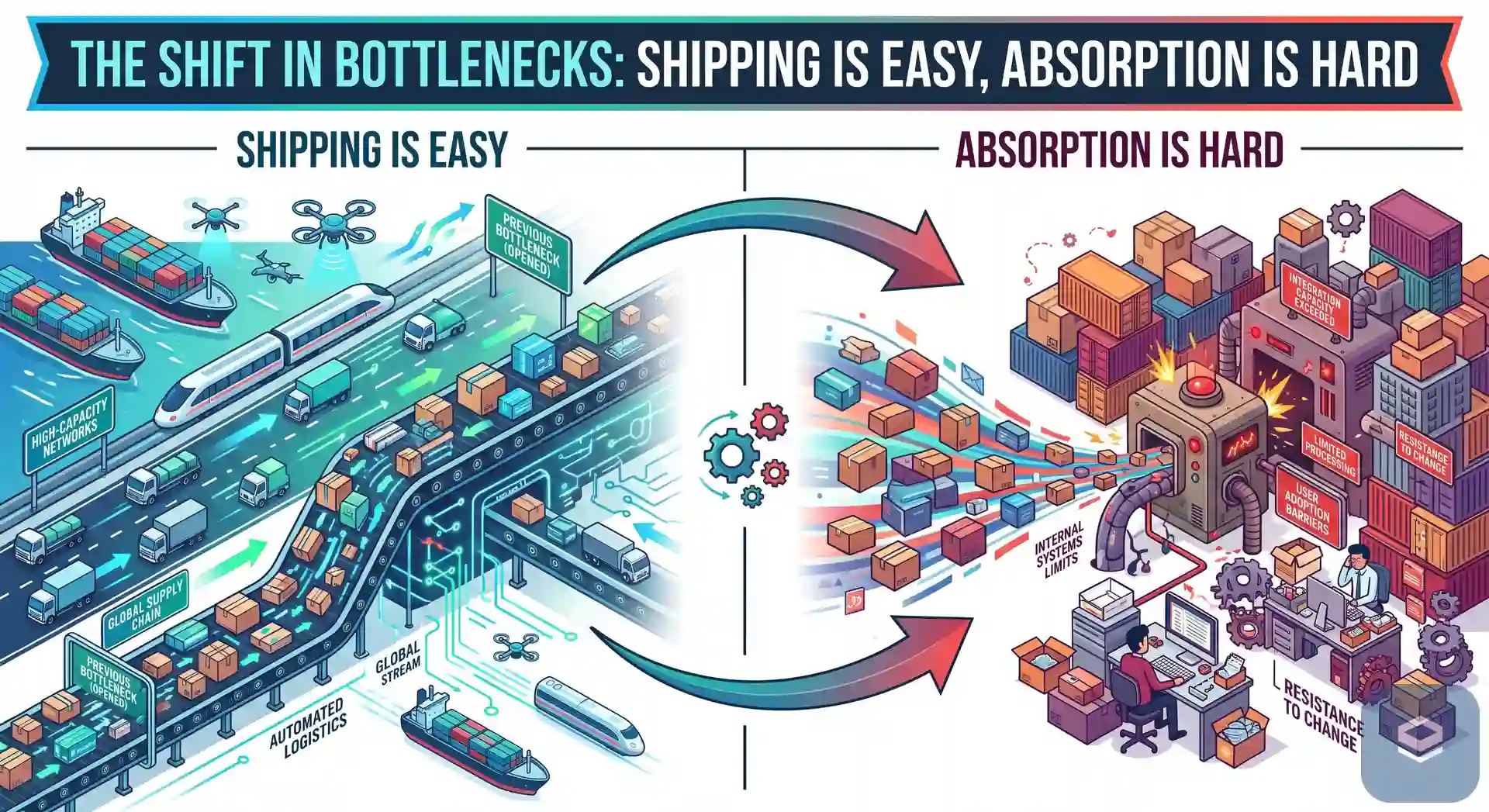
The second primary issue stems from an unexpected plot twist: easy engineering makes marketing exponentially harder. Developers wielding modern AI coding tools are demonstrating real, unprecedented productivity gains, measured largely in the volume and velocity of software shipped. Historically, shipping code was the ultimate bottleneck, but AI is making that process incredibly fast and relatively cheap.
This ease of development has led to an “MVP-palooza,” where the barrier to building is so low that ideas are shipped before they are carefully considered. However, building is only a fraction of the cost. Once a feature is shipped, it must be maintained, documented, positioned, and supported. Taking a product to market requires extensive cross-functional orchestration, including sales enablement, legal reviews, and pricing updates.
Most importantly, the true constraint is now the customer's mental bandwidth. Existing customers are incredibly busy, and their attention is a scarce resource. Asking them to continuously pause their workflows to learn new, rapidly deployed AI features is a massive ask. If an organization's product teams use AI to ship features faster than the market can absorb them, the resulting gap creates a severe coherence crisis.
Industry-specific friction points
- SaaS — feature fatigue: The rapid injection of AI features into SaaS platforms has led to extremely slow adoption rates. Customers often find it easier to entirely replace their software stack than to constantly update their mental model of an existing, rapidly changing product.
- Healthcare — clinician burnout: Doctors and nurses are already suffering from extreme digital fatigue. Continuously pushing new AI interfaces into Electronic Health Records without perfectly timed, frictionless training workflows results in flat-out rejection. Healthcare professionals simply do not have the bandwidth to navigate constant UI shifts.
- Financial services — compliance chaos: You cannot “move fast and break things” in banking. While developers can write a new algorithmic feature in an hour using AI, the required legal, compliance, and risk reviews can take months. The velocity of AI engineering actively breaks traditional FinServ release cycles.
Point 3: The renaissance of product marketing
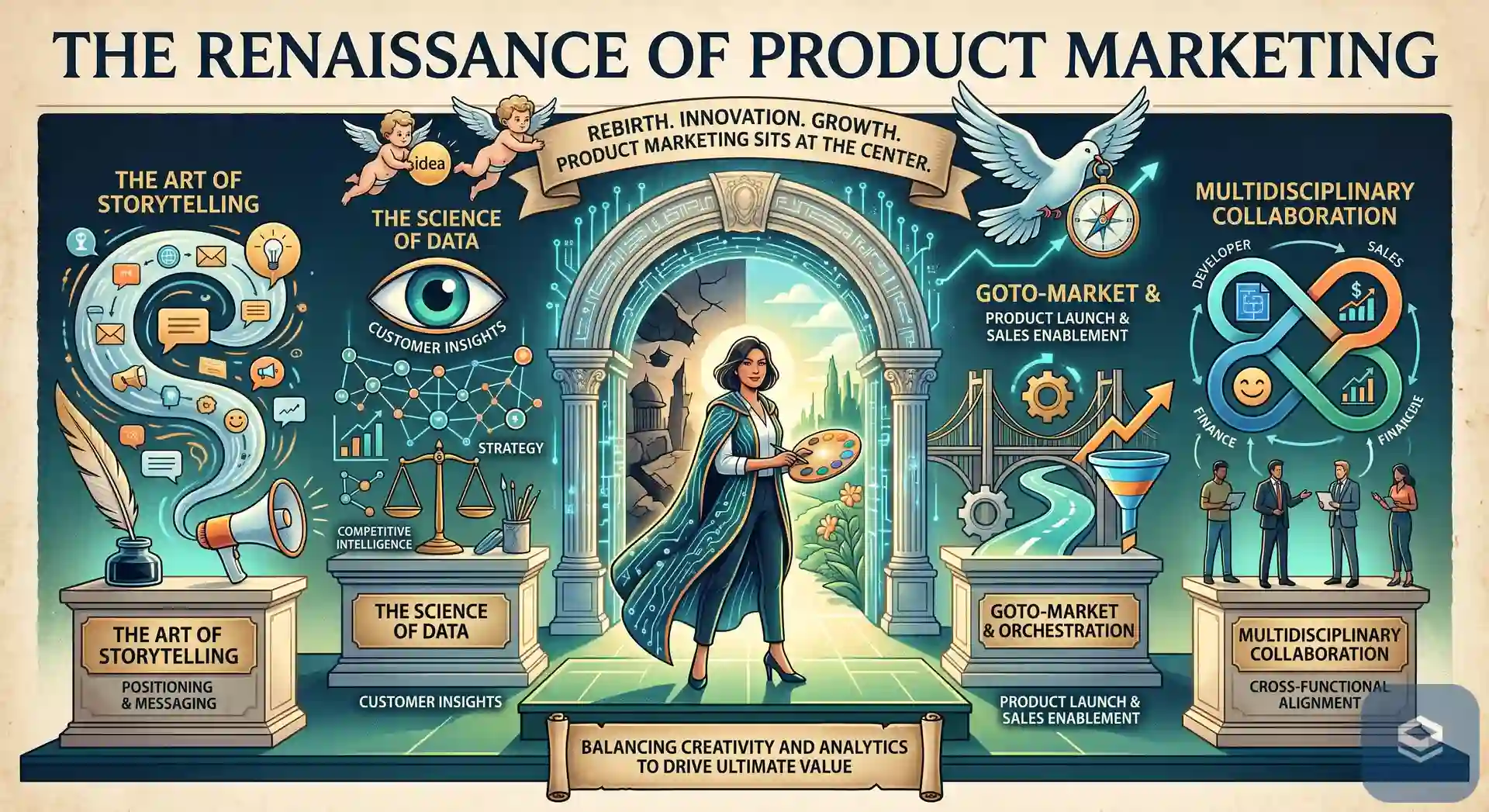
With product teams shipping at AI speeds, the burden of coherence falls squarely on go-to-market teams. To prevent market confusion, product marketing must step into the spotlight as the ultimate orchestrator. It is uniquely positioned in the catbird seat, sitting squarely at the intersection of product development, sales, marketing, and the customer.
Historically, product marketing has often been squeezed into a downstream, supporting role. However, in an era of AI abundance, this function must be elevated. Organizations need a central authority to apply market context and narrative judgment to determine not just what can be shipped, but what deserves to be shipped.
Product marketing must own the entire throughline — managing the flow from the moment code is built to the moment it is successfully absorbed by the end-user. Companies must grant product marketing the authority to curate, coordinate, and act as a strategic constraint against the sheer volume of product abundance.
Strategic interventions by sector
- SaaS: Product marketers must shift from “launching features” to “managing adoption journeys,” ensuring that users only see new tools when their telemetry indicates they are ready for them.
- Healthcare:PMMs must act as clinical workflow translators. Instead of announcing an “AI Diagnostics Tool,” they must coordinate with medical boards to introduce “Workflow Assistants” that seamlessly integrate into existing diagnostic routines.
- Financial services: PMMs must work lockstep with compliance teams, creating rigorous positioning frameworks that satisfy regulators before a single line of AI code reaches the production environment.
Where PrescientIQ™ fits
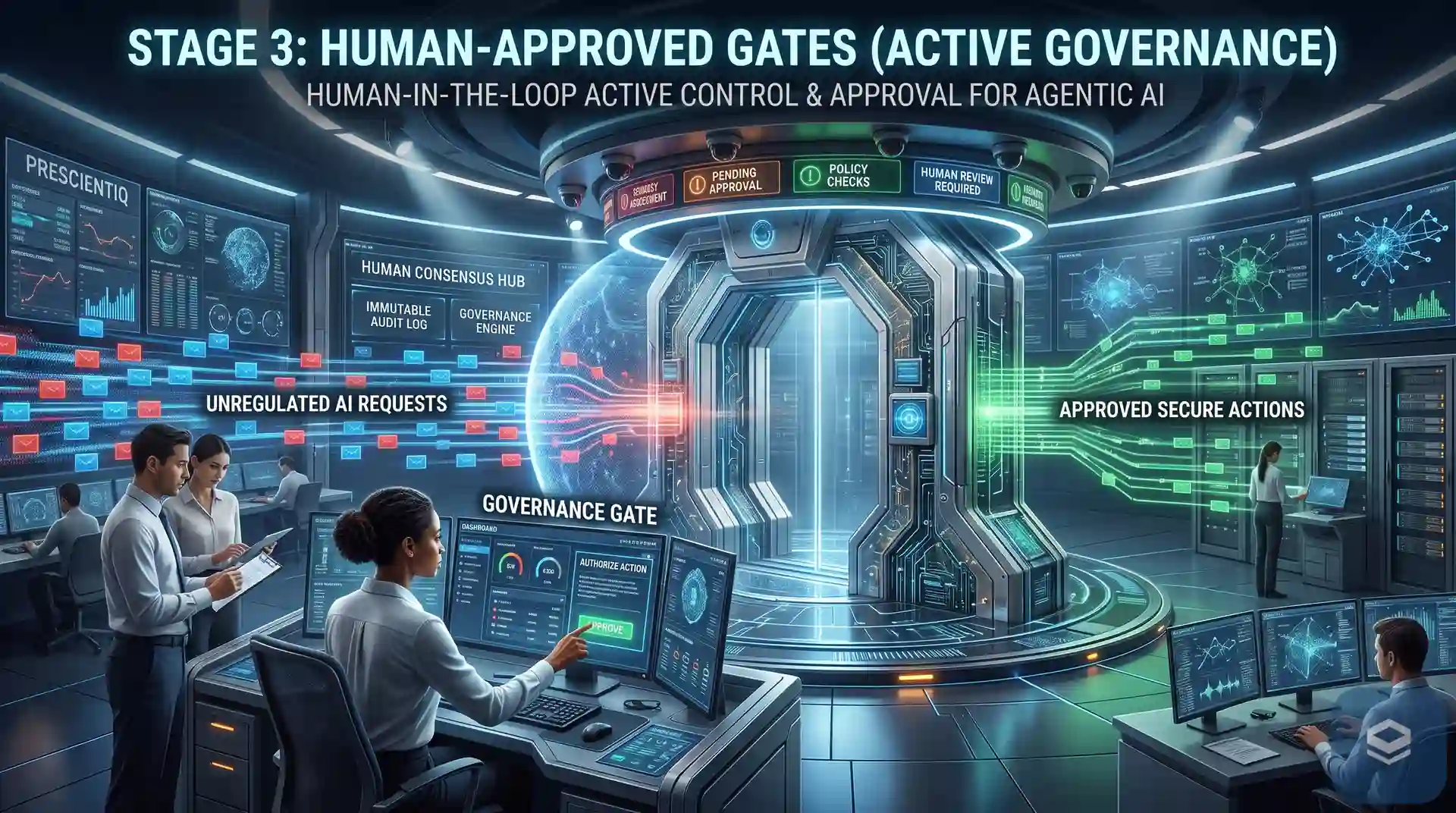
The insight is clear: engineering velocity has outpaced market absorption. The answer is not to slow down innovation, but to change what gets to leave the building without a person deciding it should.
That is the design principle behind PrescientIQ™. Four specialist agents run the revenue motion continuously — prospecting, outbound, trial conversion, and expansion — and every action that reaches the outside world stops at a human approval queue first. There is no auto-send path. Every approved action writes to an immutable audit ledger recording what was done, the reasoning behind it, the before-and-after state, and the identity of the person who authorized it.
Read against a coherence problem, that architecture is doing something specific: it puts a human judgment step exactly where volume would otherwise turn into noise. The agents remove the execution constraint. The approval gate keeps a person deciding what actually deserves to reach a customer — which is the same authority this article argues product marketing needs, expressed as an execution control rather than a process.
| The coherence challenge | What the architecture does about it |
|---|---|
| Spend measured as an end in itself, with no line to an outcome | Work is metered on completed, authorized actions recorded to the ledger. Rejected drafts and retries are not billable events |
| Execution outpacing what the market can absorb | Internal work runs continuously; anything that reaches a customer holds at the approval queue, so a person sets the pace of what actually ships outward |
| Cross-functional misalignment and regulatory risk | A named human clears each consequential action, and the ledger records the actor, the rationale, and the approver — an audit trail rather than a reconstruction |
Conclusion
The gold rush of raw AI capability is over; the era of AI operationalization has begun. The true differentiator in the market today is not who can generate the most code, but who can orchestrate the most value.
It is time to stop shipmaxxing and start delivering coherent value to the market. The broader case for why execution capacity rather than software access is the mid-market constraint is in digital labor, and the control model that keeps it accountable is set out in the enterprise AI governance maturity model.
Which coherence problem are you actually solving?
Three questions. The output is a next step matched to where you are — not a projection, and not the same button for everyone.
See where your own execution effort is going
The Autonomous Audit Report models where your team's execution capacity is currently spent, what your configuration is actually paying for, and what the governed alternative looks like on your own data — before any commitment.
Get your free AAR benchmark