AI copilots vs. autonomous digital labor: a buyer’s guide for mid-market revenue teams
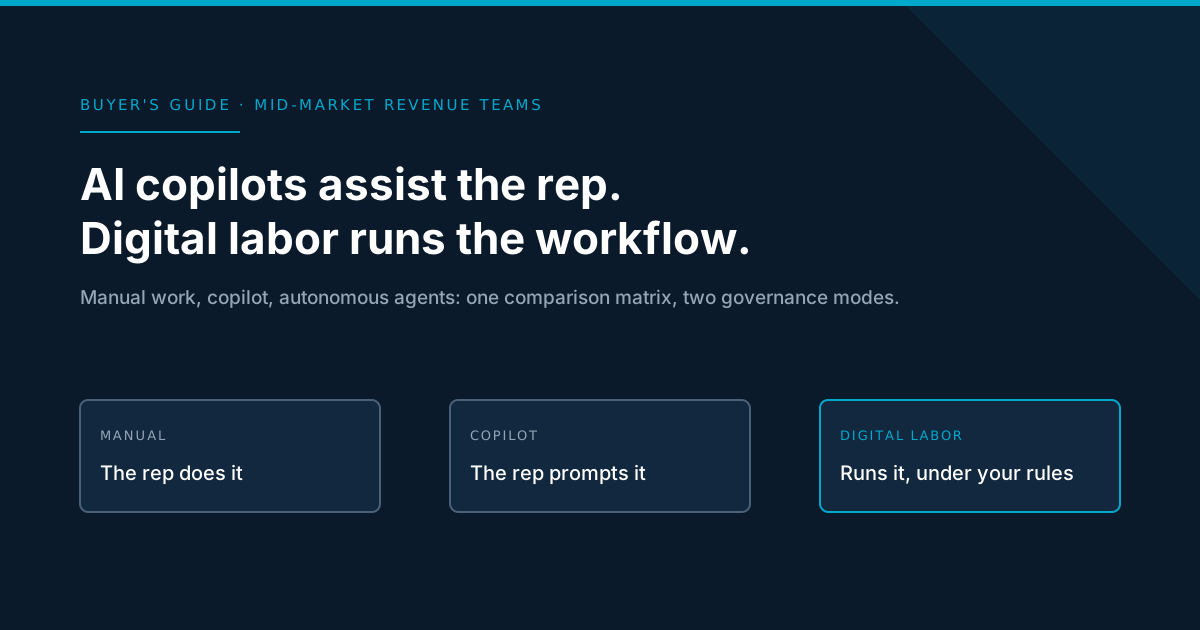
An AI copilot assists a person who still starts, supervises, and finishes every task. Autonomous digital labor owns a recurring workflow end to end: it senses a trigger, decides, acts in your systems, and records what it did, while your team sets the authority it works under. For a mid-market revenue team, the difference is whether the work leaves the rep’s plate or moves to another tab. This guide compares manual work, copilots, and digital labor in one matrix and ends with a readiness checklist.
The problem with copilots: the toggle tax
A copilot is a good tool for a person who already knows what they want. The trouble starts when a revenue team buys one expecting work to disappear. Every use begins with a rep noticing the task, switching to the copilot, supplying context, reading the output, correcting it, and carrying the result back into the CRM or the sequence. Call it the toggle tax: the switch itself is a cost, and it is paid on every task, by every rep, whether or not the output was useful.
On a large team that overhead disappears into the headcount. On a mid-market team it does not. A lean revenue organization has few people to absorb the extra step, and the recurring work that eats the week (researching accounts, updating records, following up on what happened) is exactly the work nobody has time to prompt for. So the copilot gets used for the interesting tasks and the recurring ones stay where they were. The dashboard shows adoption, and the pipeline report shows the same backlog.
Analysts see the same pattern at the program level. Gartner predicted in June 2025 that over 40% of agentic AI projects would be canceled by the end of 2027, citing escalating costs, unclear business value, and inadequate risk controls. That is a forecast, not a measurement of any one team, but the three reasons it names are the three questions a buyer should ask a vendor before signing.
None of this makes a copilot a bad purchase. For judgment-heavy, low-volume work, a copilot is the right tool. The mistake is asking it to do the job of a worker. For the conceptual argument in full, see autonomous AI agents vs. AI copilots. This guide is for the buyer who has already decided the question matters and needs to compare options.
The autonomous shift: Labor-as-a-Service
MatrixLabX is building the Labor-as-a-Service (LaaS) category: instead of selling software seats, it deploys autonomous, vertical-specific digital labor that executes revenue workflows end-to-end under customer-governed authority. The flagship platform, PrescientIQ™, runs a continuous Sense → Decide → Act → Learn loop, with Gemini as primary reasoning on Vertex AI and Claude as secondary reasoning via Vertex AI Model Garden.
In practice that means the work runs in the background rather than waiting for a prompt. In the Revenue Accelerator Stack, Scout, the Pipeline Research Analyst, prospects and enriches accounts. Herald, the Outbound Engagement Rep, prepares outreach and follow-ups grounded in the signal that triggered them. Guide, the Trial Activation Specialist, watches trials for the stall. Steward, the Expansion & Retention Analyst, reads post-sale signals. Marshal, the Revenue Operations Coordinator, sequences the four. Each agent runs under its own least-privilege identity, enforced by permissions rather than prompt instructions.
The buying difference is what you are paying for. A copilot seat buys a tool a person operates. Digital labor buys a workflow that completes. That changes who owns the result and what you measure: not prompts per rep, but workflows completed and the outcomes they produce, reconciled against the same audit ledger that records the actions. For the broader category case, see Labor-as-a-Service vs. SaaS.
The comparison matrix: manual work vs. AI copilot vs. autonomous agents
The table compares three operating models on the dimensions a buyer ends up arguing about. The copilot column describes the category as it is typically sold, not a specific vendor. The table contains no performance figures on purpose: the right numbers come from your own pipeline, which is what the free audit models.
| Dimension | Manual work | AI copilot | MatrixLabX autonomous agents |
|---|---|---|---|
| Who starts the work | A rep, when they remember or find time. | A rep, by writing a prompt. | A trigger the system senses: a signal, a stall, a record change. |
| Who finishes it | The rep. | The rep, after reviewing and pasting the output. | The agent executes. A person approves it first or supervises it, depending on the governance mode. |
| Multi-step workflows | Done step by step, across tools. | One step per request. The rep chains the steps. | Research, decision, action, and follow-up run as one workflow, in the background. |
| CRM updates and enrichment | Batched into cleanup cycles that fall behind. | Suggested text the rep still enters. | Written by the agent through its own scoped identity, with before-and-after state recorded. |
| Oversight | The rep’s own judgment, mostly unrecorded. | Implicit. The rep reads the output, and nothing records that they did. | Explicit and customer-chosen for each action class: approval before execution, or supervision under a standing policy. |
| Audit trail | Field history and memory. | Usually the chat log, separate from the system of record. | An audit ledger entry for every action with its rationale, state change, and approver or policy. |
| What you buy | Headcount. | Seats a person must operate. | Completed workflows from digital workers, priced as a platform rather than per operator. |
| Where it runs out | Hiring and ramp time. | The attention of the person using it. | The governance you have defined. Work outside the authority you set stays with people. |
Read the table by row, not by column. The row that decides most purchases is “Who finishes it.” If the answer is the rep, the tool is a copilot however it is marketed, a distinction covered in agent washing. If you are comparing vendors against each other, the buyer evaluation guide and the AI SDR alternatives guide take the next step.
The governance matrix: how autonomy stays under your control
The objection to any agent that acts is a fair one: what stops it from acting wrongly? The answer is not a single gate on every action. It is a choice, made by your team for each class of action, between two modes.
Human-in-the-loop (HITL). The action is drafted and held. It does not execute until a named person on your team approves it.
Human-on-the-loop (HOTL). The action executes under a standing policy your team sets. A named person supervises and keeps intervention, override, and revocation authority.
Your team chooses the mode for each action class, based on its risk tolerance, and can change it at any time.
Every action, in either mode, is recorded to the audit ledger with its rationale, before-and-after state, and the approver or policy behind it.
Every action class starts in human-in-the-loop until your team changes it.
That choice is the governance matrix. A low-risk, reversible class, such as updating an internal field, can run under a standing policy with a named supervisor. A customer-facing class, such as an outbound message, can stay drafted and held until a named person approves it. You move a class from one mode to the other as the record earns your trust, and the audit ledger is how you see that it has. The same record answers the security reviewer and the CFO, which is why setting the autonomy ceiling for each revenue action is the first design decision and not the last.
Digital workers execute. Humans authorize.
The readiness checklist: is your revenue stack ready for digital workers?
Before a shortlist meeting, answer these eight statements honestly. Each one is a yes or a no. They follow the six dimensions of an agentic readiness assessment: governance, non-human identity, shadow AI, data, workflow suitability, and evidence.
- Every class of agent action has a named owner and a decided mode.
- Every AI tool that touches the CRM has its own identity, separate from any person.
- We can revoke one tool in one step without disabling a person.
- We hold an inventory of every assistant, extension, and agent that can reach CRM data.
- The systems an agent would act on agree on who the account is and where it stands.
- The first workflow we would hand over is internal and reversible.
- Someone outside the revenue team could reconstruct an agent action from the record alone.
- We have written down which workflows should stay with people.
Count your noes. Zero to two: you are ready to model the return on your own data. Three to five: fix the weakest area first, starting with the earlier items in the list, because a gap in governance or identity undermines everything after it. Six or more: take an inventory of what already touches your CRM before adding anything new. The full 12-statement score, with what each result means, is in the AI readiness assessment for revenue teams.
When to choose which
- Keep or buy a copilot when the work is judgment-heavy and arrives rarely: a board memo, a custom proposal, a one-off analysis.
- Move to digital labor when the same work arrives every week in a recognizable shape, and its cost is the follow-through rather than the thinking.
- Keep it manual when the relationship is the product: a renewal negotiation with a strategic account, a sensitive escalation.
Most mid-market teams end up with all three. The goal is to put each workflow in the right column deliberately, rather than by whichever tool was bought first.
Where the data runs
PrescientIQ is hosted and operated by MatrixLabX on Google Cloud. SOC 2, ISO 27001, and PCI DSS attestations are held by Google Cloud, which operates the underlying infrastructure. They are not MatrixLabX certifications. MatrixLabX application-layer SOC 2 is in progress.
Frequently Asked Questions
- What is the difference between an AI copilot and autonomous digital labor?
- An AI copilot assists a person who starts and finishes every task: it drafts, suggests, and summarizes when prompted. Autonomous digital labor owns a workflow end to end. It senses a trigger, decides the next step, executes it in your systems, and records the result, while your team governs what it may do.
- Why do AI copilots disappoint mid-market revenue teams?
- Copilots speed up individual tasks but leave the workflow with the rep. Each use needs a prompt, a context switch, and a review, so the work moves to another tab instead of off the plate. Mid-market teams run lean, so that overhead can cancel the minutes saved on any one task.
- What is Labor-as-a-Service (LaaS)?
- Labor-as-a-Service is a software category where a vendor deploys autonomous, vertical-specific digital labor that executes workflows end to end, instead of selling seats a person must operate. MatrixLabX is building the category: its platform, PrescientIQ, runs revenue workflows under authority the customer governs and records every action to an audit ledger.
- Is autonomous digital labor safe to run on our CRM?
- It is safe when authority is explicit. PrescientIQ gives each agent its own least-privilege identity, lets your team choose a governance mode for each action class, and records every action to an audit ledger. Start in the stricter mode, review the record, and loosen control only for action classes you trust.
- Which revenue workflows suit autonomous agents first?
- Start with recurring, rule-shaped work whose errors stay internal and reversible: pipeline research and enrichment, CRM updates, and follow-up drafting. Keep judgment-heavy, low-volume work, such as a negotiation or a board memo, with people. A copilot remains a good fit for that second category.
- Do we have to replace our copilot to use digital labor?
- No. A copilot and digital labor answer different questions. A copilot helps a person think and write; digital labor takes a repeatable workflow off the person. Many teams keep both. The buying question is which recurring workflows should stop depending on someone remembering to ask for help.
- How do we check whether our revenue stack is ready for digital workers?
- Check six things: the approval path, non-human identity for each tool, an inventory of AI that already touches your CRM, data agreement across systems, workflow suitability, and the evidence trail. The eight-statement checklist on this page takes a few minutes, and the free Autonomous Audit Report applies the same six dimensions to your own data.
Related Reading
Notes on this post
MatrixLabX sells an autonomous agent platform, so this guide has a stake in the comparison, and the matrix is written to be checked against any vendor. The copilot column describes a category, not a product. The checklist is MatrixLabX’s own, not a benchmark, and nothing in it is stored. The one external figure is a published analyst prediction, linked above.
See where your own execution effort is going
The Autonomous Audit Report models where your team's execution capacity is currently spent, what your configuration is actually paying for, and what the governed alternative looks like on your own data — before any commitment.
Get your free AAR benchmark