Sales capacity planning with AI agents: rebuilding the capacity and quota model when digital labor does part of the work
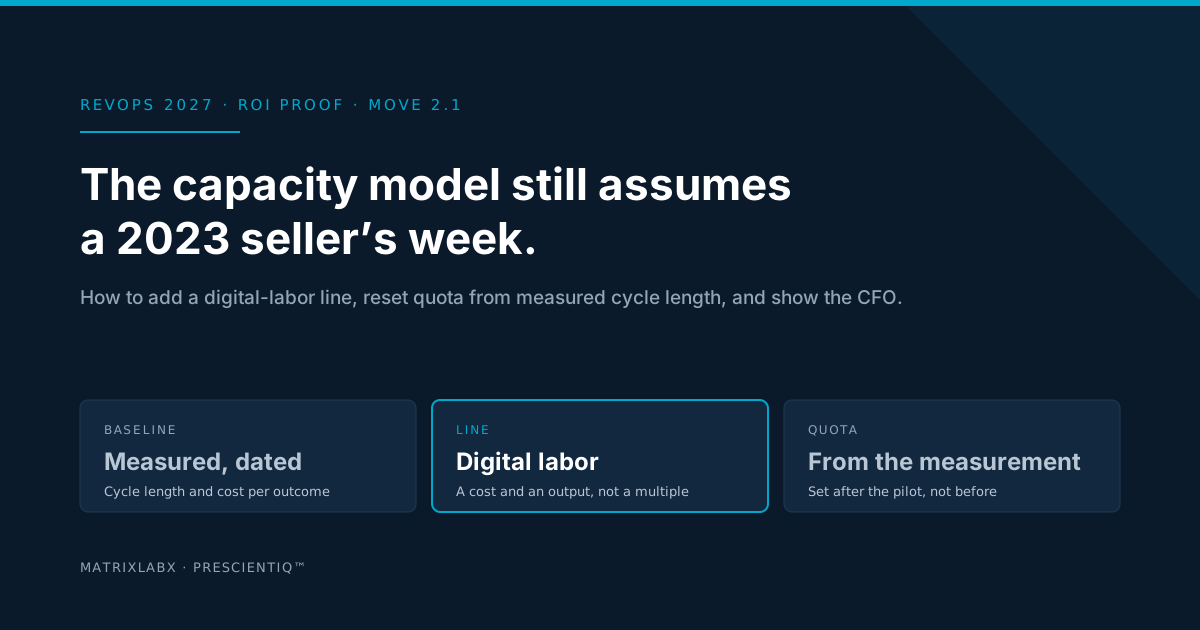
A sales capacity model built for an all-human team breaks the day digital labor does part of the work, because it has nowhere to put a worker with no salary, no ramp, and a measured output. The rebuilt model has five lines: human capacity restated for the work people still do, a digital-labor line with a cost and an output, a review-capacity line, measured cycle length and conversion, and ramp applied to humans only. Quota is reset from line four, after a pilot, not before it.
Every revenue plan has a capacity model underneath it, even when nobody calls it that. It is the spreadsheet that turns a bookings target into a hiring plan: so many reps, so many productive weeks, so much output per week, so much of it closing. The ratios in it were calibrated when every unit of capacity was a person, and most of them have not been touched since 2023.
That is the model the 2027 budget review will be run against, and it cannot answer the question the CFO is going to ask, which is what the AI spend bought. Move 2.1 of the 2027 RevOps Survival Blueprint is to rebuild the capacity and quota model around how work actually gets done now. This post is the method: the five lines, a worked example with the reader’s numbers left blank on purpose, the pilot that produces the measurement, and the readout finance will accept.
Why the old model breaks
The classic model has one kind of capacity. A rep costs a salary, takes months to ramp, leaves at some annual rate, and produces an output estimated from a ratio: so many touches a day, so many meetings a month, so much pipeline a quarter. Everything in the plan is a multiple of that unit. Add tooling as a per-seat line and the model is complete.
Digital labor does not fit the unit. It has a fixed fee rather than a salary, no ramp, no attrition, and an output that is counted rather than assumed. Teams that try to force it into the old model do one of two things. They treat it as tooling, which hides the output and makes the fee look like overhead. Or they express it as a number of reps, which is a claim nobody can measure and the CFO will not accept. Both are the symptom of the same gap: an AI plan that was never written into the business plan.
The five-line model
The rebuilt model keeps the old arithmetic where it still holds and adds the two lines it was missing. Read the right-hand column as what changes.
| Line | The old assumption | Rebuilt |
|---|---|---|
| 1. Human capacity | Reps × productive weeks × output per week, with output assumed from last year’s ratio. | Same arithmetic, but output per week is restated for the work reps still do themselves once research, first-draft outreach, trial follow-up, and expansion flags are handled by digital labor and reviewed by people. |
| 2. Digital-labor capacity | Absent, or buried in the tooling line as a per-seat cost. | A cost (the published fee) and an output (a measured count of completed, authorized actions per period). No multiple, no rep-equivalence. The output comes from the ledger. |
| 3. Review capacity | Absent. Nobody budgeted the time to approve what the tools produce. | Hours per week the named approvers spend on the queue, and the share of actions approved without edit. If this line is zero, line 2’s output is not real. |
| 4. Cycle length and conversion | Last year’s averages, applied to this year’s plan. | Measured in a controlled pilot against a dated baseline, for the stages the agents touch. Quota is reset from this line, after it exists. |
| 5. Ramp and attrition | Applied to every seat as a flat drag on capacity. | Applied to the human line only. The digital-labor line has no ramp drag and no attrition, which is the one structural difference finance will want stated plainly rather than implied. |
Line 1: restate human capacity, do not shrink it
The mistake is to multiply the old output-per-week by an assumed productivity gain. The correct move is to restate what a productive week contains. If research, first-draft outreach, trial follow-up, and expansion flags are now prepared by digital labor and reviewed by people, the rep’s week is made of conversations, negotiation, relationship work, and review. Output per week is then measured against that definition, in the pilot, not assumed.
Line 2: digital labor as a cost and an output
The cost is the published fee. The output is the count of completed, authorized actions the ledger records in the period: accounts scored and qualified, drafts approved and sent, trials intervened on, expansion plays prepared. No multiple, no rep-equivalence. The line looks like every other line in the plan: this much money, this much work, this date. The seven-rep pod cost model in the true cost of a seven-person SDR team is a useful reference for what a fully loaded human line actually contains, and for the ramp and vacancy drag that line 5 applies.
Line 3: review capacity is real capacity
Governed digital labor moves work from drafting to reviewing. A named person approves every customer-facing action, and that time has to be in the model or line 2’s output is fiction. Budget the hours per week per approver and track the share of actions approved without edit. A rising no-edit share is the evidence that lets you widen scope later.
Line 4: quota from the measurement
This is the line everyone wants to change first and should change last. Cycle length and stage conversion are measured in a controlled pilot, one territory or segment, against a dated baseline. Quota is reset from the measured result. The questions a CFO will ask about that pilot are the ones in the 2027 AI budget review, and the structure for the baseline is in the pre-purchase P&L.
Line 5: ramp and attrition apply to people
The old model applies a flat ramp-and-attrition drag across all capacity. The rebuilt model applies it to the human line only. State that plainly. It is the one structural difference between the two kinds of capacity, and if it is implied rather than stated, finance will assume you are hiding a multiple in it.
A worked example, with your numbers left blank
The shape below is the whole method. The numbers are placeholders chosen to be round and obviously illustrative; every one of them is yours to replace with a measurement.
| Line | Input | Illustrative value | Where it comes from |
|---|---|---|---|
| 1 | Reps × productive weeks × restated output per week | 10 × 44 × [measured] | HR plan; the pilot |
| 2 | Digital-labor fee; completed authorized actions per quarter | $165,000 / yr; [ledger count] | Pricing page; audit ledger |
| 3 | Approver hours per week; share approved without edit | [hours]; [percent] | Approval queue |
| 4 | Cycle length and stage conversion, pilot vs. baseline | [days] vs. [days]; [%] vs. [%] | CRM, dated |
| 5 | Ramp months and annual attrition, human line only | [months]; [percent] | HR history |
Notice what the table refuses to do. It does not compute a rep-equivalent for line 2. It does not apply a productivity factor to line 1. It does not change line 4 until the pilot has filled it in. Everything the CFO could object to has been replaced by a measurement with a date.
Key value propositions
A line, not a multiple
Digital labor enters the model as a cost and a measured output. There is no claim that an agent equals a number of people, because that is not how finance will read it and not something a vendor can prove on your data.
Quota follows the measurement
Cycle length and conversion are measured in a pilot before any quota changes. Sellers are not asked to carry a number that assumes a gain nobody has observed.
Review capacity is budgeted
The model names the hours approvers spend on the queue. That is the honest cost of governed digital labor, and it is the line most AI business cases leave out.
The fee is fixed
One flat annual platform fee of $165,000 covers all four agents and their coordinator. Adding reviewers or sellers does not move the line, which makes the model easier to defend than a per-seat tool.
The output reconciles
Completed workflows and the outcomes they produce write to the same ledger as your audit trail, so RevOps can reconcile a monthly invoice against it.
Is your capacity model ready for a digital-labor line?
Four questions, in the order the model needs them answered.
Where does your capacity model stand?
How PrescientIQ fits the model
The free Autonomous Audit Report is a P&L projection built on your own data in a read-only working session. Every figure in it is labeled as modeled. That is line 4’s baseline, built before any commitment. The platform enters line 2 as one flat annual fee of $165,000, billed monthly, covering Scout, Herald, Guide, and Steward under their coordinator, Marshal; adding reviewers or sellers does not move it. Line 2’s output is the ledger count of completed, authorized actions, which is also what the monthly invoice reconciles to. Pricing is published in full on the pricing page. If the pilot is a PrescientIQ deployment, this is the window it is built to fit:
Figures labeled as targets are modeled against current human and copilot baselines. They are not guarantees. Every engagement begins with a free Autonomous Audit Report — a P&L projection built on your own data — and targets are validated against your environment before any commitment.
What this method does not claim
It does not claim a productivity multiple, a rep-equivalent, or a cost reduction. It does not claim digital labor replaces headcount; it records what digital labor does and leaves the hiring decision to the people who own it. And it does not fill in line 4 for you. The measurement is yours, which is the point: a capacity model is only as defensible as the numbers in it, and the numbers in this one are observed, dated, and reconcilable.
Frequently Asked Questions
- What is a sales capacity model?
- A sales capacity model is the arithmetic that connects headcount to bookings: how many sellers, how many productive weeks each, how much output per productive week, and how much of that converts. It sets hiring plans and quotas. Most models still assume all capacity is human, which is the assumption that breaks once digital labor does part of the work.
- How do AI agents change the capacity model?
- They add a second kind of capacity with a different cost shape. A human line has salary, ramp, and attrition. A digital-labor line has a flat fee and an output that is measured, not estimated from a ratio. The model needs both lines, and the human line has to be restated for the work people no longer do themselves, such as research and first-draft outreach.
- Should quotas go up when AI agents are deployed?
- Not on the day of deployment. Quota should be reset from measured cycle length and conversion after a controlled pilot, with a dated baseline for comparison. Raising quota on an assumed productivity gain before the measurement exists is the fastest way to lose the sales team and the pilot at the same time.
- How do you put a digital-labor line in front of a CFO?
- With a cost, an output, a baseline, and a date. The cost is the published fee. The output is a measured count of completed, authorized actions. The baseline is what the same workflow produced before, measured on the same definition. The date is when the comparison will be re-run. Finance accepts that shape because it is the shape of every other line.
- Does the digital-labor line replace headcount?
- The model does not assume it. The line records what digital labor does and what it costs; what that means for hiring is a decision the model informs, not one it makes. Human capacity still handles live conversations, negotiation, relationships, and escalation, and the model should restate the human line around that work rather than remove it.
- What does MatrixLabX charge, and how does it fit the model?
- The PrescientIQ Revenue Accelerator is one flat annual platform fee of $165,000, billed monthly, covering all four agents and their coordinator. It enters the capacity model as a single fixed line that does not change with reviewers or sellers added, and its output reconciles to the audit ledger, so finance can tie the line to completed work.
- What should the pilot measure before quota changes?
- For one territory or segment, with a dated baseline: cycle length from first touch to close, conversion at each stage the agent touches, cost per completed outcome, and the share of agent actions approved without edit. Run it with every customer-facing action held for approval, bring the measured delta to finance, and reset quota from that.
Related Reading
Notes on this post
The worked example uses placeholder values marked in brackets; they are not measurements and should be replaced with your own. The only figures stated are the published platform fee, read from the site’s pricing register, and one deployment target rendered with its proof class. No productivity, output, or cost-reduction figure is claimed. The quotation is George Schildge’s, in a form he supplied for this series.
See where your own execution effort is going
The Autonomous Audit Report models where your team's execution capacity is currently spent, what your configuration is actually paying for, and what the governed alternative looks like on your own data — before any commitment.
Get your free AAR benchmark