Why mid-market fintech sales stall, and how governed AI sales agents help
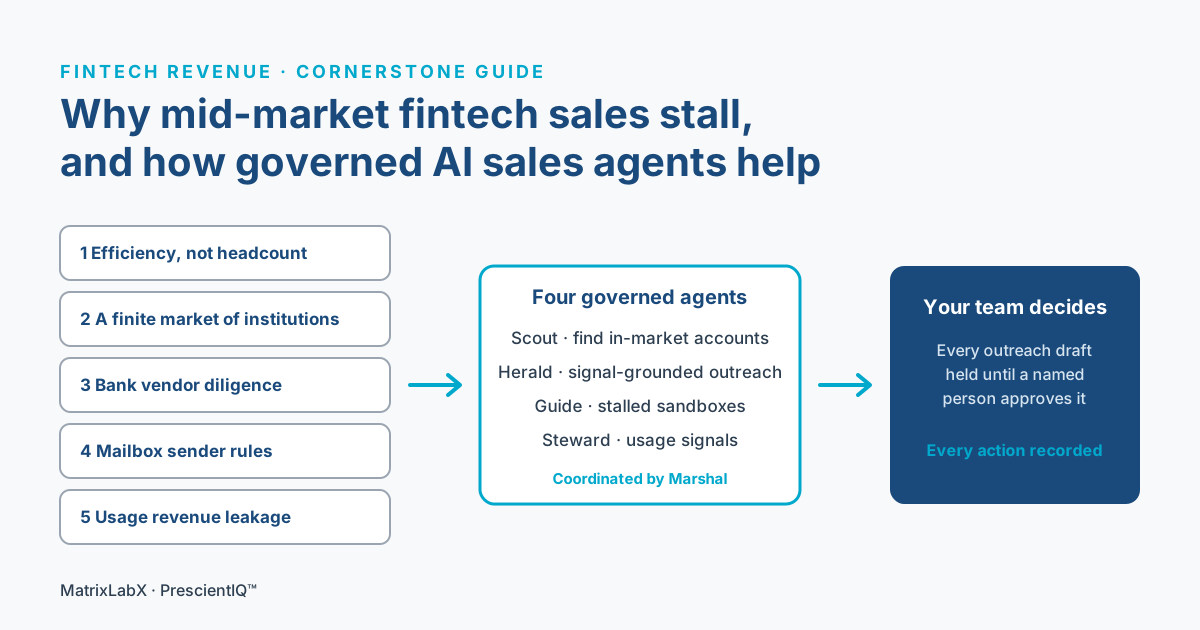
Short answer: mid-market fintech sales stall under five pressures at once: growth is expected from efficiency rather than headcount, the market of banks and credit unions is finite, bank vendor diligence stretches every deal, mailbox sender rules punish volume, and usage revenue leaks between reviews. More reps or more email does not relieve any of them. Governed AI sales agents add execution capacity aimed at live signals, with every outreach draft held for a named approver and every action recorded, which is the kind of evidence a bank buyer asks for.
Who is this guide for?
This guide is for revenue leaders at B2B fintech companies between $20M and $500M in annual recurring revenue: payments and banking infrastructure, lending and core technology, wealth and insurance technology, and compliance software. Your buyers are banks, credit unions, lenders, or merchants. Your team runs Salesforce or HubSpot. And your board wants the next stage of growth without a matching rise in headcount.
What are the primary pain points for mid-market fintech revenue teams?
Five pressures show up in almost every mid-market fintech funnel. Each has a symptom you can see in your CRM this week, and each changes only when the team gains capacity that is aimed rather than added.
| Pressure | What you see in the CRM | What changes it | Agent |
|---|---|---|---|
| Efficiency mandate | Plan grows, hiring plan does not | Execution capacity that is not a seat | All four, coordinated by Marshal |
| A finite market | The same institutions get the same generic sequence | Fewer, better-timed touches on accounts with a live signal | Scout, then Herald |
| Bank diligence | Deals sit in security or procurement review for weeks | Every buying-group role covered, and evidence ready for your own vendor review | Herald, Marshal |
| Mailbox sender rules | Open and reply rates fall as volume rises | Authenticated domains, enforced suppression, relevance over volume | Herald, under your governance mode |
| Usage leakage | Sandboxes stall; volume drifts before renewal | Signals worked the week they appear | Guide, Steward |
1. Why is headcount no longer the growth lever for fintech?
Capital came back to fintech in 2026, but not evenly. KPMG’s Pulse of Fintech for the first half of 2026 recorded $103.1 billion of global investment across 2,100 deals, with deal volume still below historic norms and investors favoring scaled, profitable, infrastructure-focused businesses. For a mid-market fintech, that reads as a mandate: show efficient growth from the team you already have.
A new account executive or SDR adds fixed cost on day one and takes quarters to ramp. Meanwhile the work that actually moves a fintech deal (researching an institution, covering every member of the buying group, following up the day a sandbox stalls) still competes for the same calendar. The constraint is execution capacity, not insight, and the fix has to add capacity that is not another seat.
2. Why does a finite market of banks and credit unions punish volume outbound?
The US market of depository institutions is small enough to count. The FDIC’s Quarterly Banking Profile for the second quarter of 2026 drew on reports from 4,238 insured commercial banks and savings institutions. The NCUA’s second-quarter data summary counted 4,214 federally insured credit unions at June 30, 2026. Narrow either list to your asset band, core platform, and geography, and the addressable set shrinks to hundreds.
In a market that size, every account is a relationship you will want again. A generic sequence that reaches a chief operating officer, a chief risk officer, and a head of digital in the same week does not just fail; it closes the door for the next year. The answer is fewer touches, each grounded in something real: a leadership change, a stated initiative, a conversion or expansion event, or intent on the exact problem you solve.
3. Why do fintech deals stall in bank vendor diligence?
A bank does not simply buy software. Under the interagency guidance on third-party relationships issued by the Federal Reserve, the FDIC, and the OCC on June 7, 2023, it manages risk across every stage of the vendor relationship’s life cycle. In practice, that puts security, risk, compliance, procurement, and the business owner into your deal, each with their own questions and their own calendar.
Deals in diligence rarely die from a single objection. They stall from three gaps:
- Uncovered roles. The champion is engaged, but nobody has worked the risk officer or procurement lead whose sign-off the deal needs.
- Slow follow-up. A security questionnaire comes back with three questions, and the reply waits a week behind other deals.
- Unanswerable questions about your own stack. The bank’s review reaches the tools your team uses on its data, including any AI vendor. If you cannot say where that tool runs and how its actions are controlled, the review waits on you.
4. Why are bank buyers asking harder questions about AI?
Banks have no settled supervisory framework for agentic AI. The Federal Reserve’s SR 26-2, the April 2026 model risk management guidance, places generative and agentic AI models outside its scope and sets no enforceable standards. Examiners can still act on unsafe or unsound practices, so a bank that adopts AI, or buys from a vendor that uses it, has to be able to show its own controls.
For a fintech vendor, that changes the sales conversation in two ways. Your product’s AI will be asked to show who approved what and on what basis. And your own go-to-market AI is part of the impression: a bank that receives obviously machine-generated outreach will reasonably wonder how carefully you govern AI elsewhere. The full reading of the guidance is in SR 26-2 explained.
5. How do mailbox sender rules change fintech outbound?
Inbox providers now enforce what used to be best practice. Gmail’s sender guidelines treat a domain that sends close to 5,000 or more messages to personal Gmail accounts in a day as a bulk sender, require SPF, DKIM, and DMARC authentication, require one-click unsubscribe on marketing mail, and ask senders to keep their user-reported spam rate below 0.1% and never let it reach 0.3%.
Most bank contacts sit on corporate mail systems with filters of their own, but the lesson carries: volume without relevance now costs the domain your whole revenue team depends on. Doubling sends to make a number trades next quarter’s deliverability for this quarter’s activity report.
6. Why do sandbox and trial accounts go cold?
API-first fintechs often run a developer motion beside the enterprise one. A developer signs up for a sandbox, makes a few test calls, and stops before the first production transaction. The signal is sitting in your product data, but the account executives are working enterprise deals and nobody re-engages the sandbox while the developer still remembers why they signed up.
That stall moment is where Guide, the Trial Activation Specialist, works: it watches in-product behavior and prepares a personalized activation sequence at the point of the stall. The figure we publish for it is a modeled target, not a measured result:
Figures labeled as targets are modeled against current human and copilot baselines. They are not guarantees. Every engagement begins with a free Autonomous Audit Report — a P&L projection built on your own data — and targets are validated against your environment before any commitment.
7. Why does usage-based revenue leak between account reviews?
Much of fintech revenue rides on transaction volume or API calls, so it moves before the contract does. A merchant routes part of its volume to a second processor. A credit union stops using a feature after a staff change. A partner’s API usage plateaus at a tier boundary. Each shows up in usage data weeks before a renewal conversation, and each is invisible if account managers only look at the account at a quarterly review. The weekly signals worth tracking are set out in how to protect the revenue you already have.
How does PrescientIQ help a fintech revenue team?
PrescientIQ™ is the MatrixLabX platform of four governed AI sales agents and one coordinator, working inside your CRM. Each one maps to the pressures above:
- Scout, the Pipeline Research Analyst, scores institutions and merchants against your ICP from firmographic and intent signals and your CRM records, so a finite market is worked where there is a reason to talk now.
- Herald, the Outbound Engagement Rep, drafts outreach grounded in the signal that triggered it, including to the buying-group roles a live deal has not yet reached, and records the reasoning behind each draft.
- Guide, the Trial Activation Specialist, prepares activation sequences for sandbox and trial accounts at the moment they stall.
- Steward, the Expansion & Retention Analyst, surfaces expansion and churn-risk signals from usage data as prioritized next-best actions for your account owners.
- Marshal, the Revenue Operations Coordinator, routes work across the crew, and every action, approval, and rejection is written to the audit ledger.
The full specification is on the Revenue Accelerator Stack page, and how the crew applies to fintech, including the controls table for selling to regulated buyers, is on PrescientIQ for fintech.
Who authorizes what an agent does?
Your team sets the oversight for each kind of action, not the vendor:
Human-in-the-loop (HITL). The action is drafted and held. It does not execute until a named person on your team approves it.
Human-on-the-loop (HOTL). The action executes under a standing policy your team sets. A named person supervises and keeps intervention, override, and revocation authority.
Your team chooses the mode for each action class, based on its risk tolerance, and can change it at any time.
Every action, in either mode, is recorded to the audit ledger with its rationale, before-and-after state, and the approver or policy behind it.
Every action class starts in human-in-the-loop until your team changes it.
Outreach is the exception to that choice. Every draft Herald or Guide prepares for a bank, credit union, or merchant is held until a named person approves, edits, or rejects it. In a market this small, that is the point: no first touch reaches a buying committee without someone on your team standing behind it.
What can you tell a bank about your own AI?
When a prospect’s review asks about the AI on your side of the deal, you can answer from the record rather than from memory: which agent took an action, what it was based on, and who approved it or which policy it ran under. Where the platform runs is stated plainly:
PrescientIQ is hosted and operated by MatrixLabX on Google Cloud. SOC 2, ISO 27001, and PCI DSS attestations are held by Google Cloud, which operates the underlying infrastructure. They are not MatrixLabX certifications. MatrixLabX application-layer SOC 2 is in progress.
Whether those answers satisfy a particular bank’s third-party risk program is that bank’s determination. What an AI vendor review typically examines is covered in what an AI agent security review actually checks.
When is PrescientIQ the wrong fit?
- No CRM of record. The agents work inside Salesforce or HubSpot. Without one, start there.
- No sending hygiene. Without an authenticated sending domain and written suppression rules, more execution multiplies the exposure. Fix those first; the pre-send controls list what to put in place.
- A pure RFP business. If nearly all revenue arrives through formal procurement with no outbound, developer, or expansion motion, the agents have little to work on.
- Below $20M in annual recurring revenue. Smaller teams usually start with the self-serve Sales Accelerator, from $399/mo billed annually, and move up as they scale.
Where should a fintech revenue team start?
- Find the leak. Pick the one stage, among account research, outbound, sandbox conversion, and expansion, that loses the most revenue. Use your own CRM data, not intuition; the five-point pipeline leak diagnostic walks through it.
- Write the approval rule. For that stage, name who approves an action, or the policy under which it may run and who supervises it.
- Check the domain. Confirm SPF, DKIM, and DMARC, and write down suppression and frequency rules before anything sends.
- Review the record. Approve the first drafts one by one, then review the ledger weekly to see which signals produce replies and which drafts you edit most.
See your own fintech funnel modeled first.
The AAR Benchmark, the free Autonomous Audit Report, is built on your own CRM and pipeline data. It shows which stage to start with and checks sending-domain and suppression readiness before any deployment.
Frequently asked questions
- What are the biggest sales challenges for mid-market fintech companies?
- Mid-market fintech companies face five recurring sales pressures: investors expect growth from efficiency rather than headcount, the market of banks and credit unions is finite, bank vendor diligence stretches every deal, mailbox sender rules penalize volume outreach, and usage-based revenue leaks between account reviews because nobody has capacity to work the signals.
- How many banks and credit unions can a fintech company sell to in the US?
- The FDIC reported 4,238 insured commercial banks and savings institutions for the second quarter of 2026, and the NCUA counted 4,214 federally insured credit unions at June 30, 2026. That is roughly 8,450 institutions in total, which is why fintech outbound has to be precise rather than high-volume.
- Why do fintech deals with banks take so long to close?
- Fintech deals with banks take long because the bank must manage the vendor relationship under the 2023 interagency third-party risk guidance from the Federal Reserve, FDIC, and OCC. Security, risk, procurement, and business owners each review the vendor, and deals stall when no one keeps every member of that buying group moving.
- Can AI sales agents help a fintech company sell to banks without damaging its reputation?
- AI sales agents help when they add relevance rather than volume. In PrescientIQ, outreach is grounded in a specific account signal, every draft is held until a named person on your team approves it, and every action is recorded, so you can show a bank prospect exactly what your AI sent.
- Does SR 26-2 apply to AI tools that fintech vendors sell to banks?
- SR 26-2 does not settle it. The Federal Reserve’s April 2026 model risk guidance places generative and agentic AI models outside its scope and sets no enforceable standards. Bank buyers still have to show sound practices, so fintech vendors should expect detailed questions about how their AI is controlled and recorded.
- How does PrescientIQ help a fintech revenue team grow without hiring?
- PrescientIQ gives a fintech revenue team four governed AI sales agents. Scout finds in-market institutions and merchants, Herald drafts signal-grounded outreach, Guide re-engages stalled sandbox and trial accounts, and Steward surfaces expansion and churn-risk signals in usage data. Marshal coordinates them, and your team sets the oversight for each action class.
- When is PrescientIQ the wrong fit for a fintech company?
- PrescientIQ is the wrong fit when a fintech has no Salesforce or HubSpot CRM, no authenticated sending domain, or no written suppression rules, and when nearly all revenue arrives through formal RFPs with no outbound or expansion motion. Teams below $20M in annual recurring revenue usually start with the self-serve Sales Accelerator instead.
Related reading
Notes on this page
Third-party facts are attributed to their primary sources and were checked on November 5, 2026: KPMG Pulse of Fintech H1 2026; the FDIC Quarterly Banking Profile for the second quarter of 2026; the NCUA Quarterly Data Summary for the second quarter of 2026; Federal Reserve SR 23-4 and SR 26-2; and Google’s email sender guidelines. The one MatrixLabX figure is a modeled target and carries its label. The Sales Accelerator price is the published tier price.
This page is not legal or regulatory advice. It does not determine how any supervisory guidance, the CAN-SPAM Act, the TCPA, or privacy law applies to your business; those determinations belong to your counsel.
See where your own execution effort is going
The Autonomous Audit Report models where your team's execution capacity is currently spent, what your configuration is actually paying for, and what the governed alternative looks like on your own data — before any commitment.
Get your free AAR benchmark