How to fix revenue leakage between marketing, sales, and customer success
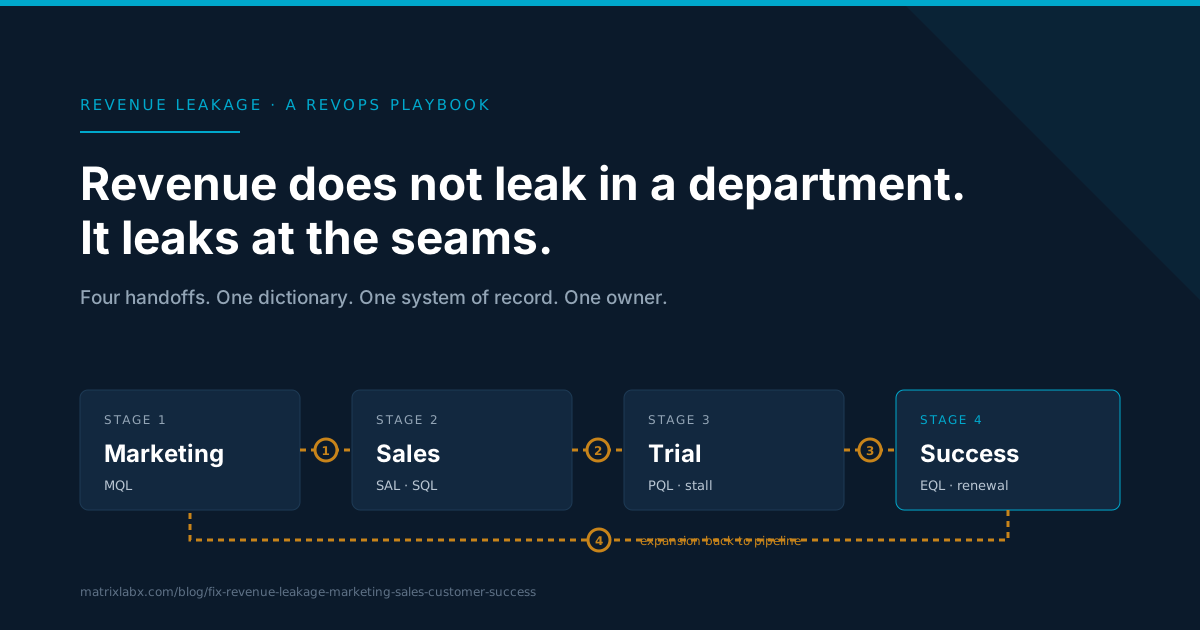
Revenue leakage is qualified demand that entered the funnel and was lost for reasons unrelated to fit or price. It almost never happens inside a department. It happens at the four seams between them: marketing to sales, sales to product trial, sales to customer success, and customer success back to sales at renewal and expansion. The fix has four parts, in order: one written funnel dictionary every team signs; one system of record every seam writes to; a named owner and a continuous watch on the signal at each seam; and one person who owns the number across all four stages.
When a revenue number misses, the reflex is to look inside a department. Marketing did not generate enough. Sales did not close enough. Customer success did not retain enough. Each team runs its own dashboard, each dashboard looks defensible, and the miss sits in none of them — because it happened in the gaps the dashboards do not cover. A lead that arrived on Friday afternoon and was first touched on Tuesday. A trial that reached day nine without hitting the value event, unobserved. A closed-won deal that reached onboarding without the promise the rep made to get it signed. A champion who left the account in March, noticed at the renewal call in September.
None of those are a department’s failure. They are seam failures, and they share a cause: the seam has no definition, no record, and no owner. This article walks the four seams in order, gives you the shared vocabulary that makes them measurable, and ends with a 30-day plan and an honest account of where governed digital labor helps and where it does not.
Leakage is a seams problem, not a department problem
The oldest and still most striking measurement of a seam failure is the study published in Harvard Business Review in 2011, in which researchers audited 2,241 U.S. companies by submitting a web lead and timing the response. 37% responded within an hour, 24% took more than 24 hours, and 23% never responded at all. The same research found that firms that tried to contact a prospect within an hour were nearly seven times as likely to qualify the lead as those that waited even an hour longer.
23%
Every one of those companies had a marketing team that generated the lead and a sales team that would have worked it. The lead was lost in between, and — this is the important part — it was lost without ever being marked as lost. It simply stopped moving. That is the signature of leakage: not a stage with a bad conversion rate, but a seam with no disposition at all. The 23% did not appear on anyone’s dashboard as a loss. They appeared as nothing.
Four seams carry most of the leak in a B2B SaaS funnel. Take them in order.
Seam 1: marketing to sales — the funnel dictionary
The marketing-to-sales seam leaks in two ways: leads that sales never accepts because it does not believe the definition, and leads that sales accepts and then does not touch in time. Both are fixed by the same instrument, which is a written funnel dictionary that both teams sign and that the CRM enforces.
| Stage | Definition (write yours down) | Defined by | What the receiving side owes |
|---|---|---|---|
| MQL | Fit threshold (firmographic, ICP) plus an engagement threshold, both explicit | Marketing, with sales sign-off | A first touch within a set window, and an accept-or-reject disposition |
| SAL | Sales has accepted the MQL as worth working — or rejected it with a reason code | Sales | A disposition on every record; no lead sits without one |
| SQL | Need and authority confirmed in a conversation; an opportunity exists | Sales | An opportunity record with next step and date |
| PQL | Product usage has crossed a threshold that predicts purchase — the value event | Product and RevOps | An intervention within a set window of the trigger, or of a stall |
| EQL | Expansion-qualified: an existing account whose behavior signals upsell or churn risk | Customer success and RevOps | A named owner and a next action, recorded |
Two rules make the dictionary hold. First, every rejection carries a reason code — “wrong persona,” “no budget,” “already a customer” — because a rejected lead with a reason is feedback to marketing and a rejected lead without one is an argument. Second, the response window is written into the definition, not left to culture. Given the HBR finding, one business hour is a defensible target for a first touch; whatever you pick, the point is that a lead past the window is a visible exception, not an invisible one.
Seam 2: sales to product — the trial that goes quiet
In a product-led or trial-led motion, the second seam is between the sales conversation and the product itself. A prospect starts a trial, and for some number of days the funnel has no human in it. The leak here is the stall: the trial that signed up, took two steps toward the value event, and stopped — on a Thursday night, while the rep who owned it was in a quarterly review.
The dictionary fix is the PQL definition and, more importantly, its inverse: a written definition of a stall as time-since-last-progress toward the value event. Without that timestamp, the funnel shows sign-ups and conversions and nothing between, so the leak is invisible until the trial expires. With it, a stall is an event a person — or an agent — can act on the day it happens rather than the week after.
We covered the mechanics of that intervention in the PLG trial conversion agent; the point for this article is narrower. Until the stall is defined and timestamped, nobody can own it, and a seam nobody owns leaks by default.
Seam 3: sales to customer success — the closed-won handoff
The third seam leaks context rather than leads, which is why it is the hardest to see on a dashboard. A deal closes. The rep moves to the next one. Customer success receives an account with a signed contract and, too often, nothing else: not what the buyer was promised to get the signature, not who the champion is or who the skeptic was, not what “success” means to this buyer in their own words. Onboarding then re-discovers all of it, slowly, and the account’s first ninety days — the ones that decide the renewal — are spent rebuilding what sales already knew.
The fix is a required handoff record with a small number of non-optional fields: promises made, champion and economic buyer, the buyer’s stated success criteria, known risks, and the first value milestone with a date. The fields matter less than two process rules around them. Customer success must be able to send the record back with a reason if it is incomplete, or the field is decorative. And one person in RevOps must own the seam and review send-backs weekly, or the rule decays within a quarter.
Seam 4: customer success back to sales — expansion and renewal
The fourth seam runs backwards, from the installed base into the pipeline, and it is the least owned data in most revenue organizations. Usage growing month over month. A second department logging in. Seat usage at the ceiling. A support ticket that reads like a buying question. A champion whose title changed, or whose email started bouncing. A renewal date ninety days out with no conversation scheduled. Every one of those is a signal, and most of them are visible in systems that customer success can see and sales cannot.
The leak is ownership. Is an expansion opportunity CS’s pipeline or sales’s? If the honest answer is “it depends who notices,” the signal has no owner and will be noticed late or not at all — which is how renewals and expansions come to “surprise” a revenue team in both directions. Define the expansion-qualified account in the dictionary, name who owns it the day it qualifies, and put a continuous watch on the signals rather than relying on whoever happens to look.
One system of record, and what “unified data” actually means
Every seam above assumes something that is frequently untrue: that there is one record all four teams read and write, and that it is accurate. “Unified data” in RevOps vocabulary does not mean a data warehouse. It means that when a lead moves from MQL to SAL, the timestamp and the disposition are written to one place, that when a trial stalls the event lands in the same place, and that when a champion leaves, the account record changes where sales and CS both see it.
Salesforce’s State of Sales statistics page reports that sellers use an average of 8 tools to close deals and that 42% feel overwhelmed by too many of them. Eight tools is eight places a record can be updated in one and not the others, which is how a CRM decays into a partial history of what each tool did. The fix is not a ninth tool; it is a rule that every seam writes back to the record, and a benchmark for how accurate that record is expected to be. For an agent writing to the CRM, that benchmark is explicit:
Figures labeled as targets are modeled against current human and copilot baselines. They are not guarantees. Every engagement begins with a free Autonomous Audit Report — a P&L projection built on your own data — and targets are validated against your environment before any commitment.
Whether or not you deploy an agent, that is the right shape of target for any writeback: a named accuracy index the record is maintained against, rather than a periodic cleanup project. We wrote about how the alternative accumulates in RevOps and CRM data debt.
Who owns the full funnel
Marketing owns its stage. Sales owns its stage. Customer success owns its stage. That is the structure that produces leakage, because a seam is by definition not inside any stage. Two roles close the gap.
RevOps owns the seams. Specifically: the dictionary, the instrumentation at every stage entry and exit, the reason codes, the handoff records, and the weekly review of what got stuck. RevOps does not own the number; it owns the plumbing that makes the number honest. If your RevOps function is currently a reporting team, this is the promotion it needs.
One revenue leader owns the number across all four stages. Whether the title is CRO or something else matters less than the scope: one person whose number includes new pipeline, conversion, and net retention, so that a leak at seam three is their problem and not a matter of which VP it lands on. When quota is missed under the departmental structure, the reflex is more top of funnel. Under single ownership, the first question becomes where the funnel leaked — which is usually the cheaper problem to fix.
78%
A 30-day plan
- Week 1 — write the dictionary. MQL, SAL, SQL, PQL, EQL, and stall, each with an owner and a response window. Get marketing, sales, and CS leadership to sign the document. Do not configure anything yet.
- Week 2 — instrument the seams. A timestamp on every stage entry and exit, a required reason code on every rejection and send-back, a required handoff record at closed-won, and a stall timestamp on every trial. All of it in the system of record.
- Week 3 — measure the leak per seam. Three numbers for each of the four seams: conversion to the next stage, median time waiting at the seam, and the share of records with no disposition at all. The third number is the one you have never seen before.
- Week 4 — assign owners and start the cadence. A named RevOps owner per seam, a named revenue leader for the whole number, and a weekly thirty-minute seam review that looks only at stuck records and send-backs. Then decide, seam by seam, whether the fix is process, people, or continuous execution.
Where is your revenue leaking?
Where governed digital labor fits, and where it does not
Some seams leak because of process, and no software fixes those. Some leak because of coverage — the signal exists, the definition exists, and no person is available at the moment the signal fires. Those are the seams where a governed agent belongs.
PrescientIQ’s four agents sit on the coverage seams. Scout (prospecting) and Herald (outbound) work the top of the funnel continuously, so a lead does not wait for a rep’s calendar to clear. Guide (PrescientIQ’s trial conversion agent) monitors in-product events and fires an activation sequence at the moment a trial stalls before the value event — which is the seam-two problem exactly. Steward surfaces upsell and churn-risk signals from account behavior before a CSM would catch them, which is seam four. Every outcome is written back to Salesforce or HubSpot as the system of record, and every externally visible action waits for a named human.
On the seam this matters most for, the trial stall, the registered target is specific to trials the agent intervenes on before the stall completes:
Figures labeled as targets are modeled against current human and copilot baselines. They are not guarantees. Every engagement begins with a free Autonomous Audit Report — a P&L projection built on your own data — and targets are validated against your environment before any commitment.
Run the 30-day plan first. It will tell you, seam by seam, whether the leak is definitional, procedural, or a coverage gap — and only the third kind is a reason to talk to us. If you want that diagnosis on your own data before you commit to anything, the Agentic Readiness Audit scores data readiness, the approval path, and the evidence trail across exactly these seams.
Frequently Asked Questions
- What is revenue leakage?
- Revenue leakage is qualified demand that entered your funnel and was lost for reasons unrelated to fit or price: a lead nobody followed up, a trial that stalled while nobody watched, an onboarding handoff that dropped what was promised, a renewal signal nobody owned. It concentrates at the seams between marketing, sales, product, and customer success rather than inside any one team.
- What is the difference between an MQL, an SQL, and a PQL?
- An MQL is a lead that meets a fit-and-engagement threshold marketing defines. An SQL is a lead sales has confirmed has a real need and someone with authority to act. A PQL is a lead whose product usage has crossed a threshold that predicts purchase, such as reaching a value event in a trial. The definitions only work if every team uses the same written ones.
- Who should own the handoff between sales and customer success?
- The handoff itself should have one named owner, usually in RevOps, who defines what the handoff record must contain and checks that it does. Sales owns filling it in; customer success owns accepting it or sending it back with a reason. What fails is when each team owns its stage and nobody owns the seam between them.
- How do I measure revenue leakage?
- Instrument every stage entry and exit with a timestamp and a reason code, then measure three things per seam: conversion to the next stage, time spent waiting at the seam, and the share of records with no disposition at all. The no-disposition share is the leak nobody sees, because those records never show up as lost — they simply stop moving.
- Does fixing revenue leakage require a RevOps platform?
- It requires RevOps discipline: agreed definitions, one system of record, instrumented seams, and a single owner of the full funnel. At mid-market scale a platform often helps enforce that discipline, but buying one before the definitions exist produces a more expensive version of the same disagreement. Write the dictionary first, then decide what tooling enforces it.
- Can AI agents fix revenue leakage?
- They can close specific seams where the leak is a coverage gap: a trial stalling overnight, an expansion signal nobody read, outbound that stops when the rep is busy. A governed agent acts on those signals continuously, with every external action approved by a named person and written back to the CRM. They cannot fix definitions nobody agreed to or a record nobody trusts.
Related Reading
- Managed revenue operations: an operator who works the handoffs between teams every week
- How to Build a B2B Lead Scoring Model Your Reps Trust
- RevOps Platform vs. Sales Engagement Tool vs. AI Revenue Agent: Which One Do You Need?
- What Is Agentic GTM? From Handoffs to Outcomes
- Beyond Top-of-Funnel: How Full Revenue Loop Digital Labor Drives Mid-Market SaaS Growth
- The PLG Guide
- RevOps and CRM Data Debt
- The Sales Process Coverage Metric
Sources
- Oldroyd, McElheran, and Elkington, “The Short Life of Online Sales Leads,” Harvard Business Review, March 2011 — 2,241-company audit; response-time and qualification findings. Link
- Salesforce, State of Sales statistics page — average of 8 tools used to close deals; 42% of sellers overwhelmed by too many tools. Link
- Ebsta x Pavilion, 2025 GTM Benchmarks Report, as announced via PR Newswire — 78% of sellers missed quota in 2025, up from 69%. Link
Third-party figures are reported as published by their sources. Stage definitions and the response-window recommendation are the author’s and are offered as a starting point for your own dictionary, not as benchmarks.
A note on figures in this article
Every PrescientIQ figure in this article is a registered claim rendered through this site’s central claims configuration, with its proof class shown. Target-class figures are modeled, not guaranteed, and are validated against your own data in the Autonomous Audit Report before any commitment.
See where your own execution effort is going
The Autonomous Audit Report models where your team's execution capacity is currently spent, what your configuration is actually paying for, and what the governed alternative looks like on your own data — before any commitment.
Get your free AAR benchmark