Glass-Box Compliance: Why AI Governance Has to Sit on the Execution Path
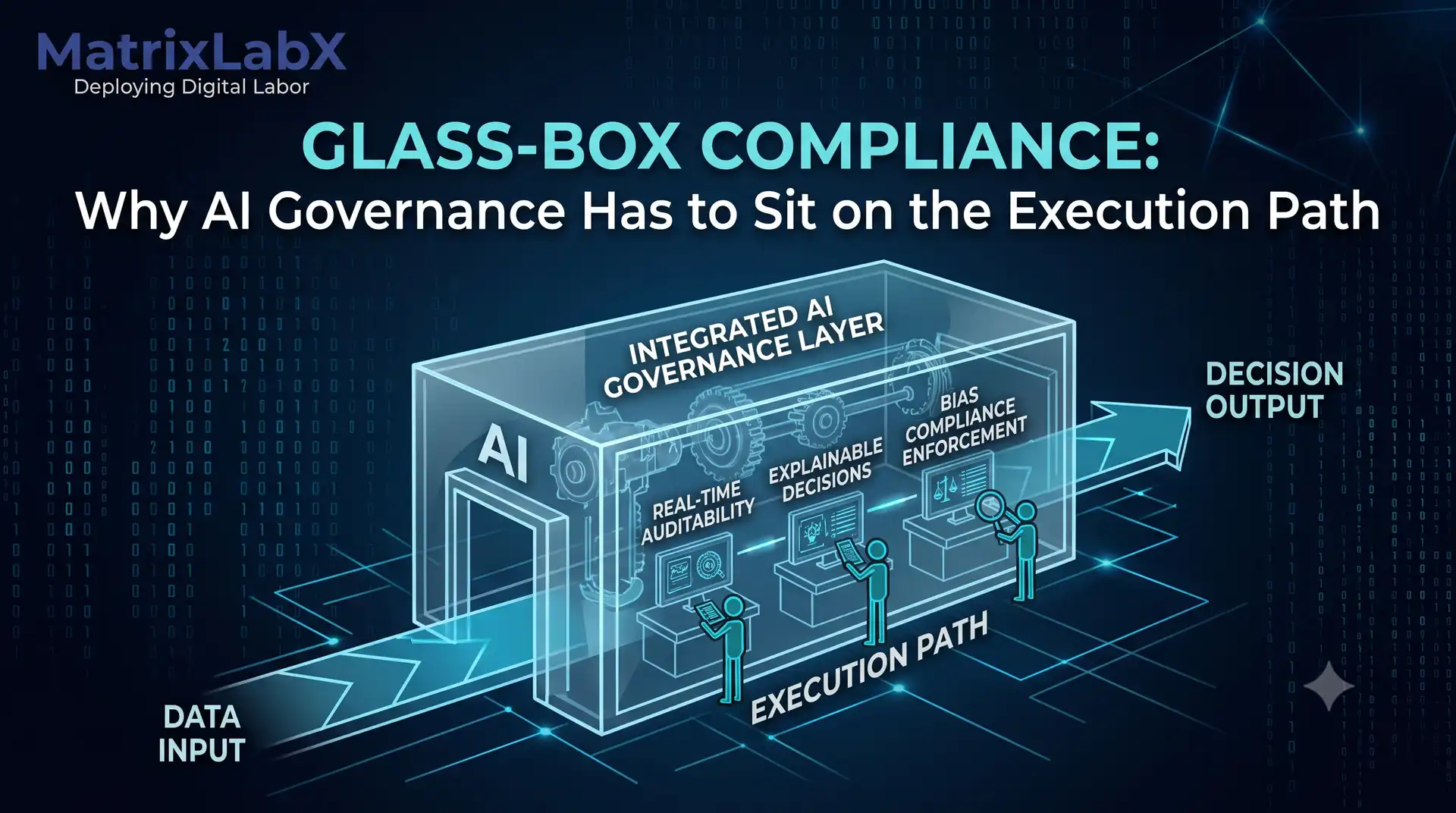
The EU AI Act's transparency duties land August 2, 2026 — and were not deferred. Governance that logs after the fact cannot defend an agent's actions. Governance that screens before them can.
On August 2, 2026, the EU AI Act's Article 50 transparency obligations become applicable. Among them: people must be told when they are interacting with an AI system, and providers of generative AI must mark synthetic outputs in a machine-readable format.
A great many teams believe this deadline moved. It did not.
What moved was a different tier. On June 16, 2026, the European Parliament approved the Digital Omnibus amendments, deferring the AI Act's high-risk obligations — stand-alone Annex III systems to December 2, 2027, and AI embedded in regulated products under Annex I to August 2, 2028. (Gibson Dunn) Headlines compressed that into “EU delays AI Act,” and teams that read only the headline concluded they have until late 2027 to think about any of it.
Gibson Dunn's alert puts the operational point plainly: 2 August 2026 remains a live compliance date, and organizations should keep preparing for it regardless of the deferred high-risk deadlines. Enforcement of Article 50 sits with national market surveillance authorities, and it was not postponed.
If you are running buyer-facing AI agents that touch the EU in any meaningful way — sales, access, or downstream integration — this applies to you next week, not next year. (Holland & Knight)
The gap between logging and defending
Most AI governance programs are built to answer one question: did the agent behave as we intended?
That is internal quality control. It is necessary and it is the second question.
The first question is whether the action was lawful, disclosed, consented, and defensible under examination by someone who does not work for you. Those are different failure modes with radically different consequences. An agent that misstates a product capability costs a deal. An agent that contacts a prospect in a jurisdiction where consent was never captured, or publishes an unqualified efficacy claim a regulator reads as a representation, costs considerably more than a deal.
Gartner's forecast names the gap in language that gets budget approved. It predicts more than 40% of agentic AI projects will be canceled by the end of 2027, citing escalating costs, unclear business value, and inadequate risk controls. (Gartner) Two of the three causes are economic. The third is the one you cannot retrofit, because a legal boundary cannot be bolted onto a system whose actions were never structured to be evaluated against one.
There is a commercial dimension too, not just a defensive one. The same 6sense study of roughly 4,000 B2B buyers found that 89% of purchases included AI features and 58% of buyers engaged sellers earlier specifically to clarify missing AI details. (6sense) Buyers are now running an AI due-diligence pass as part of vendor evaluation. The vendor with a documented, demonstrable governance posture clears that pass. The one with a policy PDF does not.
Black box, glass box
A black-box governance system produces a verdict: approved, blocked, flagged.
A glass-box system produces the verdict, the rule that produced it, the source clause that rule was compiled from, and the record of who approved that rule and when.
Only the second is useful in an audit, a customer security questionnaire, or a regulatory inquiry. “Our model determined the message was compliant” is not an answer.
The distinction also determines whether governance survives contact with a sales quarter. A compliance function positioned beside the operating path gets routed around under pressure. A compliance function positioned on the path cannot be.
Four agents on the path
Compliance Shield ingests your own compliance manuals — regulatory obligations, brand and legal policy, contractual commitments, jurisdictional rules — and operates as an always-on legal boundary around every digital operation, not only the ones someone remembers to route for review.
Policy Agent. Compiles compliance manuals, regulatory texts, and internal legal policy into a machine-enforceable, versioned rule set where every rule traces back to a source clause. This is the step most organizations skip, which is precisely why their AI governance lives in a slide deck instead of in the dispatch path.
Sentinel Agent. Evaluates every outbound artifact and system action against the active rule set before execution. Pre-publication, not post-mortem. When an action is blocked, the response returns the specific governing clause — so the reviewer resolves a question rather than filing a ticket.
Ledger Agent. Appends every agent action to an immutable audit ledger capturing actor, rationale, sources consulted, confidence score, and before/after state. Written to Firestore on Google Cloud, recording every action, its rationale, and the approving human.
Drift Agent. Monitors regulatory and policy change, re-tests standing approvals against the updated rule set, and flags accumulated exposure. Rules change. Claims that were compliant at publication become non-compliant without anyone touching them. A system that only evaluates new actions is measuring the smaller half of the risk — a point the Article 50 timeline makes concrete for anyone who published AI-generated content before the disclosure duty attached.
In practice: a wealth management firm under SEC marketing rules
A mid-market wealth management firm wants to increase outbound cross-sell volume without inheriting the compliance risk of an automated system under the SEC's marketing rule. This is the four-agent architecture above, applied to one workflow end to end.
Scout (PrescientIQ’s prospecting agent) identifies a cross-sell opportunity from account activity and drafts the outreach. Before that draft goes anywhere, the Sentinel Agent evaluates it against the Policy Agent's compiled rule set — the firm's own compliance manual and the SEC marketing rule, each rule traceable to its source clause. The advisor of record reviews the compliant draft and approves it. The Ledger Agent then appends the signal that triggered the outreach, the rule set the draft was screened against, the timestamp of human approval, and the exact text sent — before any message reaches a client.
“Compliance is often viewed as a constraint, but in reality, it is the ultimate guardrail. It allows a corporation to accelerate with absolute confidence, knowing the road beneath them is legally secure.”
If an examiner later queries that interaction, the firm produces the initial signal, the rationale, the approving human, and the sent text from one immutable record — not a reconstruction assembled after the fact from inboxes and Slack threads. Governed autonomy, not fewer sends, is what survives the exam.
Related: Human-in-the-Loop AI: Approval Gates That Actually Hold
The counterintuitive result
Executives generally assume compliance and velocity trade off. In agentic systems, the opposite holds.
Compliance Shield does not restrict agent autonomy. It is the precondition for extending it.
The ceiling on an agent's authority is the organization's ability to defend that agent's decisions. Raise defensibility and the ceiling rises with it. This is the practical path past Level 3 that most organizations never find: they attempt to authorize autonomy on the strength of a successful pilot rather than an accumulated record.
With an immutable ledger, autonomy expansion becomes an evidence-based decision. Start narrow and low-exposure. Log everything. Widen the envelope against demonstrated reliability in a specific action class, in a specific jurisdiction, for a specific claim type. That is an argument a general counsel can approve and a CFO can fund.
A seven-day checklist
Before August 2:
- Inventory every buyer-facing AI surface. Chat agents, outbound drafting, AI-generated content, voice, in-product assistants. Include the ones marketing launched without telling anyone.
- Confirm AI disclosure is present wherever a person interacts with an AI system, in the language of the market it serves.
- Confirm machine-readable marking on generative outputs you publish.
- Determine EU reach. Output touching the EU through sales, access, or downstream integration is potentially in scope regardless of where your company sits.
- Locate your compliance source documents. If your posture lives in senior colleagues' heads, externalizing it is the prerequisite for automating any of it — and has standalone value regardless.
- Test one action end to end. Can you produce actor, rationale, sources, confidence, and before/after state for a single agent action taken last quarter? If not, that is the gap.
- Assign an owner. Article 50 enforcement runs through national market surveillance authorities, not a single central body. Distributed enforcement rewards documented ownership.
Regulatory timelines are moving and subject to formal adoption steps. Verify current status with counsel before relying on any date in this article.
Can you defend what your agents did last quarter?
Book a Discovery Call →Related
- Pillar: Beyond Level 5: The Three Axes of an AI Revenue Operating System
- The Compliance Exposure Hiding in Your SDR, BDR, and MDR Motion
- Sales Process Coverage: The Metric That Replaces Meetings Booked
- The Shortlist Is Set Before You Know They Exist
- Human-in-the-Loop AI: Approval Gates That Actually Hold
- Labor as a Service (LaaS): The End of SaaS as You Know It
Sources
- Gibson Dunn, “EU AI Act Omnibus Agreement — Postponed High-Risk Deadlines and Other Key Changes,” May 2026. Link
- Holland & Knight, “U.S. Companies Face EU AI Act's Possible August 2026 Compliance Deadline,” April 2026. Link
- Travers Smith, “EU agrees to delay key AI Act compliance deadlines,” May 8, 2026. Link
- Gartner, “Gartner Predicts Over 40% of Agentic AI Projects Will Be Canceled by End of 2027,” June 25, 2025. Link
- 6sense, “2025 B2B Buyer Experience Report,” November 12, 2025. Link
See where your own execution effort is going
The Autonomous Audit Report models where your team's execution capacity is currently spent, what your configuration is actually paying for, and what the governed alternative looks like on your own data — before any commitment.
Get your free AAR benchmark