Agentic GTM series · Part 1 of 3
The agentic era of GTM: from fragmented handoffs to hands-off outcomes
Agentic GTM is a go-to-market operating model in which a governed system of AI agents owns a revenue outcome end to end — researching, qualifying, preparing outreach, and moving work between stages — instead of a chain of point tools that hands work to people at every seam. Humans authorize what reaches a buyer.
For a decade, revenue teams have automated go-to-market one step at a time. A routing tool assigns the lead. An enrichment tool fills in the record. A sequencer sends the cadence. Each tool is good at its step, and each one ends the same way: it hands the result to the next tool, or to a person, and the work waits. The steps got faster. The seams between them did not.
The agentic era changes the unit of automation from the step to the outcome. Instead of a relay of tools passing work along, one accountable system carries a qualified account from signal to conversation, under human approval. This post defines what that means, what the handoff chain costs today, and what actually changes for the people who run revenue.
What fragmented lead handoff actually costs
Start with the stack. Salesforce’s latest State of Sales research reports that sellers use an average of 8 tools to close deals, that 42% of sales reps feel overwhelmed by too many tools, and that overwhelmed sellers are 45% less likely to attain quota. Every one of those tools is a place where work can stop and wait for someone to move it.
The cost of that waiting has been measured for a long time. In a study published in Harvard Business Review in 2011, researchers audited 2,241 U.S. companies by submitting a web lead and timing the response. 37% responded within an hour, 24% took more than 24 hours, and 23% never responded at all; among companies that responded within 30 days, the average response time was 42 hours. The same research found that firms that tried to contact a prospect within an hour were nearly seven times as likely to qualify the lead as those that waited even an hour longer, and more than 60 times as likely as companies that waited 24 hours or longer.
The study is fifteen years old, and the lesson has held: interest decays while a lead sits between systems. The seam is not a technical detail. It is where pipeline leaks, and a stack of eight tools has more seams than a stack of one.
Workflow automation vs. agentic execution
This distinction is the spine of this series, so it is worth stating precisely. Workflow automation executes a predefined step when a trigger fires and hands the result to the next tool or person. Agentic execution pursues an outcome, decides the next step from context, and carries the work across stages. Automation removes keystrokes inside a step. Agentic execution removes the waiting between steps.
Industry definitions point the same way. IBM describes agentic AI as a system that “can accomplish a specific goal with limited supervision,” noting that unlike traditional AI models, which operate within predefined constraints, it exhibits “autonomy, goal-driven behavior and adaptability.” Deloitte’s 2025 technology predictions make the same separation: agentic AI “is different from today’s chatbots and co-pilots, which themselves are often called ‘agents.’”
That last clause matters, because the label is being stretched. As reported by CIO.com, Gartner predicts that more than 40% of agentic AI projects will be canceled by the end of 2027, and observes that many vendors have rebranded existing chatbots or gen AI assistants as agents without delivering meaningful outcomes. A product that drafts when asked is a copilot. A product that owns an outcome is an agent.
| Dimension | Workflow automation | Agentic execution |
|---|---|---|
| Unit of work | A step: route this lead, send this sequence, enrich this record. | An outcome: a qualified account worked to a booked conversation. |
| What starts it | A predefined trigger fires. | A goal, plus signals the system reads continuously. |
| How the next step is chosen | By a rule someone wrote in advance. | From context: the account, its history, and what just changed. |
| What happens at the seam | The result is handed to the next tool or person, and it waits. | The same system carries the work into the next stage. |
| Who owns the outcome | No one system; each tool owns its step. | One accountable system, under human approval. |
What continuous, hands-off outcome generation means operationally
“Hands-off” is easy to misread. It describes the labor, not the authorization. The research, scoring, drafting, and movement between stages run continuously without a person pushing each step along. The decisions that reach a buyer do not run unsupervised.
The autonomy ladder makes that precise. AI systems sit somewhere on copilot → HITL → HOTL → autonomous. A copilot suggests and waits for a person to act. At HITL, human-in-the-loop, the agent acts only after a named human approves. At HOTL, human-on-the-loop, it acts while a person monitors and can intervene. An autonomous system acts with no person in the path at all.
Governed agentic GTM does the work of the upper rungs and keeps the authority at HITL for anything externally visible. Two controls hold that line. The system is fail-closed: when an approval, a piece of data, or confidence is missing, it stops instead of proceeding. And every action a buyer could see waits at a human-in-the-loop gate for a named reviewer, with the result written to an immutable audit ledger. That is what makes digital labor a coworker, not a copilot: it does the work, and a person owns the moment the work becomes real.
Where PrescientIQ™ fits
PrescientIQ™ is built as the accountable system in that picture, organized as the Coverage, Constraint, and Consideration stacks. The Coverage stack runs continuous account research, ICP qualification, signal monitoring, and sequencing so the workstation is never starved and nothing sits in transit between stages. The Constraint stack instruments throughput and records what the configuration can actually carry rather than what was assigned to it. The Consideration stack holds the material list — ICP definitions, proof points, objection handling, disclosure requirements — and inspects output before it reaches a buyer. Under all three sit the approval gate and the audit ledger.
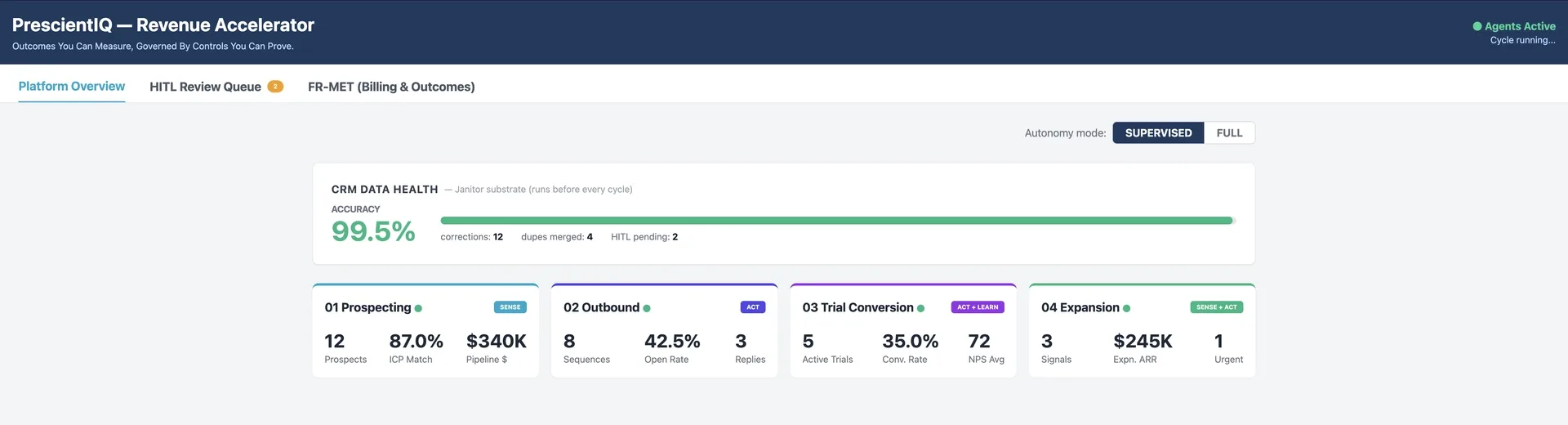
Four agents across the revenue loop, one data-health substrate, autonomy set to supervised.
In the Revenue Accelerator, that architecture runs as four cooperating agents across the loop. Scout finds and scores accounts, and Herald prepares outreach for approval. Guide (trial conversion) and Steward (expansion) carry the same accounts past the first sale.
The economic argument
Seat-based software charges for access whether or not work gets done. PrescientIQ is priced as Labor-as-a-Service: you pay for executed, authorized work rather than seats, and a draft a reviewer rejects is not counted as work. The incentive runs toward accepted outcomes, not toward generating activity. The published fee:
| Component | Investment | Billing frequency |
|---|---|---|
| Annual platform feeEnvironment provisioning on Google Cloud, per-agent IAM, audit-ledger setup, and context ingestion from your CRM — plus four cooperating agents (Scout, Herald, Guide, and Steward), their coordinator Marshal, the approval queue and standing-policy controls, and the immutable audit ledger, and the monthly execution volume a typical mid-market deployment runs. One fee, from signature, every year.Target — modeled: live in 21 days or less$165,000/year is the complete platform fee. There is no separate implementation charge and no different first-year number — deployment work is included from signature, not billed as a distinct line. Scope beyond a typical deployment — additional bundles, sustained higher volume — is quoted at your AAR before anything is signed. | $165,000/yr | Billed monthly at $13,750/mo against an annual commitment |
More detail is on the PrescientIQ page and the pricing page.
What changes for the RevOps and sales leader
None of this is aspirational. These are the concrete shifts a revenue leader manages when the handoff chain gives way to an accountable system:
You design the approval path, not the routing rules
The operational question moves from "which tool handles this step" to "who approves what, and how fast." Review capacity becomes a planned resource.
You own the grounding material
ICP definitions, proof points, and objection handling stop being slideware. They become the material the system works from, so keeping them current is real work.
You measure outcomes, not activity
Sequences sent and tasks logged describe motion. Approved work, qualified conversations, and pipeline created describe results.
You retire the handoff report
When one system carries work across stages, the report that exists to find stalled handoffs has less to find, and the audit ledger answers "what happened" directly.
You start narrow
One workflow with a clear owner and a written standard beats a platform-wide rollout. Expand when the approval data says the first one works.
Deciding which work to give the system first is its own question. The next post in this series answers it with the Agentic GTM Fit Curve.
Where does your GTM break at the seams?
Two questions locate the handoff that costs you most, and whether an accountable system would fix it or just move it.
Where does work wait in your revenue motion?
Frequently Asked Questions
- What is agentic GTM?
- Agentic GTM is a go-to-market operating model in which a governed system of AI agents owns a revenue outcome end to end — researching, qualifying, preparing outreach, and moving work between stages — instead of a chain of point tools that hands work to people at every seam. Humans authorize what reaches a buyer.
- How is agentic GTM different from workflow automation?
- Workflow automation executes a predefined step when a trigger fires and hands the result to the next tool or person. Agentic execution pursues an outcome, decides the next step from context, and carries the work across stages. Automation removes keystrokes inside a step; agentic GTM removes the waiting between steps.
- Does agentic GTM take humans out of the revenue process?
- No. It takes people out of the handoffs, not out of the decisions. In a governed deployment the preparation work runs continuously, while every externally visible action stops at a human-in-the-loop gate for a named approver, and relationship-building and closing stay with sellers.
- What is the autonomy ladder?
- A way to describe how much independence an AI system has: copilot → HITL → HOTL → autonomous. A copilot suggests and a person acts; at HITL the agent acts only after a human approves; at HOTL it acts while a human monitors; autonomous systems act without a person in the path. PrescientIQ keeps externally visible actions at HITL.
- How is agentic GTM priced differently from sales software?
- Most sales software is licensed per seat, so cost scales with headcount whether or not work gets done. PrescientIQ is priced as Labor-as-a-Service: you pay for executed, authorized work rather than seats, and a draft a reviewer rejects is not counted as work.
The Agentic GTM series
- Part 2 — The Agentic GTM Fit Curve: Where Digital Labor Takes Over, and Where Sellers Still Win
- Part 3 — The Foundation for Digital Labor: Context, Governance, and Outcomes Over Model Benchmarks
Related reading
Sources
- 40 Sales Statistics to Watch for in 2026 — Salesforce, State of Sales
- The Short Life of Online Sales Leads — Harvard Business Review, March 2011
- Why most agentic AI projects stall before they scale — CIO.com, reporting Gartner research
- Autonomous generative AI agents: Under development — Deloitte Insights, TMT Predictions 2025
- What is agentic AI? — IBM
Third-party figures are reported as published by their sources; the Gartner prediction is cited as reported by CIO.com. No performance outcome is claimed for PrescientIQ. The metric on this page renders from the site's claims register with its proof class attached.
See where your own execution effort is going
The Autonomous Audit Report models where your team's execution capacity is currently spent, what your configuration is actually paying for, and what the governed alternative looks like on your own data — before any commitment.
Get your free AAR benchmark