The Weekly Reporting Cycle Is Costing E-Commerce Brands Their CAC Efficiency
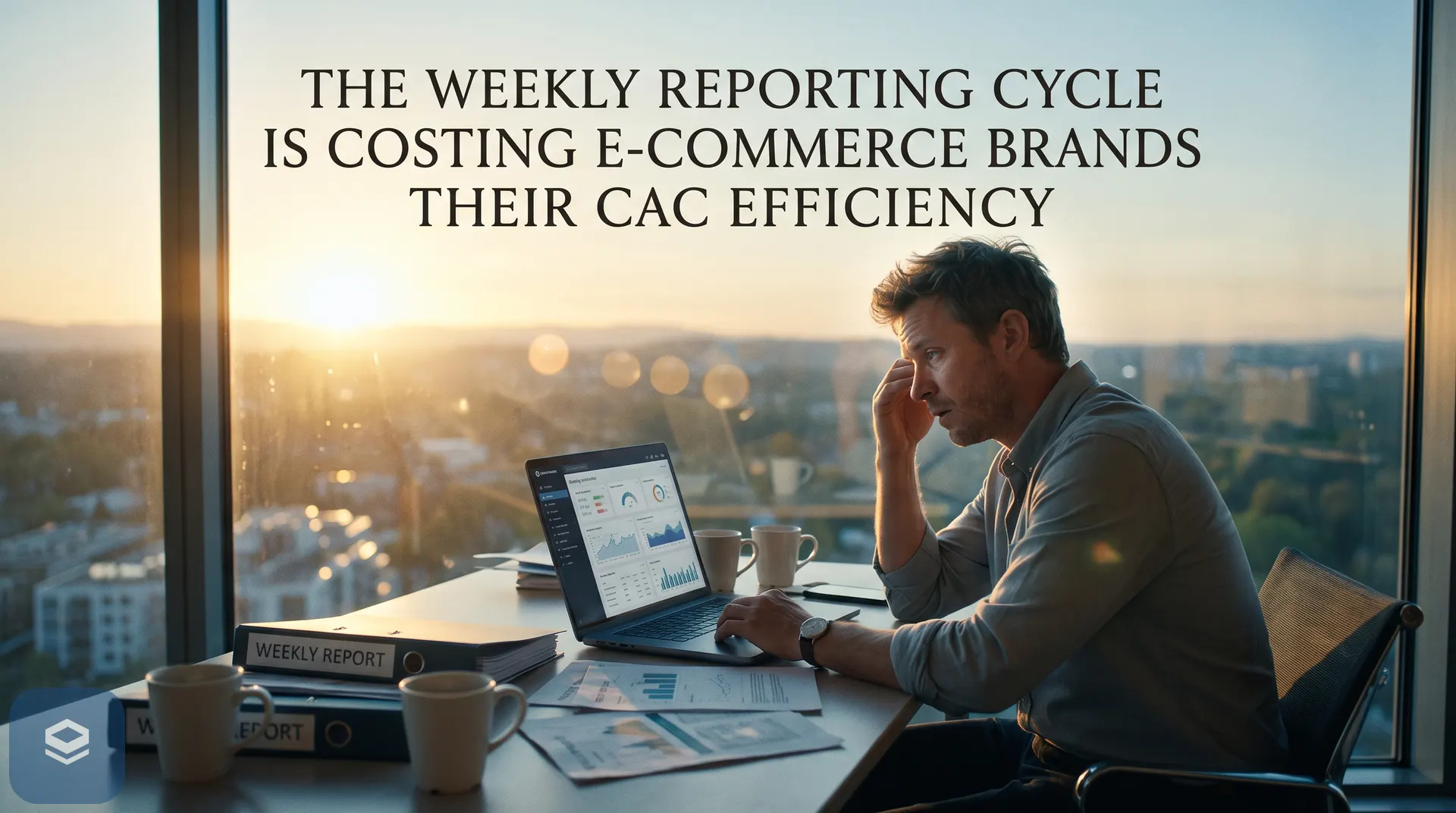
Consumer intent doesn't move on a weekly cycle — it moves hourly. Most mid-market e-commerce brands still run paid media on a weekly reporting cadence, forecast inventory off trailing order history, and remain invisible to the AI search engines an increasing share of purchase intent now runs through.
Most mid-market e-commerce and retail brands run paid media the same way they did five years ago: a media buyer or agency reviews performance on a weekly cadence, then reallocates budget across channels, audiences, and creative for the week ahead. The problem is that consumer intent doesn't move on a weekly cycle — it moves hourly, sometimes by the minute during a promotion or a competitor's stockout. By the time a human catches the signal in a Tuesday reporting meeting, the budget has already been spent against last week's reality.
This lag compounds with two other structural problems: inventory forecasting built on historical order data rather than leading demand signals, and a growing share of purchase intent moving into AI answer engines that most brands aren't optimized for at all.
Two independent forecasts point at the same shift. Gartner predicts that by 2028, 60% of brands will use agentic AI to deliver streamlined, real-time one-to-one interactions — Gartner analyst Emily Weiss called it “the end of channel-based marketing as we know it.”1 Forrester projects global retail media spending will grow from $184 billion in 2025 to $312 billion by 2030 — an 11% compound annual growth rate that would put retail media at roughly twice the level of global television ad spend.2The budget is moving toward real-time, algorithmic allocation whether or not a given brand's media buying has caught up.
Four Problems Legacy E-Commerce Marketing Can't Solve in Real Time
- Paid media is optimized weekly, not intraday. Human media buyers reallocate spend based on reporting cycles, missing the hourly signals that indicate when to shift budget between channels, audiences, and creative.
- Overstock and stockouts happen simultaneously. Demand forecasting built on historical order data misses leading indicators like search trend velocity and social signal shifts — so brands overstock slow-moving SKUs while running out of high-velocity products at the same time.
- AI search is reshaping discovery. ChatGPT, Perplexity, and Google AI Overviews increasingly answer “best [product category]” queries directly. Brands without structured GEO/AEO optimization are simply absent from these zero-click, purchase-intent results.
- Attribution is systematically wrong. Last-click attribution overcredits Google search and undercredits the upper-funnel channels that actually initiated purchase intent — so budget allocation built on flawed attribution quietly destroys CAC efficiency over time.
(Source: matrixlabx.com/industries/ecommerce)
The Generative Growth Engine: Four Agents Replacing Three Vendor Relationships
MatrixLabX's Generative Growth Engine deploys four autonomous agents that together replace the function of a paid media agency, a content team, and a demand-planning spreadsheet — running continuously, without human bottlenecks:
- Day Trader Agent — monitors Google Ads, Meta, programmatic, and affiliate channel signals in real time, shifting budget toward the highest-ROAS audiences and placements 24/7.
- Budget Allocator — applies causal multi-touch attribution to every conversion, identifying the true channel mix that drove the purchase and reallocating spend based on what actually worked, not last-click or platform-reported attribution.
- GEO Agent — optimizes product pages, category pages, and buying guides for citation in ChatGPT, Perplexity, and Google AI Overviews, structuring FAQ and comparison content to earn placement in zero-click purchase-intent queries.
- Content Agent — generates SEO/GEO/AEO-optimized product descriptions, buying guides, and email sequences autonomously, scaling content production across the full catalog without a dedicated content team or agency.
(Source: matrixlabx.com/industries/ecommerce)
“Consumer attention today is measured in seconds, not weeks. Every hour a budget sits misallocated against last week's data, or a product page fails to answer the question a buyer is actually asking, is friction — and friction is the silent killer of revenue. The Generative Growth Engine exists to close that gap in real time, not on next Tuesday's reporting call.”
How This Compares to What Most Brands Are Running Today
| Capability | Generative Growth Engine | Paid media agency | In-house growth team |
|---|---|---|---|
| Budget optimization speed | Real-time — intraday shifts | Weekly reporting cycle | Daily at best, manual |
| Attribution model | Causal multi-touch | Platform-reported (biased) | GA4 last-click default |
| AI search visibility | Structured GEO/AEO optimization | Not offered | Not prioritized |
| Content production scale | Full catalog, autonomous | Not included in media retainer | Writer-limited |
| Cost model | Workflow-volume LaaS, no retainer | Monthly retainer + 10–15% media markup | Fixed headcount + tools |
(Source: matrixlabx.com/industries/ecommerce)
Use Case: Fixing Simultaneous Overstock and Stockouts
Consider a mid-market DTC brand running a lean growth team that reallocates ad spend weekly and forecasts inventory off trailing order history. It is chronically overstocked on last quarter's bestsellers while stocking out on the SKUs currently trending in search and social. By deploying the Day Trader Agent and Budget Allocator against its paid media stack, the brand shifts spend toward the channels and audiences its causal attribution model shows are actually driving purchases — continuously, not weekly. In parallel, the GEO and Content Agents structure the brand's product and category pages to be cited in AI answer engines, capturing purchase-intent traffic that legacy SEO never reached.
Related: The Shortlist Is Set Before You Know They Exist
Integrations and Deployment
MatrixLabX integrates with Shopify Plus, Magento, BigCommerce, WooCommerce, and Salesforce Commerce Cloud via REST API. The Context Ingestion & API Blueprinting phase connects the brand's e-commerce platform, ad accounts, CRM, and inventory management systems during a deployment window of 21 days or less, running on SOC 2-attested Google Cloud infrastructure. There is no per-seat license — pricing is scoped to workflow volume. (Source: matrixlabx.com/industries/ecommerce)
See what your budget looks like reallocated continuously
Related
Sources
See where your own execution effort is going
The Autonomous Audit Report models where your team's execution capacity is currently spent, what your configuration is actually paying for, and what the governed alternative looks like on your own data — before any commitment.
Get your free AAR benchmark