How to define a B2B ideal customer profile from your own closed deals
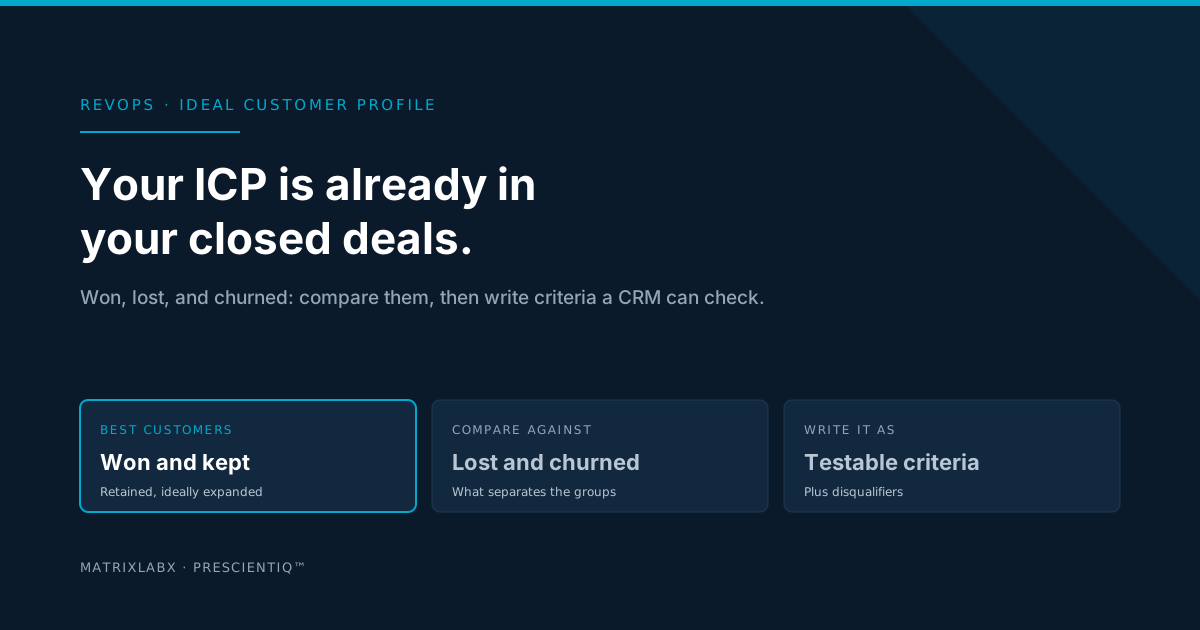
A B2B ideal customer profile (ICP) describes the kind of account that wins, stays, and grows. Build it from your own deals, not a workshop: define best customers by outcome, compare them with lost and churned accounts, and keep the firmographic, technographic, and situational attributes that separate the groups. Write each as a testable criterion tied to a CRM field, add explicit disqualifiers, and use the result as the fit axis of your lead score.
Most ICPs are written in an offsite. Someone puts a slide up, the room agrees on an industry list and a revenue band, and the slide goes into a folder. Six months later the target list in the CRM looks nothing like it, reps prospect whoever looks reachable, and the accounts that actually renew share traits nobody wrote down.
The useful version of your ICP already exists. It is in your closed deals: the accounts that won and stayed, the ones that won and left, and the ones you lost. This guide shows how to read it out of that history, write it as criteria a system can check, and put it where it changes who your team and your agents work on.
ICP, buyer persona, and TAM are three different things
The three terms get used interchangeably, and the confusion is expensive: a persona exercise run in place of an ICP produces a great message aimed at the wrong companies.
| Term | Describes | Answers | Used for |
|---|---|---|---|
| ICP | A type of company | Which accounts should we work? | Targeting, scoring, disqualifying |
| Buyer persona | A role inside that company | Who decides, and what do they care about? | Messaging, content, discovery |
| TAM | Every company that could buy | How big is the opportunity? | Planning, fundraising, territory design |
The ICP is the narrowest of the three and the one that decides what enters the pipeline. Persona work matters once an account is in; the buying committee across each stage is mapped in buyer intelligence vs. decision intelligence.
Why most ICPs do not change anything
- Aspirational. It describes the customers you want, not the ones that succeed with you.
- Firmographics only. Industry and size are simple to agree on and rarely what separates a win from a loss.
- Untestable. Criteria like “forward-thinking” cannot be checked against an account record, so nobody checks them.
- No disqualifiers. Without a list of who not to sell to, every reachable account looks like a fit.
- Not in the systems. If the ICP is not a field on the account and an input to the score, it does not exist for the people and agents doing the work.
Build it from your deals in five steps
Pull three groups from your closed deals
Export the last several quarters of closed opportunities and sort them into three groups: won and still a customer, won but churned or contracted, and lost. The middle group is the one most ICP exercises skip, and it is the one that keeps you from optimizing for deals that close but do not last.
Define "best customer" by outcome, not by logo
A best customer is one that won, stayed, and ideally expanded, on a cycle your team can repeat. It is not the largest logo or the one the founder knows personally. Write the outcome definition down before you look at attributes, so the attributes cannot redefine it.
Why retention belongs in the definition: the NRR operating guide →
Compare attributes across the groups
For each candidate attribute, check how often it appears among best customers against how often it appears among lost and churned accounts. Look in three families: firmographic (industry, size, region), technographic (CRM, stack, data maturity), and situational (a named owner for the problem, a recent trigger event, the motion they buy through). Keep what separates the groups.
Check the fields first: why CRM data decays faster than your cleanup cycle →
Write criteria a system can check
Every criterion must map to a field that exists, or can be filled, on the account record. "Innovative, growth-minded companies" cannot be checked. "Runs Salesforce or HubSpot" can. Split the list into must-haves, strong signals, and disqualifiers, and give each one a source field.
Put it where the work happens
An ICP in a slide deck changes nothing. Add an ICP-match field to the account record, use the criteria as the fit axis of your lead score, and review the definition on a schedule against new wins, losses, and churn. Version every change so you can tell which definition an account was judged against.
An ICP card you can copy (illustrative)
This example is for a company selling to mid-market revenue teams. The criteria are illustrations of the format, not recommendations; yours come from step 3. Notice that every row names the field it is checked against.
| Type | Family | Criterion | Checked against |
|---|---|---|---|
| Must-have | Firmographic | B2B company in the employee band your best customers share | Employee count (enrichment) |
| Must-have | Technographic | Runs a CRM you integrate with | CRM / technology field |
| Must-have | Situational | A named owner for the problem, such as a CRO or RevOps lead | Contact titles on the account |
| Strong signal | Situational | Change in sales leadership within the last two quarters | Trigger-event field |
| Strong signal | Technographic | Uses a sequencing tool alongside the CRM | Technology field |
| Disqualifier | Situational | Sells only through channel partners, with no direct sales team | Sales motion field |
| Disqualifier | Firmographic | Estimated deal size below the floor you set | Estimated contract value |
Disqualifiers do as much work as criteria
Teams spend days on what an ideal customer looks like and minutes on what a bad one looks like. The second list is often the more valuable. A clear disqualifier removes accounts before anyone spends research time, sequence slots, or sender reputation on them, and it protects reps from the deals that close and then churn. Find them the same way as the criteria: attributes that show up repeatedly among lost and churned accounts and rarely among best customers.
Disqualifiers also make the low-fit quadrant of a lead score actionable. In the fit and intent model, a low-fit account with high intent gets qualified through a cheaper channel; a disqualified one gets suppressed.
Is your ICP ready to drive targeting?
Run your current ICP through this check before you build a score or a target list on it.
Can your ICP drive scoring and outbound today?
From ICP to execution
Once the ICP is a set of checkable criteria, applying it stops being a quarterly list-building exercise and becomes continuous work, which is the kind of work an agent does well. Scout, the Pipeline Research Analyst, scores accounts against your ICP from intent signals, CRM records, and web telemetry. Account scoring runs on sandboxed deterministic code. No language model performs arithmetic that has a numeric consequence, so a score can be reproduced and checked.
Qualified accounts go to Herald, the Outbound Engagement Rep. Outreach is grounded in the specific signal that triggered it, with the reasoning behind each draft captured alongside it. Your team chooses the mode for each action class, based on its risk tolerance, and can change it at any time. Human-in-the-loop (HITL): The action is drafted and held. It does not execute until a named person on your team approves it. Human-on-the-loop (HOTL): The action executes under a standing policy your team sets. A named person supervises and keeps intervention, override, and revocation authority. Every action, in either mode, is recorded to the audit ledger with its rationale, before-and-after state, and the approver or policy behind it.
Your team still owns the definition: which criteria count, which disqualify, and when the ICP changes. The full four-agent loop is specified on the Revenue Accelerator Stack page, and SaaS-specific applications are on PrescientIQ for SaaS.
How to know your ICP is right
Tag every new opportunity with whether it matched the ICP when it entered the pipeline, then compare the two groups each quarter on three things: win rate, sales cycle length, and retention after the first renewal. If ICP-matched accounts do not do measurably better on at least one of them, the criteria are not separating anything and step 3 needs another pass.
Watch coverage as well. An ICP that is right but only worked on a fraction of the matching accounts leaves pipeline on the table; that gap is what the sales process coverage metric measures.
Frequently Asked Questions
- What is an ideal customer profile in B2B?
- An ideal customer profile, or ICP, describes the type of company that gets the most value from your product and produces the most value for you. In B2B it is defined at the account level: industry, size, technology, and situation. It is built from your best existing customers, not from the market you hope to win.
- What is the difference between an ICP and a buyer persona?
- An ICP describes the company you should sell to; a buyer persona describes the people inside it. The ICP decides which accounts enter your pipeline. Personas decide how you talk to the buying committee once they do. Define the ICP first, because a strong persona inside the wrong company still produces a lost deal.
- How do you build an ICP from customer data?
- Start with your closed deals. Define your best customers by outcome: won, retained, and ideally expanded. Compare their attributes with lost deals and churned accounts. Keep the attributes that separate the two groups, write each as a testable criterion tied to a CRM field, and add explicit disqualifiers for profiles that repeatedly lose or churn.
- How often should you update your ideal customer profile?
- Review your ideal customer profile on a fixed schedule, typically twice a year, and immediately after a pricing change, a new product line, or a shift in who is winning and churning. Compare recent wins and losses against the current criteria. If accounts outside the ICP keep winning, or inside it keep losing, revise it.
- What should an ICP include besides firmographics?
- Beyond industry and size, a useful ICP includes technographics, such as the CRM or stack the account runs, and situational criteria: a named owner for the problem, a recent trigger event like a funding round or leadership change, and the motion they buy through. Situational criteria can separate wins from losses better than firmographics alone.
- How do AI agents use an ideal customer profile?
- An AI prospecting agent uses the ICP as its scoring criteria. In PrescientIQ, Scout scores accounts against your ICP with deterministic code, so identical inputs produce identical scores, and hands qualified accounts to the outbound queue. The agent applies the ICP continuously; your team still owns the definition and decides how outreach is governed.
Related Reading
Notes on this post
The five steps are MatrixLabX’s working method for mid-market B2B teams. The ICP card is an illustration of the format, not a recommended set of criteria. No third-party statistic is quoted, and no win-rate, cycle-length, or retention outcome is claimed. Product statements match the current public copy.
See where your own execution effort is going
The Autonomous Audit Report models where your team's execution capacity is currently spent, what your configuration is actually paying for, and what the governed alternative looks like on your own data — before any commitment.
Get your free AAR benchmark