Beyond Level 5: The Three Axes of an AI Revenue Operating System
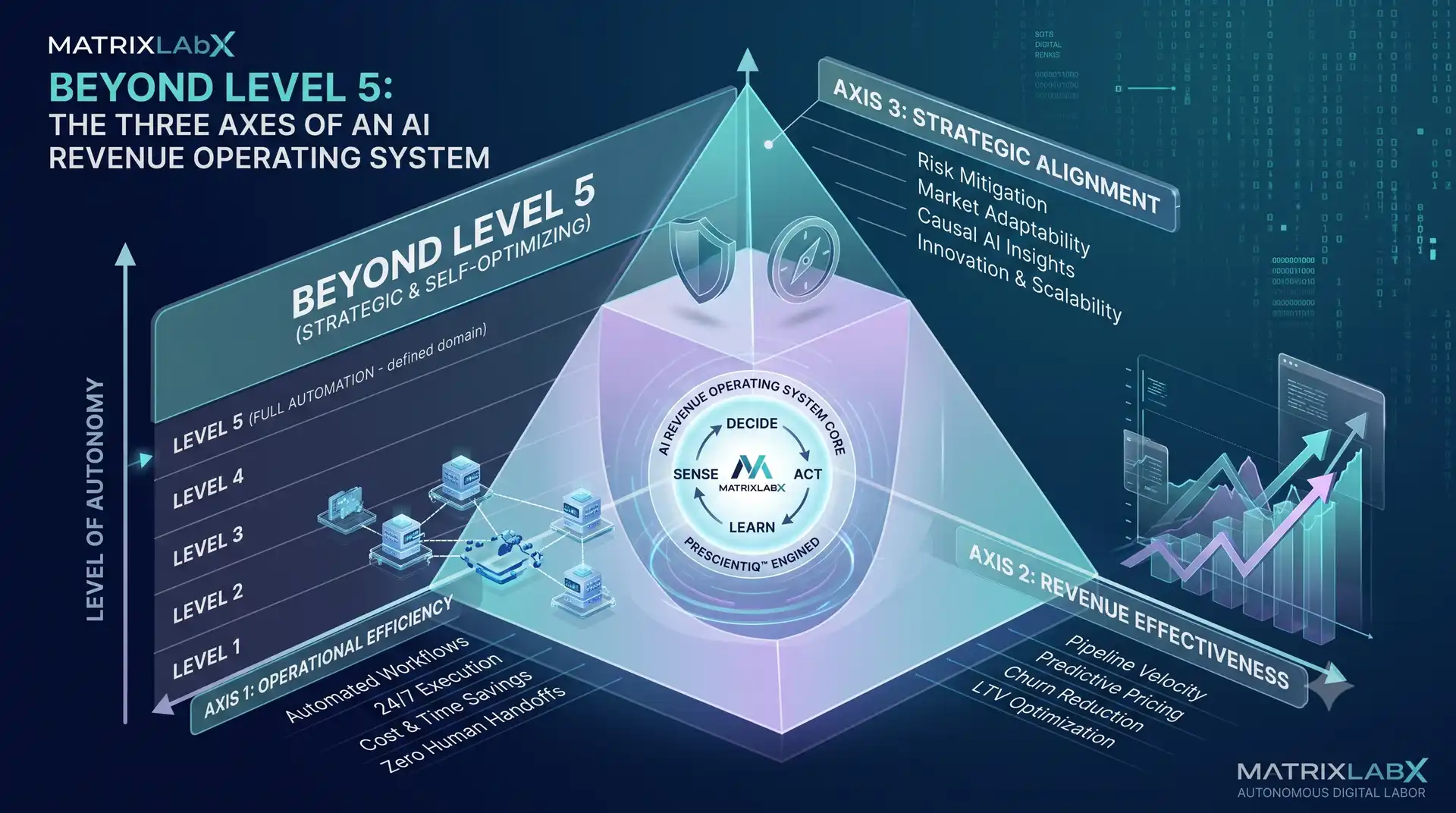
Full-lifecycle agent orchestration is the floor of a revenue operating system, not the ceiling. Coverage, constraint, and consideration — and why optimizing one produces a demo instead of a system.
The AI agent category finally has an honest map. Scott Brinker's five-level model of buyer-facing revenue agents — Level 1 scripted chatbots through Level 5 full-lifecycle orchestration — is useful precisely because it refuses to flatter the market. It says plainly that most deployed AI SDRs sit at Level 3, that Level 3 optimizes a metric buyers resent.
The model is correct. It is also incomplete, and the gap matters more than the map.
Level 5 is the terminal point on a single axis: coverage. How much of the customer journey can one coordinated agent system carry? That is the right primary question. For a mid-market enterprise in a regulated or reputation-sensitive category, it is not the binding one.
Two constraints sit entirely outside the coverage axis, and either one can render a flawless Level 5 deployment inert.
The Level 5 ceiling, briefly
The five levels progress by how much of the buying process an agent can stay involved in:
| Level | Archetype | Serves |
|---|---|---|
| 1 | Scripted FAQ chatbot | Nobody |
| 2 | Conversational site agent, reactive | Buyer, partially |
| 3 | The stereotypical AI SDR — intent capture, qualification, meeting booking | Seller |
| 4 | AI revenue teammate — objections, demos, system updates, informed handoff, live ride-along | Both |
| 5 | Orchestrated revenue agent across the full lifecycle, teams, systems, and touchpoints | The relationship |
The distinction at Level 4 is not that the agent does more things. It is that the agent stays present longer, so a buyer can ask a product question, test fit, see a tailored demo, investigate pricing, loop in stakeholders, and only then meet a salesperson who inherits everything that already happened. No sell-side organizational amnesia.
Level 5 extends that continuity past the close, because acquisition and expansion are the same relationship.
PrescientIQ's Revenue Accelerator is architected in that domain: four lifecycle agents — Scout (prospecting), Herald (outbound), Guide (trial conversion), and Steward (expansion) — under a central orchestrator that holds shared account state. The orchestrator is the Level 5 component. Four agents running independently is a tool bundle. Four agents sharing state, sequencing decisions, and escalating to the right human with intact context is an operating system.
That is a defensible position. On its own, it is insufficient.
Axis two: constraint
The capability framework that accompanies the five-level model treats governance as one of seven layers — boundaries, logs, approval rules, escalation paths, monitoring. The framing is right: governance is what makes greater autonomy deployable, not a bureaucratic afterthought. No organization hands an agent more authority when nobody can reconstruct what it said, what it did, which information it used, or why.
The framing is right and the scope is too narrow. Governance in that model is an internal quality-control function: did the agent behave as the revenue team intended?
For a healthcare technology vendor, a financial services platform, or a manufacturer with export exposure, that is the second question. The first is whether the action was lawful, disclosed, consented, and defensible under examination by someone who does not work for you.
Different failure modes, radically different consequences. An agent that misstates a feature costs a deal. An agent that contacts a prospect in a jurisdiction where consent was never captured, or makes an unqualified efficacy claim a regulator reads as a representation, costs considerably more than a deal.
Gartner's forecast makes the point in the language executives fund against. It predicts that more than 40% of agentic AI projects will be canceled by the end of 2027, and names three causes: escalating costs, unclear business value, and inadequate risk controls. (Gartner, June 2025)
The regulatory clock is no longer theoretical either. The EU AI Act's Article 50 transparency obligations — including the duty to tell people when they are interacting with an AI system — become applicable on August 2, 2026, and were not deferred by the Digital Omnibus amendments that pushed the high-risk tier to late 2027. (Gibson Dunn)
This is the axis Compliance Shield addresses: four agents that ingest your own compliance manuals and operate as an always-on legal boundary around every digital operation. Glass-box, always on, always auditable. → Glass-box compliance, explained
Axis three: consideration
The second omission is larger and more urgent.
Every level in the model, 1 through 5, describes what happens after a buyer arrives. Level 5 assumes the buyer is already in conversation with your agent. It is silent on how they got there — historically a reasonable omission, since that was a marketing problem solved by a discovery layer that stayed stable for twenty-five years.
That layer is being rebuilt underneath the category.
6sense's 2025 Buyer Experience Report, based on responses from roughly 4,000 B2B buyers across North America, EMEA, and APAC, found that 94% of buyers used large language models during their purchase journey, primarily to summarize reviews and analyze data. The same study found that buying cycles compressed from 11.3 to 10.1 months, that first contact with a seller now happens at 61% of the journey rather than 69%, and — the finding that should reorganize your budget — that the winning vendor was already on the buyer's Day One shortlist 95% of the time. (6sense, November 2025)
Read those together. The consideration set is assembled early, increasingly by a retrieval system synthesizing an answer rather than by a buyer browsing ten blue links. And the vendor who makes that first list wins almost all of the time.
Brinker has made the parallel argument from the other direction: buyer-side agents, not sell-side ones, are the real disruption, because the displacement of classic search and the SEO playbooks built to win it changes how buyers find, evaluate, and engage with vendors far more fundamentally than any seller efficiency gain. (chiefmartec, November 2025)
The implication for a Level 5 deployment is direct:
An orchestrated revenue agent that is never surfaced in an AI-native answer orchestrates an empty pipeline. Perfect coverage of a journey that no longer starts at your door is perfect coverage of nothing.
This is not a content marketing problem. It is a retrievability and authority problem running on a different clock than paid media, with different feedback loops and different failure modes. It needs its own agents.
That is what the Generative Growth Engine does: four agents shifting ad budget in real time against ROAS while establishing the brand as an authoritative, citable answer inside AI search. → How the shortlist is formed before you know they exist
The composite
Three stacks. Twelve agents. One orchestrator. One audit ledger.
| Axis | Stack | Agents | Question it answers |
|---|---|---|---|
| Consideration | Generative Growth Engine | Allocation, Creative Yield, Answer Authority, Retrieval Monitor | Does the buyer reach us at all? |
| Coverage | Revenue Accelerator | Scout, Herald, Guide, and Steward | Can the buyer complete their journey with us? |
| Constraint | Compliance Shield | Policy, Sentinel, Ledger, Drift | Can we defend everything we just did? |
The composition is the product. Any single axis is available from point vendors, and most mid-market organizations have assembled exactly that: a media platform, an outbound tool, and a governance policy document. Three systems that share no state, no audit trail, and no definition of the customer.
What the composite makes possible:
A closed loop from answer to expansion. The Retrieval Monitor observes which questions buyers put to AI assistants and which framings earn citations. That reaches Scout and Herald as live messaging signal, not a quarterly report. Objections Guide encounters become content the Answer Authority Agent publishes. The demand layer and the lifecycle layer teach each other.
One ledger for every action. Budget shifts, published claims, outbound drafts, tier changes, and expansion plays all write to the same immutable record with the same schema: actor, rationale, sources consulted, confidence, before/after state — on Google Cloud. When a CFO asks why acquisition cost moved or a general counsel asks who approved a claim, the answer is a query, not an investigation.
Autonomy that scales with evidence. Authority can be extended incrementally and defensibly — starting with low-exposure actions and widening the envelope as the ledger accumulates reliability evidence. This is the practical route past Level 3 that most organizations never find, because they try to authorize autonomy on the strength of a pilot rather than a record.
What has to be true before any of this works
The candid assessment in the source framework applies to us as much as to anyone: the technology is moving faster than organizational readiness. The barrier to Level 5 is rarely the model. It is that most GTM processes are not connected, not integrated, and often not well defined.
Three preconditions separate a deployment that produces results from one that produces a cancellation:
- Defined process before automated process. An orchestrator coordinates a process. If the trial-to-sales handoff exists as tribal knowledge rather than a specified sequence, no agent will discover it.
- Compliance documented, not assumed. A policy agent compiles what you give it. Organizations whose compliance posture lives in senior colleagues' heads must externalize it first — work with standalone value regardless of what gets automated after.
- Evidence-based autonomy expansion. Deploy narrow, log everything, widen against the ledger. Organizations that attempt full autonomy on the strength of a successful pilot are the ones supplying Gartner's cancellation statistic.
The short version
Coverage without constraint is unbounded liability. Coverage without consideration is an empty pipeline. Constraint and consideration without coverage is a compliant, well-marketed company that cannot execute.
Level 5 answers one of three questions. A revenue operating system answers all three, on one state model, against one ledger.
Ready to build a revenue operating system, not another point tool?
Book a Discovery Call →Continue reading
Sources
- Gartner, “Gartner Predicts Over 40% of Agentic AI Projects Will Be Canceled by End of 2027,” June 25, 2025. Link
- 6sense, “2025 B2B Buyer Experience Report,” November 12, 2025. Link
- Gibson Dunn, “EU AI Act Omnibus Agreement — Postponed High-Risk Deadlines and Other Key Changes,” May 2026. Link
- Scott Brinker, “Buyer-side agents are the real disruption,” chiefmartec, November 19, 2025. Link
- Scott Brinker, “Could you have AI sales agents that buyers would actually appreciate?” — five-level revenue agent model and seven-layer capability ladder.
See where your own execution effort is going
The Autonomous Audit Report models where your team's execution capacity is currently spent, what your configuration is actually paying for, and what the governed alternative looks like on your own data — before any commitment.
Get your free AAR benchmark