The ROI of AI in healthcare sales and marketing: why governance is the multiplier
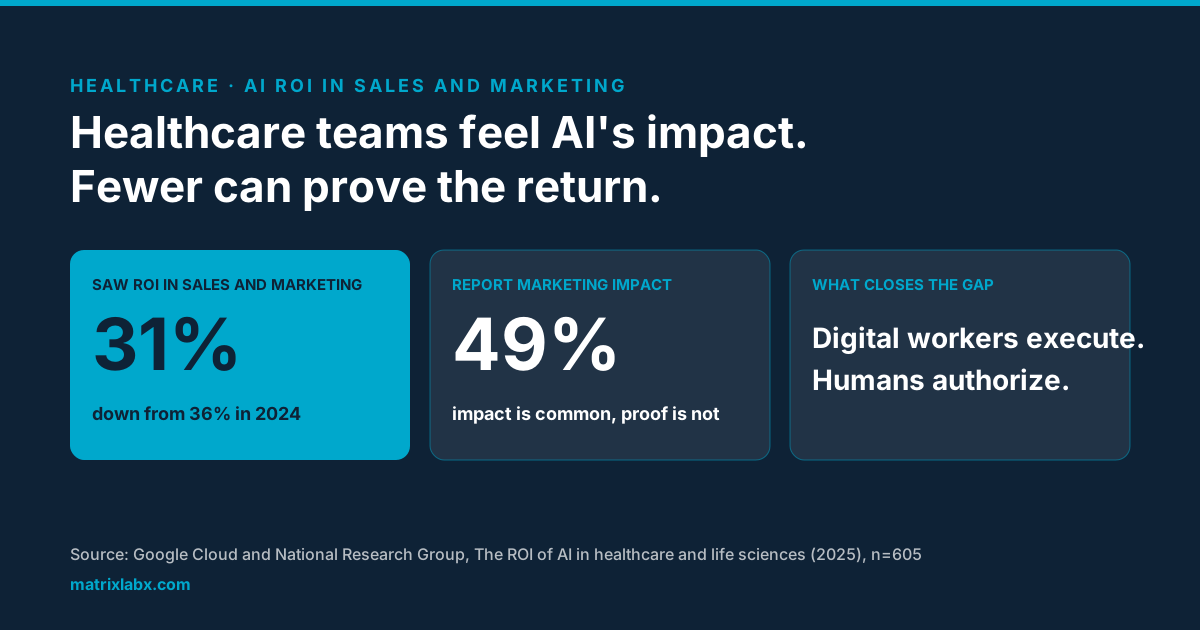
Short answer: AI is paying off in healthcare sales and marketing, but less often than a year ago. In Google Cloud’s 2025 survey of 605 healthcare and life sciences leaders, 31% saw ROI from gen AI in sales and marketing, down from 36% in 2024, while 49% say gen AI has meaningfully improved marketing outcomes. Teams feel the impact; fewer can prove the return. The next wave of ROI runs through agents that act on regulated data, and it pays only when every action is governed, authorized, and recorded.
What does the 2025 data show about AI ROI in healthcare sales and marketing?
Healthcare and life sciences organizations are committing to agents faster than their commercial teams are proving returns. Google Cloud and National Research Group surveyed 605 leaders between April 18 and June 3, 2025, at organizations with 100 or more employees and $10M or more in revenue; the report is available from Google Cloud’s healthcare and life sciences page.
| Signal | 2025 | 2024 |
|---|---|---|
| Executives whose organization runs AI agents in production | 44% | Not asked |
| Allocating 50% or more of future AI budget to agents | 46% | Not asked |
| Report ROI from gen AI overall | 73% | 74% |
| Saw ROI from gen AI in sales and marketing | 31% | 36% |
| Report meaningful marketing impact from gen AI | 49% | Not asked |
| Report business growth from gen AI | 52% | 58% |
Source: Google Cloud and National Research Group, The ROI of AI in healthcare and life sciences (2025). Inherited figures, attributed to the survey.
The split by use case is sharper. Sales, marketing, and personalization agents are among the most widely deployed, and among the least likely to show ROI.
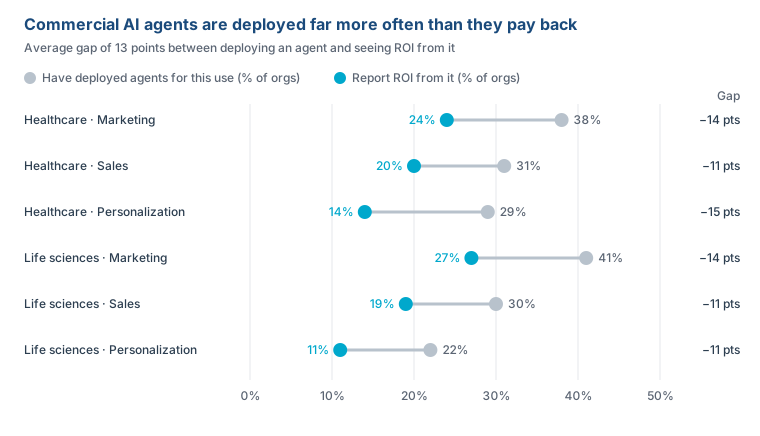
Personalization shows the widest proportional gap: in healthcare, roughly half the organizations running it report a return. Reported marketing impact also varies by region, from 45% in North America to 58% in Asia Pacific (JAPAC).
Why is first-wave commercial AI ROI flattening?
The easy wins are spent. Google Cloud’s own reading of the data is that early returns from low-hanging work, such as basic content generation, are maturing, and that the next level of ROI depends on fixing fragmented data and securing more investment. Four structural problems sit underneath that.
- Output is not outcome. Drafting more emails, posts, and nurture copy is easy to count and hard to tie to pipeline. Volume metrics inflate activity without moving booked revenue.
- Regulated data stalls the agents that matter. The report notes that core use cases touch protected health information and sensitive supply data, which makes them harder to implement. In life sciences, it cites regulations such as HIPAA and GDPR as added legal and technical hurdles.
- Trust is the buying criterion. Data privacy and security is the top factor when these leaders choose a large language model provider (37%), ahead of cost (30%) and ease of use and deployment (27%).
- Pilots never become operating models. Among organizations that grew revenue from gen AI, 83% saw gains of 6% or more, which Google Cloud attributes to moving past pilots into scaled deployments aligned with growth strategy. Executive sponsorship tracks the same way: 80% of organizations with comprehensive C-level sponsorship expect ROI, against 70% without it.
Patient-facing metrics show the same pattern. Organizations reporting improved patient satisfaction or net promoter score from gen AI fell 13 points year over year, to 70%. First-generation conversational assistants lifted engagement; they did not sustain it.
For a healthcare chief revenue officer or chief marketing officer, the bottleneck is no longer generation. It is governed execution on regulated data, with proof attached. The same argument runs through human-in-the-loop vs. human-on-the-loop for revenue actions.
How do find, understand, and act apply to healthcare commercial teams?
Google Cloud frames agentic value as three steps: find the information, understand it, act on it. For healthcare sales and marketing, the third step is where ROI is won or lost, because acting means sending, publishing, or changing a record that a regulator, a patient, or a payer can see.
| Step | What the platform layer supplies | What a commercial agent does | Where a human authorizes |
|---|---|---|---|
| Find | Search across structured and unstructured data, such as Vertex AI Search for Healthcare over clinical records | Pulls account signals, payer and provider context, prior engagement, and approved content | Data scopes and source access are set before the agent runs |
| Understand | Multimodal reasoning with Gemini and domain models such as MedGemma | Scores intent, segments audiences, drafts the next-best message or offer | Segmentation rules and claims language are reviewed against policy |
| Act | Workflow tools such as personalized outreach in Gmail and patient-education content in Vids | Executes the outreach, sequence, or campaign change | A named person authorizes the action, and the action is recorded |
Google already points marketers in this direction: its healthcare and life sciences page describes using AI to accelerate personalized patient and practitioner outreach based on health journeys, preferences, and language. Its own ROI guidance comes down to two rules: get data governance in order first, and always keep a human in the loop.
The platform answers can we do this. It does not answer who authorized this, under which rule, and what did it produce. That accountability layer is where commercial ROI becomes provable.
See what governed agents would do on your own data.
The free Autonomous Audit Report (AAR) is a read-only assessment of a sample of your CRM and pipeline data. It maps where pipeline leaks today, what governed digital workers would execute, and where a named person approves, with every figure labeled as modeled. A MatrixLabX solution architect replies within 48 hours to arrange the sample.
Get your free AAR Benchmark →Where does PrescientIQ™ fit?
PrescientIQ™ is built on one premise: digital workers execute, humans authorize. It does not replace your data platform or your model provider. It governs what agents do with them, and every action is recorded to an audit ledger. Each structural problem in the survey has a governance answer.
| Problem in the data | How governed digital labor addresses it |
|---|---|
| Output is not outcome | Labor-as-a-Service replaces software seats with digital labor that executes workflows, so spend is judged against work completed, not assets generated. |
| Regulated data stalls agents | Your team sets the oversight mode for each kind of action, so a regulated workflow can run under the stricter mode described below. |
| Trust is the buying criterion | Every action is recorded to an audit ledger: which agent acted, who approved, and what changed. See the agent audit ledger as a system of record. |
| Pilots never become operating models | The Revenue Accelerator Stack runs prospecting, outbound, trial conversion, and expansion as one coordinated crew, so a proven workflow scales without a new pilot. |
Your team chooses how much oversight each kind of action gets. The two modes are:
Human-in-the-loop (HITL). The action is drafted and held. It does not execute until a named person on your team approves it.
Human-on-the-loop (HOTL). The action executes under a standing policy your team sets. A named person supervises and keeps intervention, override, and revocation authority.
Your team chooses the mode for each action class, based on its risk tolerance, and can change it at any time.
Every action, in either mode, is recorded to the audit ledger with its rationale, before-and-after state, and the approver or policy behind it.
Every action class starts in human-in-the-loop until your team changes it.
In regulated markets, governance is not the brake on AI throughput. It is what lets throughput ship.
How should you measure commercial AI ROI in healthcare?
Measure the approved outcome, not the generated output. Google Cloud’s ROI checklist starts with executive sponsorship, an AI rulebook, governed system access, and a human in the loop. Translated into a commercial scorecard:
- Name an executive owner. One C-level sponsor accountable for commercial AI results, not a committee.
- Write the rulebook before the first agent runs. Claims language, audience exclusions, consent rules, and channel limits, in a form agents can enforce.
- Pick workflows with a revenue line attached. Account research to booked meeting, inquiry to qualified opportunity, launch content to approved send.
- Set the oversight mode per workflow. Match the level of human authorization to the risk of the action.
- Instrument the ledger, not the dashboard. Track cost per approved workflow, approval turnaround, rework after compliance review, and pipeline per approved workflow.
- Baseline before you deploy. Capture today’s cycle time and cost for each workflow so the change is measured, not estimated.
- Review quarterly and promote what proves out. A workflow that clears review cleanly earns a lighter oversight mode; one that does not stays supervised.
If a vendor’s ROI story cannot be traced to logged, approved actions, treat it as a forecast, not a result. For the procurement side, pair this with the AI agent security review checklist.
Where the data runs
PrescientIQ is hosted and operated by MatrixLabX on Google Cloud. SOC 2, ISO 27001, and PCI DSS attestations are held by Google Cloud, which operates the underlying infrastructure. They are not MatrixLabX certifications. MatrixLabX application-layer SOC 2 is in progress.
Frequently asked questions
- What is the ROI of AI in healthcare sales and marketing?
- In Google Cloud’s 2025 survey of 605 healthcare and life sciences leaders, 31% saw ROI from gen AI in sales and marketing, down from 36% in 2024. Yet 49% reported meaningful marketing impact. Healthcare commercial teams feel the effect of AI, but fewer of them can prove a financial return.
- Why is AI marketing ROI declining in healthcare?
- AI marketing ROI is declining in healthcare because first-wave gains from basic content generation are maturing, according to Google Cloud. The next gains come from agents that act on regulated data, and those need integrated data, a written rulebook, executive sponsorship, and a named person who approves each consequential action.
- Are healthcare organizations using AI agents for sales and marketing?
- Yes. In Google Cloud’s 2025 survey, 38% of healthcare organizations using agentic AI run agents for marketing and 31% for sales. In life sciences, marketing leads all agent use cases at 41%. Far fewer report ROI from those same agents: 24% for healthcare marketing and 20% for healthcare sales.
- What is governed digital labor in healthcare marketing?
- Governed digital labor means AI agents that execute sales and marketing workflows under customer-governed authority, with every action recorded to an audit ledger. In healthcare marketing, that lets a team see which agent prepared an action, who approved it, under which rule, and what it produced, before a compliance review starts.
- How should a healthcare organization measure AI ROI in sales and marketing?
- Measure approved outcomes, not generated output. Baseline each workflow’s cycle time and cost before deploying, then track cost per approved workflow, approval turnaround, rework after compliance review, and pipeline per approved workflow. A return that cannot be traced to logged, approved actions is a forecast, not a result.
- What do healthcare leaders look for when choosing an AI provider?
- Healthcare and life sciences executives rank data privacy and security first when choosing a large language model provider, cited by 37% in Google Cloud’s 2025 survey. Cost follows at 30%, and ease of use and deployment at 27%. Trust, not price, is the leading buying criterion in this market.
Sources
- Google Cloud and National Research Group, The ROI of AI in healthcare and life sciences, 2025 survey of 605 leaders, available from Google Cloud for healthcare and life sciences.
- Google Cloud, The agentic era: Reshaping the future of business, healthcare and life sciences, available from the same page.
- Google Workspace for healthcare and life sciences.
- Google for Health: AI models.
Related reading
Notes on this page
Every figure on this page comes from the 2025 Google Cloud and National Research Group survey of healthcare and life sciences leaders and is attributed to it. This page states no MatrixLabX performance figures and makes no regulatory compliance claim for PrescientIQ; any projected impact for your organization is modeled on your own data in the Autonomous Audit Report and labeled as a target until validated.
See where your own execution effort is going
The Autonomous Audit Report models where your team's execution capacity is currently spent, what your configuration is actually paying for, and what the governed alternative looks like on your own data — before any commitment.
Get your free AAR benchmark