Autonomous AI agents vs. AI copilots: why the distinction costs enterprises millions
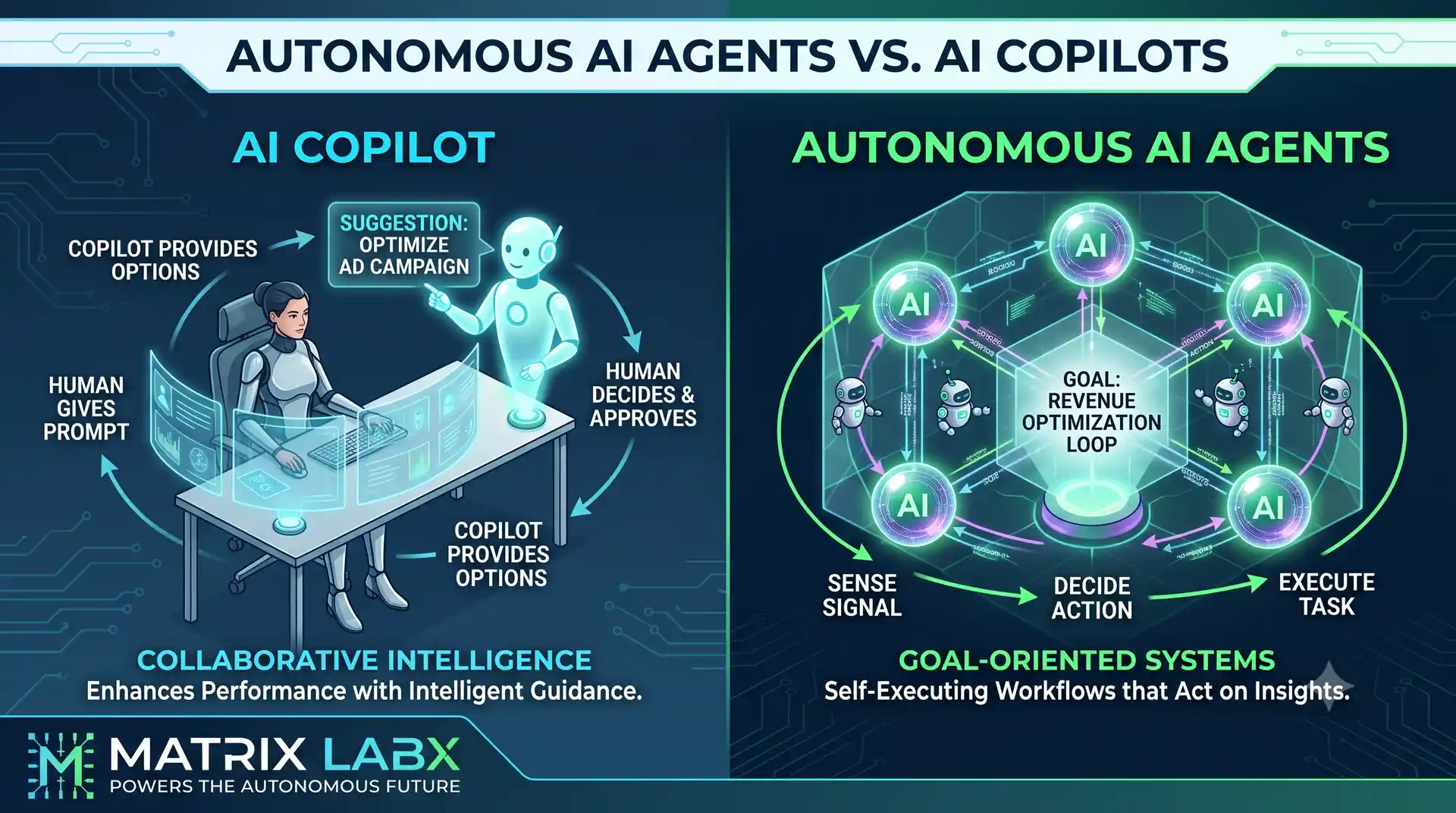
The agent-versus-copilot distinction is the difference between software that assists a human and software that completes the work. An AI copilot drafts, suggests, and summarizes while a person drives every step. An autonomous AI agent senses a trigger, decides the next action, executes it in production systems, and reports back — with humans approving anything externally visible.
🔑 Key takeaways
- Copilots accelerate tasks; agents absorb workflows. Buying one when you need the other is why IBM's 2025 CEO study found only 25% of AI initiatives delivered expected ROI.
- Gartner projects 40% of enterprise applications will embed task-specific AI agents by end of 2026 — up from under 5% in 2025 — and 15% of day-to-day work decisions made autonomously by 2028.
- Copilot gains flatten because the human stays the bottleneck; agent gains compound because throughput detaches from headcount.
- Governed autonomy — agents execute, humans authorize — is what makes the agent path survivable in security review.
- Price the workflow, not the license: the wrong choice compounds into millions across a mid-market P&L.
Why does the copilot-versus-agent confusion exist at all?
Because both categories market themselves with the same word: AI. The CFO who approved a copilot rollout last year and the CRO evaluating agents this year are often looking at the same slide template with different verbs. Yet the operating models could not be further apart. A copilot is a faster pen. An agent is another pair of hands — one that never sleeps, never forgets a follow-up, and logs every action it takes.
There is a moment most operations leaders recognize: the quarterly review where the copilot licenses renewed, the adoption dashboard looked healthy, and the pipeline number still did not move. That is the missed-opportunity tension at the center of this decision. McKinsey finds 78% of organizations now use AI in at least one business function (McKinsey, State of AI, 2025) — adoption is no longer the differentiator. What the tool is structurally capable of changing is.
The market is repricing this distinction fast. Gartner predicts 40% of enterprise applications will feature task-specific AI agents by the end of 2026, up from less than 5% in 2025, and that agentic AI will drive more than $450 billion in enterprise software revenue by 2028 (Gartner, 2025). In the context of that shift, treating "copilot" and "agent" as interchangeable line items is an expensive category error.
The adoption data shows where the line is actually moving. S&P Global Market Intelligence estimates roughly 31% of enterprises already run at least one AI agent in production, led by banking and insurance, while Capgemini Research Institute found 14% of organizations had implemented agents at partial or full scale in 2025 with another 23% in pilots (Capgemini, 2025). Consequently, the buying window in which "we deployed a copilot" counted as an AI strategy is closing — the differentiated question your board will ask next year is which workflows run themselves, under what governance, and at what metered cost.
What exactly separates an agent from a copilot?
Four structural properties separate them: initiative, execution, state, and accountability. A copilot waits to be asked. An agent watches for triggers — a stalled trial, a funding event, a usage drop — and initiates. A copilot returns text for a human to act on. An agent acts directly in governed systems through scoped credentials. A copilot forgets each session. An agent persists workflow state and resumes mid-run. A copilot's output disperses through copy-paste. An agent's every action lands in an immutable audit ledger.
| Property | AI copilot | Autonomous AI agent |
|---|---|---|
| Initiative | Human-prompted, reactive | Signal-triggered, proactive |
| Execution | Suggests; human executes | Executes; human approves external actions |
| State | Session-bound, forgets | Persistent, survives restarts |
| Accountability | No action trail | Immutable per-action audit ledger |
| Scaling driver | Per-seat licenses, human ceiling | Metered workflows, no human ceiling |
Where does the money actually leak when you choose wrong?
The leak is the workflow hours that never transfer off your payroll. Salesforce research finds sales reps spend less than 30% of their time actually selling — the rest is administration, data entry, and coordination (Salesforce, State of Sales, 2023). A copilot compresses some of those non-selling minutes, but the minutes stay attached to a salaried human. Data suggests the compression also stops compounding: analyst reviews of enterprise copilot programs report productivity gains flattening within months as users hit their personal ceilings, while fewer than a third of enterprises convert copilot gains into measurable cost reduction (PwC and McKinsey adoption research, 2025–2026).
Social publishing is the cleanest worked example of where that boundary sits: a script can draft the post, but scheduling it, clearing platform review, and handling the rejection still land back on a person. The walkthrough is in How to Automate Social Media Posts: OpenAI Scripts vs. AI Agents (2026).
Contrast the agent path. IDC research commissioned by Microsoft measures an average 3.7× return per dollar invested in generative AI (IDC, 2024) — but the dispersion around that mean is enormous, and IBM's 2025 CEO study found only 25% of AI initiatives delivered expected ROI (IBM, 2025). The initiatives that clear the bar automate end-to-end processes rather than accelerating fragments of them. That is precisely the agent's territory: a governed workflow like prospecting-to-expansion absorbed whole.
Consequently, the "millions" in this article's title is not rhetorical. Run the arithmetic on a 40-person revenue team at a $120,000 loaded cost each: if 60% of their hours are operational drag, the org carries roughly $2.9 million a year in work that a copilot merely speeds up and a governed agent can absorb. As Andrew Ng observed, "AI is the new electricity" (Stanford GSB, 2017) — and nobody buys electricity to make hand-cranking faster.
When is a copilot genuinely the right answer?
A copilot wins when the work is judgment-heavy, low-volume, and creatively open-ended. Drafting a board memo, exploring an unfamiliar dataset, pair-programming a novel feature — these resist decomposition into repeatable workflows, and the human's taste is the product. Forcing an agent onto them buys coordination overhead with no throughput to amortize it.
| Work characteristic | Choose a copilot | Choose an agent |
|---|---|---|
| Volume | Occasional, ad-hoc | Hundreds of instances weekly |
| Shape | Novel every time | Recognizable trigger → action pattern |
| Latency tolerance | Human works at human pace | Speed-to-signal decides outcomes |
| Audit requirement | Output reviewed as a document | Every action must be traceable |
The third row deserves emphasis. Buyer-intent signals decay in hours; a copilot-assisted rep works the queue on Monday. An agent works it in seconds, around the clock — which is why speed-sensitive revenue motions are the least defensible place to stop at copilots.
How do you adopt agents without triggering a governance crisis?
You adopt them under governed autonomy: agents execute, humans authorize. The pattern that survives security review gives every agent a least-privilege identity, routes every externally visible action through a one-click human approval queue, and appends every decision to an immutable ledger with its rationale. Gartner's prediction that over 40% of agentic AI projects will be canceled by 2027 is a prediction about ungoverned deployments (Gartner, 2025); the discipline is what separates the survivors. The full control architecture is implemented across every MatrixLabX solution bundle.
A staged sequence keeps the risk curve flat: two weeks of monitoring mode with every proposed action logged but none executed, then autonomous execution enabled one workflow at a time, lowest-risk first. Deployments following this sequence reach production in 21 days or less.
What does a fair evaluation look like in practice?
A fair evaluation prices one named workflow under both models over 30 days. Pick a single high-volume revenue workflow — trial-stall follow-up is a common first candidate — and run the comparison as a sequence with defined exit criteria at each step. The discipline matters more than the tooling: teams that skip the baseline step have no denominator, and teams that skip the governance step discover it in security review, after the budget is committed.
| Step | Action | Expected outcome |
|---|---|---|
| 1. Baseline | Measure current hours, latency, and conversion on the workflow | A denominator both vendors must beat |
| 2. Copilot trial | Two weeks assisted; track minutes saved per task and adoption | Task-level acceleration curve — watch for the plateau |
| 3. Agent monitoring mode | Two weeks with the agent proposing but not executing | Proposal quality and approval rate, zero production risk |
| 4. Governance review | Security inspects credentials, gates, and the audit ledger | Sign-off before any autonomous execution |
| 5. Decision | Compare cost-per-workflow-completed, not license price | The verb — assist or execute — chosen on evidence |
Note what the sequence deliberately avoids: a bake-off on demo polish. Copilots demo beautifully because a skilled operator is driving. Agents demo modestly and compound quietly — the curve only separates around week three, when the copilot's plateau and the agent's throughput line cross. In contrast to a feature checklist, cost-per-workflow-completed is the one metric neither category can game.
Why this might not work for you
If your team's bottleneck is genuinely creative judgment — positioning, pricing strategy, founder-led sales — an agent will not manufacture taste, and a copilot in skilled hands is the better dollar. If your CRM data is too degraded for deterministic triggers, fix the data first or the agent will automate noise. And if nobody will own the approval queue, governed autonomy degrades into an unstaffed bottleneck. The honest test: can you name the workflow, its weekly volume, and the person who will review its queue? If not, you are not ready to buy either tool.
Conclusion: name the verb before you sign the contract
Copilots assist. Agents execute. The enterprises losing millions are the ones paying for assistance where they needed execution — or deploying ungoverned execution where they needed control. Name the workflow, price its hours, choose the verb, and demand the governance evidence either way. Then validate the numbers on your own data with a free Autonomous Audit Report before a dollar moves.
Frequently asked questions
What is the difference between an AI copilot and an autonomous AI agent?
An AI copilot assists a human who stays in the loop for every step: it drafts, suggests, and summarizes on request. An autonomous AI agent owns a workflow end to end. It senses a trigger, decides the next action, executes it in production systems, and reports back, under the governance mode your team sets.
Why do copilot productivity gains flatten over time?
Copilots accelerate individual tasks, but the human operating them remains the bottleneck. Once each user reaches their personal ceiling, saved minutes stop compounding — the workflow itself still runs at human speed, which is why several analyst studies report copilot ROI flattening after the initial adoption lift.
Are autonomous agents riskier than copilots?
Ungoverned, yes. Governed correctly, an agent is more controllable than a copilot because its actions are systematic: scoped credentials, a governance mode your team sets for each action class, and an immutable audit ledger. A copilot's output disperses through human copy-paste with no trail at all.
When is a copilot the right choice?
When the work is genuinely judgment-heavy and low-volume — drafting a board memo, exploring a dataset, writing one-off code. If the task arrives hundreds of times a week in a recognizable shape, a governed agent absorbs it better than an accelerated human.
What does governed autonomy mean?
Agents execute, humans authorize. Each action class runs in one of two modes: held until a named person approves it, or run under a standing policy with a named supervisor who can intervene, override, or revoke. Your team chooses the mode, and every action is logged immutably with its rationale.
How do I calculate the cost of choosing wrong?
Price the workflow, not the license. Multiply the hours your team spends operating the workflow annually by loaded cost, then compare a copilot (hours shrink per task but persist) against an agent (hours transfer to the system). The free Autonomous Audit Report runs this math on your own CRM data.
Run the agent-vs-copilot math on your own P&L
The free Autonomous Audit Report models workflow hours, cost transfer, and pipeline impact against your actual CRM data — before you commit to either category.
Get your free AAR →Built natively on Google Cloud. Sources: Gartner press releases (2025); McKinsey State of AI (2025); Salesforce State of Sales research (2023); IDC Business Opportunity of AI study commissioned by Microsoft (2024); IBM CEO Study (2025); PwC CEO Survey adoption research (2025–2026). Modeled MatrixLabX targets are validated per-account in the Autonomous Audit Report.
See where your own execution effort is going
The Autonomous Audit Report models where your team's execution capacity is currently spent, what your configuration is actually paying for, and what the governed alternative looks like on your own data — before any commitment.
Get your free AAR benchmark