AI SDR alternatives: the one axis that actually decides it
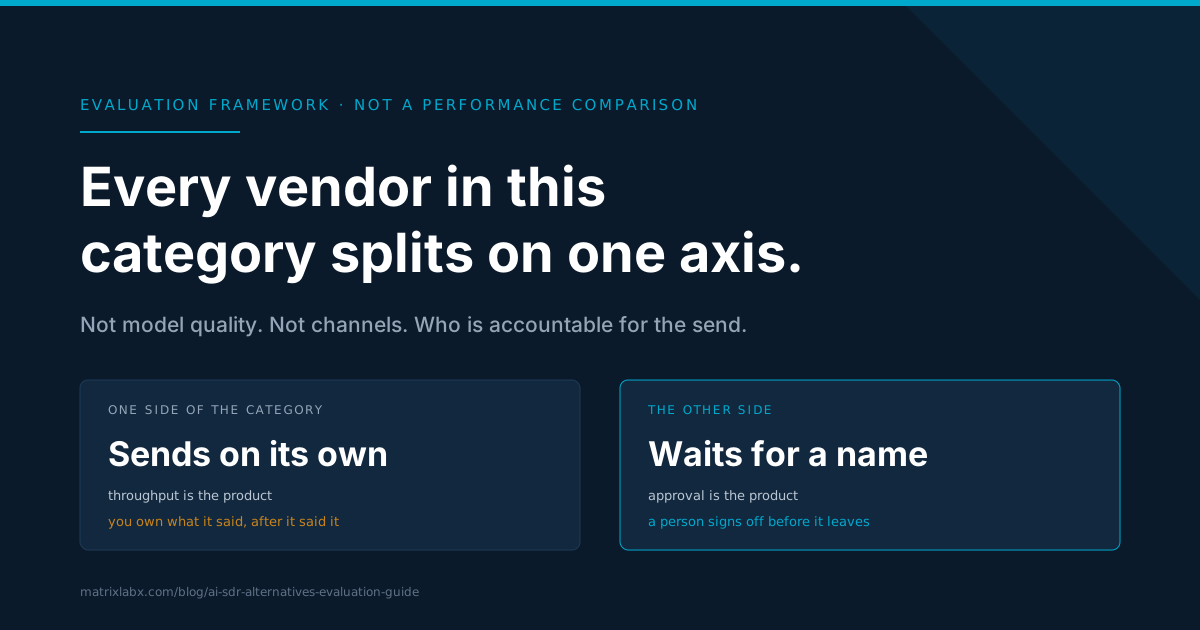
The AI SDR category does not split on model quality, channel count, or research depth. It splits on whether the system contacts a prospect without a named human approving that specific message. Everything else is a feature comparison you can run in an afternoon. This one is an accountability decision, and it should be made before you sit through a single demo.
If you are reading comparison pages in this category, you have already noticed that they all describe the same product. Every vendor identifies buyers from signals, researches them, writes something personalised, and sends it across several channels. The feature grids are nearly identical because, at the level those grids operate, the products nearly are.
The difference that matters is not on the grid. It is the answer to a single question: when the moment comes to put a message in front of a real person at a real company, does a human being have to say yes first?
The two halves of the category
One half sells autonomy as the product. 11x, for example, describes its SDR agent Alice as booking meetings “on autopilot” and states on its home page that its digital workers are able to execute complex tasks “without supervision” (captured 9 September 2026). That is not a criticism — it is the value proposition, stated plainly, and for some buyers it is exactly right. The whole point is that the work happens while nobody is watching.
The other half treats the send as the governed moment. PrescientIQ sits here. Agents research, score, draft, and prepare CRM changes continuously, and then stop.
The gate is enforced at the tool layer rather than in the prompt, so an agent attempting to act without an approval fails closed. That is a deliberate throughput cost. We are not going to pretend otherwise — the constraint moves from how much the system can produce to how much a person can review, and if your bottleneck was volume, this will annoy you.
Which side you belong on
This is not a close call once you price one thing: what a single wrong message costs you.
| If this is true of your motion | Lean |
|---|---|
| High-volume, low-consideration, single-channel email; a poor message costs a bounce and nothing else | Autonomous |
| You have no one who could realistically staff an approval queue, and you know it | Autonomous |
| Named accounts, long cycles, or a relationship a bad first touch can end | Gated |
| Outbound crosses into SMS or telephone, where the consent obligation sits with you | Gated |
| A regulator, an examiner, or an enterprise security review can ask who authorised a specific message | Gated |
| Your legal or compliance function has not been asked yet | Ask them first |
Six questions for any vendor on this list
Ask all six in a live demonstration, not on a feature page. Each one comes with what a weak answer sounds like, so you can grade the response yourself rather than take our word for who passes.
At the moment of send, what has to be true?
This is the whole decision. Either a named person agreed to this specific message before it left, or the system decided on its own. Both are legitimate products. Only one of them leaves you able to say who authorised a message a prospect is now angry about.
A weak answer sounds like: "It is highly accurate" or "it learns your tone." Neither answers the question. Accuracy is not accountability.
Whose identity does it act under in our CRM?
If the agent writes as a shared service account, your audit trail cannot separate what the agent did from what your team did. If it writes as a rep, you have attributed machine actions to a person who did not take them.
A weak answer sounds like: "It integrates with Salesforce." That describes a connection, not an identity model.
What does one approval actually record?
Ask to see a single record end to end: the action, the reasoning behind it, and the person who approved it. An approval that records only a timestamp tells a future auditor nothing about why.
A weak answer sounds like: A dashboard screenshot. Ask instead for the record behind one row of it.
Which channels will it use, and who carries the consent burden?
Email, social, SMS, and phone are four different regulatory regimes. The obligation sits with the sender — you — not with the vendor that automated the sending. A vendor that treats channels as a feature list has not thought about this on your behalf.
A weak answer sounds like: "We support omnichannel." That is a capability statement where you asked a liability question.
What does it cost, before we book a call?
Most of this category will not tell you. A vendor unwilling to publish a number is asking you to run the evaluation without the variable that decides it, and to do so after investing several hours in a sales process.
A weak answer sounds like: "It depends on your volume." Then publish the volume bands.
What does it do when it is uncertain?
The interesting behaviour of any autonomous system is at the edges. Does it stop and ask, proceed on its best guess, or fail closed? You are choosing which of those you want on the day the model is wrong about an account.
A weak answer sounds like: Silence, or a description of the happy path. Ask them to show you a deliberately ambiguous case in the demo.
Who is actually on the list
Worth naming, because “alternatives” pages usually list whoever paid for the placement. As of 17 September 2026, 11x’s own site links comparison pages against just two named vendors — Artisan and Outreach. That is a narrower field than the set it compared itself against when we first captured this page on 9 September 2026 (AiSDR, Unify, Alta, and Qualified were also named then, alongside Outreach); those earlier comparison pages are still live at their original URLs, just no longer part of the promoted set. Add the CRM-native agents — Salesforce Agentforce and HubSpot Breeze, which we cover in a separate post on their scope boundary — and governed platforms including PrescientIQ.
We are not going to rank them. We have not run them, and a vendor ranking assembled from marketing pages is worth what you paid for it. What the six questions above give you is a way to run the ranking yourself, on the axis that matters, in six demos.
Where to start
With your own numbers rather than anyone’s feature grid. The two companion posts in this cluster take the two questions buyers get stuck on:
- What an AI SDR costs when nobody publishes a number — question 05, worked out properly, including ours.
- When autonomous outbound reaches SMS and the phone — question 04, and why the channel list is a liability question.
If you would rather start from what your own pipeline is doing than from a vendor list, the Autonomous Audit Report runs against a sample of your CRM and returns where coverage is leaking and what your current configuration is paying for — before any commitment, and regardless of which side of the line you land on.
Frequently Asked Questions
- What are the main alternatives to 11x?
- The category includes 11x, and the vendors 11x names in its own published comparison pages — AiSDR, Unify, Alta, Qualified, Outreach — alongside the CRM-native agents from Salesforce and HubSpot, and governed platforms such as PrescientIQ that hold every outbound action for human approval. They are not interchangeable, because they sit on different sides of the autonomy question.
- What is the difference between an autonomous AI SDR and a governed one?
- An autonomous system contacts the prospect itself; a governed system prepares the contact and waits for a named person to approve it. Everything else — research quality, channel coverage, personalisation — is a feature comparison. This one is an accountability decision, and it determines who answers for the message after it lands.
- How do I evaluate an AI SDR vendor?
- Ask what happens at the moment of send, whose identity the system acts under, what an approval records, which channels it will use, what it costs before the call, and what it does when it is uncertain. Ask each one in a live demonstration rather than on a feature page, and ask the vendor to show you the failure behaviour, not the happy path.
- Is a fully autonomous AI SDR ever the right choice?
- Yes. If your outbound is high-volume, low-consideration, single-channel email, and a mediocre message costs you nothing but a bounce, then throughput is the thing you are buying and an approval queue is friction you will resent. The calculation changes when a bad message can cost a named relationship or a regulated disclosure.
- Does a human approval gate slow outbound down?
- It moves the constraint from volume to review capacity, which is a real cost and worth naming. What it buys is that no message reaches a prospect that a person did not agree to send. Whether that trade is worth it depends entirely on what one wrong message costs you — which is a question only you can price.
- What should a security review ask an AI SDR vendor?
- Where the workload runs and who operates it, whether model-training exclusion is a written contract term rather than a web page, whose credentials the agent uses against your CRM, and what the system does when an agent tries to act outside policy. Ask for the failure behaviour specifically — a vendor without a designed one will describe intentions.
Related Reading
- Governed AI SDR: Definition, How It Works, and How It Is Priced
- AI SDR vs. Human SDR: What Each One Actually Costs
- 7 Governance Questions to Ask an AI Agent Vendor
- The Seven Questions Every Mid-Market Revenue Team Asks
- Why AI Agent Pilots Stalled — and What Buyers Ask Now
- The Compliance Exposure Hiding in Your SDR, BDR, and MDR Motion
Sources
- 11x, “Alice — AI Powered SDR” product page. Quotations in this article are from this page and the 11x home page, captured 9 September 2026. Link
- 11x site footer and comparison pages, captured 17 September 2026, for the current set of vendors 11x names in its comparison field. 11x vs Artisan 11x vs Outreach
- 11x comparison pages captured 9 September 2026, when the comparison field also included AiSDR, Unify, Alta, and Qualified; still live at their original URLs but no longer linked from the current homepage. Link
11x, Alice, and Julian are trademarks of 11x Inc. Salesforce and Agentforce are trademarks of Salesforce, Inc. HubSpot and Breeze are trademarks of HubSpot, Inc. Other names are the trademarks of their respective owners. MatrixLabX is not affiliated with, endorsed by, or sponsored by any of them. This article makes no representation about the current capabilities, performance, security posture, or commercial terms of any named product, and no comparison of results between them. Vendor descriptions are direct quotations from each vendor's own public pages on the date given; consult their documentation for what their products do today, and use the six questions above to confirm it in a live demonstration.
See where your own execution effort is going
The Autonomous Audit Report models where your team's execution capacity is currently spent, what your configuration is actually paying for, and what the governed alternative looks like on your own data — before any commitment.
Get your free AAR benchmark