AI SDR pricing: what it costs when nobody publishes a number
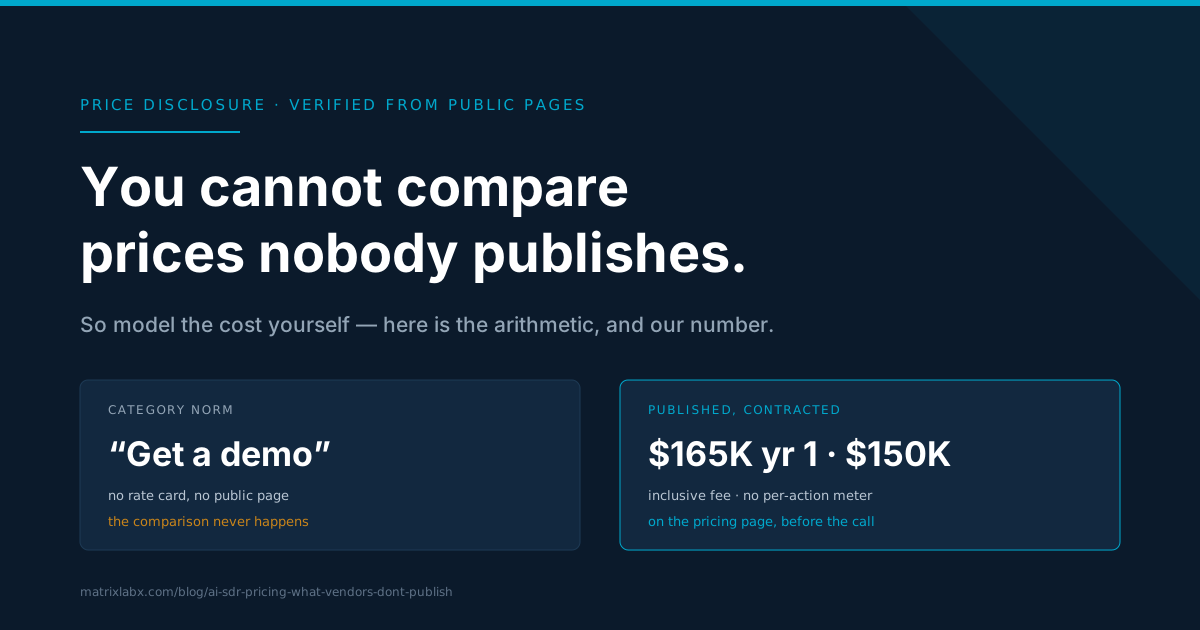
Most vendors in this category publish no rate card at all, so the comparison that would settle your decision in an afternoon cannot be run from public information. What you can do before any sales call is establish the billing shape — per seat, per contact, per meeting, or flat platform fee — because those four behave completely differently as your volume grows.
Try to price an AI SDR from public information and you will find the same thing on most sites: a demo booking form where the pricing page should be. This is the category norm, not an anomaly.
A concrete example, since a general claim is easy to make and hard to check. 11x, one of the more visible vendors in the category, publishes no pricing page as of 9 September 2026 — its sitemap lists 427 URLs with no pricing route among them, and the site routes buyers to a live demo instead. You can verify that in about thirty seconds, which is the point of citing it that way. We are not going to speculate about what they charge or why the page does not exist; we do not know, and a made-up figure would be self-refuting in a post whose argument is that the number is not public.
The four billing shapes
Every commercial model in this category is a variation on one of four, and each fails in a different direction. Knowing which one you are being sold matters more than the headline figure, because it determines what happens to your bill in year two.
| Shape | What you pay for | Where it breaks |
|---|---|---|
| Per seat | A licence per user, whether or not that user does anything | You are buying digital labor precisely so headcount stops driving cost, and then paying by headcount. The model contradicts the pitch. |
| Per contact or credit | Research, enrichment, and sends drawn from a monthly pool | Credits meter the machine thinking, not the outcome. A month of poor targeting burns the same pool as a month of good targeting, and unused credits usually expire. |
| Per meeting booked | A fee for each meeting the system produces | The cleanest-sounding model and the one that generates the most disputes, because everything depends on what counts as a meeting — held, no-showed, disqualified in the first two minutes. |
| Flat platform fee | One annual figure for the deployment | Only honest if it is genuinely inclusive. A "platform fee plus overages" is a usage model wearing a flat-fee label, and you will find out which one you signed in month seven. |
The question that separates them
Ask every vendor the same thing: what happens to this number when our volume doubles?
It is more revealing than asking the price, because it exposes the shape rather than the headline. A per-seat answer barely moves until you add people, then jumps. A credit answer roughly doubles. A per-meeting answer doubles and starts a conversation about what counted. A genuinely flat fee does not move, and if the answer is “it depends on overages,” you have just learned it is not flat.
Then normalise: total annual cost divided by held meetings at your realistic volume. Held, not booked — the gap between those two is where most of the disappointment in this category lives.
What we charge
A post arguing for price transparency has an obvious obligation. Ours is on the page:
| Component | Investment | Billing frequency |
|---|---|---|
| Annual platform feeEnvironment provisioning on Google Cloud, per-agent IAM, audit-ledger setup, and context ingestion from your CRM — plus four cooperating agents (Scout, Herald, Guide, and Steward), their coordinator Marshal, the approval queue and standing-policy controls, and the immutable audit ledger, and the monthly execution volume a typical mid-market deployment runs. One fee, from signature, every year.Target — modeled: live in 21 days or less$165,000/year is the complete platform fee. There is no separate implementation charge and no different first-year number — deployment work is included from signature, not billed as a distinct line. Scope beyond a typical deployment — additional bundles, sustained higher volume — is quoted at your AAR before anything is signed. | $165,000/yr | Billed monthly at $13,750/mo against an annual commitment |
$165,000 a year, flat — the same number in year one and every year after. It is an inclusive fee rather than a floor: no per-token meter and no per-action meter on the invoice. Scope beyond what a typical mid-market deployment runs is quoted during the audit, before anything is signed, rather than surfacing later as an overage.
Two things that price does not buy, stated here rather than discovered later. It does not buy the people who approve the work — someone still owns the approval queue and the qualification standard, and that time is real. And it does not buy speed through a messy CRM.
The comparison worth running instead
Against vendors you cannot price, the useful comparison is not vendor-to-vendor. It is against the cost you are already carrying. A seven-person SDR team runs to roughly $1.2 million a year fully loaded on our own published cost model, which is a number you can check against your own payroll rather than take from a vendor.
That comparison you can actually run today, and it is the one that determines whether any of this is worth a procurement cycle.
Frequently Asked Questions
- How much does an AI SDR cost?
- Honestly, you cannot find out from most vendors without a sales call — publishing no rate card is the norm in this category rather than the exception. What you can do is establish the billing shape before the call, because per-seat, per-contact, per-meeting, and flat-platform models behave completely differently as your volume grows.
- Does 11x publish pricing?
- Not publicly as of 9 September 2026. Its sitemap lists 427 URLs with no pricing route, and the site routes buyers to a live demo instead. That is the category norm rather than anything unusual, and it is worth knowing before you budget time for an evaluation you cannot complete on your own.
- Why do AI SDR vendors hide their pricing?
- We are not going to guess at anyone’s motive. Structurally, a category where costs scale with usage is hard to put on a page, and a sales conversation lets a vendor frame value before price. The practical consequence for you is the same either way: the comparison that would settle it in an afternoon cannot be run.
- What are the billing models for AI SDR software?
- Four shapes dominate: per seat, per contact or credit, per meeting booked, and a flat platform fee. Each fails in a different direction — seats charge for access you may not use, credits meter research, per-meeting aligns cost with output but creates a definition argument, and a flat fee is only honest if it is genuinely inclusive.
- What does PrescientIQ cost?
- A single flat annual platform fee of $165,000 — the same number in year one and every year after, with no separate implementation charge. There is no per-token or per-action meter on the invoice. Scope beyond a typical mid-market deployment is quoted during the audit, before anything is signed.
- How should I compare AI SDR pricing across vendors?
- Normalise to cost per held meeting over a full year at your realistic volume, then ask each vendor what happens to that number when volume doubles. The second question separates the models faster than the first, because it exposes which costs scale with usage and which do not.
Related Reading
- Managed SDR pricing: three published tiers, no seats
- AI SDR Alternatives: The One Axis That Actually Decides It (the pillar)
- AI SDR vs. Human SDR: What Each One Actually Costs
- Why Seat-Based Pricing Is Taxing Your Growth
- From Per-Seat to Outcome-Based Pricing
- The True Cost of a Seven-Person SDR Team
- Base Salary vs. Fully Loaded SDR Cost — the Multiplier Most CROs Get Wrong
Sources and notes
The absence of a published 11x pricing page was verified on 9 September 2026 by retrieving https://www.11x.ai/sitemap.xml and searching its 427 entries for a pricing route. Vendors change their sites; re-run that check before relying on it.
11x and Alice are trademarks of 11x Inc. Other names are the trademarks of their respective owners. MatrixLabX is not affiliated with, endorsed by, or sponsored by them. This article states no figure for any vendor other than MatrixLabX, makes no representation about any other vendor's commercial terms, capabilities, or performance, and draws no comparison of results between products. MatrixLabX pricing is the published rate for the PrescientIQ Revenue Accelerator and is current as of the date on this post. The human-cost model referenced is MatrixLabX's own, derived on the posts linked above, and is illustrative rather than a survey result.
See where your own execution effort is going
The Autonomous Audit Report models where your team's execution capacity is currently spent, what your configuration is actually paying for, and what the governed alternative looks like on your own data — before any commitment.
Get your free AAR benchmark