AI SDR vs. human SDR: what each one actually costs
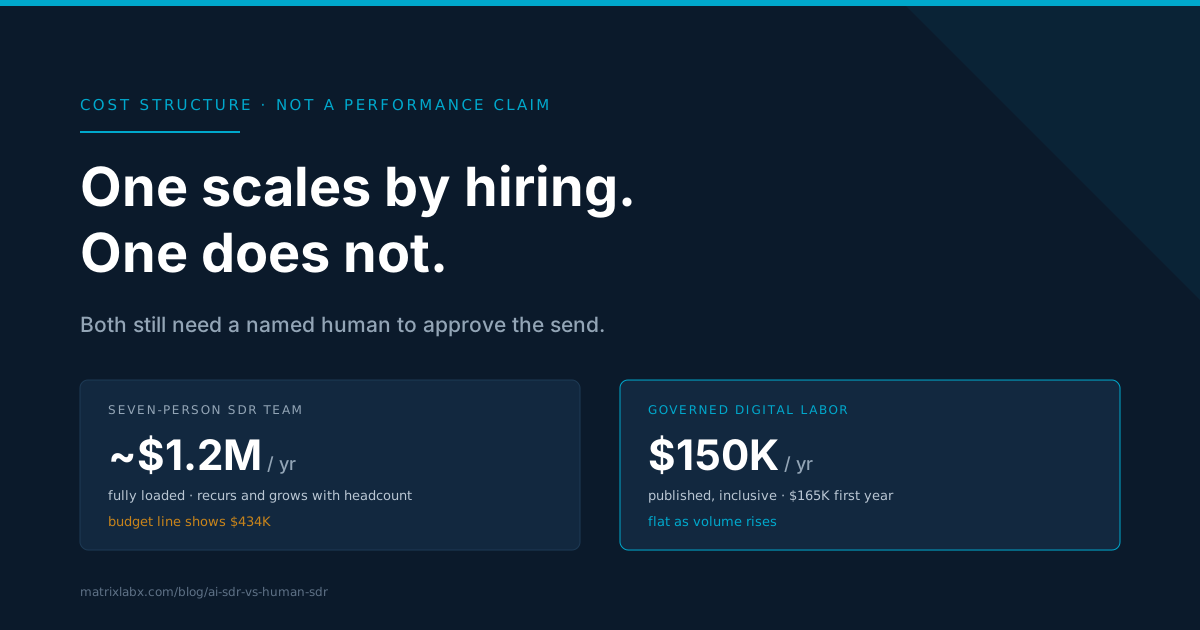
A seven-person SDR team costs roughly $1.2 million a year fully loaded — about 2.8× the $434,000 base-salary line a board usually sees, and about $1,250 for every held meeting it produces. Governed digital labor is published at $165,000 a year, flat — the same number in year one and every year after. The number is the smaller half of the decision. The half that matters is the shape: one of those costs rises with every increment of volume, and the other does not.
Every vendor in this category will tell you it is cheaper than hiring. Almost none of them will tell you what they charge. The rate card is behind a call, the pricing page says “contact us,” and the comparison the buyer wanted to run — the one that would settle it in an afternoon — never happens.
This post runs it. Both sides of the comparison are published: the human cost model is the one this site has already derived across four posts, and the platform figure is the one on our pricing page. Neither number is a projection, and neither is a performance claim. They are prices.
1. What a human SDR team costs
The plan says seven representatives at a $62,000 base, so $434,000. That figure enters the model as the cost of pipeline generation, and it is wrong by a factor of nearly three.
| Line | Annual | Note |
|---|---|---|
| Seven representatives, fully loaded | $889,000 | ~$127,000 each — about 2.05× base |
| Dedicated manager | $205,000 | Fully loaded |
| Five-category tech stack | $108,000 | Dialer, sequencer, data, intent, enrichment |
| True run rate | ≈ $1,202,000 | 2.8× the $434,000 budget line |
Divided by realistic output — roughly 958 held meetings a year, once ramp, vacancy, and turnover cut effective capacity to about 76% of theoretical — that is approximately $1,250 per held meeting, and $3,000 or more per sales-qualified opportunity, before an account executive spends a minute on any of it.
The derivations are in the true cost of a seven-person SDR team, base salary vs. fully loaded cost, and the tech stack tax. The fourth cost — ramp — is the one that never makes the model at all, and it is covered in why SDR ramp time is the hidden cost nobody models.
2. “AI SDR” names three different products
Before any price comparison means anything, the category label has to come apart. Three structurally different products are sold under it, and they do not cost the same thing because they are not the same thing.
A tool your representatives operate
Sequence generation, research summarisation, reply drafting. It is licensed per seat and it makes an existing representative faster. The headcount does not change, so the $1.2 million does not change either — you have added a line to the stack in exchange for hours back. That can be a perfectly good purchase. It is not a substitute for the team, and it should not be priced against one.
A managed outbound service
An agency motion with automation inside it, usually priced per meeting or per month. The cost is variable and the accountability is external, which is the appeal. What travels with it is that the provenance of the contact data, the sending identity, and the suppression state are all being managed on your behalf under your name — the exposure described in the compliance exposure hiding in your SDR, BDR, and MDR motion does not transfer with the work.
Governed digital labor
Agents that execute the repeating parts of the motion inside your systems, continuously, with a named human approving every action that reaches a prospect. It is priced as a platform rather than as seats or meetings, which is what makes its cost flat as volume rises. The distinction against the first category is drawn in full in autonomous agents vs. copilots.
3. What the governed alternative costs
Published, in full, with no range and no usage assumption:
| Component | Investment | Billing frequency |
|---|---|---|
| Annual platform feeEnvironment provisioning on Google Cloud, per-agent IAM, audit-ledger setup, and context ingestion from your CRM — plus four cooperating agents (Scout, Herald, Guide, and Steward), their coordinator Marshal, the approval queue and standing-policy controls, and the immutable audit ledger, and the monthly execution volume a typical mid-market deployment runs. One fee, from signature, every year.Target — modeled: live in 21 days or less$165,000/year is the complete platform fee. There is no separate implementation charge and no different first-year number — deployment work is included from signature, not billed as a distinct line. Scope beyond a typical deployment — additional bundles, sustained higher volume — is quoted at your AAR before anything is signed. | $165,000/yr | Billed monthly at $13,750/mo against an annual commitment |
Set against the run rate above, $165,000 a year is a smaller number than $1,202,000. That comparison is real but it is also the least interesting thing on this page, because it holds only at seven seats. At two seats it inverts. The durable difference is not the size of the number — it is that one of them is indexed to volume and the other is not.
Adding an eighth representative adds roughly $127,000 and a recruiting cycle. Doubling the working set inside a platform fee adds nothing until it exceeds the execution volume the fee assumes, at which point it is quoted before anything is signed rather than metered against you afterwards. That is the whole structural argument, and it is the same one made at greater length in why seat-based pricing is taxing your growth.
4. What the price does not buy
Three things, and a vendor that will not name them is not being straight with you.
It does not buy the approval. Every externally visible action waits for a named human before it executes. There is no autonomous external send in the product to switch on.
It does not buy the judgment. Qualification is a decision about whether a company is worth your time, and it stays with a person. What the agents absorb is the research, the sequencing, the writing, the logging, and the follow-up — the work that occupies the day described in what does an SDR actually do all day. The capacity that comes back is human attention, not a vacancy.
It does not buy zero headcount. Someone owns the approval queue, the messaging standard, and the qualification bar. That is real time and it belongs in your model — it is simply far less of it than seven seats, a manager, and a backfill cycle.
5. When hiring is the right answer
The comparison stops favouring the platform in several ordinary situations, and they are worth stating plainly.
- Below roughly three seats. A platform fee against one or two fully loaded representatives is a larger number, not a smaller one.
- When the motion is genuinely relationship-led. If the first touch has to be a person because the market expects it, automating the first touch is solving a problem you do not have.
- When the CRM cannot support it. Agents act on the signals in your system of record. If that data is unreliable, the first project is the data — which is why deployment is scoped against CRM quality rather than promised flat.
- When nobody will own the approval queue. A gate with no named owner becomes a rubber stamp, and a rubber stamp is worse than no gate because it produces a record that says a human reviewed something they did not.
6. How to run this on your own numbers
The example team above is illustrative. Yours has a different size, a different base, a different stack, and a different held-meeting rate, and the answer moves with all four. Three steps settle it:
- Take the fully loaded number, not the base. Multiply base salary by about 2, or build it up line by line from the decomposition in base salary vs. fully loaded cost. Add the manager and the stack.
- Divide by held meetings, not activity. Volume metrics measure effort. Your cost per held meeting is the figure that compares against anything, and the ratios that predict it are in which SDR metrics actually predict pipeline.
- Ask what the next increment costs. Not what the current team costs — what the eighth representative costs, versus what the same increase in working set costs inside a fee. That single question is the comparison.
The Autonomous Audit Report runs those three steps against your own CRM data before any commitment, and produces the P&L projection rather than the example. If the question underneath the cost question is whether your organisation can govern agents at all, that is a different assessment — the Agentic Readiness Audit covers governance, identity, data readiness, and the approval path.
Frequently Asked Questions
- How much does an AI SDR cost?
- Most vendors in the category quote per seat, per contact, or per meeting booked, and publish no rate card at all — so the honest answer is that you cannot find out without a sales call. PrescientIQ publishes its figure: $165,000 a year, flat — the same number in year one and every year after, with no separate implementation charge.
- What does a human SDR actually cost?
- About $127,000 a year fully loaded for a US mid-market representative, against a $62,000 base salary — roughly a 2× multiplier once payroll taxes, benefits, equipment, recruiting amortisation, and ramp drag are counted. A seven-person team with a manager and its tooling runs to approximately $1.2 million a year.
- Is an AI SDR cheaper than hiring?
- At a seven-seat team it is a smaller number, and at one or two seats it is a larger one. The variable that decides it is not the price but the shape of the cost: headcount cost rises with every increment of volume, and a platform fee does not. Run it against your own volume rather than the example.
- Do AI SDRs replace sales development representatives entirely?
- No, and a vendor claiming otherwise is describing something you should not buy. Qualification is a judgment call, and every message that reaches a prospect passes a named human for approval before it sends. What changes is the split: agents absorb the repeating execution, and people keep the judgment and the relationship.
- What is not included in the platform fee?
- The people who approve the work. Someone still owns the approval queue, the messaging, and the qualification standard, and that time is real even though it is far less than seven seats. The fee also assumes the execution volume a typical mid-market deployment runs; sustained volume beyond that is quoted before anything is signed.
- How long does it take to deploy compared with hiring an SDR?
- The deployment target is 21 days or less from signed contract, subject to CRM data quality and integration scope. A new SDR hire is typically 30 to 60 days to fill and then several months to full productivity, which is the ramp cost that rarely appears in the model that justified the hire.
Related Reading
- Managed revenue operations: a governed AI crew, run for you, without hiring the SDR team
- The True Cost of a Seven-Person SDR Team (the model this post prices against)
- Base Salary vs. Fully Loaded Cost — The Multiplier Most CROs Get Wrong
- The Tech Stack Tax: What Seven Seats Actually Cost
- What Does an SDR Actually Do All Day?
- Why Seat-Based Pricing Is Taxing Your Growth
- Why AI SDR Pilots Stalled — and What Buyers Ask Now
Notes on the figures
The human cost model is MatrixLabX's own, derived in the four posts linked above from US mid-market compensation, employer payroll tax, benefits, recruiting amortisation, and ramp drag. It is an illustrative seven-person team, not a survey result, and your figures will differ. Platform pricing is the published rate for the PrescientIQ Revenue Accelerator and is current as of the date on this post. This page makes no comparative performance claim about any named vendor or product.
See where your own execution effort is going
The Autonomous Audit Report models where your team's execution capacity is currently spent, what your configuration is actually paying for, and what the governed alternative looks like on your own data — before any commitment.
Get your free AAR benchmark